bearing blog


bear – ing n 1  the manner in which one comports oneself;  2  the act, power, or time of bringing forth offspring or fruit; 3 a machine part in which another part turns [a journal ~];  pl comprehension of one’s position, environment, or situation;   5  the act of moving while supporting the weight of something [the ~ of the cross].


  • What’s your heritage?

    Amy Welborn muses about understanding Christianity historically — as a movement with a history, and one which has left an indelible imprint on it.  A movement whose history means something.  It’s not just about the now.  It’s about what happened once — what really happened. 

    Christ is not a state function, I suppose.

    She’s right that most Christians lack a sense of the historical reality of Christianity.  Some out of ignorance, some out of apathy (and the concomitant willful ignorance).

    I can muster some sympathy for the attitude that Jesus is my savior and that’s good enough for me.   Why settle for good enough?  I suspect it contains a stab at humility:  I don’t need a bunch of fancy education, just a simple faith in the Lord.  And that’s not demonstrably false, of course. 

    But neither is it demonstrably humble.    Does it only depend on your decision?  Why so little curiosity about how it all came down to you through the centuries?  A little gratitude for the one who taught you, and the one who taught him, and the one who taught that one, back through the ages until you sit at the feet of the Rabbi?  Not just teachers in that line, either:  martyrs, and soldiers, and people driven into hiding.  It’s an exciting story.

    I have a cousin who gave us all for Christmas last year a portfolio containing genealogical records and supporting materials that told the story of one particular branch of our family.  My aunt and uncle and cousins excitedly pored over it and speculated about it for at least an hour.  Our family used to own that?  We’re descended from whom?  It’s not just us, of course — lots of people enjoy tracking their genealogy, digging names/dates/occupations out of census records and even commissioning calligraphers to craft elegant family trees.   Americans, at least, enjoy having an ancestor who scraped a living out of the dirt, or even one who was a bit of a shady character, as much or more than they would relish being descended from some kind of nobility.  At heart we are searching for a good story.

    The metaphor of genealogy is strong.  In the engineering department where I studied, one of the most interesting professors (deceased this past year) — a man who was at least as much poet as scientist — was honored some time ago with an "academic family tree" poster, depicting his many "children" — the graduate students he had advised — and "grandchildren" — the students they had advised after they became professors — and great-grandchildren and so on. 

    Well, we have such a thing in our religious life as well.  Every one of us received an entire heritage from someone who came before.  Dare we consider that unimportant?

    Amy writes,

    [F]or decades now, countless homilies have been preached that focus more on "the church that produced the Gospels" and "What Matthew is doing here" instead of on Jesus. And then, to add to it, any reflection that goes on about this Jesus, in the great tradition of American Protestantism, skips 2000 years and asks, "Okay, what does that mean to you, now?"

    No examination or reflection on Christianity as a faith with roots in history, no further consideration of how these Gospels came to be, how the New Testament evolved, what early Christians testified to about Jesus – no rationale is offered for how we got from there – a few well-known parables and sayings of Jesus – to here – what it means to us today.

    So eventually, thinking people start to wonder. Not unreasonably. How do I know this is the real deal? How do I know that this is what Jesus said anyway?

    What this has produced, besides an ignorance of Christian history is a cool distance between too many Christians and Jesus as he becomes a figure that is essentially unknowable because the people that told his story weren’t really concerned with what happened, but simply what it meant to them.

    Read the rest.


  • A new term for attachment parenting.

    Greg Popcak, apparently, wants to call it empirical parenting.

    In the absence of empirical, grounded theory, pure theory is an acceptable means of suggesting basic operating principles, but those principles are always weaker than principles founded on grounded theory and always vulnerable to empirical testing.

    AND THAT’s WHY I have always been confident that attachment parenting is superior to other forms of parenting.  While other forms of parenting have their good points, because they are not grounded in empirical evidence, their truth claims are always suspect.  By contrast, because attachment parenting is rooted in empiricism, the theory can evolve and certain points may be challenged, but it would be highly unusual, after 20 years of research and over 700+ studies that its truth claims would ever be thrown out wholesale.

    Hmmm.  I don’t know why, but it speaks to me!  Greg suggests two books — books I haven’t read yet! — The Science of Parenting by Margot Sutherland and Parenting with Grace by… Greg Popcak.

    In a previous post, Greg has more:

    Every other parenting model is purely theory driven.  An "expert" pulls together conventional wisdom, and combines it with the philosophical musings of someone like Freud and then makes pronouncements.

    Attachment parenting is different.  Attachment theory is grounded theory, meaning that it is theory based not primarily on philosophical musing, but on actual observed laboratory studies (e.g. the Ainsworth attachment studies and the development of the highly valid "Strange Situation Test" of attachment).  Attachment parenting is also strongly supported by recent evidence from neuro-imaging studies and the emerging discipline of interpersonal neurobiology (which, by the way, Pope JPII drew from–at least in part–in his work on motherhood and the Theology of the Body.)

    The truth is, there are many other ways to raise a child, but there are no other ways that are more rooted in science, natural law, and Catholic anthropology.  Attachment parenting is not just one way to raise a child out of many.  It is the way that has the most scientific and theological evidence supporting it.  Because of this, it is my positiion that parents have a serious obligation to educate themselves about the order God created in the mother-infant bond and to prayerfully ponder in their hearts the discernable plan God has written for the care of his children and the raising of saints.

    No argument here.


  • I studied French for ten years…

    …and somehow, I never learned that the French words for tabernacle, ciborium, and sacristy were swear words in Canada.

    You’d think we’d have picked that up, maybe in eighth grade. 

    A new ad campaign in Montreal is trying to take these words back:

    Several Montreal churches were festooned with gigantic black posters with the names of religious objects in blood-red letters and the true definition in smaller white type.

    "Tabernacle!" shouted one example. "Small cupboard locked by key in the middle of the altar containing the ciborium."

    Another explained that "ciboire" (ciborium, in English) is a container that holds the "hostie" (hosts) for communion.

    Both words, along with "calisse" (chalice), "sacristie" (sacristy) and "sacrement" (sacrament) have also become curses in Quebec’s version of the French language. Among others.

    Even with the blasphemy angle, it’s hard not to see this as kind of funny, if you’re interested in language at all.  I suppose someone’s probably already written a book on the difference between anglophone and francophone swear words.

    (N. B.  In an effort to describe anglophone swearing, I just tried to write a sentence that combined the terms "copulation," "excrement," and "roll off the tongue."  It didn’t go well.  I don’t recommend it.)


  • Fruit basket.

    "Moneybags" at A Catholic Life points to a quirky prayer suggestion for the year that begins on Pentecost 2006 (that’s this June 4, in case you’ve lost track) to Pentecost 2007. 

    The idea is to pick one — just one — of the traditional "fruits of the Holy Spirit," and spend that whole year praying for an increase of that fruit in your own soul.  You could choose the one you know you need most, or you could pick one at random. 

    What are these fruits? Wikipedia says they are "virtues engendered in an individual by the acceptance of the Spirit and His actions in one’s life."  They number either nine or twelve, depending on the tradition you look to.  You can get nine of them straight from Galatians 5:22:

    1. love (charity)
    2. joy
    3. peace
    4. patience
    5. kindness
    6. generosity
    7. faithfulness
    8. gentleness
    9. self-control.

    Traditionally, Catholics count twelve, adding 

    1.      goodness
    2.      modesty
    3.      chastity.

    Alternatively, you could pray for one of the Seven Gifts of the Holy Spirit.  These are supposed to help you to bear the aforementioned fruits.  They are

    1. wisdom
    2. understanding
    3. counsel
    4. fortitude
    5. knowledge
    6. piety
    7. fear of the Lord.

    I’m never quite sure of the differences among some of these (wisdom/understanding/counsel, for example)…


  • More on confession.

    From the point of view of the priest (in this case, Fr. Martin Fox — where would we be without the priestbloggers?)

    I sometimes wonder what folks think of the penances they accept from me. I try to match a penance to the situation shared; but too often, I receive no inspiration, and I resort to something rather standard. I have to remind myself: I’m a priest–Christ is present in my ministry, and I know that’s true when I give absolution. That does not mean, however, that I have been given any special, supernatural gift of being a doctor of souls, as it seems some priests have been given. One point I make about the penance is that is not a "punishment" nor even a "payment," but rather more like an "offering" and even more, healing. One penance I often give–which draws a puzzled reaction–is to ask a married person, "can you do something romantic with your spouse?" I could be wrong, especially as I haven’t been married, but I stand by that as a worthwhile penance: because what I’m intending is that the spouse I’m speaking to take the lead in some healing within that very important sacramental relationship of marriage….

    This gives me occasion to remind you, dear reader, that when you go to confession, the priest does not, merely, assign a penance; the penitent must accept it. At least, so I was taught and so is my practice. After suggesting a penance, I ask: "can you do that?" and/or, "that’s not too hard?" Sometimes, people will give a reason they can’t do a penance (e.g., I might say, "can you apologize to that person?" and the penitent might reply, "I don’t know that I’ll see him again."), and I will change it.

    As a confessor, I try to remind myself how delicate, how privileged, this moment is. I recall something a priest I know says often at penance services for high school children: pray for us priests that we won’t get in the way of Jesus. There are times I wonder if I should say anything at all, and there are times I merely suggest a penance and give absolution.


  • Can we think outside the “thinking outside the box” box here?

    Rich Leonardi on the trend of face-to-face confession:

    The decline in the popularity of Confession roughly coincides with the rise of the face-to-face confessional. (Whoops, I’m sorry; I of course mean "Reconciliation Room.") The intention of this innovation was to create a more welcoming, less intimidating environment than was offered by the supposedly cold, dark, screen-divided little room of tradition. Yet I suspect most people of parenting age have not-so-fond memories of sitting in a padded chair in a "Reconciliation Room" across from their parish or school priest and embarrassedly baring their souls. Or not baring — far better to mumble a sin or two, say an act of contrition, and clear out of there.

    It has always flummoxed me — what on earth made pastors and church architects think that people would feel MORE comfortable confessing their sins face to face with their parish priest, than anonymously?  The RCIA teachers years ago couldn’t explain it to me either, back in that university parish with no confessionals at all — confession was only by appointment in the priests’ private offices.

    What was the idea?  That putting a "wall" between the minister of the sacrament and the recipient damaged the character of the sacrament, somehow?  But the wall is porous — the only blocked sense is vision.  On the penitent’s side of the wall hangs the crucifix — and it’s Jesus who ultimately absolves.  Isn’t it possible that the image of Fr. Joe or Fr. Mike might itself be a wall that obscures?  Aren’t we often freer and safer behind closed doors?

    This is rather cynical, but maybe the sex-abuse scandal will help bring back the confessional.  I’m sure that many people by now , whether rightly or wrongly, don’t feel very comfortable sending their nine-year-old into the priest’s private office for ten minutes.  That unwelcoming "wall" between priest and penitent is probably starting to look like a better idea.

    From a 2002 article from OSV:

    Duncan Stroik, a professor of architecture at the University of Notre Dame who specializes in churches, told Our Sunday Visitor that he knows priests who were so concerned about their safety and/or their reputations that they have had windows or stained glass installed in reconciliation rooms. Some even have installed exit doors, alarms or telephones. Stroik noted that the traditional confessional with separate rooms had probably come about for good reason….

    Rolf Rohn of Rolf R. Rohn & Associates in Pittsburgh told Our Sunday Visitor that he has had requests for more observable confessionals [note:  I think he’s using this term to mean "reconciliation place" in general — E.] because of the safety issue. He related a story about a disturbed woman who began screaming at the priest in the reconciliation room and blocked the door. Indeed, news reports indicate that priests have been attacked and/or robbed in confessionals. Hence, Rohn likes to design reconciliation rooms with a second door emergency exit.

    How very welcoming and conducive to spiritual peace!  Instead of that pesky wall, we’ve installed panic buttons and emergency exits.  Oh, and by the way, now it’s not just the priest who can see you — anyone can see you through the window.   Have a Kleenex.  Feel free to open up.   

    My big beef with the OSV reporter is that she let architects be the experts about what a confessional is supposed to look like and feel like: 

    "One thing is for sure," Rohn said, "the guidelines for building a confessional are that it should be very, very open, inviting, with all kinds of imagery of reconciliation. Whether it’s the woman at the well, or the prodigal son, or the woman with the coin, there should always be a space in front that allows people to pray and meditate to some kind of theme. So it isn’t just a box anymore. It has to have an environment."

    James McCrery of Franck Lohsen McCrery Architects in Washington, D.C., and New York, emphasized that the setting for the sacrament should be inspiring.

    Are these guys even Catholics?  Have they ever experienced the sacrament themselves?  Doesn’t say.  Seriously:  considering the nature of Confession, what is wrong with a small private room, a place to kneel, and a crucifix on the wall?  Isn’t it weird that while the architectural trend for the church as a whole has been to remove decoration and beauty, stripping it bare and creating a "place of emptiness," suddenly the confessional (the ONE place where the attention of the worshipper is meant to be INWARD) has to have lots and lots of imagery?

    "There should always be a space in front" —outside the box? — "that allows people to pray and meditate… [I]t has to have an environment."  Duh.  We used to have those.  Very elaborate, they were, with lots of imagery.  We called it the sanctuary.

    Related: a good post from 2003 by Fr. Rob Johansen about the confession in general, and also this one about face-to-face confession in specific.  Incidentally, canon law requires that confessionals with grilles be made freely available, and permits either priest or penitent to insist on anonymous (behind the screen) confessions. 


  • Missing Friday penitence.

    A few weeks ago I posted about the loss of communal, penitential abstinence from meat on Fridays.  Now Amy Welborn has posted a quote from a book by Eamon Duffy, Faith of our Fathers, on the same loss:

    Duffy’s last chapter is on Friday abstinence, and in it, he takes a strong position: dropping the obligatory Friday abstinence was the worst consequence of these post-Conciliar years. Why?

    In abandoning real and regular fasting and abstinence as a corporate and nomative expression of our faith — by making it optional — the Church forfeited one of its most eloquent prophetic signs. There is a world of difference between a private devotional gesture the action of the specially pious, and the prophetic witness of the whole community, the matter-of-fact witness, repeated week by week, that to be Christian is to stand among the needy. …

    …But that isn’t to say that in our march into the needs and opportunities of the twenty-first century we should not try once more to summon up some of the deeper resources of our own tradition, and try to rediscover within it once more some of the supports which helped our fathers and mothers to live the Gospel. We could do worse than start by rededicating ourselves to the shared observance of fasting and abstinence.

    That really resonates with me.  Sounds like a good book, as well as the other work by Duffy that Amy links to:  a history of religion in England, 1400-1580.

    UPDATE:  Rich Leonardi blogs the same book.


  • “[M]aybe I shouldn’t have been praying for an angel with a heavenly burlap sack and some celestial baling twine.”

    I thought I was having a hard time with my kids at Mass this week.  Thank goodness for Selkie, whose story is much, much better.

    Let it be a lesson to all priests and deacons who might be tempted to score an easy homily by inviting all the children to come up front…


  • Surprise.

    The newest Minnesota Poll shows a remarkable result:

    People like the idea of getting expensive stuff more when someone else is paying for it.

    This is, of course, intended to reassure legislators outside Hennepin and Anoka Counties that there will be no backlash (for them) if they vote for a state bill that allows the state to tax Hennepin and Anoka County residents to build a stadium that Hennepin and Anoka County residents don’t want. 

    Not from around here?  Here’s the thing.  We have, like, these professional sports teams here?  One major league baseball team and one football team?  You know, these commercial enterprises?  And, like, each of them wants the taxpayers to foot a big chunk of the bill for a brand-new sports stadium?  Which they say would be a really great deal with huge economic potential?  You know, so much economic potential that they haven’t been able to get, y’know, enough private investors? 

    For ten years they and various supporters in the legislative and executive branches have been trying to get voters to agree to be taxed for the brand-new stadium for the professional sports teams, and astoundingly, no one has fallen for it.   

    No majority of voters in any town, city, or county has stepped up and said, "Golly gee, great idea!  WE want to pay for a huge attraction in our back yard that will be largely enjoyed by people from nearby towns who don’t have to pay for it, and then pay again for tickets and ludicrously expensive beer and hot dogs, so that a private corporation can profit!" 

    And no broad coalition of voters throughout the state has leaped from their seats and shouted, "Pick me!  Pick me!  Here’s my money!  I want to be taxed to fund a stadium that is four hours away from my home!  Actually can I give it to the Green Bay Packers instead?"

    This must be very frustrating to the stadium supporters.  They called for a tax and nobody came.

    But after ten years or so of trying to persuade voters to agree to pay for the professional sports teams to have a brand new stadium to replace the old, existing one  ("New stadium:  Warm and fuzzy.  Old stadium:  Cold and prickly.")  the supporters saw a light at the end of the tunnel.  Namely, they discovered a previously undiscovered loophole that allows the state legislature to agree to tax individual counties.  Get enough state representatives from outside Hennepin and Anoka county to agree, and:  there’s your tax.

    By the way, what a bizarre header on this graphic.  The pollsters asked five questions of Minnesotans. 

    Two are about public funding for the major league baseball stadium.    First, should we use public funding for a Twins ballpark?  (overwhelmingly no.)  Then a specific:  Not everyone gets taxed, only some people. (more yes’es this time, probably from the people who won’t get taxed.)

    The other three are about public funding for the public university stadium.  First, should we use state funds for the university stadium?  (Mostly no.)  How about if the state funds only half of it? (Now half say yes.)  OK, what if the state funds 3/4 of it?  (Overwhelmingly no.)

    The header is:  MINNESOTANS MORE APT TO ACCEPT SPECIFIC STADIUM, BALLPARK PROPOSALS.

    Well, sure, especially if the specific is "You won’t have to pay."


  • Public School at Home Day.

    This is exactly the sort of thing I would do to my kids.  Exactly.

    Many years ago when our two older girls were about 9 and 10, they also started to complain about wanting to go to school. The oldest had been to public school kindergarten, and this left her with the mistaken impression that public school was all about coloring, with brief interludes for playing on the monkey bars….

    I dragged our two school desks (used mainly for private art projects) into the dining room. I gathered every boring workbook and textbook I could find. I made a bathroom pass (huge) for them to carry down the hall to the bathroom. I called a friend and asked what the school lunch was for that day, and I made it (fortunately it was meatloaf, which they hated, and not pizza ;-D). I even had a bell to ring at set times. I bought milk in individual cartons and served peas.

    Read the rest


  • My nerdiness is actually multidimensional. Did you know that?

    Mark was telling me about some guy he works with who’s into geocaching.

    "Let me get this straight," I said.  "A person hides some stuff in the woods, notes the GPS coordinates, and gives the coordinates to someone else to find."

    "Yeah."

    "Like the big pile of gold in Cryptonomicon."

    "Yeah."

    "And looking for the stuff is called ‘geocaching.’"

    "Right."

    "Shouldn’t that be ‘geotroving?’"

    "Huh?"

    "Geotroving.  Hiding it should be geocaching.  Finding it should be geotroving."

    "No, see, it’s a cache.  You’re looking for a cache."

    "No, you’re not.  If I’m looking for something I hid, like my supplies for the winter, then I’m looking for my cache.  But if I come across someone else’s cache, it’s not a cache, it’s a trove.  I mean, who cares who hid the stuff.  The important thing is that I found it.  Get it?"

    "Ah."

    "Also it’s from the French.  Trouver.  To find."

    "Ah.  I see."

    "You should tell your co-worker that his sport has the wrong name."

    "Yeah."


  • While I’ve got the camera plugged in:

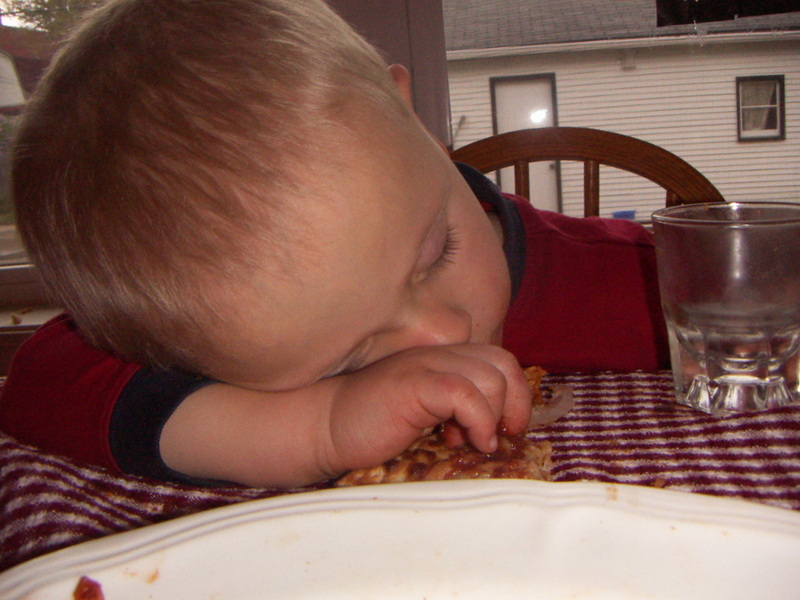
    Blog_024 Last week, while Milo was finishing his dinner, I noticed that he looked very very sleepy and was apparently about to nod off.   A better mother would have gently wiped his face and hands, lifted him onto her shoulder, and tiptoed off to tuck him in bed.

    I, on the other hand, waited until he fell face first into his pizza so I could take pictures.