bearing blog


bear – ing n 1  the manner in which one comports oneself;  2  the act, power, or time of bringing forth offspring or fruit; 3 a machine part in which another part turns [a journal ~];  pl comprehension of one’s position, environment, or situation;   5  the act of moving while supporting the weight of something [the ~ of the cross].


  • More on confession.

    From the point of view of the priest (in this case, Fr. Martin Fox — where would we be without the priestbloggers?)

    I sometimes wonder what folks think of the penances they accept from me. I try to match a penance to the situation shared; but too often, I receive no inspiration, and I resort to something rather standard. I have to remind myself: I’m a priest–Christ is present in my ministry, and I know that’s true when I give absolution. That does not mean, however, that I have been given any special, supernatural gift of being a doctor of souls, as it seems some priests have been given. One point I make about the penance is that is not a "punishment" nor even a "payment," but rather more like an "offering" and even more, healing. One penance I often give–which draws a puzzled reaction–is to ask a married person, "can you do something romantic with your spouse?" I could be wrong, especially as I haven’t been married, but I stand by that as a worthwhile penance: because what I’m intending is that the spouse I’m speaking to take the lead in some healing within that very important sacramental relationship of marriage….

    This gives me occasion to remind you, dear reader, that when you go to confession, the priest does not, merely, assign a penance; the penitent must accept it. At least, so I was taught and so is my practice. After suggesting a penance, I ask: "can you do that?" and/or, "that’s not too hard?" Sometimes, people will give a reason they can’t do a penance (e.g., I might say, "can you apologize to that person?" and the penitent might reply, "I don’t know that I’ll see him again."), and I will change it.

    As a confessor, I try to remind myself how delicate, how privileged, this moment is. I recall something a priest I know says often at penance services for high school children: pray for us priests that we won’t get in the way of Jesus. There are times I wonder if I should say anything at all, and there are times I merely suggest a penance and give absolution.


  • Can we think outside the “thinking outside the box” box here?

    Rich Leonardi on the trend of face-to-face confession:

    The decline in the popularity of Confession roughly coincides with the rise of the face-to-face confessional. (Whoops, I’m sorry; I of course mean "Reconciliation Room.") The intention of this innovation was to create a more welcoming, less intimidating environment than was offered by the supposedly cold, dark, screen-divided little room of tradition. Yet I suspect most people of parenting age have not-so-fond memories of sitting in a padded chair in a "Reconciliation Room" across from their parish or school priest and embarrassedly baring their souls. Or not baring — far better to mumble a sin or two, say an act of contrition, and clear out of there.

    It has always flummoxed me — what on earth made pastors and church architects think that people would feel MORE comfortable confessing their sins face to face with their parish priest, than anonymously?  The RCIA teachers years ago couldn’t explain it to me either, back in that university parish with no confessionals at all — confession was only by appointment in the priests’ private offices.

    What was the idea?  That putting a "wall" between the minister of the sacrament and the recipient damaged the character of the sacrament, somehow?  But the wall is porous — the only blocked sense is vision.  On the penitent’s side of the wall hangs the crucifix — and it’s Jesus who ultimately absolves.  Isn’t it possible that the image of Fr. Joe or Fr. Mike might itself be a wall that obscures?  Aren’t we often freer and safer behind closed doors?

    This is rather cynical, but maybe the sex-abuse scandal will help bring back the confessional.  I’m sure that many people by now , whether rightly or wrongly, don’t feel very comfortable sending their nine-year-old into the priest’s private office for ten minutes.  That unwelcoming "wall" between priest and penitent is probably starting to look like a better idea.

    From a 2002 article from OSV:

    Duncan Stroik, a professor of architecture at the University of Notre Dame who specializes in churches, told Our Sunday Visitor that he knows priests who were so concerned about their safety and/or their reputations that they have had windows or stained glass installed in reconciliation rooms. Some even have installed exit doors, alarms or telephones. Stroik noted that the traditional confessional with separate rooms had probably come about for good reason….

    Rolf Rohn of Rolf R. Rohn & Associates in Pittsburgh told Our Sunday Visitor that he has had requests for more observable confessionals [note:  I think he’s using this term to mean "reconciliation place" in general — E.] because of the safety issue. He related a story about a disturbed woman who began screaming at the priest in the reconciliation room and blocked the door. Indeed, news reports indicate that priests have been attacked and/or robbed in confessionals. Hence, Rohn likes to design reconciliation rooms with a second door emergency exit.

    How very welcoming and conducive to spiritual peace!  Instead of that pesky wall, we’ve installed panic buttons and emergency exits.  Oh, and by the way, now it’s not just the priest who can see you — anyone can see you through the window.   Have a Kleenex.  Feel free to open up.   

    My big beef with the OSV reporter is that she let architects be the experts about what a confessional is supposed to look like and feel like: 

    "One thing is for sure," Rohn said, "the guidelines for building a confessional are that it should be very, very open, inviting, with all kinds of imagery of reconciliation. Whether it’s the woman at the well, or the prodigal son, or the woman with the coin, there should always be a space in front that allows people to pray and meditate to some kind of theme. So it isn’t just a box anymore. It has to have an environment."

    James McCrery of Franck Lohsen McCrery Architects in Washington, D.C., and New York, emphasized that the setting for the sacrament should be inspiring.

    Are these guys even Catholics?  Have they ever experienced the sacrament themselves?  Doesn’t say.  Seriously:  considering the nature of Confession, what is wrong with a small private room, a place to kneel, and a crucifix on the wall?  Isn’t it weird that while the architectural trend for the church as a whole has been to remove decoration and beauty, stripping it bare and creating a "place of emptiness," suddenly the confessional (the ONE place where the attention of the worshipper is meant to be INWARD) has to have lots and lots of imagery?

    "There should always be a space in front" —outside the box? — "that allows people to pray and meditate… [I]t has to have an environment."  Duh.  We used to have those.  Very elaborate, they were, with lots of imagery.  We called it the sanctuary.

    Related: a good post from 2003 by Fr. Rob Johansen about the confession in general, and also this one about face-to-face confession in specific.  Incidentally, canon law requires that confessionals with grilles be made freely available, and permits either priest or penitent to insist on anonymous (behind the screen) confessions. 


  • Missing Friday penitence.

    A few weeks ago I posted about the loss of communal, penitential abstinence from meat on Fridays.  Now Amy Welborn has posted a quote from a book by Eamon Duffy, Faith of our Fathers, on the same loss:

    Duffy’s last chapter is on Friday abstinence, and in it, he takes a strong position: dropping the obligatory Friday abstinence was the worst consequence of these post-Conciliar years. Why?

    In abandoning real and regular fasting and abstinence as a corporate and nomative expression of our faith — by making it optional — the Church forfeited one of its most eloquent prophetic signs. There is a world of difference between a private devotional gesture the action of the specially pious, and the prophetic witness of the whole community, the matter-of-fact witness, repeated week by week, that to be Christian is to stand among the needy. …

    …But that isn’t to say that in our march into the needs and opportunities of the twenty-first century we should not try once more to summon up some of the deeper resources of our own tradition, and try to rediscover within it once more some of the supports which helped our fathers and mothers to live the Gospel. We could do worse than start by rededicating ourselves to the shared observance of fasting and abstinence.

    That really resonates with me.  Sounds like a good book, as well as the other work by Duffy that Amy links to:  a history of religion in England, 1400-1580.

    UPDATE:  Rich Leonardi blogs the same book.


  • “[M]aybe I shouldn’t have been praying for an angel with a heavenly burlap sack and some celestial baling twine.”

    I thought I was having a hard time with my kids at Mass this week.  Thank goodness for Selkie, whose story is much, much better.

    Let it be a lesson to all priests and deacons who might be tempted to score an easy homily by inviting all the children to come up front…


  • Surprise.

    The newest Minnesota Poll shows a remarkable result:

    People like the idea of getting expensive stuff more when someone else is paying for it.

    This is, of course, intended to reassure legislators outside Hennepin and Anoka Counties that there will be no backlash (for them) if they vote for a state bill that allows the state to tax Hennepin and Anoka County residents to build a stadium that Hennepin and Anoka County residents don’t want. 

    Not from around here?  Here’s the thing.  We have, like, these professional sports teams here?  One major league baseball team and one football team?  You know, these commercial enterprises?  And, like, each of them wants the taxpayers to foot a big chunk of the bill for a brand-new sports stadium?  Which they say would be a really great deal with huge economic potential?  You know, so much economic potential that they haven’t been able to get, y’know, enough private investors? 

    For ten years they and various supporters in the legislative and executive branches have been trying to get voters to agree to be taxed for the brand-new stadium for the professional sports teams, and astoundingly, no one has fallen for it.   

    No majority of voters in any town, city, or county has stepped up and said, "Golly gee, great idea!  WE want to pay for a huge attraction in our back yard that will be largely enjoyed by people from nearby towns who don’t have to pay for it, and then pay again for tickets and ludicrously expensive beer and hot dogs, so that a private corporation can profit!" 

    And no broad coalition of voters throughout the state has leaped from their seats and shouted, "Pick me!  Pick me!  Here’s my money!  I want to be taxed to fund a stadium that is four hours away from my home!  Actually can I give it to the Green Bay Packers instead?"

    This must be very frustrating to the stadium supporters.  They called for a tax and nobody came.

    But after ten years or so of trying to persuade voters to agree to pay for the professional sports teams to have a brand new stadium to replace the old, existing one  ("New stadium:  Warm and fuzzy.  Old stadium:  Cold and prickly.")  the supporters saw a light at the end of the tunnel.  Namely, they discovered a previously undiscovered loophole that allows the state legislature to agree to tax individual counties.  Get enough state representatives from outside Hennepin and Anoka county to agree, and:  there’s your tax.

    By the way, what a bizarre header on this graphic.  The pollsters asked five questions of Minnesotans. 

    Two are about public funding for the major league baseball stadium.    First, should we use public funding for a Twins ballpark?  (overwhelmingly no.)  Then a specific:  Not everyone gets taxed, only some people. (more yes’es this time, probably from the people who won’t get taxed.)

    The other three are about public funding for the public university stadium.  First, should we use state funds for the university stadium?  (Mostly no.)  How about if the state funds only half of it? (Now half say yes.)  OK, what if the state funds 3/4 of it?  (Overwhelmingly no.)

    The header is:  MINNESOTANS MORE APT TO ACCEPT SPECIFIC STADIUM, BALLPARK PROPOSALS.

    Well, sure, especially if the specific is "You won’t have to pay."


  • Public School at Home Day.

    This is exactly the sort of thing I would do to my kids.  Exactly.

    Many years ago when our two older girls were about 9 and 10, they also started to complain about wanting to go to school. The oldest had been to public school kindergarten, and this left her with the mistaken impression that public school was all about coloring, with brief interludes for playing on the monkey bars….

    I dragged our two school desks (used mainly for private art projects) into the dining room. I gathered every boring workbook and textbook I could find. I made a bathroom pass (huge) for them to carry down the hall to the bathroom. I called a friend and asked what the school lunch was for that day, and I made it (fortunately it was meatloaf, which they hated, and not pizza ;-D). I even had a bell to ring at set times. I bought milk in individual cartons and served peas.

    Read the rest


  • My nerdiness is actually multidimensional. Did you know that?

    Mark was telling me about some guy he works with who’s into geocaching.

    "Let me get this straight," I said.  "A person hides some stuff in the woods, notes the GPS coordinates, and gives the coordinates to someone else to find."

    "Yeah."

    "Like the big pile of gold in Cryptonomicon."

    "Yeah."

    "And looking for the stuff is called ‘geocaching.’"

    "Right."

    "Shouldn’t that be ‘geotroving?’"

    "Huh?"

    "Geotroving.  Hiding it should be geocaching.  Finding it should be geotroving."

    "No, see, it’s a cache.  You’re looking for a cache."

    "No, you’re not.  If I’m looking for something I hid, like my supplies for the winter, then I’m looking for my cache.  But if I come across someone else’s cache, it’s not a cache, it’s a trove.  I mean, who cares who hid the stuff.  The important thing is that I found it.  Get it?"

    "Ah."

    "Also it’s from the French.  Trouver.  To find."

    "Ah.  I see."

    "You should tell your co-worker that his sport has the wrong name."

    "Yeah."


  • While I’ve got the camera plugged in:

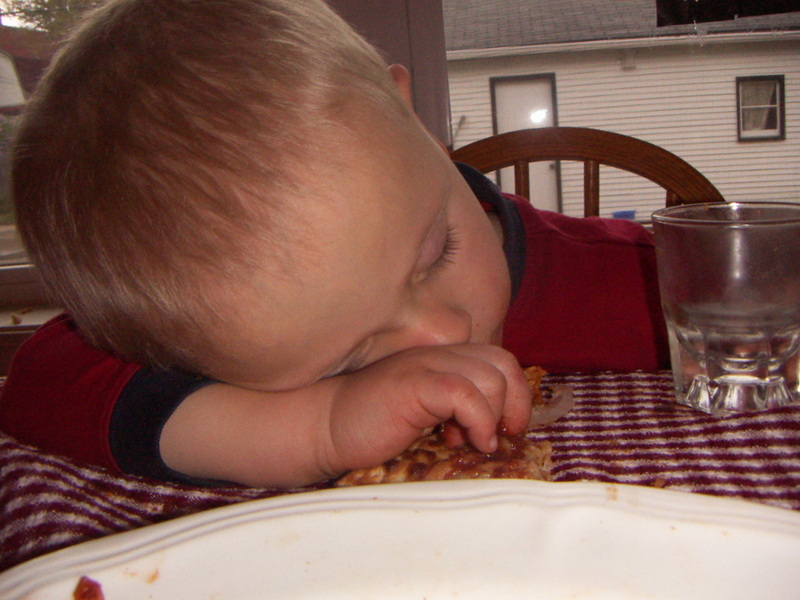
    Blog_024 Last week, while Milo was finishing his dinner, I noticed that he looked very very sleepy and was apparently about to nod off.   A better mother would have gently wiped his face and hands, lifted him onto her shoulder, and tiptoed off to tuck him in bed.

    I, on the other hand, waited until he fell face first into his pizza so I could take pictures.


  • 27 weeks. BELIEVE IT… OR NOT.

    Yesterday we paused on the way out of Mass to say hi to Father because Oscar had brought a rosary to be blessed.   Fr. D_____ blessed the rosary and then looked up at me with a smile and asked "How soon?"

    It always takes me a minute to figure that out before I remember that I’m really, really obviously pregnant.  "Oh, um, I’ve got three months left, actually."

    Genuine shock.  "No!  No way!"

    Here’s me in the bathroom mirror, today, at 27Blog_033  weeks:
    I Googled images of "27 weeks" to see how typical I am, since I feel really, really huge.  Look for yourself — there’s an amazing range, really.

    This woman, for example,  is actually made of plastic.  (Warning:  Normal, non-plastic people should not click here, and should not read the part where she writes about how she’s got to do some "serious sit-ups" because she’s still 10 pounds over her pre-pregnancy weight, which is apparently 43 lbs.,  at 7 weeks postpartum.  But her baby’s cute, to give her credit.)

    All joking aside, I’m not actually worried about my pregnancy weight gain, even though it’s on the high side by the numbers.  This is the third time, and both previous pregnancies I gained more than fifty pounds and made it back to the pre-pregnancy weight by the time baby was four or five months old.  So I’m assuming this is okay for me.


  • A glossary of Christian terms.

    Worth a few laughs, or at least a chuckle of admiration:

    Baptism
    Baptists are Christians who believe God can only be accessed by means of a swimming pool or, in some cases, a shallow outdoor stream. The first Baptist was John the Baptist, who was said to eat locusts and honey, although contemporary Baptists generally prefer barbecue.

    Sex
    Christians are not permitted to have sex. This unpopular doctrine was formulated by Pope Lactose LX at the Council of Disney in 1439. Despite this restriction, Christians have managed to increase their ranks to the point where there are roughly 2 billion of them. Scholars attribute this to the competitive health benefits and generous "flex time"
    arrangements offered by Christianity.

    Via Eve Tushnet.


  • Random link of the day.

    Ann Althouse on public accommodations for "emotional needs support animals:"

    What about the emotional needs created by finding that you’re seated in coach next to a small horse and a person who’s emotionally impaired enough to need a small horse and anti-social enough to impose it on you and shameless enough to exploit a law intended to help the disabled? Can I have a monkey to help me with that?

    No reason, I just liked the punch line.


  • Happy Mother’s Day to you too, lady.

    I have two sons — just two, so I’m only marginally experienced at this motherhood gig — ages 5 and 2.  I take my boys to Mass every Sunday. Like many other Catholic parents, and as is the norm in Catholic churches, I prefer that they, and I with them, remain in the pews during Mass.

    It’s easy with my five-year-old; by now, he knows how to behave and rarely requires correction other than a reminder to sit, stand, or kneel.   The younger one can be tricky.  If he squirms or drops a book noisily or points to the crucifix and yells, "There’s Jesus!"  I’m usually able to hush him in situ within a few seconds, whispering in his ear and pointing out various interesting things to look at. On principle, I always try, at least for a few moments, to settle him down where we are.  I prefer to leave only if he becomes disruptive and only as long as I need to, returning promptly to the pew once he settles down.  I’m willing to do this several times during a Mass if I have to.  How’s he going to learn if I spend the whole time in the nursery, watching Mass on closed-circuit TV while he and six other children play with Legos?

    We moms realize that the people around us don’t want to be disturbed (that’s one of the things I’m whispering into those little ears).  Still, it’s not as simple as "just leave."  Even the goal of minimizing disturbance to others requires constant evaluation of a specific dilemma: Which is going to be more disruptive to the people around me, spending a few more seconds trying to distract this little guy here in the pew, or hustling him AND his big brother AND my pregnant belly AND all our stuff out into the aisle and to the back?

    I think that most people in most parishes understand this.  In our parish especially, with its many large families.  So it’s not surprising that I can count on my fingers — maybe even on just one hand — the times when someone has either commented to me on, or glared pointedly at me because of,  my very young (<3yo) children’s "misbehavior" or noisiness.  You know:

    Can’t you WHISPER, please?

    or

    You know, they DO have some chairs in the back for when he misbehaves.

    Stuff like that.   Doesn’t happen often.  Nevertheless, there’s a pattern:

    No one has ever commented to me or my husband about my children’s misbehavior when my husband was with us.

    At least five times in five years, when I have attended Mass with a young child but without my husband, I have received negative comments or glares regarding my child’s misbehavior or my breastfeeding him.

    Isn’t that interesting?

    Without any further data, the obvious explanation would be that my kids are prone to worse behavior when their Dad isn’t around. Maybe my husband is a more effective disciplinarian.  Maybe they think that with me, they can get away with more. 

    But I don’t think that’s it.  I might, if I were discussing my older son’s behavior right now.  He’s five and would be capable of that kind of calculation, and he also knows how to behave by now.  But I’m talking about my 2-year-old, and my older son when he was a toddler.  Kids too young to have much self-control or even to have learned the etiquette yet.   And I’m pretty vigilant about their behavior in church (I have to be — see the second paragraph).  I’m confident that my toddlers aren’t systematically better-behaved when my husband is there with me.

    So what’s up?

    I’d like to impute charitable motives, but I can’t figure out any way that it is MORE charitable to reprimand a woman struggling to parent by herself than a woman who’s got her husband there to help her.  And I don’t, for example, notice a lot more people offering sympathetic "I’ve been there" smiles when I’m alone with my children.  I don’t hear more kind words or complements or even a knowing, "You’ve got your hands full," or even an offer when I arrive — "You look like someone who would appreciate an aisle seat — do you want me to scoot over?"   

    (And no, "We DO have a nursery, you know" isn’t a helpful offer.  It’s a reprimand disguised as a helpful offer.  Not sure?  Practice saying it out loud and see how it sounds.)

    So I always am left wondering:  Are these women (it’s always been older women) subconsciously trying to punish me for looking — somewhat — like a single mother?

    Or do they silently respect my husband’s authority in a way they don’t respect mine?   Does the same behavior that merits reprimanding a mother alone, become acceptable if a father is there radiating his tacit approval? 

    Or is the message simply, "You shouldn’t have come here and sat where you did, because you should have known you’d be unable to control them by yourself?"

    I’m not sure.  I can’t read their minds.  I do know that my husband approves of and supports the way I mother my children in public, which is not very different from most of the other families in our parish, I might add.  He’s glad, not ashamed, that I’m still able to breastfeed my two-year-old discreetly in the pew, especially since it’s such a sure-fire way to stop a meltdown in its tracks.  He, like me, strives to teach by example, which means staying in the pews as much as we can.   I think it must be obvious to bystanders that he has confidence in me.  It’s certainly obvious to ME.   So maybe it’s not just that I have A Man By My Side.  Maybe that confidence is contagious. 

    And maybe when I’m there with my two kids and my big belly, wondering how on earth I’ll carry the toddler out if he has a rare, real meltdown —  maybe they can smell fear.