bearing blog


bear – ing n 1  the manner in which one comports oneself;  2  the act, power, or time of bringing forth offspring or fruit; 3 a machine part in which another part turns [a journal ~];  pl comprehension of one’s position, environment, or situation;   5  the act of moving while supporting the weight of something [the ~ of the cross].


  • “Here we go.”

    I went to Mass this morning with Mary Jane in the sling, because I could.  Saturday mornings are my free time, and it was a first Saturday, so why not?

    It was quiet and quick, twenty-five minutes long in all.  When it came time for the Gospel reading, after the young priest announced, "A reading from the Gospel according to Luke" and we all responded, he grinned and said sotto voce, "Here we go!" before launching into the reading:  "When Jesus began his ministry he was about thirty years of age…."

    I thought, Here we go? That’s a weird thing to say right before the gospel.  What kind of priest is this?

    And then as the priest went on, I grinned.  I’ve never heard this read aloud at Mass before, because I’ve never attended on the eve of Epiphany’s celebration:

    He was the son, as was thought, of Joseph, the son of Heli,
    the son of Matthat, the son of Levi, the son of Melchi,
    the son of Jannai, the son of Joseph, the son of Mattathias,
    the son of Amos, the son of Nahum, the son of Esli,
    the son of Naggai, the son of Maath, the son of Mattathias,
    the son of Semein, the son of Josech, the son of Joda,
    the son of Joanan, the son of Rhesa, the son of Zerubbabel,
    the son of Shealtiel, the son of Neri, the son of Melchi,
    the son of Addi, the son of Cosam, the son of Elmadam,
    the son of Er, the son of Joshua, the son of Eliezer,
    the son of Jorim, the son of Matthat, the son of Levi,
    the son of Simeon, the son of Judah, the son of Joseph,
    the son of Jonam, the son of Eliakim, the son of Melea,
    the son of Menna, the son of Mattatha, the son of Nathan,
    the son of David, the son of Jesse, the son of Obed,
    the son of Boaz, the son of Sala, the son of Nahshon,
    the son of Amminadab, the son of Admin, the son of Arni,
    the son of Hezron, the son of Perez, the son of Judah,
    the son of Jacob, the son of Isaac, the son of Abraham,
    the son of Terah, the son of Nahor, the son of Serug,
    the son of Reu, the son of Peleg, the son of Eber,
    the son of Shelah, the son of Cainan, the son of Arphaxad,
    the son of Shem, the son of Noah, the son of Lamech,
    the son of Methuselah, the son of Enoch, the son of Jared,
    the son of Mahalaleel, the son of Cainan, the son of Enos,
    the son of Seth, the son of Adam, the son of God.

    Midway through, as the priest struggled with some of the multisyllabic names, I thought, I was glad I’d come just to hear this.  I am not sure why I liked it so much.  Maybe just the brief reminder of the way the liturgical year winds around — the thought that this unwieldy but weighty passage is read in the same place every year — and that there’s so much that I miss because I rarely go to daily Mass.

    And also, a reflection on how different it is to hear the readings than to read them.  I wonder sometimes if it’s not so good for us (save the hearing-impaired) to flip to the right page in the missalette and read the text at the same time that it’s being proclaimed from the pulpit.  Aren’t we meant to hear it, rather than read it, in the midst of the liturgy?  Wasn’t the word transmitted orally to most Christians throughout history?  Writing is useful, especially for epistles and such, but there’s something powerful about hearing instead of reading. 

    Look at the page of Luke’s gospel and your eye slips wearily over all the "begats," the "son ofs."  But hear it and you are moved.  "…son of God" comes like a punch line.


  • Safety and comfort and space.

    Eight years and three kids into our marriage, we’re pretty good at this natural family planning thing.   We’re practically the poster children for NFP success.   For we’ve gotten exactly what we planned for so far, our kids spaced "about three years apart:"  Oscar, who arrived just after I finished my graduate school coursework, twenty months after our wedding; Milo, who arrived when Oscar was three months past his third birthday; Mary Jane, who arrived when Milo was three months shy of his third birthday.   (In fact, she arrived the day before Oscar turned six, so we’ve only had a cumulative spacing error of about twelve hours.)

    And we’re comfortable with it too.  Without going into any intimate details, let me just say that we’re also apparently (so far) the poster children for not having much disagreement or trouble with it at all, not with the calculation and figuring out how the timing should go, not with the sacrifices and cooperation that go along with the constraints we accept.  It’s … easy for us.  I know it’s not easy for everyone, so I try hard to be appropriately grateful, but really, for us it’s been easy.

    Too easy?

    Mary Jane is only five months old, and I’m strongly committed to totally breastfeeding her for a while, so I’m positive that avoiding another conception now is right and reasonable.  That has apparently given me the safe place from which to start wondering about, and challenging, one of the assumptions I brought into my marriage:  the sacred Three Year Spacing.

    Already before we started having kids, I had (and still have) a certain belief-set.  I would carry my baby constantly in-arms or in a sling, not stick him in a seat or playpen. I would carry and hold my young walkers, too, except when they chose to stand.   We would all sleep better and more safely with our little children snuggled into the family bed.   We would care for our children ourselves and not entrust them to paid providers.  I would nurse each one until a natural, mutual end of weaning at age three or four or five, however long it might take, even if that meant I had two nurslings at once.  We would try to incorporate our children into our lives and teach them to use our tools and share our work.  Later we added homeschooling to the list, too.

    And some more beliefs:  Hunter-gatherer families, what with extended breastfeeding and lactational amenorrhea, naturally have a spacing of eighteen months to four years between children, so children naturally "expect" to have siblings no sooner than that.  The ideal spacing in terms of maternal and child health is about two and a half years on average.  And (most importantly) I can handle the intense form of parenting I have chosen as long as the kids are about three years apart.

    I’ve been pretty comfortable with this.   And though I always say that I never look more than one baby ahead, I’ve been content in the knowledge that, at this rate, we might have four or five or at most six children in all (I’m thirty-two years old), and I rather like not knowing right now what the final number will be.   I certainly know other couples (I kind of think of this as the "NFP instructor" pattern) with five kids spaced like fenceposts.

    In the past year, though, we’ve had the great blessing of getting to know (in real life and on line) a number of families with an abundance of children fairly close together.   Four children under the age of six.  Five children under the age of eight.  That sort of thing. 

    I see that often, not always, there are choices made that are not the ones I would make.  The children are often weaned earlier, perhaps at twelve months.  The babies spend less time in arms and more time in seats (heck, with my two boys around I’ve put MJ into her high chair as much as she will let me, myself; I know I’d only be doing it sooner and more if I had a young toddler as well as my small boy and larger boy.)  I don’t know what these families do about discipline, but I imagine I’d be looking for even more shortcuts than I do now, and might be making choices I don’t feel comfortable with.

    Still, it’s plain to me that there are beauties there that we miss with our perfect, perfectly wide spacings.  Closer together, the children have more years to grow in each other’s company, and maybe cannot remember a time without their nearest siblings.  Maybe when they are grown they will be closer too.  The house will be busier, noisier, crazier for sure.  Maybe those moms long for calm and quiet more often than I do — I manage to find enough of it for myself, every week.  But I doubt they’d trade a child for it.

    And then there’s those beliefs I mentioned.  Would I feel pressured to force an early weaning, or would I overuse the stroller I’d have to buy?  Would I yell more?  Would I cut corners I shouldn’t?  Would I become a mother I don’t admire?  I might pray for the knowledge that I’d do just fine.  Yet I know that we’re granted today’s bread, not tomorrow’s to set aside in safety.

    Just something that’s been on my mind, right now when I’m safe with my new little baby in my arms, safe from the need to ask myself yet if it’s time to seek new life.


  • More weirdness.

    Eric tagged me (interestingly enough, along with people named Peter, John, and James — oh, and Karl too) to tell six weird things about myself.

    Now, in some circles (say, back home visiting family and friends at Christmas) the weird things would go like this:

    1. My three kids were all born at home
    2. I homeschool
    3. I have never (yet) owned a stroller, a crib, or a playpen
    4. My three-year-old is still nursing, and I didn’t wean my oldest till he was well past 4
    5. I believe that butter is good for me
    6. I am teaching myself Latin because I hope it will be more useful in the future

    These things make me certifiably weird in a "percentile of the population" sense, but I’m guessing that they don’t seem particularly surprising to the population that visits my blog.

    So I’m going to have to do better than that.

    1.  When I was twelve, I accidentally severed all the ligaments in my right wrist.   

    I fell down some stairs with a drinking glass in my hand.  Now I have a scar that looks like I tried to commit suicide.   And I have limited sensation in my thumb and two fingers.  This is useful for having my iron tested.  Fortunately,

    2.  I am left-handed,

    as are my husband and our two sons.  While left-handedness is not weird per se, I am, as, left-handed women are rarer than left-handed men.

    3.  I share two "work days" per week with a few close friends who are also homeschooling families.

    Sometimes at my house, sometimes at one of theirs; we arrive in the morning, help out with housework, bring lunch, sit the kids down at the table together to do their schoolwork, sometimes take walks, make dinner together, hold a baby, make tea, knit, plan curriculum, read stories to eight children at once, that sort of thing.  We call it "the tribe," and it keeps us from getting that creeping sense of isolation. 

    The dads are part of it too, by the way.  We also see each other occasionally on weekends, and function as a sort of extended-family-by-choice for the purpose of, oh, moving furniture, getting someone to drive you to the airport, babysitting, someone to put down on forms as the emergency contact, that sort of thing.  For example, this evening one of the dads is coming over here with his three kids to hang out with Mark and me for a few hours because his wife needed some quiet time to work on the computer.

    If this doesn’t sound particularly weird to you, consider this:  We are hoping, and trying to figure out how, we can all move into houses that are next to each other or at least on the same block.  Unfortunately, this seems to require more computing power than I can muster.

    Where did I meet these people?  Well, that brings me to this:

    4.  I have a doctorate in chemical engineering.

    And if you don’t think that makes me weird, you don’t know many chemical engineers.  It’s not a very good doctorate (please don’t ask me to describe my thesis work), because I became a shameless slacker, academically speaking, after I decided I didn’t want to put into daycare my son who was born 3 years into the thing.  After that, I never went to any seminars or networked or published any other papers or learned any auxiliary skills or lectured any courses or did anybody any favors — in short, nothing at all that might help me get a job in my field. 

    I spent my first maternity leave finishing up coursework.  I wrote most of my thesis while on "maternity leave" (actually, they’d just stopped paying me) with my second baby.    I turned in my thesis on April 29, 2004, the same day that my son was having minor surgery in the university hospital; on May first, Mark went back to full-time work and I went home to raise my kids.

    I don’t know if it makes me weird, but it has certainly contributed.  Oh, and by the way, two of the dads in the tribe (see number 3) were in the same PhD program, and that’s how I met them.  My husband isn’t one of them — I met him when we were both undergraduate ChE students.  (Hmm.  It’s just occurred to me that maybe I better not get any more schooling.)

    5.  Unless there are some that I forgot, I own eight different kinds of slings, a.k.a. soft baby carriers.

    I do not think this ought to be considered weird — after all, I own more than eight shirts — but the number seems to be greater than the average.  This is how I have managed to make it through three children and no strollers or playpens.

    And because someone will ask:  Didymos long (blue indio), Didymos short (red indio), Maya Wrap, Mexican rebozo "extra fino especial," Kangaroo Korner Adjustable Fleece Pouch, Kangaroo Corner Mesh Water Sling, Kangaroo Korner Adjustable Mesh Pouch, and a tube sling that Hannah made for me a long time ago.  This doesn’t count the Kelty Expedition Carrier, which only Mark ever uses.

    Finally,

    6.  When I am reading something, anything, I am completely oblivious to my surroundings.

    This drives people around me crazy.  Nobody believes that I do not do it on purpose.  When I was a child my parents would shout my name at me until one of them thought to tap me on the shoulder, at which point I would put my book down and wonder why they were telling me I was grounded for being disrespectful.  When I was a graduate student, once, I got locked into the library at closing time and didn’t notice for more than two hours.  And now that I am a mother, not even the screaming of my own children — I mean, the kind of screaming that is accompanied by blood on the carpet — can break my concentration, if I happen to be looking at a magazine.  Something must be wrong with my maternal instinct.  I blame graduate school.

    tag, if you’re reading this: stella borealis, light and momentary, valerie, anyone who thought the first six weird things were weird, and the tribe (if you’re willing to come clean in my comment section.)

  • Latria and language.

    An excellent comments thread appeared over the holidays at Midwest Conservative Journal, a conservative Anglican blog, in which a remarkably respectful dialogue evolved about the fine distinction between what some called "Mary-worship" and proper devotion to the Blessed Virgin.

    (Not that it’s remarkable for that site — MCJ regularly has great commenters.  It’s just a good example of a positive discussion among people who disagree firmly with one another.)

    A number of comments, including from professed Catholics, were along the lines of "Well, we know that Catholic doctrine says, or at least claims to say, that people aren’t supposed to worship Mary.  But just take a look at the practices of Catholics and you can tell that they are."  For example, here’s a comment from "Murfee":

    As a RC for nearly 3 decades, having been immersed in Roman catechetical substance and theory, I can say w/o any qualms that the worship of the Blessed Mother has always been a fact of life from the earliest pontificates to the present. Get a grip, its a doctrine of the church. "Mary worship" may not be extantly expressed as such, but its the single strongest undercurrent in theory and practice today. Say a rosary and that should clue you in. Check out the marian altars in nearly every church or parishes so named for the mother of our Lord and tell me I’m delusional. So why do we protest (as in protestant) so much when some wag points out one of RC’s features? Hey, if we’ve got a magenta shirt on why do we insist on calling it cyan?

    Guilty admission:  My first thought on reading the bit about "single strongest undercurrent in theory and practice today" was I wish! Not that I wish people were really worshipping Mary, but I wish that theory and practice today could actually be readily mistaken for it by the unwary.  Most parishes I’ve attended over the years aren’t exactly riddled with Marian chapels or echoing with scheduled communal rosaries. 

    Others pointed out that, whatever it looks like, you’d have to be able to read a person’s soul to know whether they were really worshipping the object of their devotion.   Some confusion certainly comes from words that mean different things to Protestants and to Catholics (e.g. "pray to" doesn’t equal "worship" for Catholics) and others from ambiguities (e.g. the practice of bowing during the line "He was born of the Virgin Mary and became man" in the Creed refers to "He" and not to "the Virgin Mary.")  Some confusion, too, comes from shorthand language on the part of Catholics who do, in fact, understand the distinctions (e.g. saying something like "St. Anthony please help me find my keys" rather than "St. Anthony please pray to God for my intention that I may find my keys.")

    So how to bridge the gap of understanding?  I wonder, is it even possible to "in practice" worship someone or something, if you fully understand that it’s not God?  I could understand that if someone incorrectly thought that Mary was God, part of God, a person of God, or a goddess, that someone might worship her.   But that seems an unlikely error for anyone with the barest of catechesis.  Is it possible to worship in practice what you don’t worship in theory?    Isn’t worship really something that happens in the mind and heart?  Could this be used as an objection to the claim that Catholics worship Mary (or other saints) "in practice" even if we pay lip service to worshipping God alone?

    Then I thought of two Scriptural quotations involving "worship" of something that’s not God (in the mind of the worshipping agent, an important distinction).  First, Satan tempts Jesus in the desert to worship him; if it were impossible to worship what you know not to be God, then this would be nonsensical.  Second, I thought of "you cannot worship both God and Mammon."  Mammon generally being regarded as meaning "riches" or "money" or "worldliness," this would also be nonsensical unless it were possible to worship what one knows not to be God.  But that was just my memory:  I had to look them up.

    It turns out that the Mammon bit (Mt 6:24) isn’t exactly as I remembered — English translations say "serve," not "worship," and since "serve" is something you do externally, there’s no contradiction:  it is possible, and often commendable, to serve that which you do not worship.  Your employer, for instance.  Or even Mary, for to serve her would be to obey her words:  "Do whatever he tells you."

    Satan-tempting-Jesus-in-the-desert is even more interesting.  It’s Matthew 4:9-11:

    And he said to Him, “All these things I will give You if You will fall down and worship [1] me.” Then Jesus said to him, “Away with you, Satan! For it is written, ‘You shall worship [2] the LORD your God, and Him only you shall serve [3].’” Then the devil left Him, and behold, angels came and ministered [4] to Him.

    I added the footnotes 1-4 above to show you something interesting.  In the Latin Vulgate, verb 1 is adoraveris, verb 2 is adorabis, verb 3 is servies, verb 4 (which I mention because it sometimes is translated "served") is ministrabant.  "Worship" in both verbs 1 and 2 is rendered "adore" in the Latin. 

    In the Greek textus receptus, interestingly enough, verb 1 is (pardon my transliteration) proskyneses, verb 2 is proskyneseis, verb 3 is latreyseis, and verb 4 is diekonoun.

    I point this out only because "latria" (as in "idolatry") is in Catholic theology the specific term for the reverence or adoration that is appropriate to God alone.  According to Wikipedia  it is sacrificial in character and is usually translated "adoration."   "Adoration" is not the modern English word I would have chosen to translate this concept (I would have used "worship").  After all, kittens and babies are "adorable."  But "worship" in English, etymologically speaking simply means "respect," at least according to Wikipedia, which links it to Anglo-Saxon worthscripe

    How confusing. 

    Modern English usage worship = something you are supposed to do to God alone = latria

    Older English usage worship = "respect" = something due to many, including saints and other people

    Modern English usage adore = something one can do to God, or something one can do to a kitten

    Usual translation of latria into English = "adoration"

    It makes me wonder if whoever came up with "latria = adoration-not-worship" was an Italian who happened to be an expert on Anglo-Saxon.

    Yes, I recognize that when we "adore" Christ in the Eucharist we are doing something essentially different from what we are doing when we look lovingly upon anyone else, but the language problem here seems tailor-made to cause confusion.


  • Orient yourself.

    Rumor has it that liturgical changes are coming, including more Latin, reining in theologically  out-there hymns, and maybe the priest will be encouraged to face the same direction as the people again.  Ad orientam:  to the east.  Or, as opponents like to put it, "with his back to the people."

    Rich Leonardi quotes one of those opponents:

    Thus, when the priest was at the altar, with his back to the congregation, while reciting prayers in Latin in a barely audible manner, the message was clear, even if not explicit. The priest is the one who makes the Mass happen (the old textbooks referred to it as "confecting the Eucharist"), while the laity are present essentially as onlookers …

    That’s how the argument goes.  Ad orientam = "back turned to the people" = people reduced to onlooker status = high’n’mighty priest.  Priest turned toward the people, then, supposedly sent the message that the priest was just this guy, you know?, one of us, and raised the people to the status of participants, not merely an audience.

    I submit for your consideration: two images. 

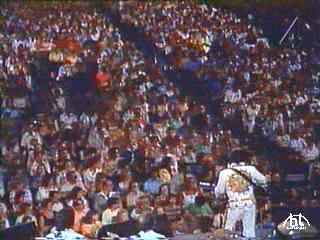
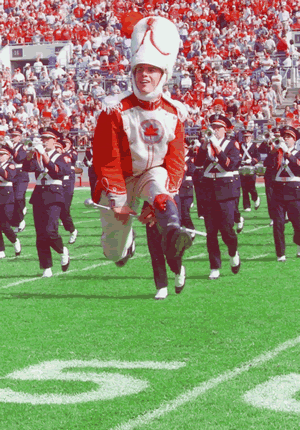
    In each, one man is going step by step through a highly ritualized routine, complete with special costume and equipment.  He is in front of a number of other people standing rank on rank in rows,  who are looking to the man in front for cues even as they go through motions that they themselves know well.  In the first picture, the man in front faces the  people I just spoke of.  In the second, his back is to them.

    Number 1:    The "Rock Star and Audience" model.  (That’s The King.)

    Elvis

    Number 2:  The "Drum Major And The Rest Of The Marching Band" model.  (TBDBITL, of course.  Yeah, I know, these guys have an audience too.  But right now I’m thinking about the folks in the Sam Browne belts.)

    Dmalor

    A few observations.

    1) The drum major may have a fancy title and a fancier hat, but he is most emphatically one of the band members.

    2)  Isn’t it obvious that the drum major and the rest of the band have a shared purpose, and that the rock star and the audience do not?

    3)  Whose position — the drum major’s relative to the rest of the band, or the rock star’s relative to the people in the pews, leads to the appearance that it’s All About The Guy Up Front?

    4)  Is the rock star singing along to the music generated by the audience?  Is the drum major dancing to the music generated by the marching band?  Hm?  So who’re the "onlookers" here, and who are the "active participants?" 

    My point is just that it’s inherently absurd to say that when the priest’s back is to the people, the message is that the people are a mere audience, but when the priest faces the people, the message is that the people are active participants.   Does anyone seriously think that because the drum major has his back to the trombone players and the drummers, "the message is clear" that the music is coming from him?

    The posture of the Performer is to face his audience. 

    The posture of the Leader Among Us is to face the direction we’re trying to go.

    Now it may well be that, back in the day, the priest mumbled, barely audibly; and now, everybody can hear fine and dandy.  Although being able to read lips probably helped some, I suspect this has not so much to do with our newly enlightened liturgical style and more to do with the fact that these days, churches (at least the big cavernous ones) have amplification systems.

    And don’t forget another thing we have in common with the marching band… we rehearse.  We do this every week, you know?  So we know what’s coming.  I could probably come up with more analogies (Music appropriate to the venue!  The Playing Field!) but I think I’d be stretching harder than the guy with the baton.


  • Union busting at the “progressive” non-profit.

    Lest you think I never cover anything on the left side of the blogosphere, here is a fascinating and detailed multi-part series about union-busting at the nonprofit FFPIRG.  (Minnesota members can take comfort:  MPIRG is not affiliated with the organization described here.)

    The link provided goes to the conclusion; use the links to "first post," "part two," "part three," etc. at the top of the page to navigate the story.

    My disclaimer on this topic is that, as a graduate student, I once worked very hard for a "no" vote on a grad student union — my beat was posting anti-union flyers in the Social Sciences Tower, which was a pretty thankless job, let me tell you.  But it wasn’t because I was against unionization, rather because I was against that particular union — a branch of a teachers’ union, and particularly because research assistants and teaching assistants were to be covered under the same bargaining unit, which is patently ridiculous.  (And, unfortunately, enshrined in Minnesota state law — I still believe that TAs deserve to be unionized, but as an RA I didn’t want to get sucked into a bad-deal union that lined the pockets of Education Minnesota at our expense).

    Anyway, the PIRG canvassers describe in the story should have had the opportunity to unionize, and they didn’t get it, largely because of legal means employed by the nonprofit to enable them to fire the organizers.  How could this work? 

    "We’ve all come to realize," Christian [one of the organizers] said to me, referring to both the firings and the long months yet to come, "that our nation’s labor laws are simply not designed to protect employees from employers who resort to measures as self-destructive as what the Fund was willing to do to prevent our union."

    It’s interesting.  After reading it, I felt like telling the next canvasser who comes to my door, "Forget the donations.  Here’s twenty bucks, go pay your rent with it."


  • Minimalist coconut chicken egg drop soup.

    Ouch.  I am coming out of a migraine, which calls for comfort food.  And I don’t feel like doing much.  Luckily, I have some broth going since Saturday night in the crockpot, the remains of that night’s grocery-store rotisserie chicken. 

    I scooped some of the boiling broth out of the pot with my soup mug and added 1 beaten egg, stirring to break up the strands as they cooked in the hot broth.  Then I filled the mug to the top with canned coconut milk.  Add a few shakes each of vinegar, soy sauce, and Thai fish sauce and I’m set.  (The coconut milk even brought it down to sipping temperature.)

    But wait!  There are a few shreds of the roast chicken left in the fridge.  Add those, too.

    Sure, I could take a few more minutes and add lime juice, or sliced mushrooms, or minced ginger.  But take a look at the kitchen:  I only dirtied two bowls and a fork (I drank the soup, I didn’t spoon it).  Tasty, a quick energy boost, and low carb.


  • Original Sin: positive or negative?

    Tongue in cheek — I don’t mean "good" or "bad," but is it something added or something subtracted?

    Pontificator (who just celebrated his first Mass as a Catholic Priest after converting from Anglicanism — congratulations!)  posts a citation from John Henry Newman about the doctrine of the Immaculate Conception, i.e., the doctrine that Mary was from the first moment of her life free from sin.  I was struck by Newman’s characterization of the differences between Catholics’ and Protestants’ concepts of original sin:

    Our doctrine of original sin is not the same as the Protestant doctrine. “Original sin,” with us, cannot be called sin, in the mere ordinary sense of the word “sin;” it is a term denoting Adam’s sin as transferred to us, or the state to which Adam’s sin reduces his children; but by Protestants it seems to be understood as sin, in much the same sense as actual sin.

    We, with the Fathers, think of it as something negative, Protestants as something positive.

    Protestants hold that it is a disease, a radical change of nature, an active poison internally corrupting the soul, infecting its primary elements, and disorganizing it…

    [B]y original sin we mean, as I have already said, something negative, viz., this only, the deprivation of that supernatural unmerited grace which Adam and Eve had on their first formation,—deprivation and the consequences of deprivation.

    Newman goes on to explain how the "negative" view of original sin, plus the ancient understanding of Mary as the "new Eve," leads naturally to a position that the Immaculate Conception of Mary is not unreasonable.

    I realize that I have always had an unconscious acceptance of Original Sin as "stain," i.e., something added to the soul.   So what if I try to change my philosophy towards it, so that it becomes a kind of emptiness, primarily a cavity to be filled rather than primarily a spot to be washed away?

    A number of interesting distinctions follow.  For one, it removes the mistaken idea of Christian doctrine that is sometimes phrased "we are judged because of Adam’s sin."  It means, rather, that Adam’s sin took something away from us, something we need to reach God where He is (a chasm overcome by His coming to where we are).

    It rings truer to me to assert that our babies are conceived with a deficiency than to assert that they pick up in the womb some kind of infection of the soul.  Such an idea transforms the sacraments.  (However, the idea of baptism as a "washing" is so common from the earliest traditions that we’d be ill-advised to throw it out — surely there’s something to that symbolism too.)

    Yes, "the lamb of God … takes away the sins of the world."  But this refers to actual sins, no?  It’s plural (peccata) and original sin is always singular (peccatum), unless I’m mistaken.

    The idea of original-sin-as-negative also helps guard against the heresy that concupiscence is "meme" rather than "gene" — that is, that the tendency to sin spreads from person to person through culture rather than through human reproduction, a tempting heresy to be sure.  (And not much more than re-warmed Pelagianism.)


  • Lully, lullay.

    This weekend, again on account of Our Lady of Guadalupe, we heard The Coventry Carol at Mass.  I’m reprinting last year’s post:

    Today at Mass during the Offertory (inexplicably; this is Advent) we sang Lullay, lullay, thou little tiny child, a.k.a. "The Coventry Carol" after its tune.

    You don’t hear that one very often outside of church, and not really very much in church, as lovely as the tune is.  (Here’s a link to the tune at Oremus.org — link plays music.)  I sing it only with great difficulty, myself.  How strange and haunting:  the lullaby of the grieving mothers of Bethlehem, on the day that Herod slaughtered the Holy Innocents:  the carol that accompanies the Flight into Egypt, and is its dark other side.

    Lully, lullay, thou little tiny child, bye, bye, lully, lullay.

    O sisters too, how may we do, for to preserve this day / this poor youngling for whom we sing?  Bye, bye, lully, lullay.

    Lully, lullay, thou little tiny child, bye, bye, lully, lullay.

    Herod the king, in his raging, charged he hath this day / his men of might in his own sight, all young children to slay.

    Lully, lullay, thou little tiny child, bye, bye, lully, lullay.

    Then woe is me, poor child, for thee!  And every morn and day / for thy parting nor say nor sing ‘Bye, bye, lully, lullay.’

    Lully, lullay, thou little tiny child, bye, bye, lully, lullay.

    I remember hearing the carol as a child and not really absorbing anything other than the refrain.  I always thought it was a lullaby for the Baby Jesus:  what other "thou little tiny child" is there to sing about at Christmastime?  I didn’t know about them, and they have disappeared these days from our Christmas story, but… some fifteenth-century English tune-smith did remember the mothers of the forgotten little ones of Bethlehem, and we should be thankful for him.

    The Christmas story is indeed a joyful one, but in the midst of it there is a great terror and sadness.  December 28th is the Feast of the Holy Innocents:  remember it, and sing Lully, lullay.

    (Matthew 2:13-18:  Now when they had departed, behold, an angel of the Lord appeared to Joseph in a dream and said, "Rise, take the Child and His mother, and flee to Egypt, and remain there till I tell you: for Herod is about to search for the Child, to destroy Him." And he rose and took the Child and His mother by night, and departed to Egypt, and remained there until the death of Herod. This was to fulfill what the Lord had spoken by the prophet, "Out of Egypt have I called My Son."Then Herod, when he saw that he had been tricked by the wise men, was in a furious rage, and he sent and killed all the male children in Bethlehem and in all that region who were two years old or under, according to the time which he had ascertained from the wise men. Then was fulfilled what was spoken by the prophet Jeremiah:"A voice was heard in Ramah, wailing and loud lamentation:  Rachel weeping for her children; she refused to be consoled because they were no more.")

    UPDATE:  It’s possible that the Coventry Carol was chosen because this upcoming weekend [remember, I posted this originally in 2005], in honor of Our Lady of Guadelupe’s feast Monday, our parish is hosting a special pro-life Mass.