bearing blog


bear – ing n 1  the manner in which one comports oneself;  2  the act, power, or time of bringing forth offspring or fruit; 3 a machine part in which another part turns [a journal ~];  pl comprehension of one’s position, environment, or situation;   5  the act of moving while supporting the weight of something [the ~ of the cross].


  • Hell is other people. Or me with other people.

    Yesterday evening, duty called me to two successive meetings out of the house.  One: a private home, where I met briefly with one person who is seriously ill, and where I encountered three other people.  Two:  A "social meeting" of an organization I belong to.  Maybe there were about twenty women there.  Details are unnecessary.   I write today about the common thread in the two meetings:  I had to make small talk.

    I drove home, as I do so often, downhearted and with a lump in my stomach.  I kept hearing my own voice, punctuated by the nervous laughter that plagues me in social situations.  What I blurted to the sick man when the uncomfortable subject of his short remaining months had to be broached.  How I pressed too hard, in my chitchat with a certain woman, on a certain point, and how she tilted her head and narrowed her eyes and issued a soft and careful reply; how I stumbled and searched for what to say next and how I failed.  (And I know her to be a friendly, warm, kind woman:  which makes it worse, of course.) 

    What a bizarre handicap:  I can’t chitchat.  I fake it the best I can, but it’s playacting.  I do all right with friends, but I cannot engage in a real conversation with a stranger.  I say stupid things.  I react weirdly, without human warmth.  I offend people by accident.   I embarrass my companions.   

    How to explain what it’s like from the inside?  I can only think of one other experience that’s like it.  Have you ever been drunk?   Have you ever been drunk and attempted, for some important reason, to appear sober?  Remember how hard it can be?  Trying to exert control over your facial expression, to compress the sloppy beery grin by sheer will into a serious-looking frown; pausing to collect your words before speaking so that they emerge from your lips in the correct order and free of slurring; listening extra-hard through the alcohol-induced dull clamor of background noice to make sure that what people are saying to you makes sense so that your reply does not sound insane; carrying yourself carefully so that you do not fall although the room is pitching around you. 

    In this situation it is impossible to enjoy the company of others.  You are simply focusing too hard on yourself.

    And that’s kind of what it feels like for me — totally sober, mind you — to get through a "social hour."  Or any situation where I can easily feel like an impostor.   Graduate school poster sessions, in which I posed as a researchr

    I hear they have drugs for this sort of thing now.  I’m not interested in treating this personality defect as an illness.  I’m more interested in learning to live with myself, to compensate where I can and to stop worrying where I can’t. 

    Social anxiety isn’t exactly covered in depth in the Gospels.  It helps to think of myself here, a little bit, as the poor — not lacking in material things, but instead with some intangible but natural defect.  He came to preach good news to the poor, and what could that be but the message that what they lack isn’t the really important thing?  And what else would He say — give the widow’s mite from what you do have, and accept humbly from others; don’t pretend to be something you’re not, and let God provide what you need to perform your daily duties.  I know that one key is to stop worrying what people think of me, and another is to listen more.   I read aloud from the children’s Bible today the sending of the twelve in pairs:  Jesus tells them not to worry what to say, to let God provide them with words.  Strong words for me. 


  • Book tag.

    Just when I really needed it to break out of my writer’s block, James of the Daily Brouhaha tagged me with an easy meme.  Thanks James!

    He wants to know what I’m reading.  Well.  I am the sort who always has several books going at once in different parts of the house (generally in all the places where I sit to nurse a baby or toddler).  Here are the books and magazines lying open face down today.

    1. The latest issue of The Atlantic Monthly.   I threatened to cancel my subscription after they stopped the crossword puzzle, but never actually went through with it.
    2. The latest issue of Cooks’ Illustrated.  This is a magazine with fabulous recipes and gorgeous food photography and amusingly breathless writing about solving the problems of the world:    Bands of grey overcooked steak between the browned crust and the rare interior!  Rapidly-coagulating Sauce Alfredo!   Omelettes that get too brown on the bottom while they are still runny on the top!  Oh the humanity!  Never fear, Cooks’ Illustrated is here.  We went through 275 pounds of ground beef to bring you the perfect all-beef meatloaf.   It’d be funny, except that if you try the recipe, you’ll discover that they succeeded.
    3. A biography of Joseph Smith lent to me by one of my LDS friends.  I’m only a couple of chapters into it, and I think it won’t take me too long to finish.  The author has drawn a fascinating portrait of life in early-1800s New York State for sure.
    4. Dawn Eden’s Thrill of the Chaste.  Not too applicable to my current life, but a quick and enjoyable read nonetheless.  I got it because I like her blogging and I got tired of reading all the bits about it on her blog without having read the book to know what she’s talking about.  I don’t know what I’m going to do with it, but I guess if Mark is ever run over by a bus I’ll dust it off in case I am ever tempted to turn in my grief to looking for a hot young drummer to sleep with.
    5. The Divine Comedy.  DarwinCatholic has been posting some commentary on it, and that got me interested in reading The Purgatorio and The Paradiso — I have long had a copy of Ciardi’s translation of The Inferno lying around, but not those other two.  So I bought Ciardi’s translation of the whole shebang.  I continue to be annoyed by annotated books that put all the annotations at the end of a section so I have to keep flipping back and forth.  Footnotes, people.
    6. The Lord of the Rings plus The Hobbit.  I read it every year or so.  All four ragged paperbacks are on my nightstand right now.

    No links, because if I don’t do no-frills blogging today, I won’t do it at all.

  • Light and crunchy blogging.

    Holy Week non-blogging is bleeding into Easter Octave non-blogging.  I picked up a short-term freelance job that is going to eat my spare time for the next eight weeks or so.  I still haven’t learned to juggle the new schedule… bear with me!

    We made "Resurrection Cookies" on Holy Saturday night — one of those "story recipes" where you read a Bible passage before each step of the recipe, and so tell the story of the Passion. 

    It seemed like a good idea up until the time to drop the little pre-meringues by the teaspoonful onto the parchment-covered cookie sheet.  I’d just explained that each pecan-studded meringue was to represent the "rocky tomb" (they turn out to be hollow the next morning, alleluia!), and my boys suddenly began singing loudly:

    Crunchy munchy Jesus tombs!

    Crunchy munchy Jesus tombs!

    They’re fun to make and fun to bake!

    Fun to crunch and fun to munch!

    Crunchy… munchy… JESUS TOMBS!

    I think the Wiggles have something to do with this, but I’m not sure.  Thankfully they did NOT try to sing this in church the next morning.

    He is Risen! Alleluia!

    Now it’s off to pick up my milk order, and then run errands…

    It seemed like a good


  • What would I do if I tried to unschool math?

    A question came up on one of my email lists about unschooling and math, and that got me thinking.

    I’m not an unschooler, at least not for subjects that I believe are (a) required and (b) skill-based — i.e., I don’t unschool mathematics, reading instruction, spelling.  Other topics we’ve been more "unschooly" about.   With Oscar I use Saxon Math, skipping a lot of the repetitiveness that plagues that otherwise fine curriculum.

    But speaking as a person trained in engineering, and who studied mathematics through the graduate-school level, and who really loves math and wish I’d studied more of it even though I am a SAHM now and not an engineer at all, if I were going to unschool mathematics, what would I do?  Here’s what I came up with.

    Well in advance of my children needing it, I’d select at least two K-8 math curricula — one that’s book- or workbook-based and one that’s exploratory/manipulatives based.  I’d want the book-based one to be (a) rigorous and traditional and (b) fairly self-teaching (Singapore Math would probably be the a-number-one choice in this one); the manipulatives/exploratory one could be more touchy-feely-fluffy.  I’d buy the first few years’ worth of each, with all the supporting materials there.  I’d also invest in a pack of sturdy math-fact flash cards and get a giant jar full of pennies.  I’d familiarize myself with the materials and books in advance so that I would be prepared to help the kids.

    I’d also get some good high school and college math texts and add them to the household library.

    Then I’d put the workbooks, flash cards, etc. and some of the materials in prominent display, among other stuff.  And I’d let the mathematic work be chosen, and/or encourage it to be chosen, in the same sort of way that I (as a hypothetical unschooler) encourage other learning opportunities.   If I was not extremely comfortable with math, or maybe even if I was, I might also get a second set of workbooks and play with them/work with them and the manipulatives myself, frequently.

    In other words, for me, "unschooling" mathematics in the primary grades would mean letting the child go at his/her own pace and perhaps picking and choosing topics somewhat, through a well-designed and complete packaged curriculum.  And making sure that it’s not hidden away, but is always there, inviting exploration.

    Also important for stimulating interest would be three types of supplementary materials:  (1) a wealth of math puzzle/logic puzzle books, (2) games that use math skills to varying degrees, inc. card games, board games, etc., (3) entertaining books written for the lay reader about mathematics/the history of mathematics/applications of mathematics, to be used as family read-alouds.

    Any other thoughts?


  • Maybe I’ll get over this when I’ve got more school-age children and less time.

    I have this problem:  When the available curricula (at least for subjects I care about) are flawed, I start designing my own curricula from scratch.  This sucks up time that I might otherwise put to productive use, say, washing the dried food off the baby’s high chair.

    Secretly, I like designing curriculum.  I think it is because I love office supplies.  And making lists.  And endlessly plan and organize.  AND I LIKE DOING THINGS MY WAY.  Mostly I want to get the stupid out of some of the curricula I buy.  Sometimes it’s good except for one thing that has to be changed or it’ll drive me crazy.

    Take "Spelling Power."  (If you’ve not heard of it, you’ll just have to bear with me.)  Spelling Power has a lot going for it.  It’s cheap:  buy one book and that’s all you need.  It’s quick:  ten or fifteen minutes to a day’s spelling work.  It’s got a great algorithm:  pre-test a group of words; study only the misspelled words;  then the next day re-test those words, plus any words misspelled in the course of other writing, and pre-test a new batch.  Nice.  And it provides all the word lists you’ll need, arranged according to levels.

    Except that I hate the word lists.  Some of them are matched with "spelling rules" that don’t fit them.  For example, here’s one comment attached to a group of words:  "The addition of a prefix does not usually change the spelling of the root word.  The prefix de can mean down or from."  The word list that follows contains 30 words — and only one of them is a word with the prefix de- attached to a root word in order to alter its meaning!  That word is "dehydrate."  (And even there, the "de-" connotes an undoing or an opposite, rather than "down" or "from.")  The rest of the words do all start with the two-letter combination "de", which etymologically indicates "down"-ness or "from"-ness in many cases, but they aren’t examples of a prefix added to a root word:

    describes (related to scribes, but not in that way),

    deposits (posits from?),

    delight (anything to do with light?),

    despite (spite?)

    demand (and "mand" means what in English?)

    delivered (maybe, if you’re explaining what happened to the organ donor!)

    … and it goes on through debate, detective, devoted, defeat, decrease, deceit, decorator, debris, deprive, destructive, delinquent, demographic (which isn’t even remotely related since it comes from Greek demos!)… and even more.

    So — I’m gonna make my own spelling lists.  This is a good starting point, but I can do better.


  • Dietary stuff.

    We were discussing Weston A. Price foundation came up over at HMS blog, and that inspired me to write a post about how our family jumped off the low-fat/low-saturated-fat wagon, at least for me and the children.   Mark is sticking with low-saturated-fat, fairly-low-calorie stuff for now, because it seems to work pretty well for him — fully-grown, non-lactating person that he is.

    We made and are still making changes incrementally, starting with the changes that are easiest and most bang-for-the-buck.  I forget where I heard this excellent rule of thumb:  If budget forces you to improve only part of your diet for now, start improving at the top of the food chain:  dairy, eggs, and animal fats first; then pork, beef, chicken in that order; then fish; last, produce.   The best new book on this is maybe Nina Planck’s very readable and appetizing Real Food, though Sally Fallon’s Nourishing Traditions is also full of good advice (even if studded with some perplexing, unsupported assertions in the sidebars and with seriously flawed advice about bottle-feeding) and the "great book with the dumb name" Eat Fat, Lose Fat has helped me a lot.  (My friends and I agree that it should be called The Coconut Book.)

    What changes have we made and what haven’t we made (yet?) 

    1. Decreased sugar and cut out nearly all trans fats – how we did that is worth a whole ‘nother post!
    2. Switched to 100% whole wheat bread and whole grains, and traded cold cereal for old-fashioned oatmeal.
    3. I started seriously eating low-carb and started using as much eggs, meat, butter, and cold-press olive oil as I wanted.
    4. Stopped regularly serving starchy food at dinner, instead doing double vegetables
    5. This Yankee learned to cook collards, turnip greens, and mustard greens, because I don’t like broccoli
    6. Switched from skim milk to whole milk and started eating even more eggs
    7. Started buying milk, eggs, and some cheese directly from a local farm that pastures hormone-free, antibiotic-free cattle and raises free-range chickens, and my butter via the co-op from another local grass-feeding dairy
    8. Started making homemade broth, keeping canned around for "emergencies"
    9. Started presoaking most grains I do cook
    10. Developed weekly breakfast schedule: Mon oatmeal, Tues eggs, Wed whole grain pancakes, Thurs eggs, Friday oatmeal — though I eat eggs every day!
    11. Started supplementing with cod liver oil and flax oil
    12. Replaced some of the olive oil with high-quality butter, unrefined coconut oil, and un-toasted sesame oil
    13. JUST LAST WEEK I put in my very first order for a locally-grass-fed, locally-butchered, hormone-free, antibiotic-free quarter-beef.

    What don’t I do (yet)?  I don’t eschew cold cereal completely anymore, now that there’s more whole-grain, low-sugar choices out there (We still limit it and I don’t touch it myself).  The yogurt I buy isn’t from grass-fed cows, ’cause I like the flavor of a particular store-brand.  I don’t bake my own bread, except pizza dough.  I don’t grind my own flour for my pancakes, waffles, and pizza.  I usually forget to soak and dehydrate nuts, but try to when I remember ’cause they’re so tasty that way.  I don’t presoak oatmeal in acidulated water because dh hates the way it tastes.  We plan to start buying high-quality pork and chicken this year, but haven’t yet.  I don’t bother with "organic unrefined evaporated cane juice" — we just try to add less sugar to our food.  And most of the vegetables and fruit I buy aren’t organic, unless I’m attracted to the organic stuff by its freshness and beauty.  I would like to do many of these things, but haven’t gotten around to making the changes yet.


  • How you know I’m on your team.

    After a disastrous haircut at a Great Clips last year (I said "undercut," the stylist heard "layer it"), I swore off discount haircutting places for good, and started going to an unpretentious, urban, hipster-decor’ed little salon (moderately priced but a real salon! they hand me a cup of coffee when I walk in the door!  what luxury!) about a mile south of here.  I tend to make appointments at the last minute, so I get whichever stylist is around.

    "Christine" was my most recent stylist.   We chatted a bit about odds and ends in the neighborhood, since the salon had recently moved to a new building.  I told her about my Great Clips experience.  She told me she once worked at the Great Clips near the University of Minnesota campus.  I know the one, I’ve been there a few times.

    That work bored her, she said, because "all the young guys there want the same haircut.  You do the same thing, short on the sides, texture on top, and ‘put some stuff in it,’ all day long. Frat boys."  She chuckled and then added, "And then they come in right before they leave for basic training and are scared to death.  ‘Make it regulation!  But don’t make it too short on top!  I want some texture in it!  Put some stuff in it!’"  I asked her if she secretly enjoyed shaving the ‘frat boys’ heads, and she just laughed.  "I’d be careful not to show it.  You’ve got to stay professional."

    Then she went on: "Sometimes, you won’t believe the kinds of people who come in.  Do you know, once when I was working there — I still can’t believe it, of all people, who wound up in my chair?  A staffer for Norm Coleman.  I couldn’t believe it.  Of all the people to wind up in my chair."  (Norm Coleman is the Republican Senator from Minnesota. ) I raised my eyebrows. 

    She went on:  "I just couldn’t believe it.  A staffer for Norm Coleman!  And I had to cut his hair!  The whole time I was just" — here she pantomimed stabbing me in the head with the scissors — "but I kept my cool.   I just kept thinking, I can’t believe of all the people who could wind up in MY chair, it was that guy."

    "Did you guys talk politics?"

    "No, not at all, I didn’t say anything and he didn’t say anything. I just couldn’t believe it."

    "I suppose Republicans need haircuts too," I offered.

    "Yeah, but do they have to get them from me?"  She laughed.  "I totally would not have expected a Coleman staffer to be at that Great Clips.  I mean, it’s right next to an educational institution.  I wouldn’t expect a Coleman guy to be anywhere near there."

    "Hmm," I said.  She was really giving me a very nice haircut.  After a minute I said, "So, you were able to keep your mouth shut, then."

    She nodded and looked suddenly serious.  "Yes.  It was hard, but I did it.  It was a real test of my professionalism."  At that point her rant seemed to be over.  She finished the haircut, the best one I’ve had in years, I tipped her pretty well, and I left, chuckling a little bit about the conversation, which had been one of the most entertaining haircut conversations I’d ever had.  I might ask for her again just to see what I can get her to say.

    I actually haven’t paid a ton of attention to Senator Coleman. I did vote for him.  I can’t think of anything specific about him that even a super-liberal person might find unbelievably horrible,  to the point that she would brag to a stranger that she’d managed to restrain herself from stabbing one of his employees in the head.   Other than generally being, you know, the Republican.  Maybe she was a grieving Wellstone supporter?

    But what I kept wondering was, what was it about me that made her think I was on her team?   Everything she said, the way she said it, indicated that she was sure she was talking to someone like-minded.  Someone who would find it equally amazing that a professional Republican would darken the borders of the University campus, let alone sit in her chair.  How did she know I wouldn’t get offended?  How was she so sure I wouldn’t turn out to be a super-conservative?   I hadn’t brought up politics and had even told her I was a homeschooling mom with three children, a demographic that skews rather more conservative than average.  Was the clientele here reliably liberal, maybe?  Still, you’d think that she would realize that anyone might walk in (although given the "educational institution" comment, maybe not). What was it about me? 

    After a while I remembered that while I was chit-chatting in the shampoo chair (actually it was a shampoo bed.  Did you know such things exist?  Mmmm.)  I mentioned that I was in the mood for a really good salad, so after the haircut I was planning to stop at the local co-op to buy lettuce.   

    Organic lettuce.

    That had to have been it.  I was on her team because I shop at the co-op.   Hey, I don’t just shop there, I’m a card carrying member!  It’s nice to know that after about 12 years of voting pro-life, pro-self-defense, and somewhat-small-government, when I can get it, my liberal cred is intact because I eat organic lettuce.  I laughed for days.

    Next time I get my haircut I won’t just take whoever’s available.  I am definitely going to ask for Christine by name.


  • Library skills lesson list.

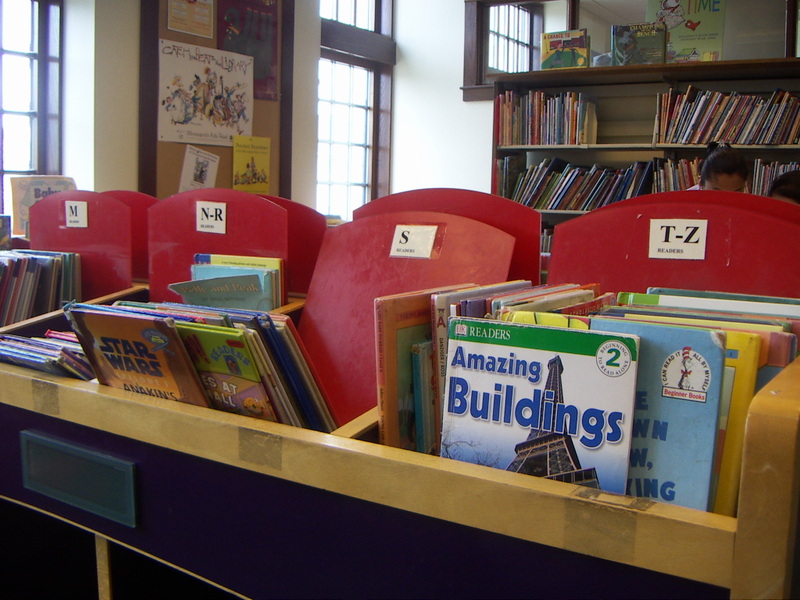
    Part 6 in my series about developing a library curriculum.

    I divided the skills I want to teach into eleven (really twelve) lessons.

    1. Rules: How to behave in the library.  How to treat library materials. What happens in the library? Who works in the library?

    2. Begin alphabetization. Parts of a library book. How to sign a library card. Get a library card.

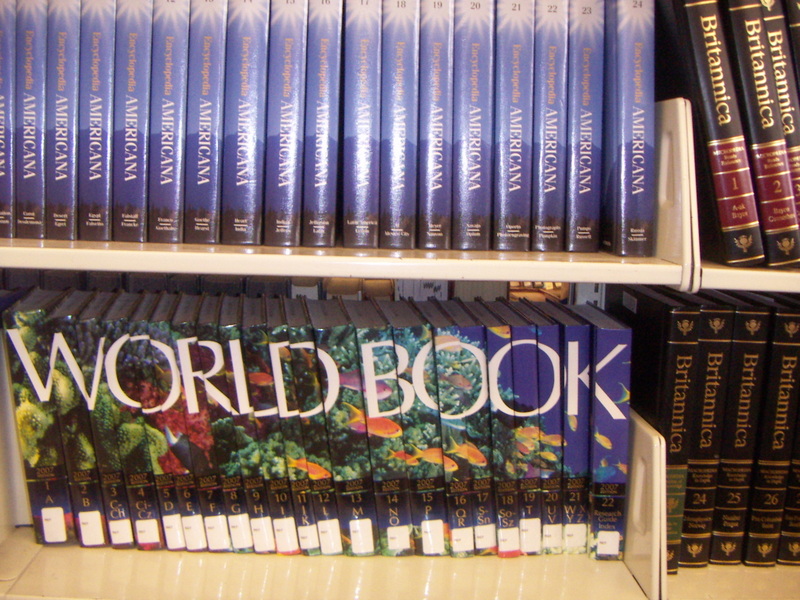
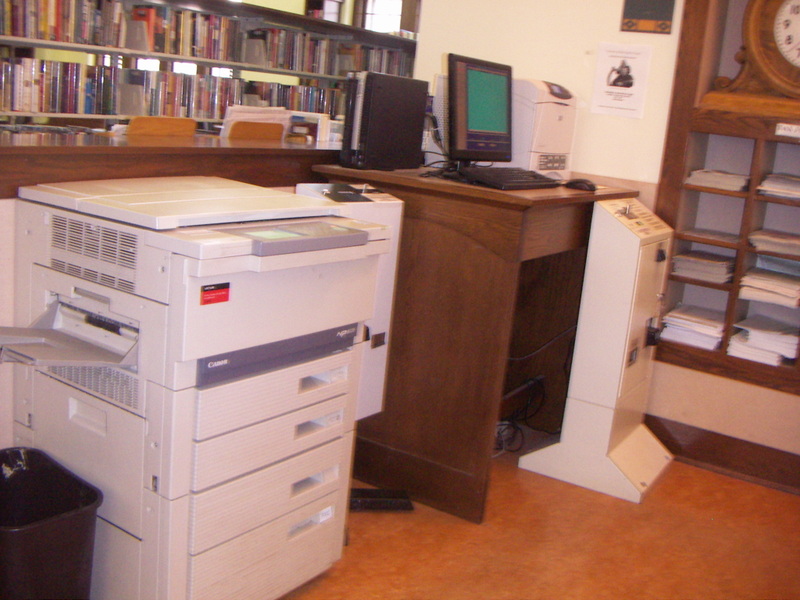
    3. Continue alphabetization. What is a reference book? Where is the reference section? How to choose the right volume of the World Book encyclopedia. How to use the copier.

    4. Practice getting a copy of an encyclopedia article independently. (Repeat as necessary)

    5. Introduction to subject-title-author. How to find the subject -title -author of a book. Books at the library are arranged all three ways. Why author’s last name is used. Find a book whose author begins with a letter. Whose title begins with a letter. Show that this doesn’t work with subjects!

    6a. Library of Congress cataloguing system. Choose a subject and go to the library and find a book. Checking out at the desk.

    6b. Dewey Decimal system. Choose a subject and go to the library and find a book. Checking out at the desk.

    (Both are going to be included because the Minneapolis City Library system uses the LC system and the Hennepin County library system uses the DD system.   They’re thinking of merging if they can figure out how to make employee pay scales match.  Wonder how much it will cost to re-label all the books.)

    7. Returning books to the desk. Finding a fiction book by author. Asking librarian for help. Checking out with the self-checkout.

    8. Introduction to catalogs. How to find fiction book by subject or title? Nonfiction book by title or author? Make a card catalog. Visit a card catalog. Introduction to concept of call number.

    9.    How to use the electronic catalog. Electronic search by Author.

    10. Electronic search by Title

    11.   And by Subject.


  • Library skills links.

    Part 5 in a series about developing library-skills curriculum for second graders. 

    I collect some links with more information:

    That should be enough to get me started.  Here are the books I checked out today:


  • Liveblogging curriculum development: Skills list.

    Part 4 in a series in which I develop a second-grade library skills curriculum. 

    I look over the scrawled list of skills that Hannah and I came up with.  What I really want is for my older child to learn how to find stuff in the library without my help, because I’m busy managing the younger ones.  On a fresh page I write: 

    Main goal:  Child is able to locate fiction & nonfiction books & reference entries on a subject of interest, independently or with the help of library staff, while following library rules.

    Yes, that’s about right.

    On a new page I make a list and label it SKILLS.

    1.  Child will know proper way to behave in a library and how to care for library materials.

    I’ll have to distill this down to essentials:  what always needs reinforcement (don’t run; don’t yell; don’t eat or drink around books) and what they wouldn’t know unless I told them (wait patiently in line to see the librarian; don’t try to put books back where you found them, but leave them out for the staff to put away).

    2.  Child will identify library staff.  Child will know how to approach staff and ask for help finding things.

    An important skill in general, but especially here in the library. 

    3.  Given a subject of choice, child will know how to find the encyclopedia and select the correct volume, then to ask library staff for help finding the right page.

    Selecting the correct volume only requires first-letter alphabetization skills.

    4.  Child will know where to find a dictionary and an atlas and will understand what they are for.

    Might as well, since they’re in the same section as the encyclopedia.

    5.  Child will know the meanings of signs that say "fiction," "nonfiction," "reference," "juvenile," "reference desk," "checkout/returns," "copier," "telephone," "restrooms."

    6.  Child will know what is meant by "author," "title," "subject," and "keyword."

    I remember when keywords didn’t even exist.  But all four are necessary to use the catalog.

    7.  Child will find the shelf containing the juvenile nonfiction books on a subject of choice, by browsing or asking staff for help.

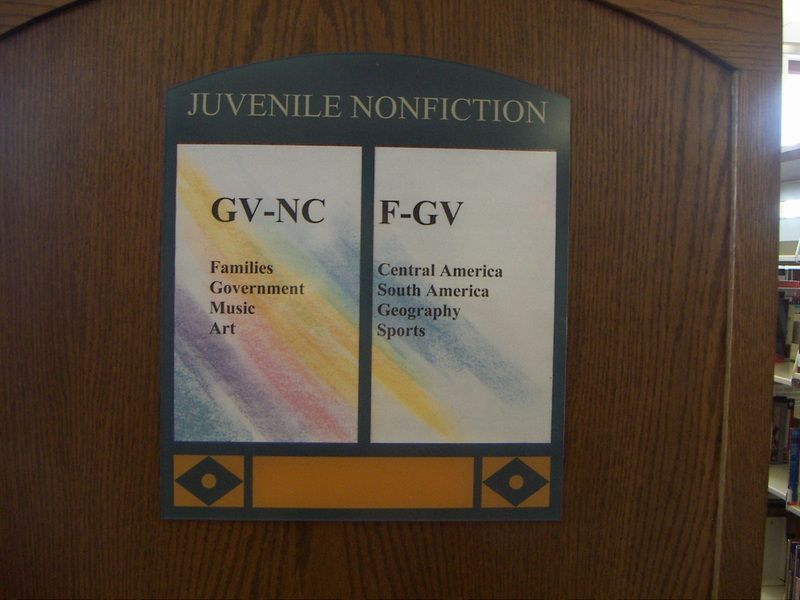
    Maybe I’ll create a reference card, a little cheat sheet, that will help him navigate the cataloguing system.  Maybe one already exists.  Google it?  Didn’t find one, but ooh, here’s a history of the Dewey Decimal System and Library of Congress system, with a comparison of the two.

    8.  Child will find fiction books by an author of choice, by browsing the shelves or by asking staff for help.

    Asking for help has to be part of this strategy for fiction until alphabetization is completely learned.

    9.  Child will know how to use the library copier.

    This is important for taking home reference information — we won’t usually have time to wait for a seven-year-old to puzzle out the encyclopedia entry on jellyfish.

    10.  Child will know how to use the online library catalog with adult supervision.

    There is one library area that I am not eager to push for independence with, and that is the computer system.  I want the child to be able to hit all the keystrokes and navigate, but I’ll be right there to help.  Besides, we’ll mostly use that from home. 

    11.  Child will use his own library card to check out books and will know when to return them on time.

    Just as soon as I learn how to return library books on time!  BWAHAHA.


  • Library skills curriculum – what do we want?

    Part 3 in a series liveblogging curriculum development.  (Part 1 – Introduction.  Part 2 – a visit to the neighborhood branch library.)

    Over a cup of tea, each of us nursing a little one, I told Hannah I was planning on developing a library-skills curriculum for second grade.  "Do you want me to develop it for Ben too?"  (Her son Ben is in the same grade as Oscar.)  It sounds like a good idea.  I write down the name of the library branch that her family uses, so I can tailor the curriculum for their library too, and I keep my notebook and pencil out while we think out loud of what the children need to learn.  We come up with a scrawled list:

    • Library rules.
    • Asking librarian for help — approaching and identifying library staff.
    • Where ref materials are
    • how to find on shelves – children F, children NF, picture books
    • author title subject keyword
    • basic – computer catalog

    At this point we pause and reminisce about card catalogs:  the brass pulls polished by many hands, the clunk  of the drawers sliding open, the feel of placing your palm on the aligned edges of many cards and turning hundreds of cards at once, the faded typewritten ink:  Subject — Libraries — Library science. Hannah tells me that her church has a library, a small collection, that still uses one — only one drawer, but a real card catalog nonetheless.   "Really?  Maybe we can take a field trip to see it!"  She agrees that this could be fun.  Maybe we could develop a card catalog for a child’s bookshelf even, as a project…

    I pick up my pencil again.  "What about alphabetization?" I ask.

    Hannah considers carefully and finally says, "I don’t think that this ought to rely on the child’s knowing how to alphabetize words.  It’s a pretty complicated skill." 

    "But maybe if they were at least able to alphabetize to the first letter of a word.  So they can at least find the right volume of the encyclopedia." 

    This seems right, so we continue:

    • Alphabet – "beginning letter"
    • The Code – library of congress or dewey
    • Library layout
    • The system of checkouts, returns, holds, etc.
    • Field trip to big central library

    I’ll compile this into a list of goals when I have a chance.