bearing blog


bear – ing n 1  the manner in which one comports oneself;  2  the act, power, or time of bringing forth offspring or fruit; 3 a machine part in which another part turns [a journal ~];  pl comprehension of one’s position, environment, or situation;   5  the act of moving while supporting the weight of something [the ~ of the cross].


  • Maybe I’ll get over this when I’ve got more school-age children and less time.

    I have this problem:  When the available curricula (at least for subjects I care about) are flawed, I start designing my own curricula from scratch.  This sucks up time that I might otherwise put to productive use, say, washing the dried food off the baby’s high chair.

    Secretly, I like designing curriculum.  I think it is because I love office supplies.  And making lists.  And endlessly plan and organize.  AND I LIKE DOING THINGS MY WAY.  Mostly I want to get the stupid out of some of the curricula I buy.  Sometimes it’s good except for one thing that has to be changed or it’ll drive me crazy.

    Take "Spelling Power."  (If you’ve not heard of it, you’ll just have to bear with me.)  Spelling Power has a lot going for it.  It’s cheap:  buy one book and that’s all you need.  It’s quick:  ten or fifteen minutes to a day’s spelling work.  It’s got a great algorithm:  pre-test a group of words; study only the misspelled words;  then the next day re-test those words, plus any words misspelled in the course of other writing, and pre-test a new batch.  Nice.  And it provides all the word lists you’ll need, arranged according to levels.

    Except that I hate the word lists.  Some of them are matched with "spelling rules" that don’t fit them.  For example, here’s one comment attached to a group of words:  "The addition of a prefix does not usually change the spelling of the root word.  The prefix de can mean down or from."  The word list that follows contains 30 words — and only one of them is a word with the prefix de- attached to a root word in order to alter its meaning!  That word is "dehydrate."  (And even there, the "de-" connotes an undoing or an opposite, rather than "down" or "from.")  The rest of the words do all start with the two-letter combination "de", which etymologically indicates "down"-ness or "from"-ness in many cases, but they aren’t examples of a prefix added to a root word:

    describes (related to scribes, but not in that way),

    deposits (posits from?),

    delight (anything to do with light?),

    despite (spite?)

    demand (and "mand" means what in English?)

    delivered (maybe, if you’re explaining what happened to the organ donor!)

    … and it goes on through debate, detective, devoted, defeat, decrease, deceit, decorator, debris, deprive, destructive, delinquent, demographic (which isn’t even remotely related since it comes from Greek demos!)… and even more.

    So — I’m gonna make my own spelling lists.  This is a good starting point, but I can do better.


  • Dietary stuff.

    We were discussing Weston A. Price foundation came up over at HMS blog, and that inspired me to write a post about how our family jumped off the low-fat/low-saturated-fat wagon, at least for me and the children.   Mark is sticking with low-saturated-fat, fairly-low-calorie stuff for now, because it seems to work pretty well for him — fully-grown, non-lactating person that he is.

    We made and are still making changes incrementally, starting with the changes that are easiest and most bang-for-the-buck.  I forget where I heard this excellent rule of thumb:  If budget forces you to improve only part of your diet for now, start improving at the top of the food chain:  dairy, eggs, and animal fats first; then pork, beef, chicken in that order; then fish; last, produce.   The best new book on this is maybe Nina Planck’s very readable and appetizing Real Food, though Sally Fallon’s Nourishing Traditions is also full of good advice (even if studded with some perplexing, unsupported assertions in the sidebars and with seriously flawed advice about bottle-feeding) and the "great book with the dumb name" Eat Fat, Lose Fat has helped me a lot.  (My friends and I agree that it should be called The Coconut Book.)

    What changes have we made and what haven’t we made (yet?) 

    1. Decreased sugar and cut out nearly all trans fats – how we did that is worth a whole ‘nother post!
    2. Switched to 100% whole wheat bread and whole grains, and traded cold cereal for old-fashioned oatmeal.
    3. I started seriously eating low-carb and started using as much eggs, meat, butter, and cold-press olive oil as I wanted.
    4. Stopped regularly serving starchy food at dinner, instead doing double vegetables
    5. This Yankee learned to cook collards, turnip greens, and mustard greens, because I don’t like broccoli
    6. Switched from skim milk to whole milk and started eating even more eggs
    7. Started buying milk, eggs, and some cheese directly from a local farm that pastures hormone-free, antibiotic-free cattle and raises free-range chickens, and my butter via the co-op from another local grass-feeding dairy
    8. Started making homemade broth, keeping canned around for "emergencies"
    9. Started presoaking most grains I do cook
    10. Developed weekly breakfast schedule: Mon oatmeal, Tues eggs, Wed whole grain pancakes, Thurs eggs, Friday oatmeal — though I eat eggs every day!
    11. Started supplementing with cod liver oil and flax oil
    12. Replaced some of the olive oil with high-quality butter, unrefined coconut oil, and un-toasted sesame oil
    13. JUST LAST WEEK I put in my very first order for a locally-grass-fed, locally-butchered, hormone-free, antibiotic-free quarter-beef.

    What don’t I do (yet)?  I don’t eschew cold cereal completely anymore, now that there’s more whole-grain, low-sugar choices out there (We still limit it and I don’t touch it myself).  The yogurt I buy isn’t from grass-fed cows, ’cause I like the flavor of a particular store-brand.  I don’t bake my own bread, except pizza dough.  I don’t grind my own flour for my pancakes, waffles, and pizza.  I usually forget to soak and dehydrate nuts, but try to when I remember ’cause they’re so tasty that way.  I don’t presoak oatmeal in acidulated water because dh hates the way it tastes.  We plan to start buying high-quality pork and chicken this year, but haven’t yet.  I don’t bother with "organic unrefined evaporated cane juice" — we just try to add less sugar to our food.  And most of the vegetables and fruit I buy aren’t organic, unless I’m attracted to the organic stuff by its freshness and beauty.  I would like to do many of these things, but haven’t gotten around to making the changes yet.


  • How you know I’m on your team.

    After a disastrous haircut at a Great Clips last year (I said "undercut," the stylist heard "layer it"), I swore off discount haircutting places for good, and started going to an unpretentious, urban, hipster-decor’ed little salon (moderately priced but a real salon! they hand me a cup of coffee when I walk in the door!  what luxury!) about a mile south of here.  I tend to make appointments at the last minute, so I get whichever stylist is around.

    "Christine" was my most recent stylist.   We chatted a bit about odds and ends in the neighborhood, since the salon had recently moved to a new building.  I told her about my Great Clips experience.  She told me she once worked at the Great Clips near the University of Minnesota campus.  I know the one, I’ve been there a few times.

    That work bored her, she said, because "all the young guys there want the same haircut.  You do the same thing, short on the sides, texture on top, and ‘put some stuff in it,’ all day long. Frat boys."  She chuckled and then added, "And then they come in right before they leave for basic training and are scared to death.  ‘Make it regulation!  But don’t make it too short on top!  I want some texture in it!  Put some stuff in it!’"  I asked her if she secretly enjoyed shaving the ‘frat boys’ heads, and she just laughed.  "I’d be careful not to show it.  You’ve got to stay professional."

    Then she went on: "Sometimes, you won’t believe the kinds of people who come in.  Do you know, once when I was working there — I still can’t believe it, of all people, who wound up in my chair?  A staffer for Norm Coleman.  I couldn’t believe it.  Of all the people to wind up in my chair."  (Norm Coleman is the Republican Senator from Minnesota. ) I raised my eyebrows. 

    She went on:  "I just couldn’t believe it.  A staffer for Norm Coleman!  And I had to cut his hair!  The whole time I was just" — here she pantomimed stabbing me in the head with the scissors — "but I kept my cool.   I just kept thinking, I can’t believe of all the people who could wind up in MY chair, it was that guy."

    "Did you guys talk politics?"

    "No, not at all, I didn’t say anything and he didn’t say anything. I just couldn’t believe it."

    "I suppose Republicans need haircuts too," I offered.

    "Yeah, but do they have to get them from me?"  She laughed.  "I totally would not have expected a Coleman staffer to be at that Great Clips.  I mean, it’s right next to an educational institution.  I wouldn’t expect a Coleman guy to be anywhere near there."

    "Hmm," I said.  She was really giving me a very nice haircut.  After a minute I said, "So, you were able to keep your mouth shut, then."

    She nodded and looked suddenly serious.  "Yes.  It was hard, but I did it.  It was a real test of my professionalism."  At that point her rant seemed to be over.  She finished the haircut, the best one I’ve had in years, I tipped her pretty well, and I left, chuckling a little bit about the conversation, which had been one of the most entertaining haircut conversations I’d ever had.  I might ask for her again just to see what I can get her to say.

    I actually haven’t paid a ton of attention to Senator Coleman. I did vote for him.  I can’t think of anything specific about him that even a super-liberal person might find unbelievably horrible,  to the point that she would brag to a stranger that she’d managed to restrain herself from stabbing one of his employees in the head.   Other than generally being, you know, the Republican.  Maybe she was a grieving Wellstone supporter?

    But what I kept wondering was, what was it about me that made her think I was on her team?   Everything she said, the way she said it, indicated that she was sure she was talking to someone like-minded.  Someone who would find it equally amazing that a professional Republican would darken the borders of the University campus, let alone sit in her chair.  How did she know I wouldn’t get offended?  How was she so sure I wouldn’t turn out to be a super-conservative?   I hadn’t brought up politics and had even told her I was a homeschooling mom with three children, a demographic that skews rather more conservative than average.  Was the clientele here reliably liberal, maybe?  Still, you’d think that she would realize that anyone might walk in (although given the "educational institution" comment, maybe not). What was it about me? 

    After a while I remembered that while I was chit-chatting in the shampoo chair (actually it was a shampoo bed.  Did you know such things exist?  Mmmm.)  I mentioned that I was in the mood for a really good salad, so after the haircut I was planning to stop at the local co-op to buy lettuce.   

    Organic lettuce.

    That had to have been it.  I was on her team because I shop at the co-op.   Hey, I don’t just shop there, I’m a card carrying member!  It’s nice to know that after about 12 years of voting pro-life, pro-self-defense, and somewhat-small-government, when I can get it, my liberal cred is intact because I eat organic lettuce.  I laughed for days.

    Next time I get my haircut I won’t just take whoever’s available.  I am definitely going to ask for Christine by name.


  • Library skills lesson list.

    Part 6 in my series about developing a library curriculum.

    I divided the skills I want to teach into eleven (really twelve) lessons.

    1. Rules: How to behave in the library.  How to treat library materials. What happens in the library? Who works in the library?

    2. Begin alphabetization. Parts of a library book. How to sign a library card. Get a library card.

    3. Continue alphabetization. What is a reference book? Where is the reference section? How to choose the right volume of the World Book encyclopedia. How to use the copier.

    4. Practice getting a copy of an encyclopedia article independently. (Repeat as necessary)

    5. Introduction to subject-title-author. How to find the subject -title -author of a book. Books at the library are arranged all three ways. Why author’s last name is used. Find a book whose author begins with a letter. Whose title begins with a letter. Show that this doesn’t work with subjects!

    6a. Library of Congress cataloguing system. Choose a subject and go to the library and find a book. Checking out at the desk.

    6b. Dewey Decimal system. Choose a subject and go to the library and find a book. Checking out at the desk.

    (Both are going to be included because the Minneapolis City Library system uses the LC system and the Hennepin County library system uses the DD system.   They’re thinking of merging if they can figure out how to make employee pay scales match.  Wonder how much it will cost to re-label all the books.)

    7. Returning books to the desk. Finding a fiction book by author. Asking librarian for help. Checking out with the self-checkout.

    8. Introduction to catalogs. How to find fiction book by subject or title? Nonfiction book by title or author? Make a card catalog. Visit a card catalog. Introduction to concept of call number.

    9.    How to use the electronic catalog. Electronic search by Author.

    10. Electronic search by Title

    11.   And by Subject.


  • Library skills links.

    Part 5 in a series about developing library-skills curriculum for second graders. 

    I collect some links with more information:

    That should be enough to get me started.  Here are the books I checked out today:


  • Liveblogging curriculum development: Skills list.

    Part 4 in a series in which I develop a second-grade library skills curriculum. 

    I look over the scrawled list of skills that Hannah and I came up with.  What I really want is for my older child to learn how to find stuff in the library without my help, because I’m busy managing the younger ones.  On a fresh page I write: 

    Main goal:  Child is able to locate fiction & nonfiction books & reference entries on a subject of interest, independently or with the help of library staff, while following library rules.

    Yes, that’s about right.

    On a new page I make a list and label it SKILLS.

    1.  Child will know proper way to behave in a library and how to care for library materials.

    I’ll have to distill this down to essentials:  what always needs reinforcement (don’t run; don’t yell; don’t eat or drink around books) and what they wouldn’t know unless I told them (wait patiently in line to see the librarian; don’t try to put books back where you found them, but leave them out for the staff to put away).

    2.  Child will identify library staff.  Child will know how to approach staff and ask for help finding things.

    An important skill in general, but especially here in the library. 

    3.  Given a subject of choice, child will know how to find the encyclopedia and select the correct volume, then to ask library staff for help finding the right page.

    Selecting the correct volume only requires first-letter alphabetization skills.

    4.  Child will know where to find a dictionary and an atlas and will understand what they are for.

    Might as well, since they’re in the same section as the encyclopedia.

    5.  Child will know the meanings of signs that say "fiction," "nonfiction," "reference," "juvenile," "reference desk," "checkout/returns," "copier," "telephone," "restrooms."

    6.  Child will know what is meant by "author," "title," "subject," and "keyword."

    I remember when keywords didn’t even exist.  But all four are necessary to use the catalog.

    7.  Child will find the shelf containing the juvenile nonfiction books on a subject of choice, by browsing or asking staff for help.

    Maybe I’ll create a reference card, a little cheat sheet, that will help him navigate the cataloguing system.  Maybe one already exists.  Google it?  Didn’t find one, but ooh, here’s a history of the Dewey Decimal System and Library of Congress system, with a comparison of the two.

    8.  Child will find fiction books by an author of choice, by browsing the shelves or by asking staff for help.

    Asking for help has to be part of this strategy for fiction until alphabetization is completely learned.

    9.  Child will know how to use the library copier.

    This is important for taking home reference information — we won’t usually have time to wait for a seven-year-old to puzzle out the encyclopedia entry on jellyfish.

    10.  Child will know how to use the online library catalog with adult supervision.

    There is one library area that I am not eager to push for independence with, and that is the computer system.  I want the child to be able to hit all the keystrokes and navigate, but I’ll be right there to help.  Besides, we’ll mostly use that from home. 

    11.  Child will use his own library card to check out books and will know when to return them on time.

    Just as soon as I learn how to return library books on time!  BWAHAHA.


  • Library skills curriculum – what do we want?

    Part 3 in a series liveblogging curriculum development.  (Part 1 – Introduction.  Part 2 – a visit to the neighborhood branch library.)

    Over a cup of tea, each of us nursing a little one, I told Hannah I was planning on developing a library-skills curriculum for second grade.  "Do you want me to develop it for Ben too?"  (Her son Ben is in the same grade as Oscar.)  It sounds like a good idea.  I write down the name of the library branch that her family uses, so I can tailor the curriculum for their library too, and I keep my notebook and pencil out while we think out loud of what the children need to learn.  We come up with a scrawled list:

    • Library rules.
    • Asking librarian for help — approaching and identifying library staff.
    • Where ref materials are
    • how to find on shelves – children F, children NF, picture books
    • author title subject keyword
    • basic – computer catalog

    At this point we pause and reminisce about card catalogs:  the brass pulls polished by many hands, the clunk  of the drawers sliding open, the feel of placing your palm on the aligned edges of many cards and turning hundreds of cards at once, the faded typewritten ink:  Subject — Libraries — Library science. Hannah tells me that her church has a library, a small collection, that still uses one — only one drawer, but a real card catalog nonetheless.   "Really?  Maybe we can take a field trip to see it!"  She agrees that this could be fun.  Maybe we could develop a card catalog for a child’s bookshelf even, as a project…

    I pick up my pencil again.  "What about alphabetization?" I ask.

    Hannah considers carefully and finally says, "I don’t think that this ought to rely on the child’s knowing how to alphabetize words.  It’s a pretty complicated skill." 

    "But maybe if they were at least able to alphabetize to the first letter of a word.  So they can at least find the right volume of the encyclopedia." 

    This seems right, so we continue:

    • Alphabet – "beginning letter"
    • The Code – library of congress or dewey
    • Library layout
    • The system of checkouts, returns, holds, etc.
    • Field trip to big central library

    I’ll compile this into a list of goals when I have a chance.


  • Library trip.

    Part 2 in a series:  I develop a library-skills curriculum for second grade. (Part 1)

    I went to my neighborhood branch library this afternoon while Mark watched the kids, armed with a notebook and a camera.  After returning some books and paying my six-dollar fine, I walked around and took notes about the layout, since that is the library I will teach my son to use.

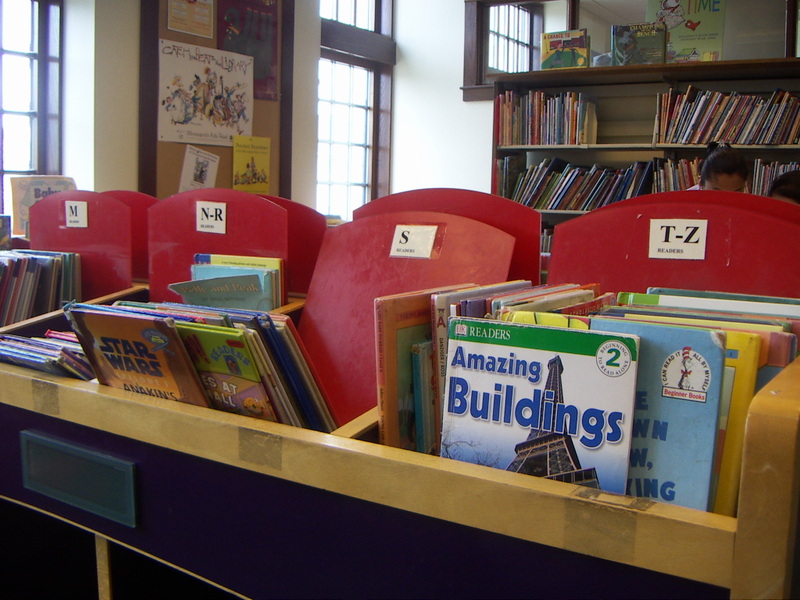
    There is a children’s room, suitable mostly for reading to little ones.   Library_024 Shown here are some picture books and readers in bins, alphabetized by title.  On the shelves are more picture books alphabetized by author.

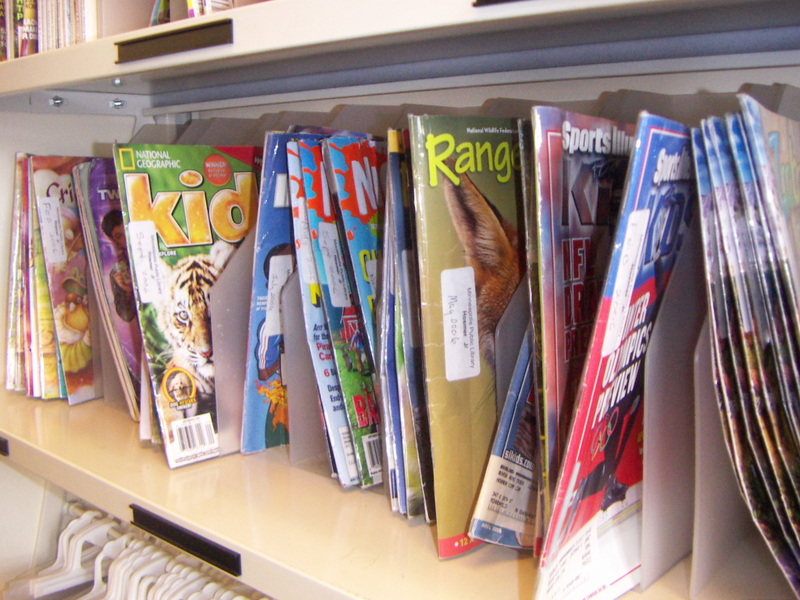
    Videos and audiobooks are kept there, as well as a collection of children’s periodicals.Library_025

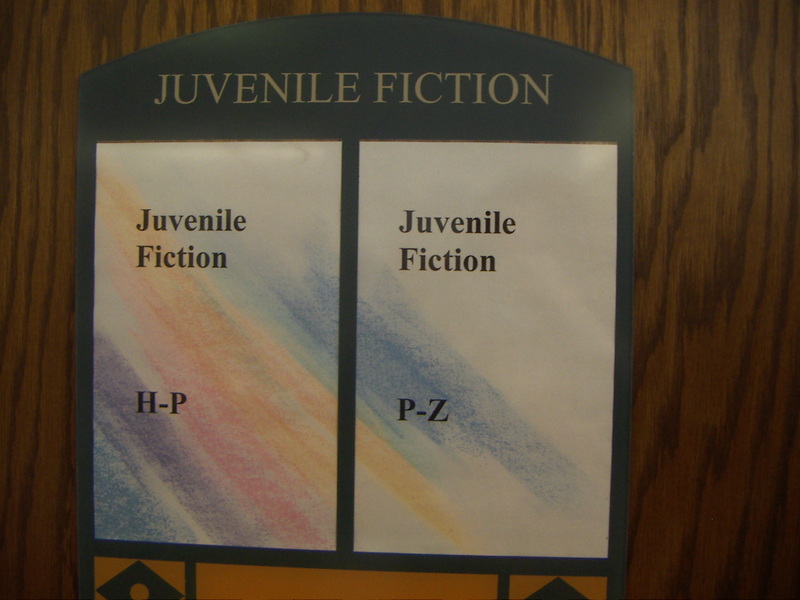
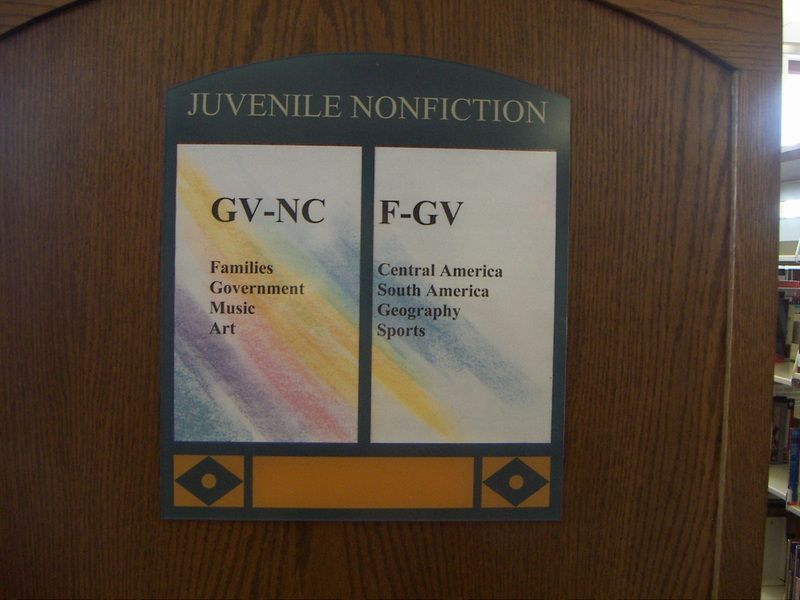
    Outside this little room are the juvenile stacks.  The fiction is alphabetized by author and the nonfiction is arranged according to the Library of Congress system, which pleases me.  I spent seven years in a library that contained almost nothing but Q-QC and TA.

    Library_027 Library_026_2 Mental note:  must find info on the rest of the LC system.   GV?  NC?  What’s that?

    Juvenile reference is a single shelf at the beginning of juvenile nonfiction.  I write down some titles we might find useful:  Lands and Peoples — social studies encyclopedia.  Children’s atlas.  Ox. Comp. Child. Lit.  Science encyclopedia — 2 of them.  Encyclopedia of Life ScienceInt’l Wildlife Encyclopedia.  Wildlife and Plants. 

    Where’s the kids’ regular encyclopedia?  I find it in the main reference section with the Encyclopedias Brittanica and Americana.  Also dictionaries and phone books and other atlases.Library_022  It’s the 2007 World Book.

    What else might we need to know?  There are three library desks:  checkout/returns, reference desk, and children’s librarian.  The children’s librarian is not there, but the other desks are staffed. 

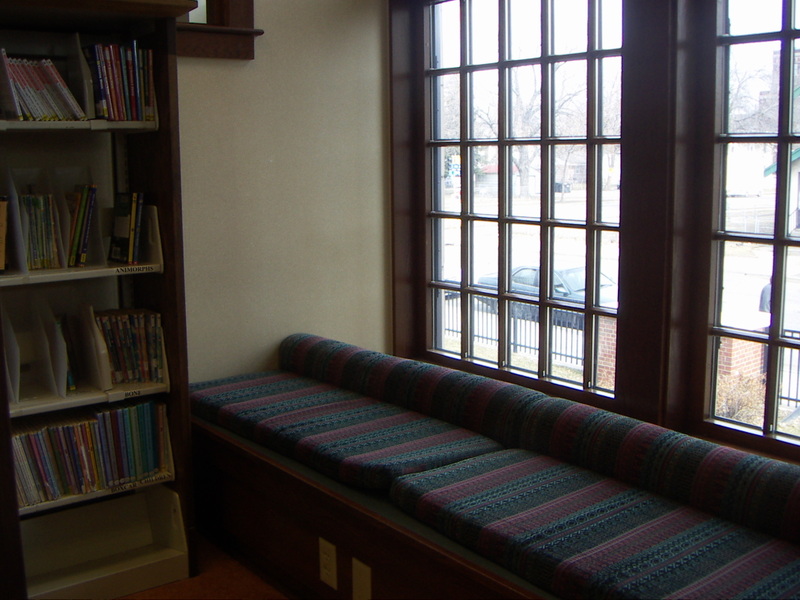
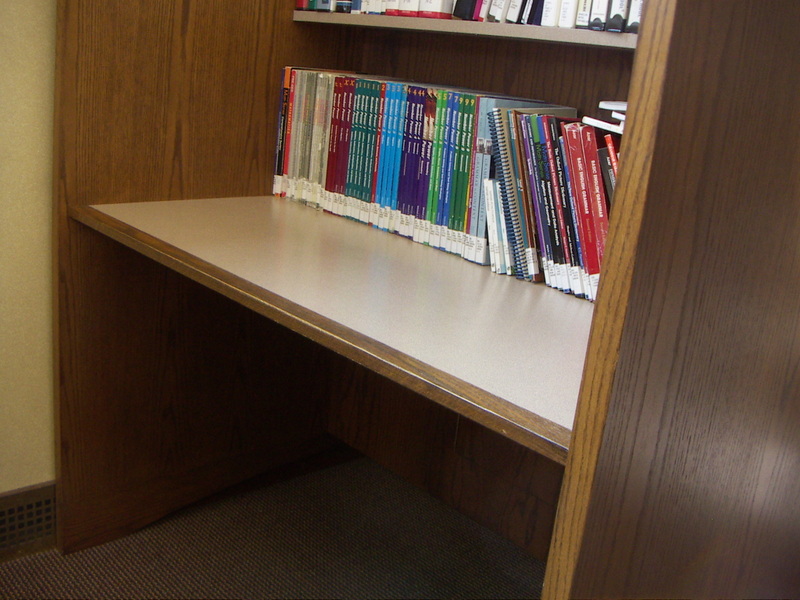
    There are a few comfortable places to read and also study desks:Library_023 Library_028

    There are, of course, computers for using the library catalog and web browsing.  One thing I like about our neighborhood library is that there are not any children’s computers at brightly colored tables with a bunch of games pre-loaded onto them.  What computers there are for web browsing are always packed with teenagers.  I suspect that this is due to low funding and I hope and pray that nobody comes through with funding earmarked for preschoolers’ computer games. 

    I sit down at one of the terminals and do a catalog search for juvenile nonfiction about libraries.  I click on one entry, which isn’t actually at this branch, read the call number, and walk over to the corresponding shelf in JUV NF.  I choose a handful of books to take home, maybe to incorporate into my curriculum, and run them under the express checkout scanner.

    Posted next to the scanner are the library rules.  I make some notes:  no loud speaking, no playing audio, no running, fighting, noise, games downloading, annoying people, eating, drinking is ok if cup is covered, no loitering, don’t break the law. 

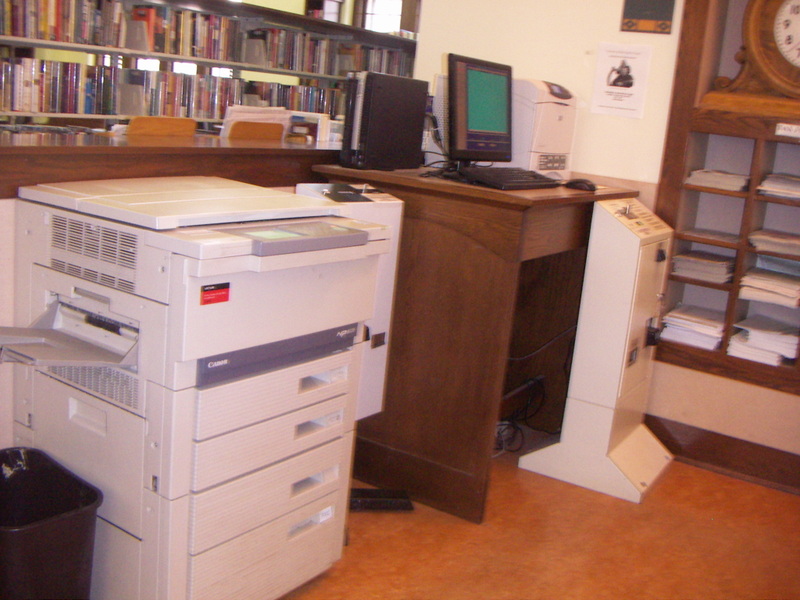
    I wander around some more.  Today’s newspapers are in the adult fiction section.  There’s a copier there too.  It accepts coins, which is good for children.  I forgot to Library_029 see how much it charges per copy.  Under the clock are shelves of tax forms.

    I can’t really take any more pictures unless I start asking people for permission — the library’s pretty crowded.  But my hour’s almost up, and my baby’s at home, so I put my books in my bag and head out to the car.  That should be enough information to get started.


  • Liveblogging curriculum development.

    I use packaged curricula and other people’s lists for a pretty big chunk of my homeschooling, but sometimes I like to design it myself when I can’t find exactly what I want.  (Maybe that’ll stop when I have more children and less time!)  Since they’re for my own use I don’t have to polish them, just sort of hammer it together the way I want and tweak as I go along.   I designed my own reading curriculum for Oscar, for example, based on the ideas of a curriculum developer that I happen to know personally but whose own phonics program wasn’t ready to use yet, and it worked fabulously for us.   I designed a biography-based combination religion and social studies program for first grade that we’re halfway through, now, and that one was really quick ‘n’ dirty and there are things I will do differently with my next first-grader, but it still met my needs well.

    I’m just about to design a sort of half-unit-study, half-curriculum for second grade library skills, and I’m going to blog it.  I’m starting by going to the local library, five blocks away.  See you there!


  • Changing style as the family grows.

    Hannah and I were discussing the other day how our parenting style, philosophy, strategy, and tactics changed when we went from one child to two to three. I don’t mean that experience teaches you the right way to do it — I mean that some choices seem reasonable when there’s only one, not so great when there are several children.

    I home-pre-schooled my first toddler "Montessori" style:  I set up low shelves of ready-laid-out work trays and allowed him to choose his work freely whenever he wished.  Worked great until the second baby learned to crawl.  Nowadays I keep all the school and art supplies inside two tall metal cabinets with padlocks on the door.  Not very Montessori anymore.

    Hannah used to lift her first toddler up onto the kitchen counter (she stayed near and taught him well how to keep safe near the edge) where he could easily help out with cooking and other projects.  Worked great for a while, but that practice had to end when three children all wanted to be up there at once.

    Another friend didn’t mind interrupting errands to retrieve a forgotten doll for her first little girl. If it was MY forgotten thing, I’d go back for it — why not do the same for her?  But when the car held a new baby who needed to nurse NOW, extra driving to get a doll suddenly made no sense.

    We parents who want to treat our children as real human beings with real needs give and give and give to the little one, and we get used to considering her needs and her wants as equal to our own.  I remember well that I used to think that I ought to respond to a request from my child the same way that I ought to respond to a similar request from my husband.  I still think that, but today I understand that requests don’t come one at a time, and no matter who’s asking, I have to prioritize.

    We are adults and able to give quite a lot, able to defer our own satisfaction until naptime!  We can be so selfless:  we believe we should never put off meeting a child’s needs, and that we should generously help her to get what they want when it’s reasonable.   And so many requests are "reasonable!"  And then when another one comes along we find out — sometimes they both need something "reasonable" at the same time, and despite our best efforts one of them is going to have to wait.  That sometimes in a family needs and wants have to balance as best they can.  And everybody learns something.  And we all grow a little.

    What’s the answer for parents of a single child? Maybe it’s to be a little "selfish," selectively so, once in a while.  But I know from experience (back when I had only one) that it’s hard to do that in a way that feels natural and right, not capricious and — well — unreasonable.


  • RIP Cathy Seipp.

    One of my favorite bloggers passed away today:  Cathy Seipp

    Ms. Seipp fought the same type of lung cancer that killed my mother.  They were diagnosed around the same time, it turns out, at the same stage; my mother had already succumbed to her cancer by the time Ms. Seipp started writing openly about her disease. 

    My mother, unlike Ms. Seipp, was a smoker; but I learned during her illness that half of all cases of that type occur in nonsmokers, and so no one could say that her tobacco use caused the disease.  I shared Ms. Seipp’s frustration with the stigma of lung cancer and the comparative publicity that, say, breast cancer gets.   This post from 2005 says it well.

    I didn’t read Cathy’s World every day, but would check in from time to time to catch up on her and see how she was doing.  For some reason I never put her on my blogroll or bookmarks list — I always clicked through from the VC link.  Never met, exchanged email, or even commented that I remember.  But especially after she started to write about her health, maybe because of my mother’s illness, I wanted to check in with her.  And always enjoyed her trenchant writing.

    I’m proud to say I never wondered “Why me?” Because that’s philosophically incoherent. But I do have a list of people that I consider every now and then, thinking: Why not you instead?

    She tended to go a few days between posts, so checking about every week seemed right.

    For months after my mom passed away, I would suddenly think that I needed to give  her a call, and then a beat would pass before remembering — oh — can’t do that.  I keep expecting at the back of my mind that if I click through to Cathy’s World, after a few days have gone by, there’ll be  a new post from Cathy, letting us know how the funeral thing went, how she’s adjusting to the afterlife.  It’ll fade, but it’s strange nonetheless.

    If you never read her, it’s not too late — her stuff is all still there.  Daughter Maia has been posting updates for a few days.  Spare them a thought and a prayer if you can.