bear – ingn 1 the manner in which one comports oneself; 2 the act, power, or time of bringing forth offspring or fruit; 3 a machine part in which another part turns [a journal ~]; 4 pl comprehension of one’s position, environment, or situation; 5 the act of moving while supporting the weight of something [the ~ of the cross].
You know how when you have that one room in your house that’s a huge mess? And it embarrasses you so you keep the door closed? And you don’t even want to think about where to start so you never go in there to try to get it organized? Even though you know that if you just did a little bit of work every day, it would eventually become more and more manageable?
That’s about where I was with my blog’s “Categories” list over at The Old Place.
Too many categories, lots of overlap, no hierarchy (everything top level).
There are also a couple of (mental) categories that I think I might like to purge, or at least, seriously edit the posts in them, or put a massive disclaimer on them or something. But because the categories are so poorly organized, that project is harder than it needs to be.
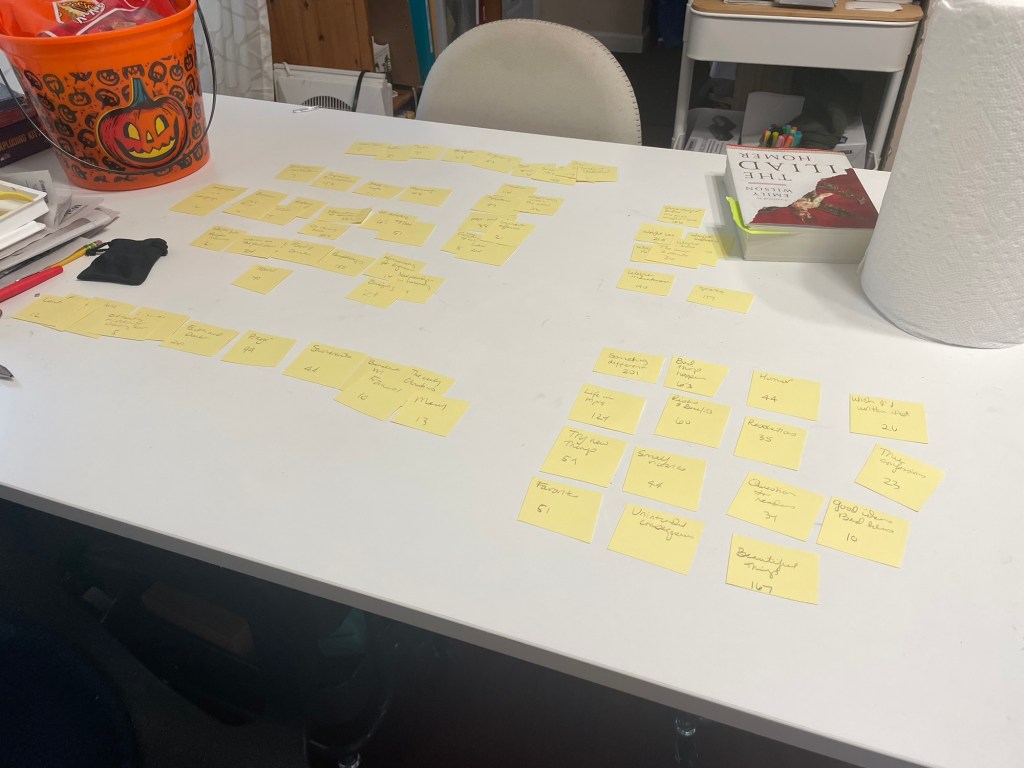
So. Recently I wrote down all my existing categories on little slips of paper. There are about 100. And I rearranged them and grouped them.
And now, a bit at a time, I’m figuring out what the new categories need to be. So, for example, today I picked up three little cards I had grouped together. I created a new temporary parent category for them. And I’m going through the posts in that group and reassigning them, mostly to one new category, a few to a different one.
As I create categories that actually work, I might be able to add them one at a time to the right sidebar. I hope so. I’ll try it soon.
Anyway, that’s just a little update. Back to more regular blogging soon.
EDITED TO ADD: I put a Categories menu with a single “sampler” category in the right sidebar (bottom, in a menu). Try it out!
A peculiar thing happens to me from time to time; sometimes for no reason at all, and sometimes very clearly because I am two cups into my morning coffee and the caffeine has just kicked in.
I get a sudden rush and a sense of the wide possibilities open to me in the day. A sudden feeling that I could tackle any task I wanted to, and all I have to do is find a place to sit down and get started on it.
(You see why I associate it with coffee.)
But today it didn’t come from my morning coffee; I was driving home midafternoon from an orthopedics appointment for Leo, an appointment that was over quickly and left us with a little extra time in our day. The sky over the highway was an amazing clear blue, and as I was admiring the sky, I felt that caffeinated rush of the possibilities that still remained.
Like this photo I took when I got home, but maybe with a few puffy white clouds.
Generally when I get that rush (especially in the morning, when it shows up on schedule at the bottom of the second cup of coffee) I move immediately to using it. That’s when I grab my notebook and start making a to-do list. Or I consider some project I have been meaning to do and begin planning next steps. Or I look around and see what needs to be done, leap up, and get started.
I can be remarkably productive, sailing along on the crest of the wave of ambition, or executive function, or whatever you should call it. Even if I’m driving, I can start mentally arranging things in my head, and when I get home, I’ll walk in with purpose and (provided I’m not distracted and the wave persists a bit) start getting things done.
Today, though, I had a sudden impulse not to do anything with it but instead to just experience it—to enjoy it.
And… I did! I took a breath, gripped the steering wheel, and declined to open the Notes pad in my head. I admired the clear blue sky and the skyline of downtown Minneapolis swinging into view as I rounded the bend in the highway. I felt the sense of possibilities for the future, and power over it, a sense of choice and openness, wash over me. It felt like an opening up or blossoming somewhere in my chest, a real and pleasurable sensation, a mood that I felt physically in my body, my breath, the sense of my hands on the steering wheel. I didn’t use it. I just felt it, and lived it.
It felt good! I was happy, excited even, as if I was looking forward to something, but without having committed to anything.
And I thought to myself how many times we are reminded that there is joy in ordinary things; that one of the secrets of living a good, happy, rich life is to fully enter into the tasks and sights and sensations of the everyday, to appreciate them and to be grateful for them and experience them. And I thought: hey, I’ve just done that! It worked really well! And thinking that I’d successfully suppressed my internal urge to constantly be doing something useful made me even happier, because that lovely sense of possibilities was now tinged with both gratitude and satisfaction.
+ + +
And then I thought, “Ooh! I can blog this when I get home!” and that did maybe take just a wee bit of the shine off it, but I did look forward to doing the writing. And now that I’ve written it, I still feel pretty good, so I suspect that maybe I came out ahead.
The Indicator is a spinoff of shorts from the main Planet Money economics podcast. This week they’re doing a series on financial crime, data breaches, etc. in the current technological environment. The episode I heard yesterday was about AI deepfakes:
REPORTER: A lot of people are falling for these kinds of audio deepfakes. It’s like millions of Americans have lost money to a scam call that uses an AI voice. And the losses from these scams can be in the thousands of dollars.
Banks are a big target of AI voice fraud… One scheme calls people up, it records you talking for several seconds, and then it turns that into a cloned AI voice, and uses that to bypass banks’ voice verification on the phone.
The episode starts out with audio of one of the show’s reporters using a deepfake of his own voice —at least that’s what he tells us he’s doing—to try to trick a colleague. The colleague doesn’t fall for it, but assuming that he really is using an AI-generated voice clone, we can hear that the voice is pretty close.
Audio voice impersonation is an element in crimes ranging from corporate bank theft to faked personal endorsements of “bogus investment schemes” to tricking individuals into thinking that a loved one has called begging for money to be wired to them, according to this recent article from the American Bar Association.
The information presented in the episode would imply that there is considerable risk in speaking on the phone to an unknown caller, unwittingly providing a voice sample that could be cloned.
Screenshot
The longer the sample, the better the clone can be; the episode didn’t mention this, but long and detailed voice (and video) samples could even more easily be lifted from video that people intentionally post to social media, no spoofing required. And of course there’s plenty of that out there; perhaps the phone is a comparatively small risk.
Still, there are plenty of folks out there who haven’t made any social media videos, and for whom the phone is the most likely place that their voice could be captured. Some of them control a lot of money, and others don’t particularly have a lot but would be anxious to send what they can to help what sounds like a weeping, frantic grandchild.
Eventually, technology and regulations may give us ways to protect ourselves by detecting clues in the audio signature of cloned voices. Banks and other financial companies are already doing so. The podcast quotes an owner of a company that makes detection software for banks; he advocates (unsurprisingly) for “all content online to be vetted for whether it was AI generated from text to voice to video”:
SOFTWARE EXECUTIVE: I think we’re going to look back and say, “We can’t believe there was a time when we didn’t have automated deepfake detection.” Our challenge is that technology is moving quicker than regulations.
For the time being, he and other authorities recommend establishing a “safe word” with family members that can be used to establish that they are who they say they are should they ever (apparently) call out of the blue and ask for money. I’m used to this already: I’ve been known to check the identity of my own adult kids when they text me and ask for, say, the Amazon password, either by dialing their number to initiate my own voice call or by asking for a bit of shared info that strangers wouldn’t easily guess.
Note: I’ve no idea whether they think this is cringe, Savvy Old Person Behavior, or just common sense; honestly it doesn’t matter. I’ve noticed a slightly disturbing trend of my younger teenage kid volunteering information to me about Internet Scams He Heard Are Targeting The Elderly. I’m working hard to answer positively (and not, say, with “How new to the Internet do you think I am? Do I look like someone who would meet a ‘CIA agent’ on the sidewalk to give him $50,000 cash in a shoebox?“)
But it’s also got me thinking about how I answer the phone. I get a lot of calls from unknown numbers. My iPhone helpfully marks some of them “Scam Likely” (as in the above photos) and increasingly, “Charity Call.” Unfortunately, it seems that occasionally calls are misdiagnosed: for example, the box office of a theatre where I have season tickets often shows up as “Charity Call,” and my kids’ healthcare providers have occasionally pinged as “Scam Likely” if I haven’t gotten around to adding as contacts. So sometimes I pick those calls up anyway, although it would really be wiser to let just about everything go to voice mail.
I suppose there are probably still a lot of folks out there who would gladly pick up a “Charity Call” and listen to the pitch, and perhaps ask questions, and consider donating to whatever charity was on the line. Giving to charity is a strong value for many, and Mt 5:42 has a broad command: “Give to the one who asks you”; you can parse it carefully and note that it doesn’t say give everyone what they ask for, but the scrupulous might consider it binding.
But increasingly we can’t be sure that the “charity call” is what it says it is (I myself am constantly getting calls from different numbers but the same distinctive voice asking for money for a national lobbying organization that pretends to be a charity and is definitely not, no matter how many times I tell him not to call me) and, it turns out, it could even be dangerous to speak for more than a moment to the callers. Social media is already overrun with donation requests from unvetted sources making highly emotional claims. This last bit is hard to accept, especially since we know that legitimate requests for help from honest people also come to us that way, verified by our own personal networks.
Prudence may, in the end, require us to stop accepting unknown calls at all, and generally to refuse requests for charities that come over the phone or internet in almost any form. But that’s going to be hard for a lot of generous people to swallow, and it does raise the question of when vigilance becomes an excuse to never give at all, or how not to forget about the people who don’t have another way to beg.
And also the Jubilee of Missions and of Migrants. What did you hear at Mass today, if you went?
Our guest homilist was a priest who directs a border ministry in Brownsville, Texas. He told us about what it was like for their clients, waiting for months on the Mexican side of the border for the asylum interview appointments that they had pre-scheduled with the U.S. government, when on January 20 of this year all their appointment were permanently cancelled. We opened up a discussion after Mass the next day, and asked people to tell us how they felt. Devastated. Deceived. Terrified. And one woman said to me: “Father, the last to die is hope.”
Migrants and refugees remind the Church of her pilgrim dimension, perpetually journeying towards her final homeland, sustained by a hope that is a theological virtue. Each time the Church gives in to the temptation of “sedentarization” and ceases to be a civitas peregrine, God’s people journeying towards the heavenly homeland (cf. Augustine, De Civitate Dei, Books XIV-XVI), she ceases to be “in the world” and becomes “of the world” (cf. Jn 15:19)….
…In a special way, Catholic migrants and refugees can become missionaries of hope in the countries that welcome them…Their presence, then, should be recognized and appreciated as a true divine blessing, an opportunity to open oneself to the grace of God, who gives new energy and hope to his Church: “Do not neglect to show hospitality to strangers, for by doing that some have entertained angels without knowing it” (Heb 13:2).
Pope Leo also celebrated Mass today in St. Peter’s Square (here’s an article about that Mass), and he preached the homily on a similar theme, anchored by the first reading from Habakkuk 1-–2 and the Gospel from Luke 17.
Brothers and sisters, those boats which hope to catch sight of a safe port, and those eyes filled with anguish and hope seeking to reach the shore, cannot and must not find the coldness of indifference or the stigma of discrimination!
…We are… to open our arms and hearts to them, welcoming them as brothers and sisters, and being for them a presence of consolation and hope.
Pope Leo XIV, Homily, 5 October 2025
I was particularly interested in Leo’s interpretation of the sometimes troubling phrase “unworthy” or “unprofitable servants”:
[S]alvation…slowly grows when we become “unworthy servants”, namely when we place ourselves at the service of the Gospel and of our brothers and sisters, not seeking our own interests but only bringing God’s love to the world.
I guess that means that placing ourselves at that service is only doing “what we were obliged to do.”
My five mostly-homeschooled kids’ high school graduation dates will in the end range from 2018 to 2032.
For the fourth time I’m beginning to teach (really guide a kid through) U.S. civics. Often, even if I plan to supplement with multimedia material, extra books, etc., I like to have a standard high school text as a spine, to make sure I don’t leave anything out inadvertently. The first time I did it, it was a fairly harried year, so I wound up using the textbook’s readings and exercises pretty closely.
That suited us fine since we agreed that really the most important part of the high school course in civics was to learn the fundamentals: how the government is structured, which levels are responsible for what, what are your rights under the law, that kind of thing. Obviously there’s plenty of opportunity to highlight specific areas of interest along the way (I spent extra time on Supreme Court cases and rights of the accused, and one class period on the legal history that culminated in the protection of families’ rights to home education*) but if you can find a relatively no-nonsense textbook, especially if you supplement where needed, it’s probably going to be fine.
Do pay attention to the tone of the textbooks you use, as well as the sides they take or don’t take, and make sure you can work with them according to your values (remembering that no text is perfect and that bringing in other points of view which add context or even contradict the text is itself a good lesson in how to read critically). I don’t particularly like them soaked in patriotism; I sought a politically neutral tone for the spine itself, but I never minded if it rang with a little optimism that the arc of history would bend toward justice and that the constitutional order applied in good faith would generally lead us in the right direction if we remained vigilant.
In 2016, I used the 2008 version of Magruder’s American Government (because all of its supporting materials were abundantly and cheaply available in the used textbook market). I remember making handouts that brought some sections up to date: the demographics of Congress, and a list of landmark Supreme Court cases that had happened in the intervening years. This was a well-designed textbook and I kept my copies; I still make handouts from it, using a feature that summarizes individual Supreme Court cases and encourages predicting how the court ruled.
Later I got the 2016 edition (do not recommend as the book was organized weirdly and the teacher’s edition was unhelpful), and this year I am mostly using 2023’s edition.
+ + +
The Magruder’s franchise updates the textbooks every year or two, which is economically convenient if you are selling to schools, but also not unreasonable considering how frequently important things might go out of date. Still, from year to year most of the text is exactly the same. The changes can be interesting. Here’s one from the section on political parties.
2008:
“Political parties… usually soften the impact of extremists at both ends of the political spectrum”
2016:
“Political parties…are very often successful in their attempts to soften the impact of extremists at both ends of the political spectrum”
2023:
“Historically, [political parties] have been successful in their attempts to soften the impact of extremists at both ends of the political spectrum”
I can’t help but notice that we’ve moved from present tense to present perfect tense.
Anyway. I’ve added a few goals to the learning this year beyond the fundamentals—but at the same time, commitment to the fundamentals seems more important than ever before, and the prerequisite is learning them.
I usually bring home some books for myself whenever I travel. Sure, I can order books from anywhere in any language these days, but nothing quite replaces the experience of browsing in a bookstore, picking up books, reading the backs, flipping through a few pages; moving from section to section, seeing which books the employees have featured at the end of aisles or in promotional stacks on tables.
I didn’t have a lot of room in my luggage this time, so I restricted myself to three slim paperbacks. (Of course, there were also three Astérix books for Simon, and two volumes of manga in French translation that I assigned Leo to select for his own edification as he learns).
One of these books is a concise history of the United States. Regardez, bearing in mind that I chose it without any foreknowledge of the author or the series, solely based on it being concise.
I think it’s interesting to see oneself from another perspective or to see something that you are used to reading from one point of view, in another point of view.
I just started it this morning. It began with an interesting reflection on how the “young” United States actually does have a history, and points out that the United States became independent around the same time that France began transitioning from monarchy to republic. It also noted the long pre-independence history of the colonies, something that I think even we don’t often appreciate: that 1607–1776 is about as lengthy as 1776–1945.
Another reflection was on the original motto E pluribus unum. Correctly noting that the reference was originally to multiple colonies forming one nation, the author re-interpreted it—as many have—as the statement of an ideal that we are continually trying to move towards, the generation of unity from a rich diversity of different kinds of people. He describes this as an ongoing, dynamic effort that is always under tension, renewed in every generation of Americans, and contrasts it with the European Union’s motto In varietata concordia (united in diversity) which he describes as “static.”
But the bit that really made me put down my book and laugh came in the opening pages of the first chapter, where the Spanish arrive in the Americas. Let me translate the bit that cracked me up.
Like the Europeans, the Amerindians struggled to comprehend lands far removed from their coasts. Upon the arrival of the Spanish, they did not know whom they were dealing with. They were astonished by…
…here is where, in my memory, every U.S. history I ever read would mentions the big ships, or the armor and weapons, or possibly the strange physical appearance of the newcomers.
What does this French author identify as the astonishing thing the Spanish brought?
…the red wines that the Europeans drank and which they associated with blood.
Now, I’m not saying this is just projection on the part of the French author. I know there are primary sources, such as ships’ logs and diaries, in which the arriving Europeans recorded their perceptions of the people they encountered, including some reactions to European materials. Maybe there is a mention of red wine in some of these!
But I must say I have never read a history in English which included this detail.
The text doesn’t make it clear whether he’s remarking on the Amerindians associating the wine with blood or on the Spanish associating the wine with blood (which they most certainly did). In any case, I thought this was a very French choice of detail.
And maybe the detail I was conditioned to expect, that of being astonished by weapons, is, well, a very American one.
So here’s another utilitarian argument for using conversational, natural language with the chatbots, such as troubleshooting programs. And if “polite” isn’t the right word, let’s say “in a tone that is broadly consistent with social norms for this type of information exchange among humans.”
A friend passed a link to my post on to someone she knows with a background in computational lingustics, and reported back to me a comment he had. I don’t have confirmation of permission to quote the individual, but I’ll try to paraphrase:
There’s something about using human-directed language that affects the information we provide.
This friend-of-a-friend’s comment really hit the nail on the head. I thought of all the times I sat down to untangle my thoughts about a subject, all the times I wrote summaries of textbook chapters I was studying, all the times I made presentation slides or outlined notes of material I was preparing to present. I’ve always written to understand, written to learn, written to teach.
And it might be different if I were speaking with my voice, but when I am interacting with a chatbot via text, I know it’s activating the writing mind. The mind that articulates, clarifies, connects, and does this in a singular act with creating a record of those connections.
Whenever I am writing in that way, even when I am writing purely for myself, I always, always, always am writing to somebody. I might have a real person in mind whom I’ve chosen to be my pretend audience, or if the writing is destined for reading, I might have the real audience in mind. But often I have a wholly imaginary interlocutor in mind—and it’s still useful. As in rubber duck debugging, explaining my arguments “to someone” forces me to articulate clearly and logically and to consider the beginner’s perspective, the starter-from-scratch.
So when I’m writing anything, but especially writing to understand a problem, I’m always thinking: How do I explain the issue to this listener?
And so why shouldn’t I use the same voice that I use to “an imaginary listener” when I write queries to a chatbot?
A chatbot is an imaginary listener!
It is essentially an extremely online rubber duck.
So I’m going to be comfortable from now on using my “imaginary interlocutor” voice when I find myself interacting with chatbots or other LLMs. I think I might have a new favorite image, however, for the entity I’m explaining things to.
My apologies for all that mess that’s on the front page today (if you’re reading this much later, it might be gone by now). I’m going to have to gradually clean things up, but I can only do one thing at a time. Today I changed the theme and fixed my main page header image, as well as make the links at the top go to dummy pages. I’m afraid there’s still a bunch of sample stuff in there that I need to replace with my own material, but we’ll do that another time.
+ + +
WordPress has a troubleshooting bot that it calls “your personal AI assistant.” (It also has human helpers, which I definitely unlocked during the migration process. And which were very helpful.)
Today I didn’t need help from any humans. I started working on the appearance of the site. I start with no experience in WordPress’s specific user interface, but I do have experience in desktop publishing of various kinds, some of it fairly outdated: I’ve coded in HTML, I’ve of course used Typepad for blogging for years, and by the way I wrote my PhD thesis in LaTeX, which will give anyone training in troubleshooting issues as they come up.
In the pre-AI-chatbot world, I would learn the new UI on a need-to-know basis, by searching for the topic I wanted to learn in the help files, finding the right instruction documents, and following the steps outlined. I’m comfortable doing things this way. It’s what I typically do when I have trouble making my iPhone or iMac do what I want it to do. It feels like “figuring it out for myself.”
If I happened to have a physical book that served as a manual or tutorial, I might skim through it looking for a general outline of the basics, then consult the index for more specific topics. This is essentially how I learned LaTeX, with Leslie Lamport’s introductory text. I was maybe even more comfortable with this kind of learning. (And I still love LaTeX, even if I don’t have call to use it very often anymore.)
Of course, if I exhausted the help pages or the index, I might seek out help from a human being. I have, for instance, entered support chats with Apple or with Amazon, where I have had a conversation with a human being who is trained to help people like me who were unable to find the answers in the help pages via search boxes.
Now I have access to a chatbot which may seem very similar to those conversations. Instead of typing search terms in a box or looking up topics in an index, I can type a question in natural language, and information (or follow up requests for more specific questions) come back to me in the form of natural language.
I could write very straightforward and simple questions. I am aware that there is no human being reacting to what I say. But I find that if I write the questions very simply, it feels less efficient. I have a sense that in order to give the chatbot enough information in one bite, I would do better to just go all in and write as if I were interacting with a human.
The question is, is this an illusion or is it correct? And if it is an illusion, is it worth doing anyway? Writing as if I were talking to a human.
+ + +
So I don’t have a lot of extra time to play with the chatbot or experiment with it. I’m not particularly entertained by trying out ChatGPT and similar programs just to see what they can do. I do not have a job in which I am expected to use LLMs or any such tools. I’m rather irritated by the rollout of AI features in search engines and other places where I didn’t ask for it, especially where it frequently returns erroneous information.
But I do see “advanced form of troubleshooting manual” as a suitable use for this kind of program. Interacting with a help database by querying in natural language, and receiving results in natural language, makes it easier to use most of the time (at least if you read and write its language)! And if the chatbot is programmed to escalate to a human expert once the queries get beyond its capabilities, there are few downsides.
In fact, if we stipulate that I will receive the correct answers (big and important if), I confess that I would rather deal with a troubleshooting chatbot than a human being support assistant. I think there are three reasons for this:
It is related to the fact that I would rather order a pizza online than talk on the phone, which is a purely social preference that I happen to have and don’t have a good explanation for.
Knowing that there is no human being on the other end, I still feel like I am “figuring things out for myself,” which is a kind of learning that I associate with key parts of my identity.
Once I gain some experience of the kind of query language that makes the chatbot issue useful information efficiently, the chatbot becomes more predictable than a human troubleshooter. If I contact the chatbot tomorrow, it will behave very similarly to how it behaved today. If I contact a human troubleshooting line tomorrow, I will be connected to a different human who may behave differently from the one I connected to today.
+ + +
So now let’s consider whether I should or shouldn’t converse with a chatbot in a tone similar to what I would use with a human being.
One practical consideration, which rests on a hypothesis that I haven’t tested, is that the tone and word choices that I use might actually give the chatbot relevant information that may usefully change its replies. This might not even be information that I am consciously aware of giving!
So, for example, if a user writes queries in a clipped, hostile tone and includes language that expresses frustration and even anger at having to deal with difficult features of whatever software I’m trying to use, perhaps the chatbot’s programming that will cause it to use language that most people might read as soothing and helpful, which might de-escalate the emotional content that the user perceives. Or perhaps it will cause the chatbot to escalate to human intervention sooner than it otherwise would. If I were designing a chatbot, I think I’d want it to be able to recognize a distinction between, say, a cheerful and open-minded user who was interested in learning lots of details, and a hurried, frustrated user who just wants to get to the point and solve the problem at hand.
I do not actually know whether the chatbot I used today has such a capability. But it does strike me as a desirable quality, which means that if chatbots programmers haven’t produced that yet, they might in the future.
I was nodding towards the possibility of that kind of practical consideration when I added in my introductory query that I had had “wonderful” help from the AI assistant before and also from “pretty great” human tech support (don’t read anything into the “happiness engineer” thing, it’s WordPress’s job title for the tech support people and I just wanted to make sure it correctly parsed who I was talking about). Using those adjectives felt right while I was typing the query, and the reason it felt right was because I believed it was likely an efficient way to get across the background information, that my migration had gone well albeit with significant support. I would have to type out a lot more words if I wanted to do it without cheerful adjectives.
Now, what about non-practical considerations? Ought I write politely to a useful chatbot? Is purely neutral and utilitarian language morally better? Or, taking it to the other extreme, is it acceptable to curse and revile the chatbot if I get frustrated with it, or just for fun?
+ + +
Let’s take the anti-politeness argument first. I think the strongest argument for refusing to engage politely and conversationally with a chatbot, eschewing little “thank yous” and “hellos” and the like, is that we run the risk of forgetting that the chatbot is a bot. What we treat as human, we begin to believe is human; what we treat as nonhuman, we begin to believe is nonhuman. This is just something that we observe happens in human nature. Maybe not everyone is susceptible to it; I feel like I am not much in danger from it, but I could be deluding myself. We are certainly seeing news reports that some people, on using an LLM, develop attachments to it and bizarre beliefs that it is sentient. I guess humans in general just have a really strong tendency to see patterns and draw conclusions without passing them through the reason-and-logic part of our brains. So, talking to a chatbot as if it is human does carry the danger that we will start to believe some very incorrect and possibly dangerous things about it. We might, for instance, trust it.
But now I’m going to give a pro-politeness (or at least an anti-cursing and revulsion) argument that is founded in the same sort of pattern-matching. How we behave is who we become. If I interact with chatbots frequently enough, and if I have developed the habit of cursing the chatbot, calling it names, responding to its questions with language that would be considered “rude” and “dehumanizing” if I were dealing with a human…. I might actually be training myself to behave in such a way whenever I am in any sort of context that has the same sort of feel to it. I might be training myself to behave that way even to human beings in human-human troubleshooting chat sessions, since the chatbots are programmed to emulate just that sort of session. I might be training myself to behave that way in texts, even to friends! I might be strengthening the neural pathways that choose rude language instead of the neural pathways that choose kind and polite language. Basically, I run the risk of programming myself to be a worse human being.
So what about a neutral, cold tone? This might seem to be the best choice or at least neutral, but honestly I think it circles back to being a special case of the anti-cursing-and-revulsion argument, since many human beings feel distinctly uncomfortable when they are spoken to in a neutral, cold tone. I’m afraid that if “training yourself to speak in a way that makes other humans feel bad” is a big problem, then writing neutrally and coldly on purpose (as opposed to if you are, well, just naturally a detached sort of person) is still a real problem.
Whether either of those latter outweighs the danger of “speaking conversationally to the chatbot risks you thinking that the chatbot is sentient and trusting it to the point that you do its harmful bidding,” I’m not sure. It may depend on the mental wellness of the user in a way that’s not terribly predictable.
+ + +
One thing that we can and should do, though, I’m convinced: we should be careful in how we talk and write about the chatbots and other LLMs to other humans. I argue that we should do our best to default to language that comes from well-established contexts of interacting with computers, databases, and other machines, rather than language that is generally used in human-to-human contexts.
For example, I strongly prefer using the terms “query” or “prompt” rather than “ask” or “tell.” We have been “querying” databases for a long time. “Prompt” is fairly new usage; we do use it for humans, but almost exclusively in describing an interaction where there is a power-and-authority differential, such as an adult prompting a child “Say please.”
The least we can do is speak honestly and not misleadingly to other humans when we talk about what these bots are useful for.
Something happened inside my head this morning that I need to shut down real fast.
+ + +
I’m still working on the jet lag. The first morning I found myself awake very early, and wrote a blog post on my phone from bed just to give myself something to do. This morning, I slept mostly through until about 5:30, a good sign.
As I lay dozing a bit and thinking over the things still undone and scattered about the house—so many Have-To-Dos—I found myself numbering and I have to write a blog post about something among them.
No! Bad Erin! Bad! Bad!
I would like to write because I want to write. I do not have to do this. Even if it is an activity that develops better with a certain amount of discipline, the big picture needs to be that the discipline is in service of skills that in turn serve self-development (or self-maintenance) that I sincerely desire.
Attaching the sense of self-worth to the short-term question of why I will write today is completely backwards.
+ + +
I called that thought out and sent it away, got up, drank my coffee, sat a while in contemplation, consulted my to-do list (which does not have “write a blog post every day or you’re a loser” on it), started on laundry and putting away school supplies. Now here I am, resting and digesting my lunch, choosing to spend it writing instead of, oh, deleting emails or looking up recipes I might make for dinner. The latter alternatives would be useful, the last one might be mildly entertaining (I enjoy reading recipes), but the writing is right now a bit more satisfying. Even though I haven’t a great deal of import to say.
+ + +
Some day Mark and I will be retired and will have, jointly, more leisure time to use and perhaps to enjoy. Obviously leisure time can be directed outwards, to service of various kinds, and I expect some of ours will. But I expect we’ll want to spend some of it on and for ourselves and each other, and I don’t much like to say that we’ll deserve it, but let’s say that I don’t know of any significant objections to our grateful enjoyment of some of our resources of time, strength, treasure as we live our lives as older persons.
I feel like it might be important for me to deeply come to know the difference between using time on what feel like obligations, and using it on what feel like opportunities (for growth, connection, or enjoyment). All this being distinct from wasting the time—spending it poorly: in numbly disconnecting, in nurturing hostility or resentment, in undermining or neglecting the real duties that remain.
Being honest with myself about why I want (or don’t want) to spend time on something, whether I have to (or don’t have to) do it, strikes me as an important foundation for the interior experience of that time—independently of how I eventually decide to spend it.
I’m being bad. It’s 3:43 in the morning, and yesterday I was awake for twenty-four hours, but the body keeps the time seven hours later.
I am somehow both really sleepyheaded, and very awake.
Airport photo: JFK around 5:15 pm Eastern, yesterday
We had a medical emergency aboard our last flight yesterday. The patient walked past our row to the back of the plane, I supposed to use the bathroom, and I remember thinking that she didn’t look well: something in the gait. A little while later all our in-flight movies were interrupted by a crewmember requesting assistance from any physicians, nurses, or EMTs who might be on the flight. Three or four people, all women, hurried back, suddenly transformed from rumpled passengers in comfortable clothing to alert professionals; one had the window seat next to Mark, so he and Leo had to quickly get out and let her by.
I’d never noticed before, but there is a secret pair of audio jacks overhead of a seat in the middle of the plane—row 24 in this A220-100—which allows the crew to connect a Medical Headset with a very long yellow cord that can go from there all the way to the back. We were in that row, and the flight attendant enlisted Mark’s help in getting it connected since the jack was right over his head. One of the medically trained passengers took it and put it on with the crew’s help before heading back. The crew member followed, draping the cord over the back of Leo’s seat and into the aisle.
I supposed the Medical Headset allowed the passenger attending the patient to speak directly to the flight deck and maybe even to a paramedic team waiting on the ground, but of course I don’t know.
All this happened when according to our in-flight seatback screens, we were about 45 minutes out from arrival. But the pilot announced that he’d been granted landing priority, and we were on the ground only about 15 minutes later. We all remained in our seats while paramedics came on, and shortly after while they helped the patient, who, I was relieved to see, could walk gingerly, move off the plane. When they let us off a few moments later, and we made our way to the gate exit, we saw that she was seated in an airport wheelchair, being attended to, looking frail but alert. So, let’s hope she’ll be all right.
+ + +
Simon and I entertained ourselves on the way to baggage claim by thinking of things we’d be glad to have again back in the States. He’d been very happy to find a bag of Cool Ranch Doritos for his layover snack, and now we listed other things: soft pretzels, yellow mustard, baked macaroni and cheese.
Signs you’ve landed in Minnesota: Caribou Coffee, LeeAnn Chin
Milo met us at the house and helped us carry in our suitcases. It was around 9 pm, and Simon (who is a child of routine) immediately disappeared upstairs and started getting ready for bed. The rest of us stayed up until a normal bedtime of ten-ish, although I slipped upstairs to change out of the clothes I’d been in for so long: what had been at 6 AM France time a soft and comfy cotton jersey knit set and the relaxed sleep bra were now digging sweatily into my flesh. I put on a flowy sleep dress, came down to get a mango LaCroix, and said my good nights.
Not before watering my two plants (in self-watering pots that last 30 days) and setting up a pot of coffee for the morning.
It will brew in one hour. I guess I’ll stay in bed till then.
I write this from (checks in-flight screen) 33,000 feet, 1,638 miles from Geneva and 2306 miles from NYC.
All dressed up for the transatlantic flight with my important accessories, such as my wrap with the zipper pocket and my footrest that hangs from the tray table
Yesterday, our last day, I first walked into town to buy more coffee pods and a selection of pastries (Simon asked for a baguette of his own instead). Then we asked the kids where they wanted to eat for lunch and dinner.
Leo chose the Indian restaurant for lunch. I told the waiter that Indian food in France wasn’t spicy enough, and he brought me a little dish of a hot-chili condiment to stir into my chana masala. Perfection! We also ordered cheese naan, and that was interesting—we expected a stuffing like paneer, but instead it was something unctuous and mild. French cheese? Do not know.
Leo returned his rental bicycle, and we all agreed to consider renting a bicycle for Leo on future trips to anywhere he could conceivably use it to get around.
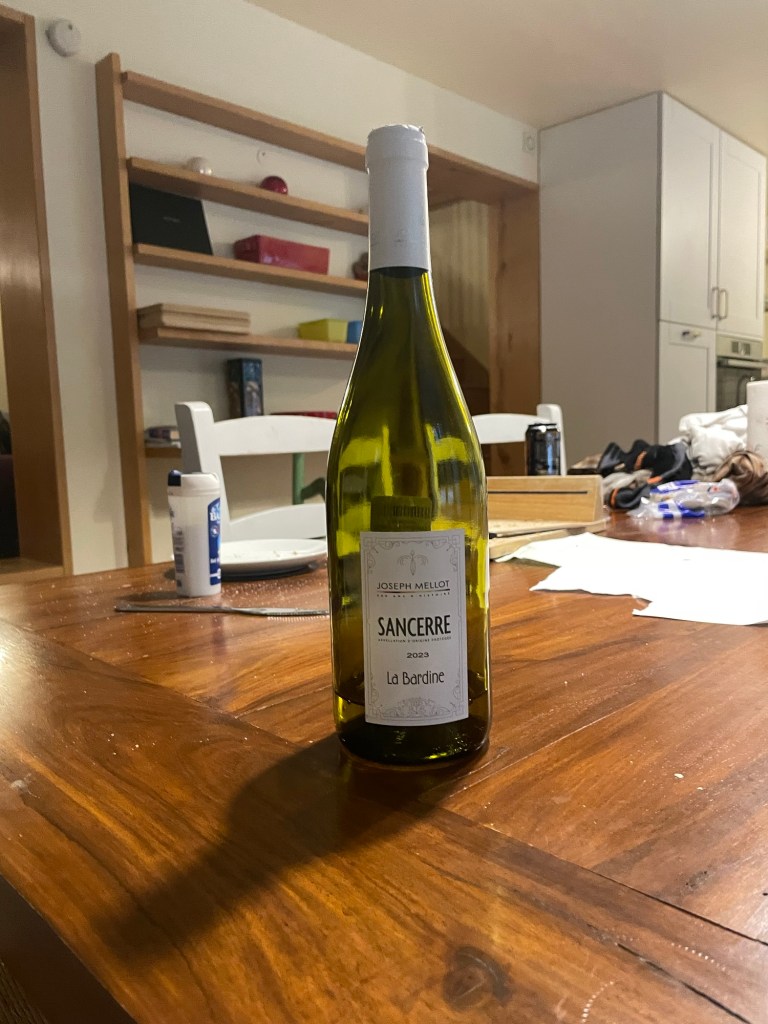
Mark took another hike. I cleaned out the fridge. We opened a bottle of wine we still had in the fridge and drank it. We all packed almost all our stuff, Mark weighing the bags on a portable luggage scale and moving things about as needed to keep under the weight limits.
For dinner Simon chose the mead place, L’Hydromel, with the American-style smashburgers and fries on the menu. Funny, isn’t it, that our last two meals in France should be food of a sort we can easily get at home? But let me tell you, my double smash cheeseburger was good. As were its fries and salad. It would have been completely at home at our favorite bar-and-grill places in Minneapolis. Sometimes a burger is what hits the spot.
I did have a glass of mead. Theirs is excellent and it is harder to find in the twin cities.
+ + +
Now that I am actually on the plane, especially since there will be a second plane, I am eager to get home. Milo has put food in our fridge: milk, yogurt, cheese, deli meat, and (he added) some cold fried chicken. I still have about 12 hours to go before stumbling into our house, and the thought of my own bed entices me.
Driving to Geneva this morning was a little hair-raising, just because we had to do a weird maneuver where we returned the rental car in the French sector of the airport, but needed to depart from Switzerland. Geneva is a weird city, a major city in a little arm or tentacle of Switzerland that protrudes into France, surrounded by French border. Switzerland isn’t EU, so it’s like a real border; it is in the Schengen area, so you can drive across easily, but customs is necessary for some cargo; the infrastructure of checkpoints and fencing is still around.
The Geneva airport runways are just barely inside Switzerland; leave the runway in an emergency landing and you might well skid to a stop in French fields. The airport terminal buildings are all physically located in Switzerland too. But they’ve worked out some kind of deal with France: there is a “French Sector” of the Geneva airport that functions as a little sealed-off bit of France. It has a rental car return, which was crucial for us as we rented the SUV in Nice and had to return it in France, or at least in “France.”
At least from the direction we were driving, we entered the Switzerland peninsula first (sailing through the first customs point), then executed a series of sharp turns that took us under the runways, back up into France, through another customs point, then back going the opposite direction on the same road under the runway—now in a sort of tunnel of barbed-wire fence. It was really giving West Berlin, as the road was physically in Switzerland but legally, I guess, French.
Mark maneuvered the SUV beast into a car return slot. I picked up the courtesy phone and figured out in Franglais where to return the key. We walked in… Mark checked us in with his phone so we’d have boarding passes (we’d read that you needed them in hand to do what we were about to do)… and we followed signs to a door marked Toute Sortie Definitive and just walked out of France.
I guess the main reason that Geneva has the French sector is that the airport is a major hub, so lots of people fly from French cities to other French cities by connecting through Geneva. The sealed-off French sector allows these passengers to get off their plane, find their gate, and get on the next plane without having to go through Swiss customs or passport control. While we were eating sandwiches in the airport bar before our flight, we could watch passengers crossing over our head in a sort of glass tunnel that I am pretty sure was “France.”
Something to tell MJ about, to file away under “interesting examples of commercial/civic interior architecture.”
+ + +
Not much else to report, although this has been a pleasant way to kill some time on the flight. I wonder if I can keep this up at home? Probably not every day; writing will be competing with exercise for my morning motivation and energy.
I wonder what I’ll write about? I’m not sure.
I let blogging slide in part because the stuff that was occupying my mind for a while there was largely stuff I didn’t want to put out into the public, and I also had this sense that I needed to be more careful with my half-formed thoughts.
It isn’t prudent, I think now, to test and refine them by exposing them publicly and seeing what reactions and replies come back from just anyone. Someone might shame you and call you out for them, of course, and maybe you don’t want to do that for some thoughts you are not committed to because they’re still developing. Or you might go viral, which is its own problem if you don’t particularly want to, even if you get a really positive response.
But I think the most important reason to be a little more cautious about just throwing stuff out there is that you might inadvertently be thoughtless, careless. You might feed the disinformation machine, if you toss off some theory about who did what to whom, or repeat something that sounded plausible, without really checking. You might perform a clinical analysis of the right and wrong thing to do in a difficult situation—but you might forget to think about the real people who face such situations, and fail either to couch your discussion with appropriate sensitivity and humility, or to consider whether you ought to consult some of them before opining, or whether you ought to opine at all (perhaps it’d be better to elevate a variety of other people’s words). You might tell a story that rightfully belongs to someone else, betray a trust, give away too much.
I once years ago wrote a blog post about a local news article that mentioned a local couple I didn’t know personally. I literally don’t remember what the story was about. One day, multiple years after I’d written the post, a person mentioned in the story contacted me and asked if I would please take it down, because my blog post was one of the first hits when someone googled their name. I did take it down, because I didn’t have any emotional investment in this one-off post about local news. They hadn’t done anything wrong or shameful, certainly nothing that deserved exposure, they were just tired of the post showing up in search results. Even the original newspaper article didn’t show up anymore.
I’ve never forgotten that, just because it was a reminder that things we write that are just another day of content to us, even innocuous-seeming content, might actually bother someone and feel like a problem to them. This isn’t an argument not to write posts that are reasonably critical of public figures—that can be important speech in a country where discussion is the best way to find consensus—but it is a reminder that it is always important to remember the real people you’re writing about, and the real people who will read what you say and maybe take it to heart; and decide what’s worth saying in the light of all those people. Could be an argument for or against hitting publish. But it isn’t good to forget that the people matter.
So I hope to find a balance, be true, even biting if necessary, but not careless. That seemed really hard for a while. I might be ready to try again.
Chances are good you won’t wake up tomorrow to a new post from me. I have been doing most of this travel blogging mid-morning, and tomorrow morning we load up our luggage in that beast of an SUV and drive to the Geneva airport. We’re supposed to return it in the French sector and then walk into Switzerland, if they let us do it that way.
+ + +
Let’s quickly summarize yesterday!
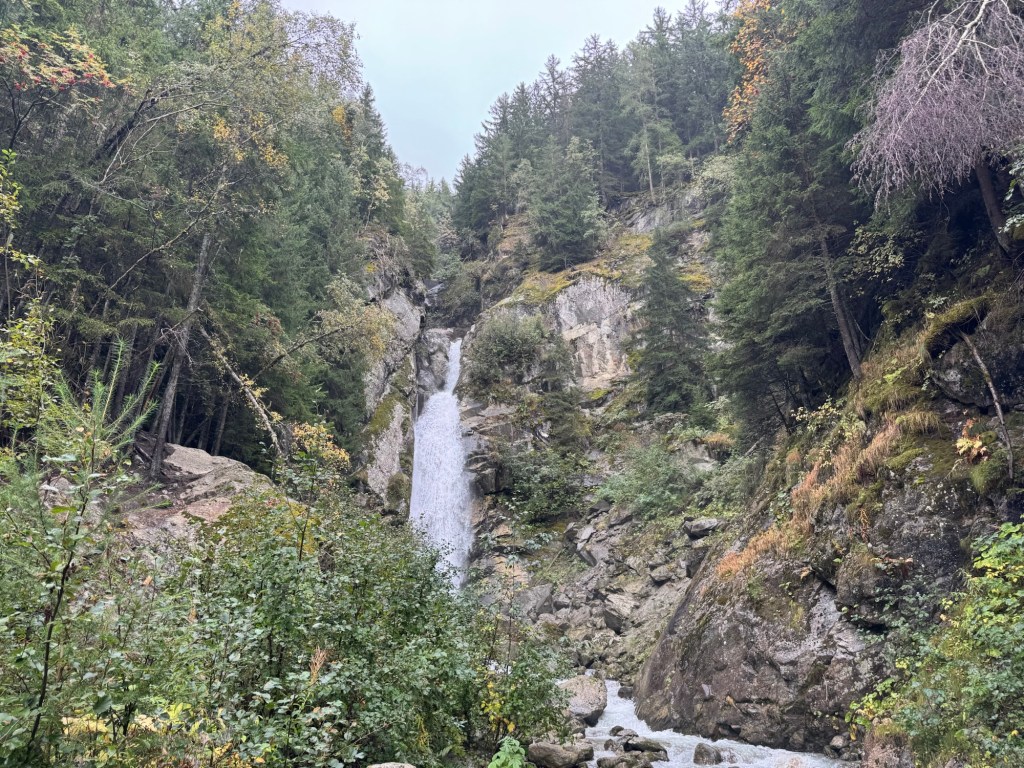
Yesterday morning, Mark went on a solo hike up towards the Aiguille de Midi, then across to the Cascade de Dard. He texted me some pictures.
Buvette along the hike, where Mark rewarded himself with a beer
I might have enjoyed that hike too, but (a) I needed to stay back to keep an eye on a kid who wasn’t feeling great and (b) everyone needs some alone time, so good for Mark for taking some.
What I did instead was nap. I dozed on and off and surfed the web on and off until about 2, and it felt really good. Sleep has been tricky for me and I needed to catch up on it.
After Mark got back I walked in town to the bookstore. This bookstore has a sizable English-language selection, so it is unsurprising that there should be a group of Americans there discussing their trip and looking at guide books. I was browsing regular French stuff, since how often do I get to do that, nearby. One of the American men said to one of the American women something like “what should I do with this?” and she answered hin in French, jokingly, “Stick it in your ass,” then looked at me, embarrassed, and apologized to me in French. Then she had to explain the joke in English to her friend or husband or whatever.
I didn’t say anything, preferring to amuse myself by letting them think I was a native, but now I kind of wish I’d made a “pardon my French” wisecrack.
Anyway, I picked out three very small paperbacks to add to my Francophone library. When I came out it was pouring rain again. I wrapped my books tightly in the sac en plastique from the shop and trudged back, stopping for a cappuccino under an awning.
In the evening we took Simon… bowling!
One of the hotels here advertised itself especially to families. It has two swings (the seats are made of snowboards) in the lobby. The hotel bar and restaurant is located in, well, a big rec room. There’s a board game library, a playroom for smaller kids, a foosball table, a touchable relief model of the Mont Blanc massif, a few pinball machines and an arcade game, and: two mini bowling lanes.
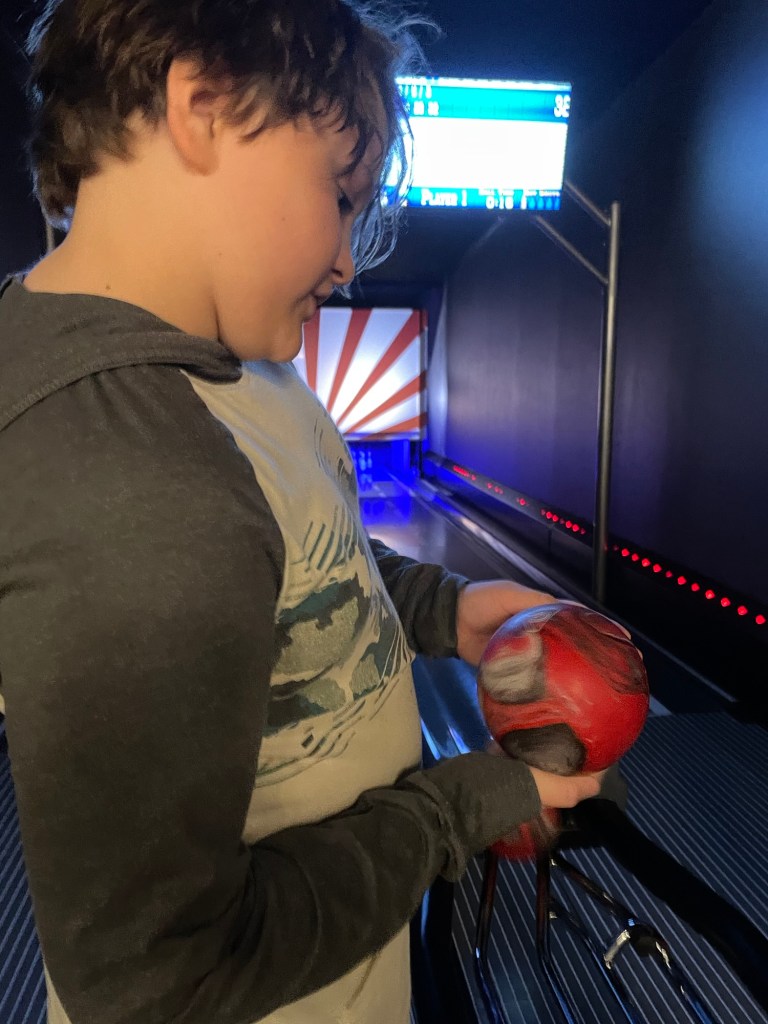
You buy tokens at the bar and put them in the slot, two per player, up to five players. The scoring software seems to be American-made with American bowling-alley rules; the main difference, a thirty-second shot clock for each throw. The ball is small, like a large grapefruit size with no holes, so you roll it underhand at the pins. The pins are also smaller and suspended independently on strings or cables. So instead of the usual pinsetter machine, an unseen tensioner pulls the strings to lift all the dangling pins up at the end of the first throw, and then sets down just the unstruck pins for your second try.
The lane is shorter too, as is the approach, so it took some getting used to, but the smaller ball was a lot easier and more natural to throw than a normal bowling ball. The three of us were more equalized than usual, although Mark still won.
Next to us in the other lane, we chatted with some folks from Ireland: a dad about 70 years old and three grown sons, plus a fifth man who may have been local. They weren’t familiar with the American scoring, so we explained, e.g., how you get extra points after a strike or spare. The family had just completed the hiking tour of Mont Blanc, a hut-to-hut hike that circles the massif. One of the young men lives in town, so we asked what it was like. He said it takes some getting used to, and that the buses and trains don’t run very conveniently outside high season. I think he said some things that made Mark more confident about perhaps planning a ski-only trip here in the near future (not with us, with the good skiers).
We ordered a beer for us (good beer from the brewpub near our rental) and an Orangina and some chicken fingers for Simon. Simon declared the chicken the best he’d had in France and made it known that he’d like to stay in this hotel someday.
After three rounds of bowling we headed back, left Simon at the house, and then went back out in the rain for dinner.
We considered the menu at a rather upscale place but I didn’t feel up to it, being kind of sore and crampy. I wanted either something light or something comfort-foody. I could have destroyed a bowl of mashed potatoes, I think, but a salad sounded good too.
We wound up at a new place where I drank champagne and had a trout “carpaccio” that was very like lox, with a crunchy toast that was very like a big bagel chip, and an ice-cream-scoop-sized blob of whipped herbed crème fraîche that played the role of cream cheese. (It was better, though, in a melt-in-your-mouth sort of way.) I followed it with a salad that wasn’t light at all. Good, though. And another glass of champagne.
Mark had classic French onion soup and a pesto ravioli. He didn’t drink anything since he had had most of the beer at the bowling place. So we didn’t get quite as amused with each other as we had the night before with the 92 centiliters of Côtes du Rhone. But we still had a good time.















 bearing blog