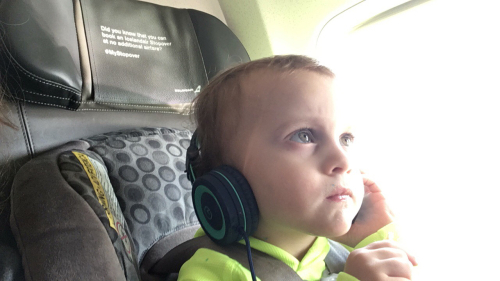
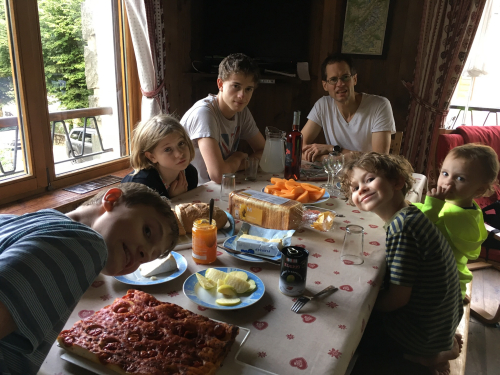
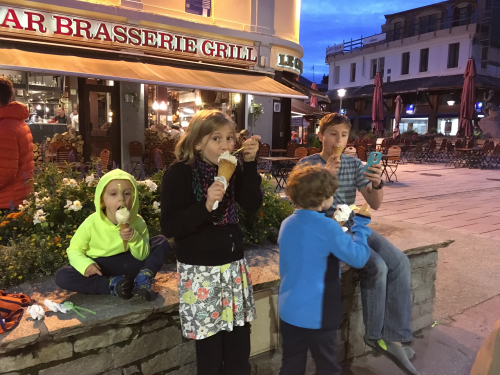
bearing blog


bear – ing n 1  the manner in which one comports oneself;  2  the act, power, or time of bringing forth offspring or fruit; 3 a machine part in which another part turns [a journal ~];  pl comprehension of one’s position, environment, or situation;   5  the act of moving while supporting the weight of something [the ~ of the cross].


  • Setting off.

    "Are you ready to go yet, Mom?  Are you ready?  Are you ready?"

     No.  No, I am not ready.

     And at the same time I am so very, very ready.

     + + +

     Remember how a few years ago we went abroad for a month, took all the kids to the French Alps and then down to Rome?   

     (If not, the first post is here, and you can page through subsequent posts at your leisure).

     So here is a piece of news I have been sitting on:  We are about to take another Big Trip With The Whole Family. 

      IMG_2991

     It's likely to be the last chance for such things, as our oldest is now writing college applications, and that's why it is now and not later. 

    + + +

    The first part of the trip is a return to the Alps, back to Chamonix.  It's my husband's favorite place.   Early in the late-summer morning the only sound that can be heard, besides little street-sweeping trucks, is the clinking and clanking of carabiners and ice tools hanging about the persons of people shuffling to gather coffee and wrapped sandwiches before heading up the mountain.

    Last time our big boys went with Mark and a guide for an adventure day of crampon practice and glacier climbing, and later for a long multipitch  climb on rock.  Last time I rock-climbed for the first time ever on a well-known crag outside of town, and had a great time.  Last time we attempted several "family hikes" that completely wiped us out but that took us through some of the most beautiful country I had ever seen.  Last time we met a family of expats who welcomed us into their home and became long-distance friends.

     I am not sure what awaits us this time.   Mark has been living with chronic back pain for years, which some months ago erupted to a new level — possibly because of a herniated disc which an MRI earlier this month has revealed, but you cannot really be sure–and left him unable to do any climbing or to hike while carrying weight.   So the trip will look different for him, and consequently for the whole family, than it did when we originally planned it more than a year ago.

     Change of plans.  We shall see.

     Even if it proves difficult for us to do the mountaineering-type activities that we originally planned, there are other things to do in the Chamonix Valley and on the other side of the Mont Blanc tunnel.  We enjoyed a day trip to Aosta last time, and didn't get to see everything there; there are many castles dotted throughout the Aosta Valley, some open for tours.  Lyon is a long but do-able 2-hour drive.  Simpler hiking that doesn't require us all to carry full packs is probably within our reach.  And some of our kids are determined to try parasailing, which is a thing you can pay people to take your kids to do, so there's that.

    Also there is wine in Chamonix, and a great deal of melting cheese.

    + + + 

    After a while in Cham we have a still-unplanned week which is tentatively devoted to driving somewhere in Italy and taking our chances.  Genoa?  Piedmont?  Not sure.  Probably no farther south than Genoa.  In any case we will return the car (van really — there are seven of us, after all) to the Geneva airport and fly… 

    …to London!

    + + +

    Having taken the kids to Rome, and wanting to do another Big Historical City With Plenty To Fill Multiple Days, we settled on London almost immediately.  

    London didn't settle on us, though.  We made a tentative trip budget last summer based on a survey of asking prices for AirBnB properties.   This budget was suddenly impacted by AirBnB's decision to force its hosts to abide by zoning regulations by limiting them to 90 days rental per year, which immediately decreased the supply and raised all the prices.  Besides the price increase, it took a long time even for us to find a property listing that wasn't a fake (we'd find identical photos used to illustrate multiple listings, or we'd contact an owner through AirBnB and then the alleged owner would email back with "ah, sorry, we've had a technical error, that property isn't really available on those dates after all, but if you send me an email at my other [i.e., non-AirBnB] email address I'll be able to show you a bunch of similar properties…").

    In the end it all cost a lot more than we expected.  But at just about the same time that we were having to accept that there was no way around the price increase, I received a couple of checks in the mail, part of the inheritance left me by my globe-trotting grandmother who had passed away in April.  I couldn't think of a better thing to put the money toward than traveling with our children, and I'm sure Grandma would agree.  

    So — that worked out.

     + + +

    London, then, for more than a week.  I have plans for myself.  The British Museum, of course — and Parliament — and the London Science Museum — and the Victoria and Albert.   The martyrs' shrine at a distance from the site it honors, Tyburn.  The Churchill War Rooms.  Taking the children to Kensington Gardens, and my lion-loving seven-year-old to see the statuary beasts keeping watch in Trafalgar Square.  A day in Greenwich, straddling the meridian.  Bletchley Park is supposedly an easy trip by train.   There's too much to have the lists all worked out in advance.  (I'm aware that I've left off a number of the Things You Must See in this paragraph — it doesn't mean we aren't going to go see them — I just have to stop somewhere…)

    I don't know what we'll do.  We'll just trust that it will work out.

    Now if we could only get everything into these suitcases.

    IMG_2992


  • Other nerdy/sci-comm people’s takes on the eclipse.

    Just in case my own nerdy take wasn't enough for you:  I'm going to gather here just a few links to eclipse reactions from minor celebrities in the world of science communications (that's what I mean by sci-comm, of course).  

    If I come across more, I might add more.

    + + +

    Derek Mueller runs Veritasium, "a channel of science and engineering videos featuring experiments, expert interviews, cool demos, and discussions with the public about everything science."

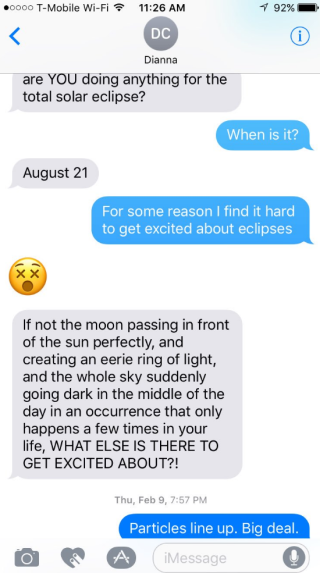
     Some months ago he had an exchange with Dianna Cowern of PhysicsGirl, which he made public recently via Twitter as "evidence of before and after."  Cowern is in gray and Mueller is in blue:

    Screen Shot 2017-08-24 at 12.42.31 PM


    "Particles line up. Big deal."

    Here's the Veritasium episode that he filmed during the eclipse.  Still no big deal?

    Mueller writes:

    As the moon passed in front of the sun turning day to night and revealing the sun’s corona, apparently all I could think to say was ‘Oh my goodness!’

     + + +

     My kids (and I) are big fans of Smarter Every Day, which is produced by Destin Sandlin.   Sandlin's best work involves high-speed videography, of things like jellyfish stings and exploding glass drops.  

    Before the eclipse he issued a couple of videos with tips about what to look for and photograph during the eclipse:


    Clearly, Sandlin didn't have the "no big deal" attitude, but he still wound up more excited than he expected.  Along with photographer Trevor Mahlmann, he traveled to the only location in the U. S. where it was possible to watch the transit of the International Space Station across the sun at the same time as the eclipse.  Here's his video — in which it is revealed that this extraordinarily precise camaraman was so blown away, he forgot to remove some of his lens caps.


    + + +

    Finally, here's the incomparable xkcd, drawn by Randall Munroe:

    Munroe's mouseover caption:  

    I watched from a beautiful nature reserve in central Missouri, and it was–without exaggeration–the coolest thing I've ever seen.

    I wasn't far away, and I agree. 


  • Totality: August 21, 2017.

    In March I suggested to Mark that we get a hotel reservation for August 20, 2017, in the path of totality somewhere, because I had heard that hotels were filling up.  Within a couple of days he had gone online, searched, easily found a couple of rooms in a motel northeast of Kansas City for $80 each, and reserved them without fanfare.   I think he may even have laughed at me a little for worrying that there would be nearly no rooms left, although he did warn me that they were not nonsmoking rooms. When we checked into that motel Sunday night, the clerk informed Mark that those rooms had only come available as a result of a computer glitch that incidentally left them underpriced for a two-day window, during which Mark had happened to log on.    That had been the start of our luck.

    + + +

    I was worried about disappointing everyone, about dragging the family down to Missouri only to see a cloudy sky; about thirteen hours of driving round-trip for a two-minute experience.   I was also worried about being trapped in a gigantic national traffic jam. I was following people on Twitter who had made three, four, six lodging reservations spaced along hundreds of miles of the eclipse path.  I knew people who would be in Tennessee, South Carolina, Wyoming.  Two weeks out I started watching the projected "sky cover" forecasts.  The center of the country did not look good.  But that was where our reservation was, so we would go there anyway and hope for the best.  

    "Maybe," Mark suggested, "we can get up in the morning, check the forecast, and drive to get away from the clouds."  I fretted, and I packed the car with 36 hours' worth of food and water.  

    + + +

    When I was a very small child I owned a paperback picture book called "Something is Eating the Sun."  I think I remember choosing it at Books & Co. in my hometown.  It was a riff on Chicken Little, a series of barnyard animals becoming increasingly worried about the bites being taken out of the sun's disk, page by page.  The last page warned readers against following the animals' example and looking directly at the sun during an eclipse.  

    When I was a bigger child (almost certainly on July 6, 1982, when I was seven) there was a total lunar eclipse visible from my street.  I remember being allowed to stand outside barefoot in the street after my bedtime.  I don't remember what it looked like, but I vaguely remember being disappointed that it did not look like something was eating it.

    I got older, and I learned about the solar system and the law of gravitation, Kepler's laws, the mathematics of ellipses, a bit of astronomy.  I learned about how the Royal Society made observations during the eclipse of May 29, 1919 that tested the theory of general relativity.  Total solar eclipses were a thing in the planetary domain that I had never seen but that I understood, the way I understood that the moon made the tides.  I had studied ebb and flow, neap tide and spring tide, the lag behind the moon and the slowing of the earth's rotation.  I had eventually been to the seashore and seen the water rise and fall, the moon's work between my feet and flowing cold around my ankles.  Someday, I might see a total eclipse too.

    I was a sophomore at Ohio State when I saw a partial phase of the annular eclipse of May 10, 1994.  The square courtyard between McPherson Lab and Smith Lab was full of people trying to look at the sun through Pop-tart wrappers and CDs.  I had no light filter and knew better than to look at the sun, but I could feel the temperature drop and see the strangeness of the light.  I stopped to sit down next to some shrubbery;  its shadow was spangled with perfectly identical crescents of light, an unexpected phenomenon that delighted me, none the less because I recognized the pinhole effect immediately even though I did not know to look for it until that moment.  No one around me had noticed the shrubbery shadow yet, and it felt for a moment like a private secret between me and the universe.

    That got me a little more interested.  And when I encountered Annie Dillard's essay "Total Eclipse," much later, I began to think seriously:  If I get a chance to experience an eclipse, I shouldn't miss it.

    + + +

    All this is to say that I knew what would happen.   I knew, too, that other people knew even better than me.  I know in the bottom of my being that the planets and the moons move in their elliptical orbits so simply and in accord with laws that are themselves so simple, that the locations and times of all the eclipses for hundreds of years in the future have already been mapped; so simple that indeed people have been predicting them for hundreds of years, before computers, before calculators, before pencils.  Eclipses are a tame thing, a trivia question, a child's picture book, a just-so story.   They may be rare, but they are a caged specimen.  A famous gem of the natural world. I knew everything about them.  I was even well informed, thanks to Annie Dillard, that they were an emotionally moving experience that was worth driving a few hours to see.  I get it, I get it; we'll go.  I knew it would be cool.

    Or so I thought.

    + + +

    Rain poured and lightning flashed in the morning in Kansas City.  We checked out of our hotel at 11 am and ran through the rain into a McDonald's, where patrons were watching the crescent sun on big screen teevees, a feed from the west coast where the eclipse had already started.


    IMG_2957  

    IMG_2956

    One hour and forty-five minutes to totality.

     The parking lot was flooding and the sky was leaden.  "At least we got to eat Kansas City barbecue last night," I was saying.  I was tense.  I had dragged the whole family down here for nothing.  

    Mark said:  "We'll check the weather radar and drive towards clear skies."

    I said:  "There will be traffic jams.  Maybe we had better stay put and hope that the rain passes."

    Mark grinned at me and said:  "You know what this is?  This is an adventure.  This is a weather-dependent activity.  I do these all the time."  And in that moment, I realized that whether we saw the sun or not, it was going to be okay.

     + + +

    Fifteen minutes later we were in the car.  Mark was driving fifty miles an hour in the pouring rain, twisting left and right between fields of tall corn, and I had a phone in each hand: one displaying the static, zoomable map of the totality path, and one tracking our little pulsing blue circle along the back roads northeast of Kansas City.  "Does this road go east?" Mark was saying.  "The skies are clearer to the south, but the car says it's going east."

    IMG_2958

    One hour and twelve minutes to totality.

    "It goes southeast," I repeated through the thunder of the rain on the roof of the car.

     "The car is going east–"

    "It zigzags.  On average, it's southeast.  We have to stay on this road to cross the river."

    Our oldest, from the back seat, with a third phone open to live weather radar:  "After we cross the river we need to cut west."

    "West?  Really?"

    "West!  After we cross the river."

    IMG_2959

    Sixty minutes to totality.


    There was a patch of blue sky, and Mark made for it.  Amazingly, there were not a large number of cars on the road with us.

    We came out of the rain.

    IMG_2960

    Fifty-three minutes to totality.

    "GO GO GO" I typed into Facebook.  A friend under blue skies in Tennessee replied:  "It's like Twister in reverse."  It was.  We were chasing the edge of the storm from the inside.  I documented our location (Lexington, MO):

    IMG_2961

    Forty-three minutes to totality.

    Blue skies were ahead.

    + + +

    "Let's stop here."

    "We've got time."

    "Look, there's space at this crossroads." 

    "We can get farther."

    And then we passed a little driveway into a pasture, with a little chained gate a few yards from the road, and a pond on the other side of the gate, and Mark said:  "That's where I'm going to stop.  He pulled into the driveway of a bed and breakfast that was the next mailbox down, turned around, and went back to the little driveway and pulled in.

    I got out of the car and I saw my shadow:


    IMG_2964

    Twenty-five minutes to totality.


    IMG_2963

    The sky.


    + + +

    We set up telescopes, and pulled out our eclipse glasses embedded in paper plates for safety, and I looked up at the crescent sun and I realized that it was really going to happen.  The children were positively leaping.  

    IMG_2965  IMG_2966   IMG_2969

    We put the three-year-old in the van for safety's sake, partly so he would not look at the sun, but mostly so he would not wander into the road.  And we looked up, and stopped taking photos, and waited.  

    We felt it get cooler.  We saw the light going all wrong, and I saw Mark laughing:  "This light is crazy!"

    "It's like a tornado sky," said my daughter.  I agreed, it was like that.

    The crickets began to sing.  The children exclaimed over the shadow bands rippling in the road.  I stood next to the van door so that I could keep some attention on the three-year-old.  I watched the crescent get smaller through the eclipse glasses.  This was so interesting that I forgot to look around at the deepening sky, or look to see the great shadow coming.  I watched through the eclipse glasses until the light was completely gone and the children started shrieking.  Then I looked.

    + + +

    I had known what was going to happen.   And… I had not known.   What happened to me was this:  

    I staggered backward, two, three, steps, staring at the sky.  I'm not sure if I was recoiling, or backing up to try to take it all in — either way, something crazy that couldn't make sense, because there is no way to get farther from the sky.  "Oh, my God," I was saying, over and over again.  

    Yes, I could see the corona, ghostly in the blackness, and Venus down and to the right.  Yes, I could see the ruby-colored sparkles around the black disk of the moon.  Yes, it was beautiful.  

    It was not like seeing the tide rise and fall according to the tables.  It was not like knowing that general relativity had been proven correct.  It was just like the photographs, and yet it was nothing like the photographs.  It looked just like the photographs, but standing there between a pasture and a cornfield, in the chilly midday of August, was not 

    I know some people say that it was like a religious experience.  It was not like that for me.  A religious experience is a sense of communing with the supernatural.  I am kind of familiar with those, oddly enough.  This was new.  It was a natural experience.   And it was making tears well out of my eyes.  

    "Oh, my God," I kept saying.  My 13-year-old son kissed me on the cheek.  I became aware of someone standing close behind me, grasping my bare upper arms in his warm hands.  I remember deciding that it was probably Mark, but I could not tear my eyes away from the moon and the sun.  

    + + +

    The first thing I came up with to try to explain the experience was:  Have you ever seen videos of audiences from the Beatles' tour of the U. S. in 1964?  The young women weeping and dropping to their knees upon catching sight of the stars?  I always wondered what on earth would make people act like this.  But having seen the eclipse, I think it was a little bit like that, an extremely nerdy celebrity sighting.  I am a science nerd.  It is essential to my being.  Total solar eclipses are celebrities, rare celebrities, a thing that I thought was tame but that has tamed me, apprivoisé, a thing I know like an old friend, like Fibonacci's sequence, like the digits of pi, like the hydrogen atom.  

    And there it was right in front of me!  A thing I'd hoped to see for my whole life, but not ever allowed myself to long for, because maybe I would never attain it.  And now I was face to face with it, and I knew — knew – it was something worth longing for.  Had always been.  And I was, in fact, weeping at the sight, and my knees really were weak.

    + + +

    You can study the biology of human gestation for your whole life, become an expert, do original research, earn a medical degree, a Ph. D., see patients, weigh evidence, make predictions, feel the satisfaction of measuring the outcomes and watching them come true.  Knowledge is valuable.  And yet:  it is not a substitute, never can be a substitute, for bringing your own child to birth.  It's not the same.  

    You can know everything that's going to happen, and everything can progress exactly as you expect, and then experience knocks you back, with something you didn't even know was there, something beyond knowledge, something that ties you to every other human on the planet who has ever experienced the thing, and forever separates you from those who haven't.

    And they don't know either, any more than you did, in the time before.

    + + +

    The second thing I came up with to describe the experience was:  It was less like an event than it was like a feature, like the mountains and the sea are features of our planet, but this is a feature of the solar system instead, the first feature I ever really got to see.   Oddly enough, the starry night sky seems also to be a feature of our planet; even though it is located outside the planet, it looks the same all the time; we can look in different directions from here, but the view is essentially the same.  The planets moving against the sky is a little like this, but you cannot really watch it happen because it is too slow.   

    Our planet has some very beautiful features.  Before Monday I often said that the most beautiful place I have ever been is the Alps above the Chamonix Valley; I said that the first time I went there when I was in college, and I said it again when I returned with my husband and five children twenty years later.  I have seen and heard other beautiful features:  certain birds and jellyfish, certain beaches at sunrise, certain echoes of laughter ringing in columned arcades, certain cleverly shaped and polished stones.   The total solar eclipse is like that:  a thing worth traveling to see, all by itself, but it's not of this earth, it's of something larger, it's of the sun and all its orbiters, including me.  The limited slips of time in which it happens, well, that's just part of the directions to get there, they're simply directions that include both time and space.

    I will be back in the Alps very soon, and I somehow think it will no longer be the most beautiful place I have ever been. 

    + + +

    If there's one thing I perceive intellectually more than I did before, it's the tremendous gift given to us at the formation of the solar system, the gift of a moon that is, sometimes, the same size in the sky as our sun.   Much larger or closer and it would cover up the corona; much smaller or farther, and we would never have totality.   It did not have to be that way, and it is, for no particular reason; it just is.  A gift.  Everything that is beautiful is a gift, but knowing it increases its beauty.

    I knew that, but I know it more now, and I am truly grateful.

    + + +

    It was over fast, and the light came back, and the shadow bands were streaming over the road, like the shadows of clouds, but impossibly fast.  And we threw everything in the car and raced to beat the traffic going home on I-35.

    The memory of those two minutes and nine seconds is truly dreamlike; I remember the feeling, the shock, the staggering backwards, the tears, reaching my hand out to the van to steady myself.  One of the strangest parts of the memory is the way I realized that Mark was standing behind me and holding me:  that I hadn't even noticed him coming up to me and putting his hands on my arms, the way he seemed to came out of nowhere, the way I had become aware of that sensation without really being aware of what it meant, or who he was, or thinking, really, about anything at all.

    Astonishment.  Pure astonishment, and a sight, and even now I can barely remember the sight, but in a breath I can remember the way the astonishment took hold of me.  I can relive it, sometimes, not by watching videos of the sun disappearing, but by hearing audio of the crowds gasping and stammering, the way I gasped and stammered.

    Will it happen again, if I travel to see another one?

    I don't know.  I will find out, I hope, in 2024.


  • At the risk of accusations of virtue signaling.

    It's just possible that not signaling opposition could be taken as signaling collaboration.

    So.

    1200px-Modern_British_LED_Traffic_Light

    + + +

    (1) Neo-Nazis, Classic Nazis, white supremacists, white nationalists, the Confederate flag, swastikas, and anti-semites are wrong and indefensible.

    (2) There is no "both sides."  People who showed up to resist and protest Nazis-and-their-friends were on the right side of the Nazi question, not on the wrong side.

    (3) Even when Nazis and those who are content to march with them have permits, they're wrong and their ideas are anathema.

    (4) Even when Nazis and their friends get punched before throwing any punches, they're wrong and their ideas are anathema.

    (5) There is no equivalence.

    (6) I knew Donald Trump was a disgraceful human being before the election, and to my amazement he keeps revealing that he is even worse than I thought he was.

    (7) Whereas I concentrated my rhetorical efforts before the election, such as they were, on trying to convince those conservatives who thought they were obliged to vote for Trump to vote 3rd-party instead — trying to help people, especially well-meaning Christians, see that they would do better to move from the pro-Trump column to, at least, the Pox-On-Both-Their-Houses column;

      and whereas, at minimum I tried to show them that they were free to choose, in the face of a disturbing amount of pressure from people claiming that nothing but a vote for Donald Trump would satisfy the Almighty;

    and whereas,   I stand by those efforts today, wishing Trump had lost by more in Minnesota, but rejoicing that he did not, at least, take this state;

    … I understand that people may have done the best they could with their vote given the information they had at the time.  Heck, that's my only defense for throwing my vote to a third-party Hail Mary, after all, when arguably I should have voted for Clinton (I had many discussions with people on this topic and went back and forth quite a bit).  But: If you're still standing by Donald Trump, I don't have much to say to you.  It's better that I say nothing, for now.

    (8) The fact that there are still Christians carrying water for this immoral, unbalanced, self-obsessed, small-souled, white-supremacist-appeasing human being fills me with more sorrow than I can describe.  Not surprise in many cases; but in all cases, sorrow.

    (9) You will never, ever achieve a win for life by allying yourself with dealers in a philosophy of death.  Never.  No politics of pragmatism can ever justify it.  Any apparent success will be fleeting and hollow, or will be expiated at the cost of souls.  I believe we are watching it play out now.

    (10)  Conservatives need to clean their own damn house.  I'm uncomfortable with the label "conservative" and don't belong to the GOP, but the fact is that I've voted for GOP candidates, though not every time, much more often than I've voted for Democrats or independents since I became eligible to vote.  So this is, in part, my own damn house to clean.  And this is me saying:  This mess is unacceptable.  No, this is me saying, perhaps rather than rolling up our sleeves and getting back to work, we would do better to set this house on fire and start over in a new place with a new foundation, with fewer rats and roaches.   Perhaps it hasn't gone quite that far yet, but it's getting close.

    President Donald Trump should resign.  Failing that, the cabinet and Vice President should act to remove him under the 25th Amendment.  Failing that, the House should move to impeachment.  Failing that, the GOP in both the Senate and the House should vote to censure the President publicly.  

    Tear him down.

    Don't wait for the light to change.


  • Yesterday changed my mind.

    First, the obvious caveats:  I am white and, to be blunt about it, wealthy.

    Second, the less obvious caveats:  I have always lived in the Midwest, primarily in cities, and have never lived in the South except for a few months' internship at a chemical plant in small-town Kentucky.

    + + +

    Confederate flags flying as part of, or next to, state and municipal government flags are awful.  A flag is what you decide to fly to represent yourself right now; you make a decision every morning to haul it up the pole in first light.  If it's a reflection only of your heritage, then it's a reflection of the parts of your heritage that you feel are banner examples.  Thus:  Flying a Confederate flag or an image of one is an implicit endorsement of, or expression of fondness for, the Confederacy.  Full stop.  They don't belong in the government display of any U. S. State.

    + + +

    I had a different opinion about Confederate monuments and memorials.  A monument and a memorial are placed by the people of one time to represent themselves to the people of the future.  My opinion was that it would be better to leave them in place.  

    Not because I disagreed with the desire to root out the ideology of enslavement and dehumanization that put the monument there, and for which the memorialized combatants fought and died; the desire to take them down from a place of figurative and literal elevation.

    My reasoning:  
    I thought that it would be a kind of whitewashing that would someday allow the descendants of the monument-builders to pretend that it didn't really happen.  To pretend that the ordinary white Americans who lived and shopped and worked in the communities around those monuments were not participants in the ideology of enslavement, did not really support politicians who openly advocated white supremacy, were just following orders, were themselves victims of oppression (economic, gender) and all the rest of the tired old excuses that never go away.

    No, the monuments were proof that the people with the power to make monuments—and the docents love to tell the story, when the monuments have been built not just by the grand benefactors of the day but with children's pennies and young housewives' pin-money—that the people who built the monuments wanted us to know this about them:  they mourned the slave system, along with the men who died to protect it.

    I thought it was better that we had that proof, where it could stand out in the open and in the center of the town, shat upon by pigeons and washed by the rain, so we couldn't deny it now or in the future.

    + + +

    But this wish was supported by a certain failure of imagination:  the idea that people of all sorts would mainly, and increasingly, see in them what I see, monuments to shame, complicity in the promotion of a truly disgusting set of ideas, and participation in an untold list of violations against the dignity of human beings and of family life.

    I didn't really expect them to become once again popular rallying points for people — violently or without laying a finger on anyone — who are openly carrying the flags of America's defeated and nearly universally reviled enemies.

    Failure of imagination.  Yes, I'll raise my hand:  I am a fool for not anticipating this.  I know about systematic racism.  I know about overt racism and that it still happens even though I am insulated from it.  I've got my own sins and to the extent that I know them I am ashamed.  I have been silent when I should have spoken, when to afflict the comfortable would have meant to afflict myself too.  I have been a coward.  

    Failure of imagination.

    + + +

    If this is going to be a thing, now and in the future — and it seems that we have no kind of guarantee that it will not;

    If Confederate monuments and the graves of fallen soldiers are to be a rallying point for swastika flags and chants of "Blut und Boden";

    If anti-Black and anti-Jew and anti-immigrant cheers are to rise from crowds, encircling the bronze hooves of poor effigied horses bearing graven images of white supremacy on their backs;

    then tear them all up, and shove them every one–the more beautifully executed and artistic, the more damning, because white people really did pour their creativity, their resources, and their capacity for beauty into memorials to crushing faces with boots–shove them all into the museums, where people with sense can make rules about maximum occupancy, noise levels, and weapons.

    I thought we needed to have it all out in the open, where we would all be forced to reckon with our past.  It turns out that we are not wise enough or kind enough as a people to handle it.  We must, it seems, put them under armed glass after all.

    DHCaO6rVoAAzCGc


  • Repost: The lack of checklists.

    This is a repost from October 2014.

    + + +

    Recently a friend of mine asked me if I could recommend any books for someone who was struggling with scrupulosity — in particular, the Do I Have A Sufficiently Serious Reason To Delay Pregnancy sort of scrupulosity, mixed with depression and struggles with anger and being overwhelmed. I wanted to help, so I put some thought into it.

    Longtime readers will know of my irritation with the tendency of some corners of the Catholic internet, lacking any actual lists of rules from the Magisterium, to write their own rules for what constitutes a Serious Reason and then disseminate them.

    My position is that those entrusted with the teaching authority of the Church, as well as the inspired writers of Scripture, knew what they were doing when they didn't, for example, add "subclinical depression isn't a good enough reason to watch your fertility signs" or "if only one spouse is sure that it's a good time to try for another baby, the other one should get in line." The fact that the Church has declined to give further guidance beyond generosity and the good of the family, is itself a kind of guidance: a signal that discernment about family size and childbirth timing belongs not to theologians and pastors, nor to doctors and therapists, nor to social media friends and Twitter, but to a well-formed married couple themselves — and no one else.

    I couldn't think of any books that I could recommend through experience, although I found some promising titles via Google. I know of a number of web-published articles and blog posts that make the case for backing off from pressuring others with the so-called Grave Reasons and minding yer own business, but as it was of course web-published articles and blog posts that helped convince my friend's friend that her own struggles were not bad enough — that she was not good enough, and if she could only be better she could handle everything, and maybe the first step towards being better was to take on more and more and more — well, I wasn't sure that piling more websites, no more authoritative than the others, would help.

    So I suggested working on recognizing scrupulosity in general, and left it at that.

    + + +

    Later on this week it occurred to me that there is another sort of commandment — one that is much, much more fundamental to the Christian life than anything having to do with married life, since it applies quite strictly to everyone of any age and state of life — that, despite its importance, is similarly light on the details.

    We all know we've got to do it. In a very real sense our salvation is said to depend on it. But no one — not Christ's words in scripture, not the Catechism, no papal teaching document, no synod — has ever told us exactly how to do it, or how to know when we've done it, or given us a checklist of features of successfully practicing it. And yet this virtue, this activity, is not something that is purely spiritual or invisible; like generosity in the service of life, it plays out in the arena of real contact between real human beings, and if we invite it in, if we practice it, somehow (but no one will tell us how, exactly) it will change the course of our days.

    I am speaking of forgiveness. We know it's always necessary: Jesus said himself that we can't be forgiven unless we forgive. We know it must be offered again and again, without practical end; that, at least, is what the exegetes tell us that "seventy times seven" times means to say to us.

    But beyond the teaching that we have to do it, and that we are never allowed to give up doing it — we are not told what we have to do to be forgiving.

    How can we ever forgive enough? There is no "enough," because our model of forgiveness — just like our model of life-giving generosity — is God Himself.

    There is only what we are called to do. And because it is a matter of a call, no one can figure that out for us. We have to discern on our own.

    + + +

    Let's talk extremes: Almost nobody (unless they are trapped, themselves, somehow) believes that the injunction to forgive means that a physically abused person must go on putting himself or herself in danger of more abuse. We don't say that there is a limit on forgiveness; rather, we advise that forgiveness doesn't require the risk of being harmed by a dangerous person.

    And yet… all forgiveness means some level of risk and vulnerability (otherwise we wouldn't have to remind people to do it). And so there is always the open question of how much vulnerability we can create before we have forgiven.

    The question is open. There is no checklist.

    "If your neighbor commits such-and-such a crime against you, and then he apologizes and makes restitution, forgiving him means declining to press charges. But if your neighbor commits such-and-such a different, particular, crime, and then apologizes and makes restitution, forgive him some other way while you still press charges." Nope. We don't get advice like that.

    "If you lend money up to $X and the borrower never pays you back, forgiveness means that you stop demanding the money and you should be willing to lend to that person again. If the unpaid amount is between $X and $Y, forgiveness means that you stop demanding the money, and don't think of it again, but probably you should not lend to that person again. If the amount is between $Y and $Z, it is permissible to take the borrower to court for the money, while forgiving the borrower in your heart…" Nope. We don't get advice like that.

    "If a family member hurts you in such-and-such a way, forgiveness means that you tell the person of your hurt and then never speak of it again, and not gossip to other members of the family, and keep going to visit the relative who hurt you, and send Christmas cards, and the like. If a family member hurts you in a different way, forgiveness means that you keep silent about the hurt, keep visiting with that person, and learn to change the subject when necessary to avoid the topics that lead to people saying hurtful things. But if a family member hurts you in such-and-such a different way, it's okay to separate yourself completely from that person and quietly work on your own anger issues without subjecting yourself to further mental abuse, and that is what forgiveness means in that case." Nope. No specific advice.

    Look in the encyclicals all you want. Read the Bible as much as you want. There is no algorithm.

    But isn't this dangerous? Aren't some people going to feel trapped by the injunction to forgive, trapped in cycles of self-hatred, trapped in abusive relationships, trapped by toxic family members demanding what they have no right to demand?

    Yes. It is dangerous. And people are trapped in this way.

    And yet it would be dangerous in a different way if we were given such an algorithm, because we would none of us have any room for discernment — for working out the best way to forgive in a specific situation, with specific human beings.

    We have a Church, not a clinic; we have a Teacher, not a Diagnostic and Statistical Manual; we deal with disordered human persons (including ourselves), not with disorders. We have to judge the situations that we are in by looking at the needs of the people who are affected by the situations. We as individuals are the only ones who can see the details of our surroundings. A predictive, exhaustive flowchart (if P then Q) would, I presume, hobble us; leaving no room for a flowering of authentic human forgiveness, it would tempt us to go just so far and yet no farther.

    It might serve as an excuse to limit forgiveness, by telling us when we had forgiven "enough."

    Forgiveness comes in different shapes, and we have to see the shape it will fit into, in our hearts and in our relationships, and work over and over again to more fully fit it into its place. But it isn't ever done and isn't ever enough. The nature of forgiveness, like generosity, is a nature of readiness-to-serve; never saying "I am done," but instead always ready to be called to do something more.

    What that something may be, we apparently have to figure out on our own, for it to be forgiveness and not some other thing — maybe, a good thing, but something else.


  • Invitations to mercy.

    Still mercy-blogging.  I want to riff further on a paragraph from a few posts ago.  Writing about inappropriate exercise of the duty to "instruct the ignorant" and "admonish the sinner," which are two of the seven spiritual works of mercy:

    I look back at the corporal works of mercy, which are so much easier to understand.  Feeding the hungry is a work of mercy; but force-feeding even the dangerously malnourished is a work of cruelty.  Giving drink to a thirsty man is a work of mercy; waterboarding him is not.  Visiting the sick is merciful; barging in on one who needs privacy and quiet is not.

    I was trying to get at the idea that when we go out to reach people, we're in the business of issuing invitations to mercy—offering gifts, without strings attached—and making good on them when they're answered.  

    + + +

    I'm not the first to suggest that there are limitations on the duties implied by the corporal and spiritual works of mercy.  

    The 1917 Catholic Encyclopedia (that venerable online resource) refers limitations on the corporal works of mercy to the article on Alms and Almsgiving, which gives a sort of survey of different ideas theologians have had about alms.  Such as:  Two categories of your surplus material goods*, three categories of poverty**, and two kinds of almsgiving***, and some different ideas to combine them to figure out whether you have satisfied your duty to "give to all who asks."  It's not definitive, but it's a good start for thinking about it if you are struggling with guilt and fear over the details: whether you give enough, whether you may say "no" to any solicitation, how many of your material advantages you may permissibly enjoy.  

    Without forgetting that many of the saints displayed and taught radically generous charity, a systematic analysis of principles seem to soundly establish limits.  Our binding duty is, like the examples of the saints, boundless in theory (we may be called upon, unexpectedly, to give everything); in day-to-day living, it normally calls for prudence and discernment.

    In short, that article recognizes a right to own and to use property:  as long as you do not stand by while you know someone else to lack vital necessities, you have the right to use your material advantages.  You may keep enough to maintain your own bodily needs and even enough to maintain your social status and carry out purely social duties.  You are not obliged to donate yourself into poverty or even into a different social stratum.  

    These are limits on what one must do.  In current terms, we might say:  It's an affirmation that you may set boundaries.

    + + +

    Limitations on the duties outlined in the spiritual works of mercy fall into a different category.  You might call it "limits of competency."   Where the first set involves setting reasonable boundaries so as not to imprudently exhaust your powers, the second set involves recognizing the boundaries of your own qualifications.  At the risk of repeating myself, here is the money quote from the relevant CE article:

    Likewise the law imposing spiritual works of mercy is subject in individual instances to important reservations.

    For example, it may easily happen that an altogether special measure of tact and prudence or, at any rate, some definite superiority is required for the discharge of the oftentimes difficult task of fraternal correction [i.e., "to admonish the sinner"]

    Similarly to instruct the ignorant, counsel the doubtful, and console the sorrowing is not always within the competency of every one.

    By reason of our relationship with the person and the specifics of a situation, we can find ourselves under the obligation to do the best we can regardless of whether we think we can do a good job; but much of the time if we lack special competency, it's okay and quite possibly better not to step in and possibly make things worse.

    Or you could say that special relationship—a relationship of trust or of place in a hierarchy—is its own kind of competency.

    Or yet again you could make a sort of four-way matrix:

    • If you have competency and relationship:  You have a duty to offer these works, and the recipient may have a duty to accept your offer.
    • If you have a relationship, but no competency:  You may have a duty to offer to connect the recipient with someone who is competent.
    • If you have competency, but no relationship:  You may have a duty to invite the recipient to enter into relationship with you, either before accepting your works or by accepting it.
    • If you have neither competency nor relationship:  The obligation to offer help may not exist, and should be undertaken only with considerable prudence.

    In contrast with the four "competency-based" works of mercy, the CE goes on to remind us that we don't need any kind of special competency "to bear wrongs patiently, to forgive offenses willingly, and to pray for the living and the dead."   These works, the silent works, the universal works, bear fruit silently as well. They cannot impose on anyone else because they happen within oneself and are brought to fruit only by the action of grace.

    But about all the works of mercy this additional caveat holds:

    It must not be forgotten that the works of mercy demand more than a humanitarian basis if they are to serve as instruments in bringing about our eternal salvation.  The proper motive is indispensable and this must be one drawn from the supernatural order.

    Which is to say, that in the realm of Christian duty (as opposed to merely humanitarian duty that any moral person ought to try to carry out in order to help their neighbors), improper motives may make these "services" not worth performing.  If you perform the acts associated with mercy in order to look good in the eyes of others, or to make yourself feel superior, or (heavens) in order to shame someone, then perhaps it would be better for everyone if you didn't.

    + + + 

    So I want to suggest another potential limitation on the manner of performing works of mercy:   that they ought to be everywhere and always offered by way of an invitation (or a response to a request), never an imposition.

    The human person is a being with knowledge and will, and that agency needs to be respected.

    So, let's take a look at (most of) the corporal works of mercy in the form of invitations:  almsgiving and friendship.

    • Would you like something to eat?
    • Would you like something to drink?
    • Would you like help getting clothing, bedding, outdoor gear, shoes?
    • Would you like help finding a place to stay?
    • Would you like me to stop by for a visit, or to bring a meal, or to help out somehow?
    • Would you like some company?

    (Burying the dead is a little bit odd as we aren't generally able to secure their permission except in advance.  But we can extend invitations to the bereaved:)

    • I am sorry for your loss.  Would you like help and company in your grief? 

    + + +

     The competency-based spiritual works of mercy in the form of invitations:

    • Would you like more information?
    • Would you like some advice, or suggestions?
    • Would you like a heads-up, or a word of warning?
    • Would you like someone to come sit with you?

     The silent works of mercy do not require invitations.   No one needs permission to be patient, to forgive someone, or to pray for someone.  But it may be worthwhile to resist the temptation to announce your intention via an assertion.  "I forgive you" and "I'll pray for you" can have a distinctly non-comforting effect if deployed indiscriminately.

    • Bearing wrongs patiently is something you show, not tell.  (And be careful with this one:  It's not the same as allowing someone to abuse you.)
    • Forgiveness is something to be offered freely for the asking; but if no one ever asks for it, it can remain in your own heart.
    • "Would you like me to pray for you?" is at least as kind as "I'll pray for you."  And often, more so.

    In any case:  there need be no outer sign of these works of mercy at all.  As with all the works of mercy, you must send them into the world trusting that the outcome is essentially out of your hands.

    + + +

    Related:  This recent piece by Simcha Fisher.


    _______

    *The two categories of surplus material goods:  Those that are over and above your vital necessities, and those that are over and above what you need to maintain a standard of living appropriate to your social class.  It is an interesting exercise to consider what is meant by the latter in one's particular case.

    **The three categories of poverty:  Extreme (without vital necessities), pressing (experiencing a sudden reversal of fortune or crisis), and ordinary (having regular difficulties in the quest to meet the basic needs of life).

    ***Types of almsgiving:  Transitory (help offered in response to an individual, whether it's a stranger asking for money or a family member in need); organized (help offered to an organization that provides services to the poor).


  • An addendum to the previous post: One diocesan policy.

    Apropos of yesterday's post about the hypothetical dilemma of "the pregnant student at the Christian school," here is one Catholic high school's life-affirming policy, informed by the policy set by the Catholic diocese of Lafayette (LA).

    As represented (I've added paragraph breaks) by the school website:

    Diocesan Policy adopted in the spring of 1999 reads as follows: 
      
    The Catechism of the Catholic Church reaffirms the teaching of Christ regarding chastity in stating:

    “All the baptized are called to chastity. The Christian has ‘put on Christ,’ the model for all chastity. All Christ’s faithful are called to lead a chaste life in keeping with their particular states of life.”

    As we continue to form young men and women in their baptismal commitments through Catholic education, each educator within our school system should take an active part in teaching the virtue of chastity. When a student or unmarried faculty member has not lived according to the virtue of chastity and the sexual act results in an unwed pregnancy, the clergy and the principal are to counsel and offer pastoral care to those involved. Counseling should include the added responsibilities of the new parents, which will arise, with the birth of the child(ren). 
      
    While premarital sex is wrong, the pregnancy is a gift from God, and unless the sex act occurs on campus or at a school-sponsored event, students may not be penalized or punished by the school.   A female student who becomes pregnant may continue her education on-campus unless her own physical, spiritual or psychological state requires at least temporary withdrawal and the beginning of a course of home study.

    As one major concern is for the health and safety of the pregnant girl while attending school, the student shall furnish a Pregnancy Status Report to the Administration as soon as the pregnancy is confirmed and then at least every six weeks thereafter. If this form is not completed or if it is not submitted within the time frame set forth, the principal may consult the appropriate people and then take whatever action is deemed suitable to ensure that the health and safety of the young lady involved is protected. 

    Seems in accord with justice and mercy to me.  It's true that "unless her own … spiritual, or psychological state" is a loophole one could drive a truck through, if you were a school administrator bent on punishing a student anyway; but a girl at least theoretically would have recourse to the diocese if she and her parents felt that this was happening.

    The same page notes that procurement of an elective abortion is something for which students (male and female) are "liable to" expulsion.  It would seem that this wording allows room for counsel and consideration of specific cases, while making it clear where the school's priorities are with respect for life.


  • Messaging vs. mercy, and the principle of double effect.

    I've been writing about mercy recently, spurred on by the quote-meme my friend posted on FB a couple of weeks ago.  I'm at the point where I think I need a hypothetical situation to analyze, a situation where one party stresses the importance of the message "this person is very wrong and we are right," and in the process utterly–and needlessly–fails to display a loveliness that might draw anyone in.

    Let's call this situation "the pregnant student at the Christian school," a situation that must happen far more often than it makes the news.  Here are the features of this hypothetical:

    • A girl attending a private religious school, which may or may not have a written moral code forbidding nonmarital sex, becomes pregnant.
    • When school officials learn of the young woman's pregnancy, they either expel her or punish her by removing her access to certain school functions.

    Here are typical arguments put forward by defenders of such a punishment policy:

    • The school has a moral code, written or unwritten, to which the family agreed explicitly or implicitly upon enrollment; the pregnant girl has clearly violated said code; the punishment is justified.
    • The policy is not sex-discriminatory because the school would of course punish in the exact same way a boy who fathered a child, if the mother decided to carry to term.*
    • The girl's education is not being restricted by anyone; she has lost nothing to which she has a right, only privileges.
    • The school's intent is not to punish, only to prevent her from being a scandal to other students.
    • The school's intent is not to punish, only to prevent her from representing the school to the community.
    • The school claims to be acting in the pregnant girl's best interest.
    • The school claims that they must punish her because otherwise the school would be teaching the falsehood that nonmarital sex is permissible, something they may not do even for good reasons.

     + + +

    I oppose the punishing of students for pregnancy at Christian schools.

     This won't surprise you, I think, but I would like to offer some analysis that goes beyond the two obvious reasons (namely, "punishing students for being visibly pregnant encourages abortion" and "punishing students for conceiving children is de facto unfair to female students.")  These two concern justice alone, and I'd like to move beyond justice to mercy.  

    But again:  don't get hung up on the specifics.  The whole reason I bring this situation up is to move back out to general principles that can guide us in other situations of messaging vs. mercy.  So let's begin.  I can think of several principles at work here, moving from the specific to the general.   All of them at least permit the school to decline to punish the pregnant student; I think they all argue against punishment, too.  See what you think.

    In the following I draw on Catholic sources to back up my doctrinal arguments, but I believe them to apply broadly.

    + + +

    (1) No pregnancy is a scandal.

    Scandal is a technical term; it is defined (CCC 2284) as "an attitude or behavior which leads another to do evil."  

    There's a bit more to that:  people are guilty of scandal if they "establish laws or social structures" which degrade morals or religious practice or which make it "difficult and practically impossible" to obey the Commandments and conduct a Christian life (CCC 2286).

    Pregnancy cannot in and of itself constitute a scandal for a very basic reason:   it is neither an attitude nor a behavior; it establishes nothing.  Rather, it is a biological state which naturally progresses to its end.  


    Furthermore,

    (2) An unmarried woman's pregnancy is not evidence that she is in violation of any life-affirming moral code.

    Simply put, the pregnancy is not sufficient to "convict."  You can hem and haw all you want about likelihood and about gullibility and about these kids today, but it is true: a girl's pregnancy is not evidence that she is in violation of any life-affirming moral code.

    • Sexual activity is not always freely chosen.  The fact that a pregnancy is in progress says nothing about whether the pregnant young woman exercised full freedom in the sexual act that resulted in the pregnancy.  And there are degrees of freedom, coercion, and competence
    • Even if freely chosen, sexual activity that is (by Christian standards) illicit has the same character as any other sin:  its guilt can be absolved via repentance and (for a Catholic) the sacraments.  Pregnancy says nothing about whether the pregnant young woman is in a state of grace.
    • It would  be a grave violation of the  student's dignity for a school official — in fact for anyone who is not her parent — to attempt to coercively extract from her a confession about the freeness of her choice, the degree to which she regrets or repents her choices, or the identity of any persons who have had sexual contact with her**.  If she freely seeks the sacrament of confession–which she cannot be made to seek — then she is protected by the seal of the confessional.

    Objection:  "But the pregnancy is only part of the picture — can't there be additional evidence that proves the student is in violation of the moral code?" 

    Reply:  Sure, this is a hypothetical, so we can imagine more information.   A student might brag about bad behavior (not just sex; could be drug use, shoplifting, bullying), or get caught in a banned activity, or be overheard pressuring other students to misbehave, or parents could choose to bring problems to the school's attention in an attempt to get help.   But if you've got any of that, a pregnancy doesn't add any information relevant to "Should we punish this girl?"


    (3)  All Christian ministries, including schools, can distinguish between the people they serve and the people WHO serve.

    What I'm getting at here is the notion that a pregnant or parenting student is disqualified from school activities because she cannot represent the school the way that the school wants to be represented.   The ministry of a Christian school is to provide a Christian education to the young people who are enrolled in the school.  The students do not bear the burden of "representing" the school.  The school is represented by its board, its officials, its employees, and its volunteers:  grownups.    

    Schools sometimes tell young people that they are "representing" the school when they travel outside of it for extracurricular activities, and so they should be on good behavior.  This is faulty reasoning.  They should be on good behavior because good behavior is good.  They should practice good behavior as a student because that is how one learns to behave.  It's not for the institution's benefit that the institution teaches good behavior, but for the clients of the institution:  the people served by its mission.

    The real representatives of the school are the adults who serve students through the school.  The school protects its identity in part by vetting its employees and volunteers for their commitment to the institution's mission.  

    Even extracurricular activities are means by which a school serves the children it is teaching, not means by which the children are meant to serve the school.  An institution does not need to require correct moral character of the people it exists to serve; it does need to require good moral character of the people doing the serving, because that is how it ensures good service that is aligned with the mission.  Unless you want to come right out and say that your mission is only to serve people who are of good moral character; in which case, I commend you for your honesty, but not particularly for your charity.

     (An institution does, however, need to require clients to refrain from obstructing other clients' receiving service safely.  More on this below, so as not to leave a loophole.)

    All this is to say:  Yes, you can expel or punish students for violating the moral code; reasons may exist why this makes sense.  However:   "because they make our school look bad" is not a Christian reason.  

    If you persist in thinking that this is a reason, you might rather unjustly think that visibly pregnant students, because they make your school look bad (to people who haven't thought it through), must be expelled or punished too — even if you somehow knew the student to be repentant or not at fault!  


    Now I want to address the notion that a school must punish a pregnant student in order to avoid inadvertently teaching that freely engaging in nonmarital sex is okay.  "We could give scandal if we don't respond punitively," the school might argue, and since a school (unlike one pregnant girl) is an institution that is capable of establishing social structures within itself (cf. CCC 2286 again), it's true:  a school can give scandal.  And they are supposed to try to avoid it.

    This is the most difficult to answer, because it is undoubtedly within the school's mission to convey Christian doctrine regarding sexual conduct, and they are right to want to avoid scandal.  However, we can be guided here by a sound principle of moral reasoning:  the principle of double effect.  

    (4)  The principle of double effect permits a Christian institution to decline to punish a student for reasons aligned with their mission, even if giving scandal and leading others into error is a foreseeable outcome.

    There are many good reasons for a Christian school to accommodate a pregnant student without reservation.  It provides the girl — like any other student at the school — the education that she and her parents have chosen and that the school thinks best.   It welcomes her child into the world.  It teaches by example that unborn children are a gift and not a burden, and that supporting women in difficult pregnancies is a work of mercy.  It lets other students know that, should they become pregnant, they need not have an abortion to finish their education at the school.

    Although it's obvious, it's necessary for completeness to note another condition upon the principle of double effect:   accommodation of the girl is not itself illicit:  there is nothing inherently wrong about educating pregnant girls.  The school needs to do nothing whatsoever that is inherently contrary to its mission.

    It is foreseeable that some people — perhaps students, perhaps parents, perhaps members of the community — may interpret the school's declining to punish the girl as teaching that Christianity passes no judgment on nonmarital sexual activity.  But because this outcome — which would indeed be, technically, the school's giving scandal — is a foreseeable side effect of the charitable and merciful act of accommodating the pregnant student, and not an intended outcome, the accommodation is permitted under the principle of double effect.  

    Not only that, but the school is in an excellent position to use its foreknowledge to mitigate the outcome of possible scandal.   It is a teaching institution, after all; it can, you know, use its words to teach Christian doctrine about both sexuality and mercy to the rest of the school and to the community even as it is using its powers of administration to try to enact Christian teaching in the lives of one of its students and her child.

    If the school actually intends  to teach that nonmarital sex is not grave matter, or if they try to accommodate the student by the inherently illicit means of teaching "Nonmarital sex is not a big deal, there is no shame or guilt in it" — well, then, they would be guilty of scandal.  But concern that people might get that unintended impression is not, actually, a reason that requires school officials to punish the student.

    + + +

    A possible objection:  "Technically, the principle of double effect could also work in the opposite direction.  The school intends to firmly teach a Christian moral code.  The school does not intend to encourage students who become pregnant to try to hide their pregnancies or to seek abortions, either.  Nor does the school intend to block a student from receiving an adequate education.  Nor does the school intend to teach the error that carrying a pregnancy to term is the real sin.    Therefore, the school officials, who intend to promote morality and discourage nonmarital sex, are permitted to punish students whose sexual contact is discovered because of carrying their babies to term.  That other students may, for example, conclude that abortion is the better option, or that babies are unwelcome, is a foreseeable but unintended effect of the school's visibly consistent enforcement of its moral code."

    This reasoning is, as far as I can tell, correct; so it becomes a matter of deciding which of two paths are better.  

    • Let us stipulate that to punish a pregnant student directly teaches that chastity is important while at the same time it risks indirectly encouraging other students to destroy the living human evidence of their sexual activity.
    • Let us also stipulate that to accommodate such a student directly teaches that unborn children are welcome gifts while at the same time it risks indirectly encouraging other students to view nonmarital sexual activity as permissible in the eyes of Christian authorities.  

    If we accept both stipulations, then it is impossible for the school officials to choose a path that certainly avoids all scandal, since how others receive their messages is ultimately out of their control.   

    We must turn then to CCC 2287:  "Anyone who uses the power at his disposal in such a way that it leads others to do wrong becomes guilty of scandal and responsible for the evil that he has directly or indirectly encouraged."

    The school must choose which evil it would rather risk being held responsible for.

     + + +

    I'm going to write more about double effect and double messaging, I think.  I suspect there are more applications, anytime we feel that we are caught between showing truth and showing love.

     ADDED:  Here I write about, and link to, one Catholic diocese's life-affirming policy on student pregnancy in its high schools.

    ______

    *N. B.  Try googling to find examples in the US of such a policy being enforced against a boy.

    ** (If a crime is suspected, law enforcement and child protection should be involved and the student should have legal counsel; it's not a job for school officials).


  • The immovable object and the irresistible force.

    I've been doing some mercy-blogging recently, trying to stab at some unformed thoughts.

     What all of them have in common is the concept of "meeting people where they are:"  – a point of difficulty for many Catholics who are engaged in the world, because it seems to put two values in tension:  

    • speaking the truth without compromise
    • welcoming, loving, and serving people without reservation.

    The reason for the tension is the combination of the two "withouts" — it seems as if we wish to put into play both an immovable object and an irresistible force.  

    You know that old paradox, right?  There is a handy Wikipedia article about it.  It goes like this:

    The irresistible force paradox, also called the unstoppable force paradox, shield and spear paradox, is a classic paradox formulated as "What happens when an unstoppable force meets an immovable object?"

    …The immovable object and the irresistible force are both implicitly assumed to be indestructible, or else the question would have a trivial resolution.

    Furthermore, it is assumed that they are two separate entities.

    The paradox arises because it rests on two incompatible premises: that there can exist simultaneously such things as irresistible forces and immovable objects. The "paradox" is flawed because if there exists an irresistible force, it follows logically that there cannot be any such thing as an immovable object and vice versa.

    ….The problems associated with this paradox can be applied to any other conflict between two abstractly defined extremes that are opposite. 

    We wish to speak the truth without compromise:  that's the immovable object (and indeed, we are not relativists, we affirm that there exist immovable truths).    We have a duty of self-donation:  to love the neighbor as ourselves, to serve everyone — but believing in the human person as subject means always and everywhere the interaction of service must start with inviting everyone in, hopefully successfully; we wish our love to be an irresistible force which attracts everyone.

     Unsurprisingly, we run into problems. It seems that we wish both to radiate a love that is stronger than truth, so that it draws people in regardless of whether we tell them the truth, and proclaim a truth that is stronger than love, so that our poor showing in the love department does not matter.

    This cannot stand.  The commonest resolution of the irresistible-force-immovable-object paradox, mentioned above, is to point out the logical fallacy:  both cannot exist in the same causal domain.  Thus the easiest answer comes to mind:  Either there is no truth that cannot yield, or there is no love that can move every heart.  

    If I stick within the rigid fence I build from Truth, and my attempts at Love from within its boundaries fail to move people outside it, I conclude those people are unreachable by Love.  Not my neighbor. 

    If I regard Truth as essentially flexible, then when in the course of exercising Love I encounter a person who resists it beyond my ability, I conclude those people are un-attractable by Truth.  I feel free to distort, deny, or denigrate Truth to attract them; I draw them wherever I can draw them, in the process taking both of us off-target.  

    In practice (practice only), faced with any moral dilemma or tension that appears between serving truth and serving others, Catholics seem to fall into two camps:  the "truth" faction and the "love" faction. 

    In that practice, by the way, it isn't a moral fault, may simply reflect incompetence or lack of practice, to find ourselves stuck in one camp. 

    I mean, how do I stay within the bounds of truth, and yet reach out to people in love?  Maybe I'm just not good at navigating a particular situation.  We might find it very easy to avoid distorting the truth, but not know how to reach out.  Or we might find ourselves overflowing with energy to serve all sorts of people, but be flummoxed as how to answer questions truthfully and stay in that place of tact and kindness.

    The crucial trouble — in practice — comes when the two camps point at each other and say "You are the problem."

    + + +

    There is an intriguing hint at the resolution (sadly, marked "citation needed!") in the Wikipedia summary of the irresistible force paradox.

    One of the answers generated by seeming paradoxes like these is that there is no contradiction—that there is a false dilemma….

    [A]n irresistible force, an object or force with infinite inertia, would be consistent with the definition of an immovable object, in that they would be one and the same. Any object whose momentum or motion cannot be changed is an immovable object, and it would halt any object that moved relative to it, making it an irresistible force.

    The less common resolution is not to deny the existence of the opposing realities, but to remove the assumption that they are separate, and to assert that they both exist in the same entity.  They will never meet each other because they are fused in their essence from the beginning.  

    I think this is the correct way for Christians to look at it:   Love and Truth are  one and the same, and in fact are personified on earth in Christ.

    In theory Christians accept this, actually.  It's just that we don't behave like it.  We behave in every situation as if one is more important than the other, and to emphasize the "wrong" one is sure to lead to disaster.

    (See above regarding "in practice.")

    In theory, whichever camp we fall into, we claim we are uniting Truth and Love.  

    The "sola veritas" crowd theorizes, "I am putting Love first, because I put Truth first, and Truth is the same as Love."

    The "sola caritas" crowd theorizes, "I am putting Truth first, because I put Love first, and Love is the same as Truth."

    But in practice, because it is difficult, we usually compromise one for the sake of the other.  And always, always, always, we point at people who make the opposite error — even people trying hard in good faith! — and say, "You are the one making it hard for the rest of us!"

    + + +

    Only in the person of Christ have Truth and Love ever been perfectly united.  In one sense this lets us off the hook:  we don't have to be perfect, because we can't.  On the other hand it means we have to let other servants off the hook in the same way.   And we have to strive for that unity, and encourage others to strive for it too:  point out the contradictions, point out the gaps into which people fall, keep bringing that fraying thread right up to the the eye of the needle over and over again.


  • If Love isn’t first, then something else is.

    Yesterday, I posted something my friend said in response to a quote-meme:

    Everything starts with actually loving people. If you don't love the person first, for who they are right now, why the heck would they want to converse with you about deeply personal topics? I sure wouldn't.

    Love before all else. Love underlying everything. Love informing every action.

    So, essentially, the friend had attempted a link, an identification:   the problem with reaching-out-with-correction, she was saying, is that it does not start with loving people.  It does not put love before all else.

    I thought:  Yes, intuitively that seems to be an accurate identification.  

    And I thought:  I wonder, then, if love is not coming first, then something else must be put first.  So what is the value, or message, or whatever, that is being put ahead of love when people make the mistake that the meme quote is calling out?  The mistake of trying to "draw people to Christ by loudly discrediting what we believe, by telling them how wrong they are and how right we are."  The mistake of failing to show them "a light that is so lovely that they want with all their hearts to know the source of it."

    If the problem is caused by not putting love first, then something else is being put forward in its place and underlying the attempt.

    And yet I am sure that the problem is obscured.  Whether they say "You are wrong, you do wrong" explicitly or subtly, I think many evangelizers of that sort would say that they are putting The Truth first.  And that, because Truth = Jesus and Jesus = Love, this means that they are putting Love first.  "You don't love someone by hiding the Truth," we might imagine them saying.  "You don't love someone by lying to them.  That's not loving."

    You might imagine such a person pointing out that right in the midst of the Seven Spiritual Works of Mercy are "Instructing the Ignorant" and "Admonishing the Sinner."  They are instructing and admonishing; ergo, they are offering Mercy.  If the listener stops listening or responds in defensive anger — or, say, simply stops tweeting back — whose fault is that?  "Perhaps I planted a seed," says the evangelizer.  "I'll pray that his heart softens."

    + + +  

    I know that this line of reasoning — which I know I've articulated so poorly that it's simplified to a near-caricature, forgive me — is not quite right.  At least, that's not all there is to it.  The pieces are right — truth is good and Jesus is the Truth and instruction is a work of mercy — but they seem to have been put together crooked.  How to put them back together correctly, and show what went wrong?

    + + +

    I look back at the corporal works of mercy, which are so much easier to understand.  Feeding the hungry is a work of mercy; but force-feeding even the dangerously malnourished is a work of cruelty.  Giving drink to a thirsty man is a work of mercy; waterboarding him is not.  Visiting the sick is merciful; barging in on one who needs privacy and quiet is not.

    Not-dead-yet

    Not a work of mercy.

    A crucial ingredient of mercy is respect for the knowledge and will of the human subject.  

    + + +

    Whenever the subject is Love, we do well to consider some ideas that were articulated by Pope St. John Paul II.  These are my paraphrases, which we'll put together in order to understand what it means to put forth, before all else, love; and what it would mean to let something that was not love underlie our outreach.

    • Idea 1:  The human person is the entity towards which the only proper response is love.
    • Idea 2:  The human person must always be regarded as a "subject" and never as an "object."
    • Idea 3:  The opposite of love (the noun) is use (the noun)' to use a person, instead of loving the person, is to treat the person as an object.
    • Idea 4:  An object, but never a person, may be treated as a means to an end; if we catch ourselves treating a person as a means to an end, we may be sure that we are not loving them.

    It strikes me that in every interaction or contact with another person, we either can put love first; or we can put first the furthering of some end that we find desirable.  

    In the first case, the person exists for us as an end in himself; perhaps we enter into a transaction, a conversation, a mutual labor, or a cooperation together, as two subjects whose equal dignity is a reality to us.  

    But in the second case, the person exists for us primarily as the means of furthering that different end that we desire.  How do we know that we have treated someone as the means to an end?  We fail to recognize their subjectivity, their personhood. We treat them as a being devoid of knowledge and will, at least for the length of that interaction.  We do not engage them as persons, but as a tool; or perhaps as a creature that we have the power stimulate as we wish in order to evoke a looked-for response.  If our stimulus yields the desired response, we are content, and if it gives us a response we do not like, well then, that particular one is messed up, broken, won't work.  

     + + + 

    So, if we aren't putting love first when we try to draw people to Christ, what are we putting first instead?  How do we reconcile the intellectually obvious fact that Truth = Love from the intuitively obvious fact that certain presentations of the Truth are not demonstrations of Love?

    I think the answer is that if you aren't putting Love first in the interaction, you are seeking — not really the good of the other — I mean, maybe if everything worked perfectly that would be a by-product — but are seeking an end that satisfies your own self, your ego.  

    You are perhaps using that person in order to make yourself feel good about yourself.

    Or as a mock-debate partner (an involuntary one) on which you can practice your logical argument.

    Or to rack up points on a scoreboard in your head.

    Or to amuse and impress the onlookers or the readers of your blog.

    Or to satisfy your sense that you have done all you could for that person and you are clear of any obligation to try to reach them any more.

    There are lots of things you could be seeking entirely for your own good, while you tell yourself with plausible deniability that you are really only seeking the instruction of that ignorant person, the admonishment of that sinner.  And you could be using that person not as a subject, but as an object, a toy with which to stroke yourself, for your own intellectual or emotional or moral gratification.

    + + +

    It is really easy in even close relationships for an abuser to convince himself that his abuse is a kind of love.  So in distant or tenuous or momentary relationships it should be even easier to convince yourself that your using that person is a kind of love.

    + + +

    The 1917 Catholic Encyclopedia, the online incarnation of which I referred to just now to check my memory of the lists of works of mercy, offers a helpful reminder:

    It has to be remembered however that the precept [to perform any of the works of mercy] is an affirmative one, that is, it is of the sort which is always binding but not always operative, for lack of matter or occasion or fitting circumstances.  It obliges, as the theologians say, semper sed non pro semper.

    Thus in general it may be said that the determination of its actual obligatory force in a given case depends largely on the degree of distress to be aided, and the capacity or condition of the one whose duty in the matter is in question.  There are easily recognizable limitations which the precept undergoes in practice so far as the performance of the corporal works of mercy are concerned…. Likewise the law imposing spiritual works of mercy is subject in individual instances to important reservations.

    • For example, it may easily happen that an altogether special measure of tact and prudence, or, at any rate, some definite superiority is required for the discharge of the oftentimes difficult task of fraternal correction.


    • Similarly to instruct the ignorant, counsel the doubtful, and console the sorrowing is not always within the competency of every one.


    • [on the other hand…. ] To bear wrongs patiently, to forgive offences willingly, and to pray for the living and the dead are things from which on due occasion no one may dispense himself on the pleas that he has not some special array of gifts required for their observance. They are evidently within the reach of all.


    • It must not be forgotten that the works of mercy demand more than a humanitarian basis if they are to serve as instruments in bringing about our eternal salvation.  The proper motive is indispensable and this must be one drawn from the supernatural order.


    It seems I have been too harsh.  It could be that some of the people who are "loudly discrediting what people believe," "telling them how wrong they are," are failing to draw people to Christ out of simple incompetence.  They are out of their depth.  They do not know that they need to have a relationship with a person — must be fratres — before they can exert fraternal correction.  They do not realize that the relationship they have is the wrong one.

    There comes a time, however, when incompetence is confronted with its lack of results and must decide whether to go on being incompetent just the same, or whether to attempt to acquire competence, or to go off and serve people by some method that is actually in the servant's wheelhouse.  And it is maybe in that  moment when the motive becomes clear, and whether they ever meant to serve at all.


  • Which came first? The truth, or the love?

    Last week I tried to start writing about why it seems so hard, for so many Catholics trying to live faithfully, to “meet people where they are,” to really welcome people in. I wound up veering off course (seemingly) into a monograph about pronoun usage in the Divine Mercy Chaplet.

    I mean, it is relevant, but it wasn’t quite where I intended to go, as I tackled this mass of unformed thoughts I have been having.

    This is me coming back around from another direction and trying another stab at the beast.

    And as you’ll see, I wind up being deflected again into a place I didn’t mean to go when I started the post.

    + + +

    A friend of mine posted this quote-meme on Facebook:

    My friend added,

    Everything starts with actually loving people. If you don’t love the person first, for who they are right now, why the heck would they want to converse with you about deeply personal topics? I sure wouldn’t.

    Love before all else. Love underlying everything. Love informing every action.

    + + +

    I agree with her, and I agree with the meme, except I would tweak it in one way. I would prefer a different adverb, or no adverb at all, where the meme says “loudly.” No qualification there is needed.

    Discrediting what others believe does not do any of the work in drawing people to Christ; or at least, it pulls very little of the weight, and then only if it’s done by an unusually well-spoken and sensitive person.

    Now: Lots of us believe that people are intellectually convinced by good arguments. Especially, those of us who value logic and therefore believe that we ourselves were convinced mainly by good arguments, like to believe this. I believed it for a long time. Let me tell you a story:

    Once when I was a teenager, mostly still being shuffled back and forth between weekends at one parent’s house and school days at the other parent’s house, I found myself away and alone and with an opportunity to go to Mass. I stayed after everyone else had finished shaking hands, had left; and approached the priest (very, very nervously) and asked if I could talk to him.

    When I got him alone I spilled out my story, living at home, no car, longing for what the Church offered, having many months before I would go away to college, wondering what to do in the meantime.

    He listened to me and he gave me a copy of a book that he had handy — it was a catechism for adults — it’s not important which one — but not “the Catechism,” which wouldn’t be released yet for another year or so. A thick paperback, about the size of the Catechism that would come out later, but written by some American priest. It had an IChThYS on the cover. I took it home and hid it and read the whole thing. It explained so much that I had been wondering about.

    And you know, for years and years I told myself that the important thing, what pushed me to go through RCIA when I finally found myself living in a college dorm across the street from a Newman Center, was content of the book. That its clear and logical explanations, along with other ones I encountered later when I sought out more books like it, had spoken to my mind and my intellect, had convinced me.

    The book was important, yes. But:

    It wasn’t until relatively recently that I realized that the thing that started everything moving forward was not the book, but that the priest listened to me, and that he responded. The first thing that this first representative of the Church offered me was not, actually, the book that explained Catholic doctrine. The first thing he offered me was a chair and a box of tissues.

    The thing is, even I do not know how significant the chair and tissues were, relative to the book. I am a fairly cerebral person, and a private one; it was easier for me to accept the book (free book!!) than to accept the tissues. Perhaps the main thing that drew me in for good really was the catechism, and the tissues — the “You are welcome” message of the tissues — only mattered insofar as they got the book into my hands.

    Then again, maybe they were everything.

    + + +

    So, that is the story that I did not plan on telling today when I started writing this post. But now that I have, I want to get back on message. Let me just throw something out there:

    We, human beings, are evidently readier to listen to and understand new and different ideas when they come to us from a person with which we have a relationship based on trust.

    This is inconvenient to people who like to believe that the only thing that matters, or should matter, is objective evaluation of the facts. But apparently many apparently rational decisions are really made in intuitive reaction to rapid emotional response. One of the ways we fool ourselves, apparently, is by letting our reasoning powers (Jonathan Haidt called human reason the “press secretary of the emotions” in his fantastic book The Righteous Mind) convince ourselves retroactively of the satisfying logic that supposedly led to our judgments — judgments that our emotions made in a flash, leaving our reason to catch up.

    (Besides Haidt’s book, I strongly recommend Thinking, Fast and Slow by Daniel Kahneman for more on how intuition makes decisions that reason subsequently ratifies.)

    None of this, by the way, implies that the steps of reasoning are faulty; it only means that most of the time, unless we are sitting down to do a geometry proof, we don’t begin with an intellectually reasoned step in the most logical direction. The reasoning part, especially if we are careful to remain skeptical of our own biases (as scientists are supposed to be trained to do), can be transformed from a satisfying rubber-stamp of our impulses into a check upon them. I find that writing out those steps of reasoning — or of back-justification, or of rationalization, call it what you will — does at least sometime lay them bare to where I am forced to recant my first conclusion.

    Kahneman put it this way: “People can overcome some of the superficial factors that produce illusions of truth when strongly motivated to do so.” (Although they often do not.)

    + + +

    If you need logical convincing of the practical importance of relationship-building in evangelization, you would do well to read those two books.

    Haidt, for example offers data that demonstrates that the only thing that is reliably associated with the moral benefits of religion is how “enmeshed” people are in relationships with their co-religionists, and that our minds are designed for a sort of groupthink, based on feeling a sense of belonging with the group. This can be a feature, not a bug, if we accept that it isn’t going away, if we reach out to people with commonalities instead of right away underscoring the things that set them apart from us, send the message “You could belong — if you change — which means that you don’t belong at this time.”

    Each human being is, evidently, adapted to regard with suspicion and skepticism all groups to which s/he appears not to meet the criteria of belonging.

    Furthermore, information (this is Kahneman again) that comes from “a source you trust and like” carries
    with it the “sense of cognitive ease” that reinforces an impression of truth; this implies the converse, that information that comes from a source you dislike or distrust carries with it a sense of cognitive stress that doesn’t dispose you to accept it.

    I don’t write this in order to advise you to pretend that you are trustworthy and likable in order to get people to swallow your difficult message.

    I write this in order to make plain that few interlocutors will consider your pleasant-sounding but difficult-to-believe messages, let alone your unpleasant-sounding ones, if you are not demonstrably worthy of their trust.

    + + +

    Like, not putting on a trustworthy face, but actually really you are really trustworthy, and they can sense that reality.

    If you can’t do that, it is not their fault if they do not listen to your truth.