I went to the Minnesota Catholic homeschool conference accompanied by my friend Kim. Her oldest is only four, and she's contemplating homeschooling, but as her family's facing a number of changes in the next year — including a move to Iowa — that's still quite up in the air. Anyway, because I was with her, I chose to skip some of the more nitty-gritty detail-oriented workshops (e.g., "Homeschooling At The Library") and instead attended a couple more general sessions: "Homeschooling Beginnings" and a panel discussion called "Let's Get Real," in which a group of mothers were to answer some questions about what homeschooling's really like.
bearing blog

bear – ing n 1 the manner in which one comports oneself; 2 the act, power, or time of bringing forth offspring or fruit; 3 a machine part in which another part turns [a journal ~]; 4 pl comprehension of one’s position, environment, or situation; 5 the act of moving while supporting the weight of something [the ~ of the cross].
-
Tips vs. stories.
I am so glad I did. Especially the panel discussion. The presenter, Anne Gross, had prepared the panelists not so much with practical-side questions about what they do each day — you know, "What math curriculum did you choose and why" or "How much time do you spend studying each day" or "What style of schooling do you follow" or "Do you have a school room set up" as with introspective questions that led them to tell stories about their families. Questions like "What is the name of your homeschool and why did you choose it?" Or "Describe a recent joy you experienced." Or "What have your children taught YOU lately?" Or "What's the most important piece of advice you can give?"In answering those questions, they told us so much. A woman described how she asked her husband, so that he would have more "ownership" of their schooling, to prayerfully decide on a name for the homeschool, and she told us the reasons he gave her for choosing what he did. Another was trying to tell how "in tune" family members remain with one another, and told that when pregnant, she'd feared she was losing the baby, and though her children hadn't been told of the crisis, they begged to be allowed to ask their friends at church to pray for their family that Sunday. Two were former schoolteachers and both described how they came to realize that trying to emulate school at home wasn't feeding their families. Two had already given up once, put the kids back in school, seen what it did to their family lives, and restarted homeschooling with new confidence. One mother's advice was to avoid signing kids up for activities that break up the family: "If they're playing soccer, you'll have different kids on different fields and you'll go crazy. Go skiing together. Play tennis. Do things that keep you together." Another: "You have to take care of mom. Make sure she gets what she needs so that she can do it for the long haul. And if you feel like you need professional help, get it." All emphasized right priorities: teach your children to be good people, maintain a healthy family life, and "the academics will come."Most of us find ourselves in conversations with people who are curious about homeschooling. Rarely do I meet people who are actively hostile; there's a lot more of the "Well, I know I could never do that" kind of comments. Those in turn come in two types: "I would never want to spend that much time with my children" and "I don't think I'd be able to teach them as well as a trained teacher."I used to like to emphasize that it's motivation, not training or even knowledge that makes the difference, that every parent wants their child to do well, wants it for the child more than any teacher ever will, and that we'll move heaven and earth to get kids what they need. Whether it's learning algebra one step ahead of a child, or hiring somebody else to teach them. I've decided to stop emphasizing that. Not that it's not a good argument, but I'm not the right person to make it. After I explain that many parents learn as they go, my interlocutor — if she doesn't know me already — always looks at me suspiciously and asks, "Well, what's your academic background?" And then I have to admit that I studied engineering, and even if I don't admit to the PhD, the response is, "Well, there you go. Of course YOU didn't have any trouble. Now ME, I could never do that." (Never mind that if my kid someday puts up a real fight against learning algebra, I'm going to have as much trouble or more teaching them as anybody else.)So now when people ask me about homeschooling, I tell about how our family life runs. How the kids are each others' best friends, and how they enjoy playing with kids of all ages, with never any disdain for the younger ones. About family gym night and how the boys and I have all taken swimming lessons together. How we can go on vacations whenever we want, not just on school breaks. How we can, and do, stay up late to get those bedtime stories in, never worrying that the kids will be too tired for school in the morning. How the children learn to do chores by my side every day, because I've got the time to teach them and to make sure they do them. How we have so much time together to really be the family that we are and to really know each other.You know what? People respond to that. Sometimes their face changes right in front of me and I can see a real longing appear. Although some shake it off and protect themselves — they crack a joke that amounts to, "Well, my kids and I don't like each other enough for that to be any fun." And what do you say to that? I'm sorry. As for me, I usually say that spending lots of time together changes the relationship in surprising ways.I'm glad I got to hear the stories instead of the tips and tricks. Some tips work and some tips don't, but stories stick. They'll go on inspiring me for a long time. -
Homeschool bloggers.
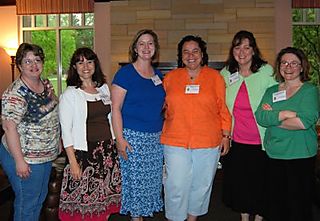
So I finally made it to the Minnesota Catholic Home Education Conference — this is the first year I've not been out of town for it — and lo and behold, they had a homeschool bloggers fireside chat! I met several bloggers new to me and saw a few more. I stole this picture from Margaret:
From left to right, Mary, Margaret,Tracy, Ana, Jamie, and your hostess. Aren't we a colorful bunch?
Most of the folks there didn't know me. So first I had to tell everyone I was "bearing blog," and then I had to tell everyone again that it was not "baring blog."Though now that I have a built-in web-cam, that does give me an idea for increasing my traffic.Kidding.I haven't gone through my pile of stuff from the conference yet, but when I do I can add links to a couple more bloggers I met. A great time was had by all.p.s. Wikipedia article on Erma Bombeck. Whom I nominated as candidate for the first pre-blogosphere Catholic mommyblogger. And may she rest in peace. -
Faster, I hope.
Laptop problem solved!
Because I have a brand new iMac. We cashed in a bunch of credit card points yesterday.This is going to take some getting used to. I never had a Mac before, although I used a G4 to do a fair amount of my work in graduate school.
But I can't help noticing that the Internet seems to be working again.And in the great tradition of suddenly having a brand-new iMac to play with, complete with PhotoBooth, here's me blogging with wet hair in my living room at 7:50 a.m. Sunday morning.The odd-looking cock of my head is an attempt to keep the glare of the screen from reflecting off my glasses.When the kids find out they can do this….ooh. Better not tell them. -
-
Chicken.
Ever since I found a convenient source for free-range “organic” humanely raised chickens, I haven’t cooked much chicken.
This sort of makes sense. You see, although the chickens are very yummy and don’t require an extra trip — they are sold by the same folks who sell me milk and eggs and cheese every week — they only come in the form of “whole frozen bird.” (OK, they’re plucked and headless and feetless). The problem is that my meal-planning algorithm classifies dinners by type of dinner, and the only chicken paradigms I have ready-made in my brain are “cook a whole chicken in a fairly complicated recipe, then eat leftover chicken for a couple of days” or “simple, quick dinner made with boneless skinless chicken breasts.” I don’t want to eat chicken three days in a row very much, even if the last day is soup from luscious homemade stock, and I don’t have much time anymore for complicated recipes. Also I never seem to have time to let the darn thing defrost. I still want to eat chicken, but now that I have a source for humanely raised chicken, I don’t buy boneless chicken breasts at the store. Clearly it is time for a new plan.
The solution was obvious when I actually sat down to think of it. America’s cooking repertoire is full of simple, quick dinners made from boneless skinless chicken breasts, ’tis true. But! America’s cooking repertoire is also full of simple, quick dinners made from chopped cooked chicken meat. And if you’ve got a whole frozen chicken, producing chopped cooked chicken meat is hardly any more work than cooking boneless skinless chicken breasts. So I need to replace one mental set of recipes with another. That’s all.
A couple of days ago, I got a whole frozen chicken from the dairy. I stuck it frozen in the slow cooker at 10 pm (here’s the rub — the chicken has to fit in your slow cooker even when frozen, else you have to defrost it so it will squish) and added salt, pepper, about a half a cup of water, and a bay leaf. It cooked on low until about 8 AM when I pulled it out and transferred it and its liquid to a bowl in the refrigerator. When I had time, that afternoon, I picked about six and a half cups of chicken meat off the bones, leaving the wings intact. I divided the meat into thirds. One third I set aside for enchiladas that evening. Into each of two zip-loc freezer bags I put one third of the meat and one of the chicken wings. (About eleven ounces of meat per bag, plus the wing). Those went, labeled, into the freezer. And of course, the carcass plus most of the liquid went back into the slow-cooker for stock.
Here’s my thought. If I process one chicken like this every three weeks, we can have one chicken meal per week plus all the stock we need. By freezing a wing with each batch of chicken meat, I can better adapt recipes that call for braising bone-in chicken parts — I’ll throw the wing into the braising pot with vegetables, then when it’s all done pull the wing out and put in the cooked chicken meat. I’m planning to try this method with my paprikash recipe next week. Since there’s only eleven or twelve ounces of meat per meal, it meshes pretty well with Mark’s cook-less-meat -for-a-better-world plan.
Hannah and Recipezaar.com helped me come up with a list of recipe ideas and classes of meals that would work with cooked chopped chicken. Here is what we came up with:
- chicken tortilla soup
- chicken fried rice
- lasagna with velouté sauce instead of traditional béchamel
- chicken wild rice casserole
- jambalaya
- white chili
- chicken pot pie in several variations
- gumbo
- cassoulet
- a skillet dinner I used to make with pork, rice, tomato sauce, provolone cheese, and green beans — chicken should substitute for the pork
- calzones — maybe with artichokes!
- wrap sandwiches of all types — I’m thinking of one I had at a restaurant that was turkey, wild rice, sweet potato, and cranberry sauce…
- chicken mole, maybe this “lasagna” recipe
- something from the bizarre category called “hot chicken salad” — I’ve never heard of this before but the recipes sounded promising
- Middle Eastern curry pilafs with dried fruit in them
- Biriyani
- Cacciatore
- For the kids — sweet and sour chicken
- Chicken sloppy joes
I think these should keep me busy for a while, don’t you?
-
Slowness.
TypePad recently upgraded their user interface, and my aging laptop is having a really tough time dealing with it — I hit a key, it takes three seconds for the character to appear on the screen. It's not so bad if I'm willing to type raw HTML instead of using the WYSIWYG screen. They claim it's a common complaint and they're working on it, so I'm crossing my fingers and hoping it gets fixed in a few days. Till then I may blog a bit less often.
-
Dry run.
Last night we gathered up all our camping stuff, including the new big tent, and took it to Hannah and Mark’s house in the suburbs to camp in the backyard, you know, just to make sure everything worked okay. Thunderstorms threatened, which was perfect for testing out the new tent. It started to rain while we were setting up, and within a few minutes we were bedraggled and yelling at each other and at our friend who was trying to help. Just like real camping!
“Grab the other end of this pole! No, not THIS one, this OTHER one!”
“Where’s the door? Is this the door? The vestibule has to go OVER THE DOOR.”
“Don’t put the fly on yet, we still have two poles left. MARK! DID YOU HEAR ME?! Two poles!”
“Quick! Unclip everything and rotate it! What? Uh, one hundred twenty degrees. No, one eighty.”
I came around the corner of their house, mostly soaked, and found the other invited guests waiting on the porch. They turned to me with big “So glad to meet you!” grins, so I said, “Hi! Um. I don’t live here. I’m just camping in the back yard.” Then Hannah opened the door. “She’s the one who lives here,” I explained and then went back to my car to get more tent stakes.
After the party, during which I learned from one of the other guests (weirdly) that some poor graduate students at the university are still being made to read my thesis, the sky cleared and Mark and Hannah pitched their tent in the backyard too. Mark built a fire in the fire ring. We’d also pitched the little three-man tent that Mark and I used before we had children, and the bigger boys clamored to be allowed to sleep in the little tent by themselves. What better time to see how that would go? We all guessed that the boys would creep back into their respective families’ tents before too long. Anyway, we all turned in about ten-thirty.
Around midnight I woke with a start and had that go check on the kids feeling. But I was really tired, the baby was latched on, Mark was asleep, we were in a fenced suburban backyard… everything had to be fine. I suppressed the urge and fell asleep.
Suddenly I was startled awake by the boys’ voices, shouting. I sat up. I heard Hannah calling, “Boys! Be quiet!” They didn’t pay any attention to her.
I shook Mark awake and told him to go make the boys stop that awful noise before they woke the neighbors. He sat up, fumbled for his glasses, and slithered out of the tent. I heard him mutter, “Who left the rainfly open?” Then I heard his voice, alarmed: “Where arethey?”
Instantly I was outside standing in the wet grass in the dark. The boys’ voices lingered a moment and faded rapidly, just evaporated into the night air, like a dream. Their little tent was open and their sleeping bags were empty. Hannah was running into the house. You have to understand that I was so certain I had heard them calling out, just a moment before. I can’t remember ever being so disoriented, confused, and frightened (and not really certain I was awake) all at the same time.
Of course everything made some sense in just a moment, when Hannah came out of the house and reported that they were both upstairs in her eight-year-old’s bedroom fast asleep. We all rolled our eyes and wondered aloud why they didn’t just come into one of our tents, and pointed at the lit windows and laughed, (they’d apparently turned on every light in the house), and swore we’d let them have it in the morning. Hannah’s Mark went inside to sleep and the rest of us stayed out with the little kids in the tents.
We never did figure out what the noise was that awakened us. Probably some cats. In the morning we found out that they’d tried to get into our tent but hadn’t been able to find the zipper pull in the dark, so — rather than calling for us and “bothering” us — they decided they’d rather just go inside.
You know your dry run has been a success when after it’s over, you pour yourself a beer and say to each other, “Thank goodness we didn’t try this when we were camping for real.” After one lecture, and one mental note to buy zipper pulls that light up in the dark, we declared the mission accomplished.
-
Salmon loaf glaze update.
I can report that the two glazes I tried the other night on two experimental salmon loaves were well received, although perhaps not so much as ketchup would have been.
Glaze number one: Grocery-store hoisin sauce thinned with apple cider vinegar.
Glaze number two: 1/3 cup plum jam, 1 tsp prepared Chinese hot mustard (I would have liked more, but I wanted the kids to eat it), five-spice powder, and a couple tablespoons of apple cider vinegar.
-
Meat, less. And more blegging.
Mark, getting more and more interested in sustainability, has been urging me to cut back on the animal protein in favor of vegetable protein. I see his point — sure, our family can afford to eat as much meat, fish, eggs, and cheese as we want, but six billion people can't eat like that. We could make a few sacrifices without sacrificing our health and be part of the solution instead of part of the problem.
I am the only trouble. I'm the only person in the family with any sort of chronic health problem at all, and that problem is overweight. Combine that with a family history of diabetes, and it's a high priority in meal-planning to make it easier for me to keep my weight down. The easiest way for me is to stay fairly low-carb, and the way to do that is to get most protein from animal sources, since legumes and grains mostly pack a high starch load. That's why in the last few years we've moved away from the vegetarian dishes that used to make up about a third to a half of the dinners I made, and towards meat-veg-veg plates with the occasional side of rice or potatoes or pasta.
But the rest of the family doesn't seem to have that problem, so maybe we can cut back on animal protein as a whole family while still letting me follow what I've learned works for me. When I make my meal plan this week, I'm going to try for combinations that use some meat and some vegetable protein, that I can serve to family members in different proportions. Hannah helped me brainstorm some possibilities that will seem natural and not complicate things too much:
- Meat and bean enchiladas: make some very beany and some very meaty.
- Chicken picadillo enchiladas: make some very almondy and some very chickeny.
- Pan grilled salmon served over lentils, a very nice recipe I will share sometime.
- Mjadra, a middle eastern lentil-rice-onion dish, with grilled sausages on the side.
- Extra-beany minestrone soup with shredded cheese on top.
- Vegetable stirfry with a bit of meat stirfry on the side, served with high-protein quinoa instead of rice.
- Ma po tofu, a pork-and-bean-curd-and-green-pea dish.
- Bean soup with ham, the ham shredded separately and mixed back into the soup in varying proportions.
- My fast chili, made extra beany and with some of the browned meat kept back out; also, the kids and Mark can serve it over pasta, and I'll eat it neat.
- Now that there are some new higher-protein pastas, macaroni and cheese can be an excellent protein source; I can have it as a side dish with a serving of ham or tuna, the kids and Mark can have a little ham or tuna mixed in.
- Black bean tostadas — always a favorite around here — with chicken or beef as a topping.
- Serve high-protein edamame as a vegetable next to a smaller portion of meat — that's tonight's plan (see below).
- Pitas stuffed with hummus, cucumbers, lettuce, tomatoes, and a bit of seasoned ground beef (all you need is oregano, onion, and salt — a little yogurt-dill sauce and you're in business — my family loves this meal and it goes together very fast).
- Stuffed peppers — some with rice and hominy, others with mostly beef.
- Spaghetti and meatballs. I'll just eat the meatballs.
- A simple approach: Make a mess of vegan rice and beans in the beginning of the week, and serve it every day as a dish to stretch whatever else we're having. Recipes are earnestly requested (that's the blegging part); hit "comments."
I'll start tonight — the plan is for grilled fish, edamame, a big salad, and some rice. I'll try to make the rice more interesting, like fried rice or pilaf, to see if the family can be satisfied with only 2 oz of fish per person. Since fresh wild-caught fish is freaking expensive (I decided never to buy frozen packaged fish again, it's so frequently yucky — we're getting it from The Fancy Grocery Store fish counter or else from a can from now on), I'm thinking my cheapskate frugal husband won't mind.
-
Sumer is icumen in
…lhude synge the hamesculing mum, "Get thee outside! Now! Don’t be icumen back in until you’ve played out there for a while!"
Ahem. Sorry. I’m not exactly Geoffrey Chaucer Hath A Blog.
Today is the first day of our "summer break." The scare quotes are there because (a) it’s barely spring, and (b) we only sort of take a break in the summer. Oscar (finishing second grade) will drop all the "subjects" and continue with spelling and math, each only twice a week. He also will work through a "50 States" workbook in preparation for American History beginning in the fall. Milo (pre-k) will finish up the Saxon Math K, which is tied to the calendar, in June, and after that he will only work on phonics. I elected not to teach any new Latin over the summer, but we’ll drill on it once a week so we don’t forget what we’ve learned.
I rearranged my days for the summer, too, to keep the kids outside when the sun’s low and inside when it’s high:
Morning is for outings: clean up breakfast; pack a snack; be gone a couple of hours and come home for lunch. I’m envisioning a lot of trips to the local playgrounds and parks.
Early afternoon is "inside time," for stories, chores, light schoolwork, and indoor play.
We have tea/snack sometime between 3 and 4.
After tea is "back yard time." They have to go outside and not come in until Mark gets home.
So far so good. We had a bit of a wrench thrown into our schedule because the kids were all exposed to chicken pox a couple of weeks ago. No spots yet, but the potential contagiousness has already kept us out of music class and postponed one long-planned playdate.
But today? Great.
My biggest problem right now is that I’m overusing videos during the day, especially for Milo (who’s 4). I have a hard time keeping him out of trouble while I’m concentrating on teaching his older brother, at the same time that I’ve also got Mary Jane to manage. As a result, Milo’s getting at least an hour a day of screen time. That is more than I really want him to have. I allay my feelings of rottenness a bit by showing him a lot of edu- and quasi-edu-videos (Signing Time, nature shows, The Electric Company), but I’d really like to cut everybody back to one video a couple times a week. With exceptions for rainy days or illness or… a chance to sit and talk to my husband for a little while without being interrupted, maybe.
Sigh. Maybe I could just start by saying "No movies on Mondays." And then I could expand it to Tuesdays. And so on. I wonder if I would learn how to cope. It’s more about disciplining myself than disciplining them. As is most of parenting, I have noticed.
-
“Church bars severely autistic boy from Mass”
This story reported in the Strib today will have you scratching your head.
The Rev. Daniel Walz, disturbed by what he said is Adam’s dangerous behavior, filed court papers to bar him from the Church of St. Joseph with a temporary restraining order against his parents. The Races are ignoring the order, which they see as discriminatory, and getting support from advocates for the disabled.
But before you come down hard on Rev. Walz, consider what he has to say about the boy, who is 6 feet tall and 225 pounds:
Walz, the church’s pastor for three years, said in an affidavit that as Adam has grown, the situation has worsened, and the boy has been "extremely disruptive and dangerous" since last summer.
Walz alleges that Adam struck a child during mass and has nearly knocked elderly people over when he abruptly bolts from church. He also spits and sometimes urinates in church and fights efforts to restrain him, Walz wrote.
The pastor wrote that Adam’s parents often sit on him during mass to restrain him, and sometimes bind his hands and feet, pulling a rope under the pew so his father can control the line from behind.
Walz wrote that Adam once pulled an adolescent girl — an exchange student staying with the family — on top of him, grabbing her thighs and buttocks. And, at Easter, Walz alleged, Adam ran from the church, got into the family van and started it, then got into someone else’s car, started it and revved up the engine.
If you read on, you will find that the mother does not contest these claims much, although she uses different words to describe them. According to the mother, for example, Adam pulled the foreign exchange student onto his lap because his parents often sit on him to comfort him.
What an awful situation for everyone involved.
"Disruptive" — noisy, very distracting, interrupting, etc. — is one thing. ‘Tis a fact of life that small children can be disruptive through no fault of their own — even if their parents scramble them out of the room as fast as they can climb out of the pew. And yes, disabled youth and adults can be noisy, interrupting, and distracting too, through no fault of their own. This is all just a fact of life. Some people just happen to come with more obvious problems than the rest of us. We still have to welcome them to the sacraments.
"Dangerous" is another matter. The mother admits that the boy climbed into the driver’s seat of a stranger’s car in the parking lot and that it was running? One word: LIABILITY. It is pretty hard not to see that there is a problem here.
The article claims that the church offered the family certain unnamed accommodations, and the family refused; and that the family asked for certain accommodations — one is mentioned, it’s ambiguous, but I think it means that they asked to have all the other parishioners get out of the aisles while the family leaves the church — and the church has not provided them. It is hard to judge the situation without knowing what the suggested sets of accommodations were. Certainly the parents, their son, the parish priest, and the other parishioners all have rights under Canon Law that must be respected. I’m also wondering if the bishop has been involved at all in the decision to ask for a restraining order against the family.
Note that this takes place in rural Bertha, MN, where it’s not quite so easy to shop around for an accommodating parish as it might be in the Cities. (There are only 2 parishes within 10 miles and 14 within 25 miles). I think if my family was struggling with a family member who, because of a disability, was making other people reasonably frightened, I might be inclined to look for a Mass offered at a hospital chapel, or find a priest willing to celebrate Mass at least sometimes for my family in my home.
-
Blogging Daughter Zion: Ratzinger’s definition of “world-view.”
A bit that I liked very much, and that can inform a great deal of contemporary discussion. The Episcopalians, apparently in the midst of a split along the lines described in the first part of this quote, should take it to heart!
(Except where noted, the emphasis, the bracketed comments, and the paragraph splits are added by me.)
The confidence with which Jesus’ birth from the virgin is denied today [he means, I think, by theologians in particular, not the average Joe] cannot be explained on the basis of the historical problems [e.g., the age of the biblical texts, the existence of similar stories in non-Christian traditions]. The underlying, actual cause which spurs the historical questioning lies elsewhere: in the difference between our modern world-view and the biblical affirmation and in the presupposition that this biblical affirmation can find no place in a world scientifically explained.
At this point the then the question must be raised: what is a "world-view"?
To what extent is it a determinant of our knowledge?
Closer scrutiny and reflection…of components of our own and previous world-views allows us to say this: a world-view is always a synthesis of knowledge and values, which together propose to us a total vision of the real, a vision whose evidence and power of persuasion rest upon the fusion of knowledge and value.
This is, however, the very basis of the problem: the plausible values embedded in the practice of a specific time attain through their conjunction with what is known a certitude that they do not enjoy of themseves and which, under certain circumstances, can become a barrier to more exact knowledge. The plausible [that is, I think, the set of commonly-held cultural values] can direct investigation toward truth, but it can also be truth’s opponent.
I think it would be instructive here to consider– to the limits of my own historical understanding — a past error caused by a past world-view, namely, the general rejection of the findings of Copernicus and Galileo. To the theologians of the time, the metaphorical "centrality" of man in creation (a value shared with today’s Christians), together with observations of heavenly bodies (a collection of true knowledge), together with a plausible-for-the-time idea that creation reliably reflected metaphorical realities (a value that is very different from one held by most of today’s Christians) implied a physical centrality (an untruth).
The world-view which would force us psychologically to declare the virginal birth an impossibility clearly does not result from knowledge, but from an evaluation. Today, just as much as yesterday, a virgin birth is improbable, but in no way purely impossible. There is no proof for its impossibility, and no serious natural scientist would ever assert that there was.
What ‘compels’ us here to declare the…improbability an impossibility, not only for the world but also for God, is not knowledge but a structure of evaluations with two principal components:
-
one consists in our tacit cartesianism—in that philosophy of emancipation hostile to creation which would repress both body and birth from human reality by declaring them merely biological;
-
the other consists in a concept of God and the world that considers it inappropriate that God should be involved with bios and matter.
The following sentence, I suspect, is much wittier in German:
…[T]he cause of the denial is due to the world-view, yet its consequences touch our understanding of God (our God-view).
Contrary to the usual presentation the real dispute occurs not between historical naiveté and historical criticism, but between two preconceptions of God’s relationship to the world.
MODERNIST: "You only believe in the incarnation because you don’t understand history. If you knew how the biblical texts were really produced, you’d understand what they really mean and what they really imply."
CDL. RATZINGER: "Excuse me, let me restate this to be certain that I understand. I affirm the real truth of the incarnation and the virginal birth. And this is because, according to you, I do not know very much about the current scholarship in the field of biblical exegesis."
(long pause, deadly penetrating stare)
MODERNIST: "Aaaah! The eyes! Like gimlets! They burn!"
CDL. RATZINGER: "Very well then. Moving on."
For the preconception that what is most improbable in the world is also impossible for God conceals the tacit presupposition that it is impossible both for God to reach into earthly history and for earthly history to reach him. His field of influence will be limited to the realm of the spirit. And with this we have landed back in pagan philosophy such as Aristotle elaborated with a singular logic: prayer and every relation to God is, in his view, "cultivation of the self".
If in the final analysis this is reality, nothing but the "cultivation of the self" can remain.
This is of course an argument that I have seen repeated many, many times, but doesn’t Cardinal Ratzinger have an elegant way of putting it?
-

Recent Comments
Recent Posts
- “Unprofitable servant”… of God.
- Mardi Gras recipe hack: Bread Machine king cake.
- Minnesota furious.
- Contemplation of the work.
- Boundaries and whom to set them with.
Categories
…more to come later