bearing blog


bear – ing n 1  the manner in which one comports oneself;  2  the act, power, or time of bringing forth offspring or fruit; 3 a machine part in which another part turns [a journal ~];  pl comprehension of one’s position, environment, or situation;   5  the act of moving while supporting the weight of something [the ~ of the cross].


  • Records.

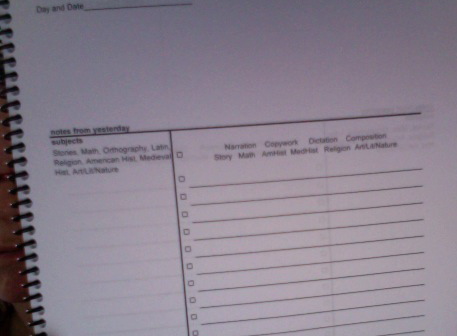
    Last week I had several homemade record books spiral bound at Kinko’s:

    Photo 12

    Each record book is for one quarter of the academic year. The front of each book has ten “week pages” for me to write my plan for each week. The left half of the week pages is organized by subject, the right half by day.

    Photo 14

    After the week pages come the daily pages. There are enough for every day, plus a few extra in case we mess some up.

    I tried this system at the end of last year, and it worked fabulously.  The idea is, the daily pages serve as Oscar’s to-do list.   Each day we have “lesson time” (when I work with him) and “independent time” (when he works independently from his list).  During lesson time, we create the to-do list together on the daily page.  He checks off each item as he finishes it.   Then these daily pages serve as my school record.  I have space at the top and bottom of each page to make notes or write evaluations.

    Photo 13

    This method doesn’t produce neat and tidy records organized by subject. But it does give me the day-to-day data that I would need to produce neat and tidy records with a few hours’ work, should they become necessary — say, if the school district were to request them. Much more importantly, it gives me detailed records that I can use to adjust my child’s instruction from day to day and week to week.

     Best of all, once the notebook is set up, this method requires almost no extra work. I would be writing this list out every day anyway (and indeed I was, and throwing the lists away at the end of the day, until I realized that what I was throwing out was a valuable record of our daily accomplishments.)


  • Measurements.

    In the comments to the final part of my “Gains” series, Amy F wrote,

    Thanks also for clarifying your height — seeing numbers in the 120’s is sort of jarring otherwise.

    Isn’t it funny that I didn’t even think about that?  I have a handful of IRL friends reading this, and a couple people I’ve met only because I blog (waving), and sometimes I forget that there are other people who’ve never stood next to me.  OK, so, to reiterate, I’m four foot eleven.  Which means that way back before there was a BMI, the magic “ideal weight number” I would get off the chart at the doctor’s office was either (a) not there, because the chart started at 5’0″ or (b) a number that always sounded as if it might as well be the winning pick in next week’s unicorn race.  (hint: It was always a two-digit number)

    [Editing note.  Deleted some out-of-date information about the utility of BMI.]

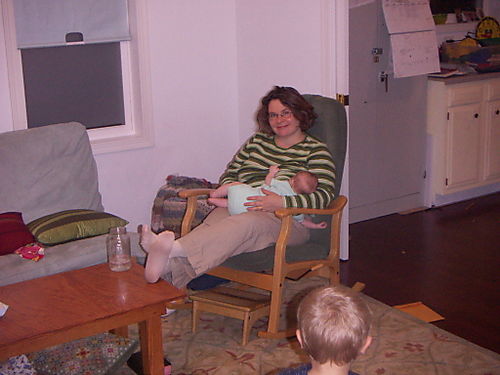
    In my photo post below, the first picture, a few weeks after MJ was born, has me at about 160 pounds and a BMI of 32.3, well into the “obese” category.  The picture taken a year later (after some time low-carbing) has me at about 148 pounds and a BMI of 29.9, at the very top of the “overweight” category.  Today I weigh 127 pounds, with a BMI of 25.6, at the bottom of the “overweight” category.

    If I reach 124 pounds, I’ll cross into “normal” with a BMI of 24.9.  The weight I have to reach to get below a BMI of 22, and thus statistically at low risk of overweight-related health problems, is 108 pounds.  That’s nineteen pounds away (and to be honest, I still do not really believe I will ever get there).


    Maybe after I lose three more pounds I will have to throw an “I’m Normal” party.  But perhaps a party would be counterproductive, considering.


    Aha!  Perhaps I will serve everything at my hypothetical party in pre-measured recommended serving sizes.  “Welcome!  Here are 16 tortilla chips and 1/4 cup of salsa.  Can I interest you in something to drink?  Would you like something that comes in twelve ounces, five ounces, or one and a half ounces?  Or a little something metric, perhaps?”


  • Conventional.

    Instapundit links this morning with the words, “Good news on saturated fat.”  The article, which is interesting and worth a read on its own, opens:

    Should we be reconsidering the conventional wisdom on saturated fat? Yes, according to Gary Taubes’s interpretation of the new report in The New England Journal of Medicine on a two-year diet experiment in Israel.

    We should always be reconsidering the conventional wisdom.  Refusal to reconsider is the mark of bad scientific thinking, not good.   Especially in an area as obviously complex and un-settled as human nutrition.

    And even more when the “conventional wisdom” is largely the result of policymakers’ decisions to simplify the message  delivered to the public…

    UPDATE.  Christy P’s comment on this post has got me thinking about messages.  I want to write more about this topic after I think about it a bit.

  • This one’s for you, Kelly.

    I have a search box now, over on the right.  Enjoy.


  • Monotonically decreasing.

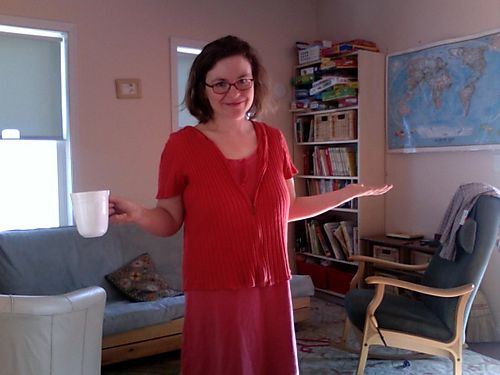
    Because someone asked, I hereby present some (1) way before, (2) before, and (3) now pictures.

    About 3 weeks after MJ was born:

    Photo Dump 2006 147


    I'm cheating because I don't have any recent pictures of myself.  This is from last summer (at about the same weight I was two months ago):

    Camp du nord 027

    This morning, via Photo Booth (pay no attention to the reversal of my living room):

    Photo 11


  • Weeknight menu plan: Two-slow-cooker dinner.

    We had a two-crockpot dinner the other night:  slow-cooked black beans; slow-cooked collard greens and kale; and a cast-iron skillet full of homemade cornbread.   If you have two slow cookers, this is a perfect weeknight dinner; cornbread is ridiculously easy to make, and you can pre-measure all the ingredients (don’t mix the wets with the drys until right before you bake it, though).  You can also prep the greens the night before and have them ready to go in the crock in your fridge.  

     If you don’t have two slow cookers, you should ask yourself what’s stopping you.  I have a big one and a small one.  But if you only have one, you can still have this dinner:  Cook the greens overnight, transfer them to a bowl in your fridge in the morning, and then start the beans in the same slow cooker.  You do not even have to wash it.  The greens will heat up fine in the microwave.  

    The day I cooked this was a busy-at-home day, so I could start one cooker at 7 AM and the other at 1 PM.  If I wasn’t going to be home, I’d have started them both at the same time in the morning; I have never heard of collard greens being ruined by cooking too long.  But if you like the way they taste best when they’re only medium-stewed, I’m pretty sure you could safely set the greens to turn on midday, on a timer (the kind you use with your lamps when you go on vacation).

    I served these three items with sliced fresh tomatoes and avocados.  Nothing more is needed.  Except maybe a cold beer to suck back while you’re waiting for the cornbread to come out of the oven.  (Oh, and my husband would like to add:  honey to slather on the cornbread.  Me, I’m happy to slather it with the beans, but to each his own.)

    For-the-big-slow-cooker black beans
    • 1 pound dry black beans, soaked overnight in water to cover
    • 6 cups water 
    • 1 carrot 
    • 1 rib celery with leaves 
    • 1 onion, peeled
    • Several sprigs fresh cilantro (optional; don’t let it stop you if you have none)
    • 5 whole cloves
    • 1/4 tsp crushed red pepper 
    • 2 Tbsp cocoa powder
    • 2 Tbsp lard or other fat
    • Salt and pepper to taste 

    Stud the onion with the cloves.  First thing in the morning, put everything into the slow cooker EXCEPT the salt and pepper (do NOT add the salt).  Cook on high until dinner time, at least 10 hours.  Just before serving, discard the vegetables and season to taste.

    For-the-small-slow-cooker collard greens and kale (slightly adapted from Not Your Mother’s Slow Cooker Cookbook by Beth Hensperger and Julie Kaufmann)

    • 1 bunch each collard greens and kale, rinsed well, tough stems trimmed, and cut into half-inch strips
    • 3 Tbsp olive oil or other fat
    • 4 cloves garlic, chopped
    • 1 cup chicken stock 
    • 1 canned chipotle pepper in adobo sauce, whole (that’s one PEPPER, not one CAN) 
    •  Salt and pepper to taste 
    • Juice of 1 lemon 
    • 1 Tbsp cider vinegar 

    Saute the garlic in the olive oil over medium heat, about 1 minute.  Add the greens in handfuls, tossing each addition to coat in the oil, and then covering the pan for a minute each time to wilt them before adding more.  When they’re all done, transfer to the slow cooker and add the broth and the chipotle pepper.  Cook on Low for 5 hours (more’s okay).  Remove the chipotle pepper, season with salt and pepper, and stir in the lemon juice and vinegar.

    Corn bread, my way, not too sweet
    • 1 1/2 cups ordinary yellow cornmeal, medium grind
    • 1/2 cup whole wheat flour 
    • 1 1/4 cups buttermilk or yogurt or a mix of the two 
    • 1 1/2 tsp baking powder 
    • 2 Tbsp lard, butter, or coconut oil
    • 1 Tbsp sugar 
    • 1 tsp salt 
    • 1 egg 

     Preheat oven to 375 degrees F.  Heat the fat in a medium cast-iron or other oven-safe skillet over medium heat until the fat melts and is hot (or melt it in a 9-inch square Pyrex pan in the preheating oven).  When it’s hot, turn off the heat.

    Meanwhile, mix the dry ingredients in one bowl.  Combine the buttermilk and egg in the other, and add to the dry ingredients, stirring until well combined.  Pour the batter into the hot fat in the prepared pan, smoothing the top if necessary.  Bake about 30 minutes or until it’s lightly browned on the edges and a toothpick comes out clean; if you use a larger skillet, so the bread is flatter, it might be done sooner.  Serve right out of the skillet.

    Meanwhile, mix the dry ingredients in one bowl.  Combine the buttermilk and egg in the other, and add to the dry ingredients, stirring until well combined.  Pour the batter into the hot fat in the prepared pan, smoothing the top if necessary.  Bake about 30 minutes or until it’s lightly browned on the edges and a toothpick comes out clean; if you use a larger skillet, so the bread is flatter, it might be done sooner.  Serve right out of the skillet.


  • Gains, the final part. The future?

    (Parts 1234, 5)

    So how is this going to end?

    There’s something unsettling this kind of doing things.  Because it really isn’t supposed to stop, is it?

    With low-fat and low-carb diets, I could always tell myself I would get to “stop” at some point (though I never got there because either I didn’t lose any weight, or I got pregnant and had to stop dieting for that reason).  

    Not now.   Before this May, I now know, I was simply eating too damn much food.  If I “stop dieting,” and go back to the old way, the weight will come back.  The thing is to do this for the rest of my life.  Perhaps I’ll get well enough familiar with portion sizes that I’ll be able to stop measuring everything; but there’s no way to get around the need to keep making sure I keep feeling a little bit hungry, before my breakfast, before my lunch, before my supper, for the rest of my life.

    Can I?  Will I?

    Will I keep getting hungry between meals, ever?  Will I never eat an entire pizza?  Will I always ask for the half portion?  Will I forget about ever filling up on bread, ever again?  Will I roll over in bed when my stomach growls at 3 a.m., saving that appetite for breakfast?  Will I throw out the kids’ sandwich crusts?  Will it start to feel wonderful, instead of worrying, to believe that the eating-till-I’m-stuffed is over? 

    And what will I do when this streak comes to an end? When the scale stops going down, will I find another hit of motivation every day, to keep myself from reverting to gluttony?  Or without that little bit of feedback, will I start thinking I can blow it a little bit here, a little bit there… and get back where I was?

    After all, since I’m not planning to waste away to nothing, there are three ways out of this:

    • I might reach the middle of the “healthy” BMI range.  (still sounds pretty unbelievable — there’s 19 pounds to go) and I might have to experiment with how much food to eat to maintain that weight.
    • The weight loss might slow and stop, since my leaner body needs fewer calories, and I might decide I’m comfortable enough where I am at that stable food intake.
    • I might get pregnant.  

     I have to be careful about the way I think about that last one.  I hope to have another baby, not that far in the future.  But I catch myself with mixed feelings about it now.  Pregnancy so far has meant pressing the “reset” button.  When my first baby was 6 months old, I weighed 156 pounds.  When my second baby was 6 months old, I weighed 156 pounds.  When my third baby was 6 months old, I weighed 156 pounds.  See?  Reset.

    Wrong-headed thinking?  Plenty.  “Why bother with the work to lose all this weight; I’m just going to weigh 156 at the end of my next pregnancy AGAIN.”  

    (Answer:  Because even a few months at this weight is a few months when I don’t put extra strain on my heart, my pancreas, my arteries)

    (Answer:  Because if I start out leaner, and eat the right foods, maybe I’ll gain less weight and have a healthier pregnancy)

    (Answer:  Because I’ve learned that I can get hungry without freaking out; I’ve learned that I don’t die if I don’t have second helpings of everything; I’ve learned how to eat the right amounts in all kinds of situations; and maybe I’ll keep those habits)

    The other kind of wrong-headed thinking is this:  “Maybe it’s not worth it to have another child.  Maybe it’d be more fun to stay thin.  Maybe it’s worth it not to try, because what if I never manage to lose this weight again?  What if I can’t summon the willpower to eat for one again after I’ve spent months eating for two?  No, better never go off the wagon, because I might never make it back on again.”

    (Answer:  Deep down, I know it’s not the right reason.  I have reason to believe I can lose the weight again, even if I weigh 156 six month after a hypothetical #4, because I’ve done it after #3.  And I know I’d regret never trying for another child.)

    So… There’s still mental work to be done, and an “end” to find.  For now, I can concentrate on one goal at a time, even though I only have a few goals left.  The next one, for now, is the top of the “healthy” BMI range, which not too long ago was 33 pounds away, and now it’s only 4.  I guess I’ll worry about what’s next when I see what’s next.  Whichever way it ends.

    [Editing note.  Years and years later, I wish I’d done a better job distinguishing gluttony from other problems with food, like clinical eating disorders and other kinds of compulsiveness.  

    I want to emphasize that, whereas I identified some behaviors in myself that probably qualified as self-centered gluttony in the technical sense, I am not and never have been qualified to make that distinction for anyone else.

    I hope to add some commentary to all the posts that have this problem as I find the time to review them.  Here’s a more recent post where I acknowledge some of the problematic material I wrote and set new ground rules for myself going forward.]


  • Gains, pt 5. Learning to be hungry.

    (Parts 123, 4)


    Whew.  It’s not done, for sure.  I’ve only been at this for six weeks or so.  Probably some crisis will come that will test me.  Who knows how I will do then?  But I think I really am learning.


    This time around, I make a point not to try to fool myself or fill myself up with water or broth or fiber capsules or fat-free popcorn or raw plain cabbage or any other thing that’s supposed to keep you from getting hungry.  I am trying to embrace hungry.  Like any other kind of phobia therapy, I’m shooting for controlled exposure to the thing I fear.  I’m getting hungry on purpose.  I’m seeing that it doesn’t kill me.


    I guess the first step was to get hungry on purpose, in a way that felt “safe.”  I carefully planned and meausred all my meals and snacks, keeping within a certain calorie range that was much lower than what I had been consuming.  Low enough, anyway, that I got hungry.  I really did.  But it wasn’t too scary, because I always knew exactly when I was going to have my next snack or meal, and exactly what I was going to have.  I’m hungry, but it’s okay, because in 45 minutes I’m going to eat 15 almonds, and then I won’t be hungry until lunch.


    It took a while before I really started to believe myself!  But it was true, and it keeps being true.  It is okay.   (Even better, the almonds are very tasty if you are hungry when you eat them.  I didn’t think I liked almonds, but it turns out they are nice.)


    The next step was to start noticing the hunger, and noticing that I’m okay.   I tried to remember to check in with myself as often as possible.  How do I feel?  Does my stomach feel empty?  Full?  Somewhere in between?  And how am I?  Am I worried, tired?  Thirsty?  Can I wait till snack time?   Would it be a good idea to have that snack now, and then wait longer till lunch?  I’ll wait fifteen more minutes and see how I feel then.

    I started to back off on the pre-planning and pre-measuring, then, at least at dinnertime.  I started trying other little tricks.  Like eating a full portion of salad or plain vegetables before putting a serving of meat or pasta on my plate (along with more vegetables).  Sticking religiously to one serving of the non-plain-veg at dinner.  And each time I finished something and thought about maybe having more, sitting, waiting, practicing noticing… knowing that it takes a few minutes for that satiety to kick in, waiting to see if it does.  You know what?  That hunger signal is replaced by a “full enough” signal, sometimes, if you know what you’re looking for.


    Then, when my confidence was growing and I felt I could make my decisions from a place of power (I know it’s psychobabble sounding words, but it does describe how I feel remarkably well), I started to have some fun with it.  I started experiencing having a reasonable amount of things I like.


    I went to restaurants.


    I took the kids out to breakfast the other day.  In my low-carb days I would have ordered, like, a three-egg cheese-and-spinach omelet and a whole lot of hollandaise sauce.  Hold the toast, hold the potatoes.  Instead, I ordered a veggie eggs Benedict (split English muffin, roasted mixed vegetables, 2 poached eggs), with the hollandaise on the side.  Hold the potatoes, because I know better.   I took one half apart.  The veggies went on my other half, and then I gave half the muffin and one of the eggs to Mary Jane.  I put about a tablespoon of the holly on top and so I had a half-Benedict with light holly and extra veggies (and MJ had a breakfast she liked too).  That’s not too bad!  I calculated about 350 calories.  Totally reasonable.  Balanced. And very satisfying, one of my very favorite breakfasts, off limits for such a long time.


    You remember I went to Chicago a few weeks ago?  That I ate in nice restaurants all by myself?  It was a special occasion, and I told myself I would eat anything I liked, but that I would not eat all of it.   I did it!  At one Italian restaurant I ordered the appetizer of roasted-mussels-in-sauce-diavolo and left two of the mussels (the ones that didn’t open, ha ha!) and did not soak up the leftover sauce with chunks of bread.  I asked for, and got, a half-portion of the pasta course I wanted, the oxtail ravioli in rich reduction broth, and I left a bit of pasta and broth in the bottom of my bowl.  I ordered dessert, the rice-pudding tart, and I ate about four bites of it and left more than half of it on my plate.  (I admit:  I did drink all of my champagne.  I had something to celebrate!)


    When I look at restaurant menus now, I have a completely different strategy from the one I had as a low-carber.  Then, the solution to practically every restaurant was green salad with meat on top.  I still like this kind of meal, and at some restaurants, like McDonald’s, it’s still the best choice.  But at other restaurants it’s not.  I took the kids to Chili’s the other day.  Have you ever seen the “green salad with meat on top” at a place like Chili’s, or Applebee’s, or TGIFriday’s?  It’s gigantic!  It comes, like, on a serving platter.  It is a cilantro-lime-vinaigrette-soaked mountain.  Topped with MEAT!  So, um, it doesn’t fit into my lifestyle anymore, because my lifestyle is not about lots and lots of “the right food,” it’s about small amounts of normal food.  Now I look for something that’s going to be small.  I ordered a side salad and a bowl of soup.  It was more than I needed, and I probably liked it better than I would’ve enjoyed the Hill O’Greens’N’Meat.   A second time I ordered the “guiltless grilled chicken sandwich,” which comes with veggies and black beans, and I gave half the sandwich to MJ.  (Unexpected bonus:  When I eat like this, I get the youngest child’s meal for free!)


    I’m eating at restaurants a lot, right now while I’m feeling confident and able to make good choices.  I’m getting into the new habits.  I’m trying to get used to seeing less food and eating less food, being okay with letting the extra go to waste if
    I can’t feed it to the kids.  It feels great.


    Next post:  Looking into the future.


    (Part 6)


  • Gains, pt 4. Getting over the fear of hunger.

    (Parts 1, 2, 3)


    The summary, to repeat:  I have an irrational fear of getting hungry.  Fear of getting hungry makes me overeat at meals so I won’t get hungry later.  Because I try never to get hungry, I don’t respond normally to hunger signals; so I look for external cues (rather than internal hunger/fullness signs) to decide whether and when to eat.  In the last post I wrote about one approach to the problem, that is, to find non-overeating ways to deal with the effects of the fear of being hungry.


    This post is about the fear itself.


    There must be a lot of people out there who are afraid of getting hungry, because I notice that many diets and diet books sell themselves with the promise “You don’t have to be hungry.”  You could fill a category at Amazon.com with the topic, “Lose weight by eating.”  (We’ve heard this before in the forms “The more you spend, the more you save!” and “Simplify your life by buying more stuff!”)  This is always the promise:  as  long as you eat the right food, you can have as much of it as you want.  Perhaps, as in low-fat diets, the right food has got less calories than something you might eat instead; or perhaps, as in low-carb diets, the right food produces satiety signals in smaller amounts; or perhaps, as in a fairly new category of low-energy-density diet, the right food has low calories per unit volume and so physically fills you up on few calories.  Whatever; sooner or later when you read the book, you will come to a sentence that tells you on this diet, you’re not supposed to be hungry.


    This is a great promise, for people who are afraid of being hungry!  You will not have to face your fear.  


    (It’s not a bad thing.  It can work; I’ve done it.  If you’re not ready to face your fear it might be the best thing.)


    But it’s clearly not the thing that we broken-hunger-signals, fear-of-hunger people should shoot for, because of a simple fact:  Normally, people get hungry.  


    • Point one:  Most people throughout world history have had to be hungry at least some of the time, so we evolved/were designed to deal with and even thrive with frequent pangs of hunger.
    • Point two:  Even here in the fat USA, normal-weight and healthy people get hungry.  (I know.  I live with one.)  They eat, they’re full, time passes, they get hungry, they eat.


    “Never being hungry” is something that I suspect is highly correlated with obesity.  (Note:  not the same as “never describing yourself as hungry.”)


    Perhaps it’s really a fear of all kinds of suffering.   Fear of hunger; fear of pain; fear of loneliness; fear of sadness; fear of exhaustion…  Would you take a drug or follow a program that promised you’d never feel sad again?  Many people would; many people do, or at least they try to.  People deaden themselves to get rid of the sadness and the pain and the loneliness, sometimes even with full knowledge that they deaden the same self that could feel joy and pleasure and connection.


    ANYWAY.


    About ten years ago I read a halfway-decent diet book that taught me quite a bit I didn’t know at the time; in retrospect, it was probably the one that started me climbing out of the (for me, useless) low-fat rut.   It helped me begin to notice sugar, and fiber, and protein.  But that’s not the most important thing I got from it.  One sentence from this book caught my eye and stuck in my mind back then, and I still remember it.  It has kept coming back to my mind for years, even though I have rarely followed its advice.   On page 203 it says:

    “Three-quarters of the world’s population goes to bed hungry, and so should you.”

    For someone with an irrational fear of hunger, this is a bracing slap in the face. Get some perspective!   it says to me.  Get over yourself!  Be thankful for what you have!  Oh, and, by the way, it’s not such a bad idea for losing weight.


    The corollary to this is, of course, that most of the world’s population also gets hungry between meals.  And so should you.


    I’ve been trying to get around it for ten years.  I’m ready to stop.  I’m ready to go to bed hungry.


    More later on how I’m doing it.


    (Part 5)


  • First name basis.

    Margaret, who in real life goes to the same parish as us, wrote in the comments:

    “PS. Milo got annoyed at me during CVBS [Catholic Vacation Bible School] when I told him–gently–that my name was Mrs. B. “No,” he insisted, “Your name is ‘Margaret’!”

    Ha. 

    Seriously, I think my children will never figure out the first-name-basis thing.  

    Readers who may live in the American South or outside the United States of America will please be asked not to be scandalized by what follows, as it reflects a genuine cultural difference between where you are and where I am.

    The parish we belong to is the only situation in my children’s lives where adults commonly introduce themselves to children, and refer to themselves in children’s presence, as “Mr. So-and-so” or “Mrs. Such-and-such.”  

    Remember, my kids don’t go to school, so they don’t have the experience of speaking to teachers and staff who would properly remain professionally distant.  Everyone else in kids’ lives, it seems, is totally informal with them.  When they go to science classes at the nature center, the naturalist introduces herself:  “Hi, I’m Leah.”  When they come with me to the grocery store, Oscar can read the cashier’s name tag:  “JAMES, customer service associate.”  Even my kids’ pediatrician says “Hi Milo, my name is Sylvia,” before she asks him to say aaahh.  Just about all of my friends are close enough to our whole family that it never even occurred to me to teach my kids to call them “Mrs. X” or “Mr. Y;” they use the same first names I do.  Our old parish was similarly informal (yes, it was “Father Mike” and “Father John” too).  So when we switched over to the new one, it was a bit of a culture shock to me to hear new friends introduce me to their kids as “Mrs. A.”  (Nearly ten years after my marriage, this moniker still seems to belong to my husband’s mom, not to me.  I suppose I could insufferably insist on Dr. A., but that’s been taken too.)

    Generally, the world suffers from too little, not too much, civility.  If I could go back and start over, I think I would teach my kids to refer to adults with their titles and surnames until invited to do otherwise, but I think it’s too late for me to learn.  It seems a little bit silly to insist that the children call our close friends “Mr.” and “Mrs.;” but then, as I look back, I remember that my mother taught me to call her close friends “Aunt So and So” — a term of endearment and respect (although it was a bit confusing, as I thought they were all really my aunts for an embarrassingly long time.)

    Anybody else not sure how to navigate this one?

    UPDATE:  Steve, in the comments, has an idea I’d never heard before.  I’ll think about it!

    UPDATE AGAIN:  Margaret brings the discussion over to her own blog.  Her commenters are much more uncomfortable with children addressing adults by their first names than I am!  But I want to stress I’m not uncomfortable at all with the choice to teach children to be more formal with adults, it’s just that I didn’t grow up that way and so it didn’t occur to me to do it.


  • Gains, pt 3. Living with what’s wrong with me.

    (If you’re just getting here you might read part 1 and part 2 first)


    So, to sum up so far:  I have an irrational fear of getting hungry.  Fear of getting hungry makes me overeat at meals so I won’t get hungry later.  Because I try never to get hungry, I have screwed-up hunger signals; because I have screwed-up hunger signals, I look for external cues (rather than internal hunger/fullness signs) to decide whether and when to eat.  There are two approaches to this problem:  (1) get over the fear, (2) find non-overeating ways to deal with its effects.   This post is about approach #2.


    For example, I know I respond to cues like  “Someone near me is eating, so I should be eating too”  or “There is still food here, so I should eat it.”  At least in my home, I can make a few simple improvements:  eliminate junk food so that people eat healthful things near me; use smaller plates so there is less food here; serve less food so there aren’t many leftovers.  I stopped keeping junk in the house long ago, and more recently I bought smaller dinner plates and tried to produce less leftover food, after reading Brian Wansink’s book Mindless Eating.  [Editing note:  Now largely discredited by substantiated allegations of p-hacking.]  I realize now that these things are working because they alter the environment so that the external cues I respond to are helping me instead of hurting me.  Other things to do in the same vein, particularly if you work and eat outside the home, are to avoid dangerous places like all-you-can-eat buffets, and to try to eat near thin people.


    If you want to go a level deeper, you can try to substitute more-helpful external cues for less-helpful ones.    When I pre-planned and pre-measured my meals and snacks, I introduced a helpful external cue:  “I will stop eating when I have consumed a certain mass or volume of a particular food, i.e., a certain number of calories.”  Weight Watchers’ “points” plan works the same way, as does consuming only “the recommended serving size” of everything.   A suggestion I’ve heard about, but not yet tried, is what I think I’ll call the Boolean Diet: consciously switch from “Someone near me is eating, so I should eat” to the more-restrictive “Everyone near me is eating, so I should eat,” or equivalently, “Someone near me is not eating, so I should not eat too.”  This might be a good thing to try the next time I go to a party.  At mealtime, it amounts to waiting to pick up my fork until everyone else has begun, and not picking at the leftovers when others have finished.


    Having the planned meals and snacks around helped me in another way I didn’t predict.  For a while, I saved time by assembling my midmorning and midafternoon snack in advance, toting them with me in a cooler if I had to be out running errands.  A typical summertime snack was not very large: for example,  3 strawberries, 5 almonds, and an ounce of cheese.  Still, even this small snack — carried with me and ready to eat whenever I got hungry — made me feel safe!  I didn’t feel the compulsion to eat extra at meals because I knew that if I got hungry, I could eat something healthful right away.  So I found a more constructive way to satisfy that irrational anxiety.


    Still better is to get rid of it, of course.  More on that later.


    (Part 4)