bearing blog


bear – ing n 1  the manner in which one comports oneself;  2  the act, power, or time of bringing forth offspring or fruit; 3 a machine part in which another part turns [a journal ~];  pl comprehension of one’s position, environment, or situation;   5  the act of moving while supporting the weight of something [the ~ of the cross].


  • Trade-offs.

    I've had the kids continuously enrolled in Music Together classes since Milo was a baby; we haven't missed a quarter.  I'm not very musical, and so I prefer to outsource music education.    The children really love it, or at least they do from ages 2 to 4.  Mary Jane sings the songs all the time, changing the words to suit herself as she goes about her day.  Milo's five now and his interest is starting to flag.  He wants to be like his big brother, and sit outside the studio and work on math problems while MJ and I are in the music class.

    But Milo seems to have developed a different interest.  Lately at Hannah's house you will find him sitting at the piano — not pounding on the keys, but picking out little one- and two-finger melodies of his own.  I have a few school recorders in my cabinet, and I gave him one a few months ago; he very much enjoyed trying to play it.  I taped over some of the holes so he could easily play a simple melody and he learned it quickly and was pleased with himself.

    What's this?  Interest?

    I don't know, but I suppose it's time to give him a chance to find out.  

    I'm not about to buy a piano — no room for it.  Instead, I was able to find a local teacher who would give him lessons on the soprano recorder, an instrument which I very much like for the slacker home school because it is inexpensive, portable, accessible, and does not really require very gentle handling.  So that is one of our summer projects:  finding out if Milo is interested in formal instrument lessons.

    Oscar was a little bit appalled that I would offer something to Milo that I never offered him.  "Oscar," I pointed out, "you never asked to play an instrument, and you've never shown any particular interest.  I taught you a little bit of recorder when you were five, too."  He had to admit that when he was five he didn't want to practice or take lessons.

    This decision highlights three aspects of my teaching style, I think.

    (1) My philosophy about musical instruments:  Everybody should have a little bit of instrumental instruction whether they're interested or not, but we can wait until the interest appears or until high school.  Instrumental education is too expensive to waste on a child who doesn't want it, except as needed for developing the basic musical literacy that every high school graduate should have.

    (2) My philosophy about teaching multiple children:  You can't give all your children identical educations, even if that was a good idea (which I doubt).  It's okay, therefore, to dole out certain opportunities to the child who's most likely to appreciate them.  In other words, I don't have to deny Milo instrument lessons at age five just because Oscar didn't seem interested in lessons at age five.  And I don't have to enroll Oscar in lessons just because Milo's getting them (though if Milo's experience really gets Oscar interested, I'll consider it).

    (3) My determination not to overschedule us.  Because during the summer while Milo's taking recorder lessons at MacPhail, I'm suspending the preschool Music Together class.  In some ways it's hard!  Mary Jane really loves the class, she has clearly learned and developed a repertoire of real musical skill, and I hate to take it away from her even for a quarter.  But I know it won't seriously damage her, I know I want to give Milo a chance to try out instrument lessons, and I work really hard to keep our family activities from overwhelming us, especially when we don't yet know whether Milo's lessons will turn out to be something we will want to continue.  In the fall, we'll decide whether to pursue the lessons, the preschool music class, or both, based on how much value we're getting out of them.

  • “Dip spinach” and other weird one-bowl lunches.

    Do you have a favorite thing to eat for lunch that you are perhaps secretly ashamed of, because you think other people would take one look and say, "Eww, gross!" or "I can't believe you're eating that!"

    Or, even if it's not objectively disgusting, maybe some other weird mixture of stuff that you love to just dump in a bowl and eat:  quick, easy, and as long as you like it, what's wrong?

    Extra bonus points if your meal is actually healthful, unlike, say, this offering from John Scalzi (which I admit looks tasty to me, at least if I'm really hungry).

    So, here are my mooshed-up-in-a-bowl lunches.

    1.  What I had today:  "Dip Spinach."  You've heard of spinach dip, which is an attempt to make a cream-cheese-garlic-and-parmesan base vaguely like a vegetable?  This is my attempt to make a vegetable vaguely like a cream-cheese-garlic-and-parmesan base.  I heat up a box of frozen spinach, drain it well, and then add yogurt, Worcestershire sauce, garlic salt, and shredded parmesan cheese.  (If I have any cream cheese or goat cheese, that goes in there too).  Moosh it all up, possibly heat it up some more, and eat it with a spoon.  Though if you happen to have some pumpernickel toast, erm, yummmmm.

    2.  "The First Solid Food I Ever Ate:"  A big bowl of cottage cheese topped with applesauce from a jar and sprinkled with cinnamon sugar.  I could eat this for breakfast, lunch, or dinner, any day of the week, and I think it would take me a really long time to get tired of it.

    3.  "Weird Muesli:" This is vaguely adapted from one Hannah admitted to eating as a child:  Chopped green apple, raw oats, and pecans with buttermilk or plain yogurt poured all over.  If I happen to have some crispy cereal to sprinkle on top for a little crunch, so much the better.  

    4.  "Salsa Tuna:" Tuna, a dab of mayo, some hot salsa (preferably imported Mexican salsa verde), and shredded cheddar cheese, mooshed up in a bowl and microwaved until bubbly hot.  I admit to making this dish with sardines a couple of times, too. 

    5.  "Fake Caesar Salad," a.k.a. "I'm Too Much Of A Food Snob Just To Go Out And Buy A Bottle Of So-Called Caesar Dressing Salad:" Romaine lettuce, parmesan cheese, olive oil, lemon juice, garlic, Worcester sauce, and Thai fish sauce.  With a poached egg on top.

    Now if only I could get my kids to eat this stuff, I'd never have to make separate lunches for them and for me again.

  • Raw vegan lunch.

    I am no vegan, but one of my favorite places to take myself out for a veg-er-riffic lunch is Minneapolis's finest raw vegan restaurant and oxygen bar, Ecopolitan.

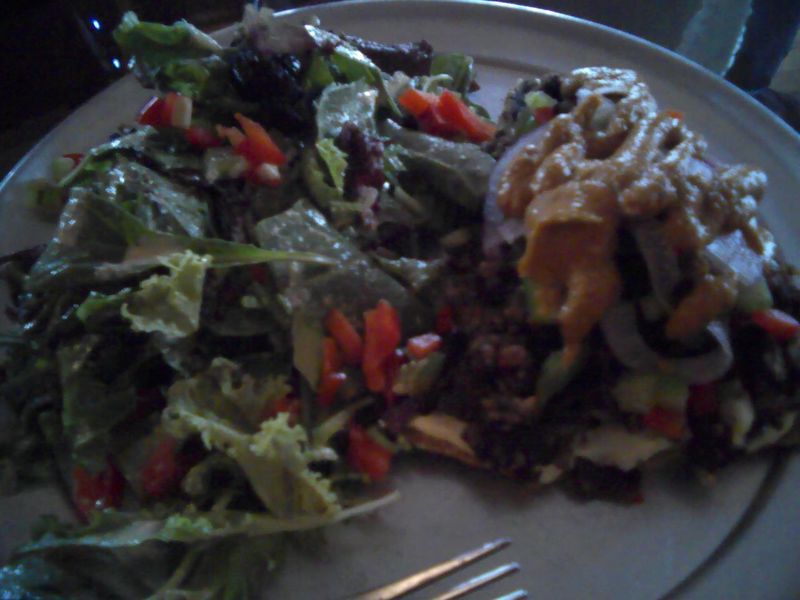
    The cooks — er — uncooks? — there are certified magicians.  How do they do it?  They tell me they have some fancy gadgets back there, e.g., for turning root vegetables into "noodles."  Last time I ordered a Thai curry noodle, full of coconut and macadamia nut and sparkling with ginger, lime, and basil.  Today I had a half-order of the "sausage" "pizza" and a side salad with tahini-garlic dressing:

    Ecopolitan lunch 

    The pizza "crust" is a sort of sprouted and dehydrated buckwheat flatbread.  The "sausage" is a spiced mushroomy-walnutty-mixture, with a flavor as satisfying as meat if you ask me — lots of umami.  There are also onions, peppers, olives, and a sort of tahini sauce on top.  This was a half order — I wished I'd ordered a full order after I had a single bite.

    This is the kind of thing I don't think I could ever recreate at home.  Maybe someday I'll take their uncooking class.  I fear, though, that to make this food one needs a lot of specialty equipment:  juicerators, dehydromogrifiers, daikon noodleizers, extruder dies, etc.

    I ordered dessert — I skipped the spiced carob cake (not a carob fan) and went for the oatmeal raisin cookie.  Sorry, no picture.  It was a fork cookie — too soft to pick up — a sweet, crumbly sphere of soaked oats, chopped nuts, and plumped raisins.  Like eating a nut-filled streusel topping, straight!  It was nestled in a bed of a sweet, honey-colored paste of apple and spices. 

    I don't know why I always feel compelled to explain to my server that I am Not Actually A Vegan when I eat there…

    Ecopolitan is a great place to take your vegetarian friend, who will surely be wowed, and also for multiply allergic people – unless one of the allergies is tree nuts, in which case you probably don't even want to walk in the door.  (link to .pdf menu)


  • Five books that explain the 20th century.

    I love posts in which commenters are challenged to name a handful of books and/or movies that meet some specific criteria.  (Here's a previous post along the same lines)  If anything else they often add to my lists of must-sees and must-reads.  

    Name in the comments the five works of fiction that you believe best explain – not define or symbolize or exemplify, precisely – but in some way explain the past century to (in Brecht's phrase) 'those who come after.'


    Lots of suggestions there already, including many that I've never read.  I don't know if I'd keep the list down to five, but among the suggestions that I agree do explain the parts of the 20th century I lived through are Tom Wolfe's I Am Charlotte Simmons and  Neal Stephenson's Cryptonomicon.   I'm almost embarrassed to find myself agreeing, too, with another Wolfe work, The Bonfire of the Vanities.   Wolfe's a stylistic and journalistic genius and it translated to his novels.  

    As for the others listed, mostly what's been produced is a catalogue of novels that have palpable senses of place and time.  The Great Gatsby.  Catch-22.  To Kill a Mockingbird.  Lolita (which may seem like an odd choice to explain the 20th century, if you've never actually read it).  1984 is a strange choice in some ways, but in others it is not.  Did the events come to pass or did they not?  I think I'd defer to the judgment of a citizen who actually lived under a real 20th century totalitarian regime, when deciding whether 1984 turned out to be an accurate portrayal.

    Love the list — I'm going to have to read some of the suggestions.

    A lot of people wondered what it means to "explain" a century.  I would say it means a novel which has a strong sense of the time and place, so that the reader of the future can understand the answers to some of the questions of "How could people have lived that way?  How could so many have made the choices they did?  What were they thinking?  Why did history take the turns it did?  How did the choices and beliefs of individuals come together to create the conflicts and movements that shaped history during those years?"

  • The toxicity of everything.

    Conversation at In the Pipeline:  "On the Uselessness of the MSDS."

    That's "materials safety data sheets," which are shipped with every substance that can be bought from a chemical supplier, and which famously warn about the horrible toxicity of everything, including sand and distilled water (and, according to a Usenet post linked in the article which is probably an urban myth, vacuum).

    It's one of my favorite rants about the problem of over-warning, and it has real consequences that in the end make laboratories safer for lawyers but more dangerous for everyone else; as one commenter points out, when harmless stuff and deadly stuff can both be labeled "Toxic," who pays attention?  And where do you go to get real information about how to protect yourself appropriately from exposure?

    One very interesting possibility in which information dissemination appears to be coming full circle:  As the official, government-approved channels of information become less and less useful in real life practice, will those who need useful information turn back to the age-old channels of folklore, hearsay, anecdote, oral legend?  It's "unofficial" but its anonymity (and consequent immunity from lawsuit) shields it from danger-warning-creep.  In the modern age, is this the niche occupied by wikis?  Already underway:  a new chemistry wiki, including a category for personal protective equipment.

  • “Could plagiarism be our friend?”

    Two provocative ideas for those whose vocation requires them to assign writing projects, from Jennifer Fitz.  I especially like the second one.  


  • So, the nature study book for this year is…

     In a previous post I wrote about my philosophy for teaching nature study to elementary-school kids, and promised to mention the book I'm going to use next year with Oscar.  Here it is: Messing Around with Baking Chemistry by Bernie Zubrowski, from the Children's Museum Activity Book series.  (Little, Brown, and Co., 1981; ISBN 0-316-98878-2)

     There are a lot of books about "kitchen chemistry" out there, and most of them don't really fit my style.  This one, however, is a little bit different.

    The usual problem with many of these books of demonstrations — I do not call them "experiments" — is that they are all about being impressive, and only superficially treat the deeper reasons why the material works.  A particular handicap is that the level of chemistry knowledge which elementary-school-age children might actually be able to assimilate — inorganic solution chemistry — is not readily available in the home kitchen, and most of the solutions that change colors or do otherwise interesting things are, um, toxic.  So the kitchen chemistry books play with baking soda and vinegar and call the one a base and the other an acid, and demonstrate that acids and bases combine to give off carbon dioxide.  Also that this is how volcanoes work.  Um.  No.  

    For good reason, introductory chemistry courses in formal study — high school and college — do not begin with sodium bicarbonate, but instead begin with inorganic hydroxides.   Nor do they begin with acetic acid, but instead with inorganic acids.  They are simpler systems that readily demonstrate basic principles of stoichiometry. (You try to demonstrate Dalton's law of Multiple Proportions in your kitchen when your reaction evolves a gas.)  

    Because this tendency in kids' science books irritates me so much, I never thought I'd use one that relies heavily on baking soda and vinegar.  Well, I spoke too soon.   This one's pretty good.  

    For one thing, it doesn't pretend to teach the fundamentals of chemistry.  Instead, what it's teaching are the fundamentals of laboratory practice:  as I wrote in my earlier post, "developing skills of safely handling, carefully observing, accurately describing, faithfully reporting, and logically analyzing."   And I think with a little bit of emphasis on my part it can also teach that "we can learn from our experiences and make predictions about the future, and when our predictions are wrong we have still learned something" — this is no less than the fundamental postulate underlying all of natural science.

    For another thing, it is honest about its limitations.  Zubrowski writes in the introduction, "What this book is about is how to investigate the chemistry of cake and bread making."  Indeed, "how to investigate" — not "This book will teach you all about the chemistry of cakes" or "this book will teach you why cakes and bread rise" or "this book will teach fundamental concepts of chemistry."  

    No, what it does it encourage kids to begin with recipes, change them, and observe the differences in the results.  This is different from most of the activities in kids' kitchen chemistry books — it's not just a demonstration ("Drop some food coloring in a jar of warm water and a jar of cold water and see what happens!  If you did it right, you'll see that the color spread faster in the warm water!"), it's actually an experiment.   If I require the child to keep a laboratory notebook and run parallel experiments with "control" cakes, then he'll really be doing a real experiment — much like my soaked-flour-in-the-bread-machine series I wrote about earlier.

    The experiments in cake-baking are followed by activities that demonstrate the effects of mixing various liquids with baking powder, and the author does not commit the error of calling these  activities "experiments."  He writes, "If you play with baking powder by itself you will find that it does some very curious things…"  and suggests that the child keep a record of his observations.  To introduce an activity in which the baking powder is mixed with soap water, he writes:  "Now here is something special to try that will show you what happens to the baking powder when it is added to the cake batter."  The explanation:  "The foam, especially in the sudsy water, is similar to what happens in cake batter. The water in the milk in the batter reacts with the baking powder to make small bubbles.  In the sudsy water, air is trapped by detergent film.  In the cake the combination of flour, eggs, and milk forms a sticky dough that traps the bubbles as they are formed."  

    This is accurate, unpretentious, and uncondescending writing for children about science (and about cooking).  Compare this to the language in, say, The Everything Kids' Science Experiments Book by Tom Robinson:

    Question:  What makes things fizzy? 

     In this experiment, you will produce different combinations of mixtures that react to form fizzy solutions.  You'll start with a baking soda/vinegar mixture and then move on to produce your own safe-to-drink, though not particularly tasty, lemon soda.

    Science concept:  Certain materials, when brought into contact with other materials, react in a way that forms bubbles.  Acids and bases often combine to form carbon dioxide, which, as a gas, is what makes carbonated soda fizzy.  You'll be experimenting with several common ingredients to determine which react in this way.

    The last statement is an out-and-out lie, and the thing about acids and bases "often" combining to form carbon dioxide is… well… misleading at best.  Not to mention implying that this is how soda drinks are carbonated.  Oh, by the way, one of the "reactions" is dropping a lump of dry ice into some water, which illustrates a physical (not chemical) change.  

    Back to Zubrowski.  Because he has kids making small cakes (6 Tbsp of flour in each one), we can use that to discuss the concept of scale-up.  Because he has kids comparing recipes that have been altered by one change at a time, we can discuss experimental design and controls.  There are several activities where mixtures of different quantities are compared, so the importance of measurement and careful replication is demonstrated.  Different brands of baking powder are compared:  since these will, of course, have different prices, there's a nod to economics and to variations in quality control from different suppliers, which Dad-the-process-engineer is really going to appreciate.   A suggestion that the child try making a baking soda cake with orange juice leads me to think the child ought to be able to design his own recipe based on what he's learned from the previous experiments.

      Gas collection syst
    ems begin with crude balloons-on-bottles but progress to the child's building a gas generator and a collection system in which the volume of gas can actually be measured.  (Here's where I'm going to go the extra mile and get some lab equipment — no need to bore holes in rubber balls stuck in the necks of jars when I have access to online retailers that will sell me value-priced two-hole stoppers and Erlenmeyer flasks).  The child is encouraged to try several activities that demonstrate the properties of the gas.  "Experiments?"  No!  Zubrowski writes, "Just what is this gas?  Is it plain old air or does it have special properties?… One of the jobs of a chemist is to find out about things like this.  Scientists have developed all sorts of tests for substances to find out exactly what they are.  Here are some you can try." He goes on to tell how the child can demonstrate that the gas doesn't support combustion, is heavier than air — a chance to explain molecular mass! — and dissolves in water to form an acidic solution).  And then, rather than claiming that all these tests prove it's carbon dioxide, he warns the reader "You would need to do other tests to establish this fully…"  (Guess what.  I can buy saturated lime water online.  Problem solved.)

    Why does the language matter so much to me?  It reminds me a little bit about my philosophy towards child discipline. With discipline responses, the most important thing to me isn't whether a given technique, or way of explaining things, "works" (appears to give immediate results).  I obviously don't want to choose things that turn out NOT to work, but not just anything that appears to "work" will do.  Ultimately, I choose techniques and language that I am comfortable using:  language and actions that communicate the truth, namely,  that the child is a human person deserving of respect while learning, AND that I as his parent have a real, natural, and just authority over him, AND that I expect him to learn to comport himself more and more as he gains experience and maturity.  If I can't find something that meets both those criteria (truth and effectiveness), I'm going to do my best to try to come up with one, and in the meantime I err on the side of truth over apparent effectiveness.  Because I believe that the truth IS effective, even if it seems to take longer than, say, duct-taping a kid's mouth shut.

    For the same reason, I need to use books that use language I can stand to hear.  Language that isn't dumbed down so much that it no longer accurately describes what's physically going on.

    So… even though Exploding Color Changing Slime may appear to get kids interested in science, really it only demonstrates that kids are interested in exploding color changing slime.  Which is not representative of "science."  I'd rather introduce children to what workaday science really means:   observation, measurement, recording, communicating, repeating and repeating and repeating, calculating, predicting, testing.  It is not, perhaps, as impressive; it perhaps will not produce wide-eyed wonder, at least not right away.  But it is true, and I think there is a special kind of quiet fascination that some children can find in the thought:  I can do this.  I can discover this.  I can measure this.  I can find it out for myself.  It takes longer to develop, but I think it will stick.

  • “Lard has clearly won the health debate.”

    See?  See?  I told you so!


    My husband, the Fat Guy (not the Big Fat Guy yet, but he can dream) has always put it this way:  “Look, chemically speaking, human fat deposits are more chemically similar to pig fat deposits than they are to any other animal that we eat.  So doesn’t it make sense that we should eat, and deposit in our bodies, the fat that’s most like the fat we already tend to have?”


    We get natural lard from a local farmer.  It’s not deodorized, so it has a faint porky scent that initially turned me off, but that I have come to appreciate in many dishes.  I especially love the flavor of cornbread baked in a well-larded cast-iron pan.  It’s also my choice for frying tortillas or chicken (not fish though) and it’s what I add to the pan when I brown ground beef unless I’m going for an Asian flavor.  I mostly use it for Mexican/Southwestern type cooking, and the occasional French item.  It’s my second choice for frying potatoes, after duck fat, which I render myself (I only have to do it every couple of years or so, as I don’t fry potatoes very often).


    I typically don’t use lard for pie crust (probably its most famous application in white-bread American cooking) but only because I learned to make a butter crust long ago and that’s what tastes normal to me.  I think I may have to find a recipe for those Mexican cookies he mentioned.


  • Labor and mind.

    Nice post from Kate at Peace and Pekoe about manual labor and the mind.

    It seems reasonable enough that there must be some real differences in cognitive development between the person who interacts with physical puzzles and products every day vs. those who only think and read and write and interact primarily with computers, pencil and paper. I see traits in my carpenter husband that seem organically connected with his trade, as though being a craftsman is a character trait like being introverted or optimistic, and I've learned to recognize some of these traits in other tradespeople as well – not that I find it easy to describe what exactly those traits are, without being guilty of over-generalization or romanticism. It's more a mode of being, thinking and doing, I think. In any case, I appreciate it and often envy it and I wonder sometimes whether anyone else has noticed this – this imprint one's work seems to make on one's soul – or whether I am alone in this.


    Oh yeah, I've noticed it — I'm married to a process engineer, a very hands-on, problem-solving sort of person who loves his job and comes home dirty.  I like to think I share a little bit of that mode of thinking, even though I always had a much more theoretical bent.

    Don't forget that there's another class of work that I'm sure changes your cognition — the kind where you work intimately with other people, and have to learn to navigate other people's flaws and talents, their immaturities and their gifts.  The kind where you teach others, and others teach you, if you're open to it.  Mothering is just such a life, but interpersonal interactions are central to lots of paid work too.  One can be good at it or bad at it.  And if you are getting better at it, it must be because your mind is making new connections, because you are learning.

    I find that living and working at home alongside my learning and growing children has been both a laboratory of "physical puzzles and projects" — and a laboratory for understanding human relationships in a way I never did before.  You might say I am learning how to manipulate people (smile) or you might say I am learning to motivate them.  In any case it is a laboratory of love, too.

  • Finally, a plan for science next year.

    Some subjects I don't plan ahead, we just pace through the lessons fast-enough-on-average:   math, spelling, Latin, English grammar, composition, and fine arts, plus reading lessons for my 5yo.   We continue most of these through the summer at a lighter pace.  

    Other subjects, the ones I don't do during the summer, I usually set up a week-by-week schedule to spread out the workload evenly through the year and so I can see at a glance what I need to prepare for the upcoming week:  our family read-alouds, American history, world history, religion, and science  nature study.

    I was really stressing out about nature study.  "Why, Erin?" you might ask.  "Why, when there are so many fine elementary-school-age science curricula, all boxed up and ready for you to purchase?"  The answer is that I am a bit, um, opinionated when it comes to so-called science curricula.  I can't help it.   I see a hundred flaws in every one I examine.  The problem is I am trained.  

    So, for example, I can't stand to use any curriculum that is "Designed for the parent without a strong background in science!"  That eliminates, um, a lot of them.  

    And then — let me pause to add that this is a matter of personal taste, and I do not think less of you if you differ from me on this one — I am unsatisfied with most science curricula that present elementary school science in a Christian worldview.  It is not just that I prefer not to use a young-earth-creationist curriculum; obviously, not all Christian curricula are young-earth-creationist. Mostly, my problem with them is theological-pedagogical:  they try too hard, and it feels forced and superficial.  Perhaps it's just that, having studied so much chemistry and physics myself, I would personally illustrate the connections among the structure of the universe, Christian revelation, natural law, and mathematics in a different way than the elementary school textbooks choose to do it.   I guess I think the universe so obviously bears the fingerprints of a Creator, and the more I learn about it the more sure I am of that, that it seems extraneous to me to stick God-language to a science curriculum.  Learn about the Big Bang; read Let there be light.  It's much cooler if you allow a child to discover these connections on their own.

    And then, I don't like the "Exploding Color-changing Slime" school of science curricula, you know what I mean, nor the especially cringe-worthy subcategory of Science For Girls! in which you explore the science of, say, bubble bath and perfume.  (I have before me a 1959 book called The Challenge of Chemistry:  Careers in Tomorrow's World of Chemistry, by O. A. Battista, in which the chapter called "The Challenge of Chemistry for Women" presents a more liberated world view than does the cover of today's bubble bath science kits.)  The Exploding Color-changing Slime curricula are all about grabbing kids' attention — they don't build a grammar of comprehension of how the world works.  They are  toys, pure and simple:  and they are fine toys, but not something to build a curriculum around.  (Occasionally a kit comes along that you can really do something with:  last year I had Oscar do a unit study on electrical circuits using the Snap Circuits kit, supplemented with an old library book about electricity, and also many wonderful dinner-table discussions.)

    And finally, even if a curriculum manages to pass all those tests, I always find some explanation of something in there that's oversimplified to the point of not being true, and it bugs me.  A LOT.  I guess you could say I am sort of a perfectionist about science.

    (Maybe everyone has that about some subject.  I have a friend who's done so much research about emergent readers that she can't stand to use any prepackaged phonics/reading curriculum at all, and was finally forced to write her own curriculum.  A good one, too, I should add.)

    The way I see it, there are several definite purposes to elementary school nature study.  (I really prefer that to the term "science" because to me, "science" means doing original — not contrived — research and discovery, which is only PART of the work kids are doing when they're studying nature — and usually it's a pretty small part, if they're lucky enough to do it at all.)  
    • First:  it's for learning a lot of random stuff about the world, the vocabulary of nature:  whatever interests the child, from how to recognize the species of birds in your back yard, to what makes the moon have phases, to what we call the reason why stuff falls down.  
    • Second:  it's for understanding that mostly, we can learn from our experiences and make predictions about the future, and when our predictions are wrong we have still learned something.
    •  Third:  it's for learning that mathematics is wonderfully useful for describing the physical world.  
    •  Fourth:  it's for developing skills of safely handling, carefully observing, accurately describing, faithfully reporting, and logically analyzing.  
    All of these are to be harnessed in formal instruction at the high school level, but it can all be done informally with a young child.

    And you don't have to hit all of those goals every single year, with every single curriculum.

    Aaaaaanyway.  I finally found something I am pleased with — not a curriculum, not a kit — but an ordinary children's library book, which I've been able to track down from a used book dealer, thank goodness.  We could do almost everything in it with kitchen equipment, but I think I will choose to buy some lab equipment, too.  I think it'll serve all of the above purposes at least a little bit, but especially the fourth one.  I had to sit down for an evening and break it down into a week-by-week schedule, and to my pleasure it filled about thirty weeks, which is just about perfect because it's a "full year" and yet leaves me about six weeks of leeway.

    I'll introduce you to the book in another post — this one's gone too long already!

  • “I do it for the children.”

    Anna Prasomphol Fieser explains the agony of the decision:  whether to have cream cheese wontons on the menu of her restaurant True Thai, easily the best Thai place in Minneapolis.

    (Now open on Sundays!  Woo hoo!)

    I've only just discovered Ms. Prasomphol Fieser's blog and am really enjoying reading through it, although it's making me hungry.  From her entry on "Starting the day right:"

    Reading an old newspaper I saw that a very bright young man just graduated from the University of Minnesota at the ripe old age of 13! Congratulations to Caleb Kumar for becoming the UM's youngest graduate ever.


    Wow, and I thought I was precocious for having graduated from high school at the age of 15!

    I don't know about Caleb, but I was the victim of a very harsh upbringing. Instead of getting to eat donuts and junk food like all my friends, my mother made me start the day by eating her special salmon dish. On our menu it is known as My Mother's Salmon because it's exactly the same recipe as what I ate each morning as a schoolgirl in Thailand.

    Did it work? Well, none of my donut-eating friends graduated until they were 18 and by then I was off to America to study business at Kentucky Business College.

    Gorgeous photo of "My Mothers Salmon" at the link.  It makes my fried egg on steamed kale and spinach with olive oil, which I thought was so lovely, look like a bowl of corn flakes.


  • How to get a link from Margaret (just wait).

    "Margaret had her baby!" I was telling Hannah, and showing her the beautiful photo that Margaret posted on her blog (shown to the right as a thumbnail).

    DSC_0119
    Mary Jane came around the corner and pointed at Hannah's computer screen.  "We have that picture on our 'puter!" she exclaimed.

    "Who's that mommy and baby?" asked Hannah's four-year-old Hazel.

    "That's Erin's friend Margaret," said Hannah, "she just had a little baby boy."

    "Margaret?" asked Mary Jane quizzically.  I could tell she didn't recognize the name.

    "She likes little girls to call her Mrs. Berns," I added by way of explanation.

    "Why?" asked Hazel.

    "Because it's her full name," answered Hannah, "like sometimes people call me Mrs. P____."

    "Mrs. Berns?" said Hazel wrinkling her nose.

    "I don't like to call her Mrs. Berns," announced Mary Jane.  "I like to call her Mrs. Coffee."