A reader just let me know through the comboxes that email to bearingblog.com was bouncing — I believe I've fixed the problem. I really don't know how long it's existed, it may have been six weeks or more. Sorry about that.
bearing blog

bear – ing n 1 the manner in which one comports oneself; 2 the act, power, or time of bringing forth offspring or fruit; 3 a machine part in which another part turns [a journal ~]; 4 pl comprehension of one’s position, environment, or situation; 5 the act of moving while supporting the weight of something [the ~ of the cross].
-
-
Grilled meatloaf.
I always feel a little shameful when something I make derives most of its tastiness from ketchup, but, well, there you go. What's not to like? Sweet, tangy, tomatoey…
I am sure there is nothing particularly original about this, but I did make it up myself when I wanted to make hamburgers but didn't have any buns. My. Family. Loved. It.- 2 lbs ground beef
- 6 Tbsp ketchup
- 2 Tbsp hot sauce (Frank's RedHot, to be specific)
- 1 egg
- 1/4 cup minced onion
- 1/4 cup minced green bell pepper
- Fine fresh bread crumbs or similar
Mix beef, ketchup, hot sauce, egg, onion, and bell pepper in large mixing bowl. Add bread crumbs until, er, until the texture holds together "just right" — the amount depends on the kind of crumb, but about a half cup seems to do, maybe a bit more. Let the mixture rest in the fridge for at least 30 minutes or so to firm up, then form into hamburger patties. Grill till done and a bit charred on the outside.You could serve these on buns if you wanted to, but they are fine fork food too. They are a little softer and crumblier than a good solid burger; if I were going to put them on bread, I think open-faced on buttered toast would do very nicely.I served them with fruit salad and steamed broccoli, with ketchup and mustard on the side. -
In which I sleep a lot, and learn to eat more.
Well, I've dropped a couple of nearly invisible hints that no one (with permission to mention it) seems to have noticed, and all friends and family IRL have been dutifully notified, so I'll just come right out and announce it, even if it means nobody will read the other two posts I wrote today:
Baby #4 is expected in late January!
There will be a larger gap than I originally wanted between Mary Jane and her younger sibling — she will be nearly 3 1/2 when baby X is born. After I met my weight loss goal, we decided, I needed some more time to learn how to manage my new weight. I am certain that was the right decision — my confidence was so much better in April than in November.
Besides, almost by definition, weight loss depletes your physical resources. A few months of solid, good nutrition at a stable weight seemed like a good foundation for a healthy pregnancy.
In many ways, this pregnancy feels like a first time. So many things are different: I am getting regular exercise, I am more physically fit than I have ever been in my life, I am eating a different diet richer in vegetables and fruits and lighter in starches and meat, I am starting out 27 pounds lighter than I ever started a pregnancy. Already at 8 weeks there are some obvious differences. I am tired and sleep a lot, but mostly in the afternoon and evening rather than all day long as in previous first-trimesters. I have a little bit of aversion to certain foods, but so far zero nausea and vomiting.
On the other hand, I am astonishingly stressed out and obsessed over the 3 pounds I have put on. My morning weigh-in is swinging wildly up and down and every morning it kind of freaks me out. Is anyone surprised? No, me either. And I am having some trouble figuring out what to eat, especially with the slight food aversion which is monkeying with the routines and meals I had carefully settled on in the past few months. I can't even look at a Brussels sprout, for instance.
I tried to find some helpful advice online by googling "pregnancy after weight loss". Not a whole lot out there, or at least, if it's there, it's a needle in a haystack of "weight loss after pregnancy" and "pregnancy after weight loss surgery." I'm beginning to wonder if I should be looking for pregnancy-and-nutrition information on sites for people who are recovering from eating disorders.
Anyway, coming into it I decided that a safe thing to do is mostly to eat how I've been eating, and add extra calories mainly in the form of yogurt. Because one of the ways my new way of eating shook out is that I don't eat nearly as much dairy as I used to.
So… let the expansion begin.
(UPDATE: Just in time, here's Alice Bradley's new website, Let's Panic About Babies. Check out the "ad" for slings in the right sidebar. Awesome.)
-
Obsessive avoidance of backsliding, or, I feel bad about my bread.
Alert readers, especially those who came from Cathie's blog, remember that I keep up with my family's need for sandwich bread pretty well using a bread machine. Also that I experimented recently with acid-soaking flour in the bread machine and came up with a more-or-less reliable method for adapting bread machine recipes to an eight-hour soak.
(Acidulate the liquid if needed with 1 Tbsp white vinegar; halve the yeast; remove added gluten at first, and experiment to see if you need to add some back; hold back the salt, mix the dough 5 minutes on the quick bread cycle, reset the machine to make whole wheat bread in 12 hours, and put the salt on top for it to be mixed in when the cycle starts)
Soaking the flour, while it is more nutritious, is marginally less convenient than not soaking because of the plan-ahead factor. And the method isn't perfect (yet) — the loaves are always edible but occasionally don't rise properly. So I've soaked every loaf of whole grain bread I've made since I developed my technique, but… I've also made less bread and allowed us to run out from time to time.This morning I didn't have any bread but I need some for lunch, so I went ahead and started a non-soaked loaf for the first time in months. I feel kind of guilty!* * *This is a problem I have, my own special kind of perfectionism. I avoid developing new good practices unless I am sure they are permanent. All-or-nothing: once you add, don't cut back. For some reason it seems okay to say "I know I ought to do such and such, but I haven't figured out how to fit it into my schedule yet." But it seems not so okay to think about saying in the future, "I used to do such and such, but then I decided I didn't have time for it."This is probably the number one reason why, for example, I have never even attempted to add any daily Masses to my schedule with my kids. I dread coming to a decision where I have to say "Sorry, I have to cut back on going to Mass." Even though I know very well that going to Mass more than on Sundays is optional and not at all required, I fear that once I've established a practice of going more than once a week it will feel like "CHOOSING SOMETHING ELSE OVER GOD" if I ever decided to back off from that.(Thank God for liturgical seasons, by the way. They give me the freedom to try out devotions without the stress of commitment past the end of Lent or past the end of Advent.)I recently decided to try out instrument lessons for Milo over the summer. I explicitly announced to everyone "This is just trying it out, we might not continue in the fall," and I deliberately cut out preschool music class for the summer to make up for the extra cost and time. I'm trying very hard to be committed to deciding whether it makes sense with our schedule, but I am still anxious about the possibility that I might have started something we'll need to stop.In short, I'm good at saying "No" to too much commitment up front. I'm not so good at being a quitter. Or, at least, I feel bad about the possibility of quitting. This even though some of the best decisions I ever made have been decisions to quit something.So, Cathie, if you're reading this, please tell me I have your permission to occasionally bake some bread that hasn't been soaked. I think I will feel a whole lot better. -
Fusion cuisine.
A dish I never had before moving to South Minneapolis is tacos al pastor (Google image search results). It's a specialty of the place up on Lake Street where we always get our Mexican carryout when the tribe comes over: Taqueria La Hacienda, 334 E Lake Street. We send Chris to fetch it because he's the only one who speaks any Spanish, and he likes the practice.
Tacos al pastor look a little bit like Greek gyros. The meat is spiced, pressed, and stacked on a vertical spit, then slow roasted and shaved off onto corn tortillas. It's usually served with cilantro, onions, and pineapple; the Taqueria also does a plattered version where they top it with bacon, onions, red and green peppers, and cheese and run it under a broiler or something.So I find out today from the tcfoodies blog that tacos al pastor looks like gyros for a reason! It's actually descended from Lebanese shawirma:…at least according to Wikipedia, the al pastor taco is a Mexican adaptation of shawirma, introduced to Mexico by Lebanese immigrants.
Nice adaptation. Very nice.So often we think of fusion cuisine as a peculiarly American melting-pot sort of thing… it's good to be reminded that it happens other places too. Well, if you ever see tacos al pastor on a menu, be sure to order it — it's kind of rare to see it outside Mexico City, I'm told. Lucky South Minneapolis! -
Hiking.
There's a good post on introducing your kids to backpacking at Sectionhiker.com. The author is Tom Murphy, a guest-poster from the comboxes. Good to read it, because one of my great frustrations is hiking with children.
Maybe it sounds like a bit of a cliche, but of all the kinds of exercise in the world, probably my favorite for sheer enjoyment is a medium-strenuous trail hike, taken fairly swiftly. I don't much like to stop and rest and enjoy the view; I like the way the view keeps changing when you keep moving, and I like the steady bite of my soles into the ground and the slight soreness of the muscles when you've been going for a long time, and I love how delicious trail food can be when you've worked up an appetite by walking all morning. Here in Minnesota, most of the hilly sorts of hikes are forested; my favorites have been out West, on drier, rockier land, in and out of gullies, having to scramble here and there. We had an extended-family trip to Las Vegas a couple of years ago; Mark was thrilled to get to do some premier rock climbing (not with me!), and I was thrilled to take several hikes in the canyon including one without the children. (Mark doing his thing)
 (Nobody took any pictures of me on MY cool hike, but I did get some cool plant photos) It's not that it's not fun to hike with the kids — it has its own charms — but I get so impatient at how slow we have to go. I want to GO GO GO and they want to do stuff like look at bugs or hide under overhangs or or identify flowers or stop to eat trail mix or climb on big rocks.
 What is with them, anyway? I mean really.Anyway, I am going to show the linked article to Mark, because it's one thing I definitely wish we did more of: hiking with the kids.And — frankly — also, hiking without the kids.
 Or at least only with the kids we can carry.
 -
This afternoon’s project: Defragging the schoolroom.
View from the front door of my house:
 View from the living room:
 I know what you're thinking: that I took some pictures midway through reorganizing the schoolroom. Those big cleaning projects sure can make a mess!Except this is the "before I start" picture. We've been living with this pile for a week or so. The only thing I've done so far is go up to the attic to clear off a couple of spaces on the shelves to store stuff that will come out of this room.Wish me luck.
 -
This bothers me too.
From DarwinCatholic:
At the end of the day, I can't help suspecting one of the real reasons for all our regulations in regards to cars is to make sure that the car inventory turns over often enough. Having driven my car 4,600 miles in the last 16 months (so the JiffyLube guy told me in wonder) I'm not exactly destroying the planet — but the government won't rest until I shell out the money to buy a new car, which would probably involve more emissions to produce than driving my '96 around for another decade.
Yup.And unless you get it immediately junked, what's going to happen is that someone else will buy your old car and there will be one more on the road. At the margins it makes a difference: the more old cars there are on the road, the more people can afford a car. Some folks would say that's a good thing, and some would say it's a bad thing; I won't take a position, having sympathy for both sides and no inclination to run through the calculations right now; but when you buy a brand-new, high-mpg vehicle you can feel good about, those older cars don't usually disappear into thin air. -
Coming back for more.
I ran my second 5k this morning, the Center for Diagnostic Imaging "Back In Shape" Run/Walk in Bloomington. As I told my friends Eric and Kim In IA a few weeks ago: "I think the reason I want to keep doing this is that even after months of running, I still hate the feeling of running. I am determined to keep going until I don't hate it any more!" (They laughed. "So, as soon as you like it, you'll stop, right?")
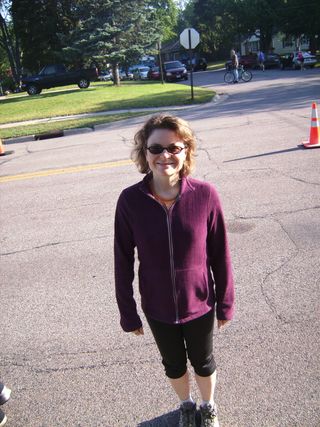 I felt really good before the race, on a breakfast of poached egg, corn tortilla, black coffee and tomato juice. But about 5 minutes in I was beginning to wonder if I would make my primary goal of "not stopping to walk."
I did make it! That's me in the orange, #310, coming in for the finish. and lagged behind my previous time by a whole 3 seconds. 28:27. If nothing else, I'm pretty consistent! So I didn't set a new PR, although it is a PR of sorts (more on that another time).
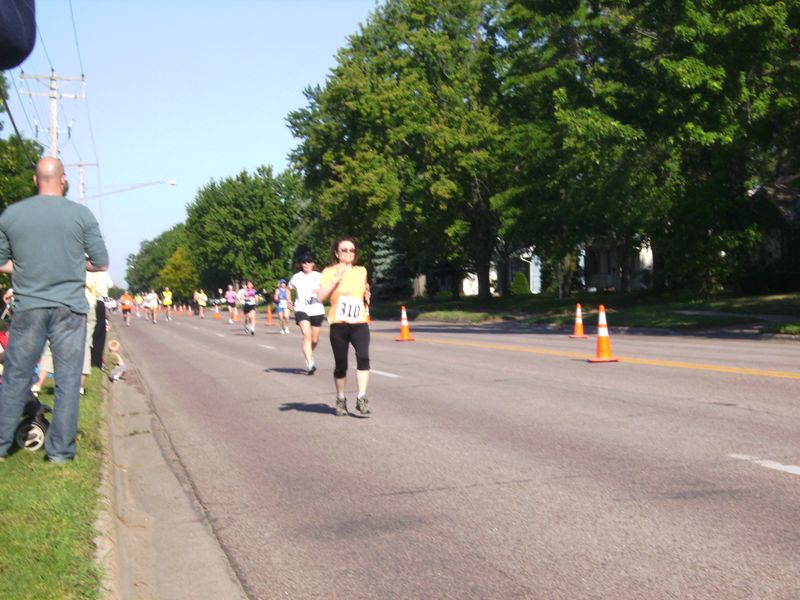
The race was a really fast one — the winners were in the 14-15 minute range. It was a well-run race, with a sweet buffet at the end — yogurt, fruit, trail mix, "race rolls" from Great Harvest Bread Company (I swear it's worth it just to get the race rolls, even if they don't have raisins), sports drinks, bagels, muffins, and COFFEE. They were also giving free massages in the lobby of the chiropractic/alt-med college that hosted the run.
Big purse, too — the male and female winners each took $1,500.
After the race we stuck around eating muffins and watching the awards ceremony. They had a full field in the 80-to-84-year-old men's race, and the winner wasn't that far behind me. Good for them!
There was a kids' fun run too:
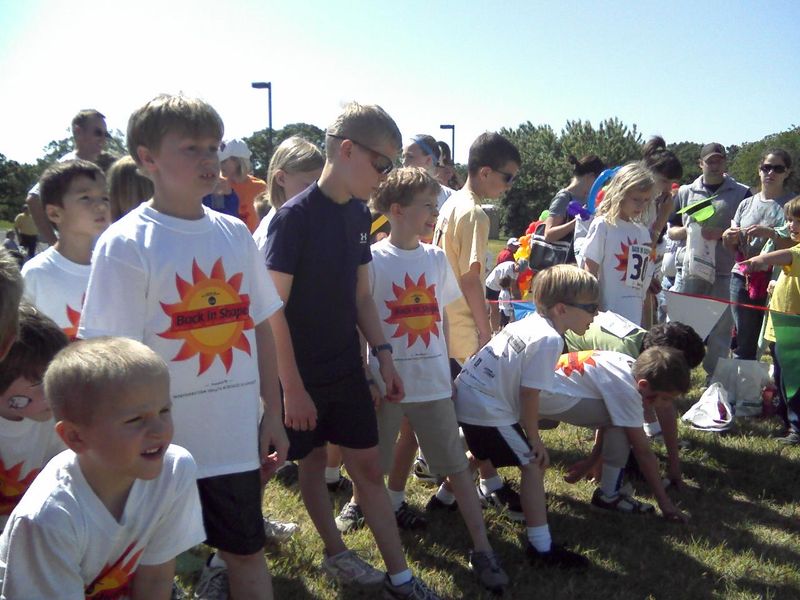 There's Milo in the bottom left corner, and Oscar is three kids down.
There's Oscar coming in at the end of the half-mile. Milo has the balloon string in the foreground; he did half the half-mile race and decided he was satisfied and didn't need to go around again.
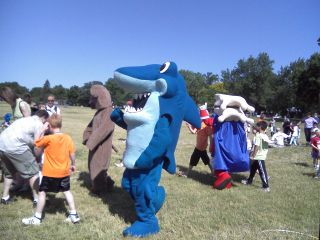 Aaaah! Mascots!
I call this one the "NOBODY TOLD ME THERE WOULD BE SHARKS." shot.
We had a great day! Maybe I don't hate this so much after all.
-
Counterbalance.
I just finished reading a book that's been out for several years but that I ignored until recently, when I thought I might need a corrective to all the diet books I read last year while I was losing weight: The Obesity Myth by Paul Campos. It's been a while since I deliberately read something that I expected to disagree with — a practice I recommend heartily!
I was surprised to find that the book was in more than one way a wake-up call for me.
The basic thesis of the book is that our public policy towards obesity, and the amount we spend in public and private dollars to combat obesity, doesn't make sense for three reasons.
Number one: there's no credible evidence that obesity in and of itself (except at the extremes) causes health problems.
Number two: there's no credible evidence that losing weight in and of itself makes obese people healthier.
Number three: We're not getting much bang for our buck anyway, since the money and effort we've poured into the goal of getting people to lose weight is not resulting in weight loss.
I will begin with several significant caveats. I am not entirely convinced by Mr. Campos's review of medical data. There is not that much of it; I would like to see a much more thorough and detailed cataloguing than is present in this book, one much more like Gary Taubes' analysis in Good Calories, Bad Calories. I am also certain that some of Campos's data points raise questions that require answers before one can come to a conclusion. (One example: he writes that, excluding extreme thinness and fatness, life expectancy increases as you go from lower to higher BMIs. I thought: Now wait a minute — life expectancy also increases as you get older, and people gain weight as they age, so shouldn't there be a correlation there anyway?) Third, he seems to sort of selectively criticize and praise the practice of controlling for confounding variables. I agree that this statistical tool can be used judiciously or maliciously, but Campos does not explain why he says it's justified here and not there. Has he proven that "there's no credible evidence" that obesity causes illness? I don't think so.
However, I think he does succeed in showing something a bit less ambitious: that the evidence is not nearly as strong as most people assume it is based on media reports and public policy recommendations. Five arguments he made struck me as very persuasive, if they are true, of this less-ambitious thesis. I feel I have to add that caveat because I think Campos needs more evidence to demonstrate that they are true. But if they are true, I agree with him that they call into question the obesity-health connection.
(1) To demonstrate that obesity causes health problems, most of the studies had to exclude smokers. (He says this isn't legitimate; I say it is; but regardless, the following point still stands.) After you exclude smokers and maybe a few other classes of people, the number of deaths in the studies are small. Nonsmokers in one study had a less than 1-in-600 chance of dying of cardiovascular disease; thinner nonsmokers were less likely to die than fatter nonsmokers, but the number of excess deaths attributable to obesity alone is perhaps not high enough to justify the effort we're putting into combating obesity. At the very least, the harm of obesity is likely dwarfed by the harm of smoking. Which do you suppose our country spends more on: attempting to lose weight and get people to lose weight, or attempting to quit smoking and get people to quit smoking?
(2) Public policy advisory boards have an astonishing level of conflict of interest. It goes beyond the level of "this study was funded by that industry which has a stake in the findings." For example, he says that a claim of a strong international consensus that BMI>25 was based largely on the report of a World Health Organization panel that "consisted entirely of physicians who run weight loss clinics." Even if you assume a good-faith effort, could such a group really be objective?
(3) Campos says that studies that purport to show a connection between weight loss and improved health have not adequately controlled for the effect of improved nutrition and increased physical activity; and news reports fail to distinguish this effect too. Campos gives an example of a study where participants significantly increased their physical activity and as a result both lost a few pounds and improved some measures of their physical health: the media reported it as "losing a few pounds can improve your health." It is now very well established that, independent of your weight, physical activity makes people healthier. (I wrote about this in my post about reasons to exercise.) Because of that, it's obvious that a study purporting to show that obesity causes poor health must control for physical activity. Campos says that many of the studies don't have that control.
(4) Taking all the methods together, the act of losing weight introduces significant health risks that have not been adequately compared to the risk of not losing weight. For instance, he claims that bariatric surgery is shockingly dangerous (the risk of death within a month of the surgery is somewhere between one in 20o and one in 50!). Is it really proportionally dangerous not to have bariatric surgery, especially at the lower-BMI end of the market? He says there are health risks associated with traditional methods of weight loss as well.
(5) Being "BMI-normal" or less appears to cause some serious diseases that obesity protects you from. Osteoporosis, which can lead to deadly hip fractures, is one such disease; there are others. When you include these "diseases of mild thinness," does the relative danger of mild obesity start not looking so bad?
Since it's true that physical exercise really is well established as something that improves health, it's apparent to me that it's dangerous to suggest "You should exercise to lose weight, because the weight loss makes you healthy." Physical exercise is not actually that good at bringing about weight loss. If someone starts exercising to lose weight for their health, they could really be improving their health and yet not see a weight loss; and will they then conclude that it's not doing any good, and so quit? Or will thin people dismiss exercise because they don't think they need to exercise to be thin?
* * *
Not all of the book is about the medical research. A large part of it is about the social pressure to be thin. This is the part of the book that, for me, was a wake up call. Because I've probably been contributing to it a bit over the past year, as I chronicled my own struggles with weight loss. I hope on the whole my writing has been positive, because I firmly believe that physical activity and well-balanced, not-excessive nut
rition are worthy goals in and of themselves, even if they don't result in thinness, and I want my writing to have reflected that. Still, I measured my success last year largely in the pounds that came off the scale, and I'm a bit more aware that I emphasized the number too much.Even in my personal experience, Campos's points ring true. I've been telling people that I've never felt better since I lost the weight — but maybe I feel better because I'm so much more physically active, and the weight loss is just a side effect.
And then there is the lengthy discussion of why we criticize obesity so much. We say it's about health, but is it really? Particularly if the medical evidence against it turns out not to be so damning? Campos makes a strong case that it's about the need for us to have some kind of social pariahs among us, a need to feel superior to others. (Hoo boy, that hit home. Consider this post. And consider that it was after I started to lose weight that I started to write that I was "conquering gluttony." Look, I'm getting thinner! It proves I'm becoming a better person!)
A point I found especially interesting: Campos, a Mexican-American, argues that the freedom to look down one's nose at fat people has functionally created a way for elite, highly-educated white people to continue to sneer at low-income black and Hispanic people, without having to feel guilty about it:
Precisely because Americans are so repressed about class issues, the disgust the (relatively) poor engender in the (relatively) rich must be projected onto some other distinguishing characteristic… In 2003, any upper-class white American liberal would be horrified to imagine that the sight of, say, a lower-class Mexican-American woman going into a Wal-Mart migt somehow elicit feelings of disgust in his otherwise properly sensitized soul. But the sight of a fat woman — make that an "obese"– better yet a 'morbidly obese' woman going into Wal-Mart … ah, that is something else again.
He has got a real point (made only clearer by the fact that some upper-class white people would be disgusted merely by the mention of the Wal-Mart, without any reference to obesity at all).
Race intersects with obesity culture in another way I wasn't aware of. According to Campos, girls and young women in the U. S. who are black or Hispanic are much more likely to have a positive appreciation of their own bodies than are white girls. They are more likely to evaluate their self-worth independently of their appearance. They are also likely to have a higher BMI. And (this is the kicker) at least for African-American women, the denonstrated connection between obesity and poor health is even weaker than it is for white women. Campos seems to suggest that public health authorities are actively promoting educational campaigns that will sensitize young black and Hispanic women to the dangers of obesity. If this is true, it is really hard not to come away with the impression that some public health policy amounts to "Let's make black and Hispanic girls feel bad about their weight."
So here's my final word on the book. It's not perfect. It's flawed. It raises questions that go unanswered. I'm not convinced of Campos's thesis. But I think I'm convinced that he raises good points, points that people like me — who tend toward the weight-obsessed, and who like to tell ourselves that it's "about our health" — need to read and take to heart. Some of this seeking after thinness is not necessarily healthy, and it's not necessarily virtuous.
Over the months after I reached my goal weight, it took constant vigilance to keep my weight at 108 instead of, say, 112. Is it reasonable for me to fear those four pounds? OK, the truth is I'm really afraid that if I let myself gain 4 pounds, I'll let myself gain 40. Is that a reasonable fear? All my clothes still fit at 112. If I relaxed my diet slightly and became stable at 112, would I be happier or sadder? And does it make any sense at all to be "proud" of my weight loss? Even if it's true that gluttony was a big problem before, am I better off if I replace it with vanity and pride?
I think I came away very convinced of one sentence in the book, one of the principles of the "health at every size" movement: A healthy weight is the weight a person maintains while living a healthy life. To me, that means while being physically active and eating a well-balanced diet in response to real hunger signals. Campos derides the traditional approach, but I disagree. I think traditional "diet and exercise" can help a person create that healthy life; you may have to exercise on purpose in order to get enough physical activity, and you may have to control your eating in order to balance your diet and learn to eat in response to hunger. I did. But it does suggest that the number on the scale ought to have less sway on our decisions, personal and public, and especially on our compassion towards others, than it currently does.
-
Cultural Youtube surfing.
This morning I followed a link from Deep Glamour in a post about sprezzatura to this clip of Viviana Durante dancing the lead of Aurora in "Sleeping Beauty." (Embedding disabled, but it's worth a view — the control and balance and precision is amazing. It's been a long time since I've seen a ballet in person, and watching the clip made me remember how much I enjoyed going to the Dayton [OH] Ballet as a child and teenager).
The kids arrived and watched over my shoulder, and so I showed them numerous other clips. Mary Jane in particular was entranced by the ballerinas.
Every once in a while, an afternoon spent surfing YouTube randomly with the kids is a lot of fun, and why not count it as part of the school day? We usually come across at least one thing that's quirky and very cool.
Today it was this clip of a Russian children's choir. They sing two songs. The second is okay, but the first one — "Katuschia", lyrics and translation are here — amazed the children (and me) so much that we had to watch it at least five times. My kids love to watch clips of children performing, they love to hear people singing in exotic foreign languages, they love fancy costumes — it's perfect:
Something about the exuberance of the children in the chorus really got to me! -
“The one method of so-called discipline that does not work.”
Fantastic, fantastic post from Leila at Like Mother, Like Daughter.
Read it and understand why it's good and right, not a hopeless dream and not an idiotic permissiveness, to aspire to "punish" your young kids as rarely as possible.Because foresight, respect, and reasonable selflessness go a long way.
Recent Comments
Recent Posts
- “Unprofitable servant”… of God.
- Mardi Gras recipe hack: Bread Machine king cake.
- Minnesota furious.
- Contemplation of the work.
- Boundaries and whom to set them with.
Categories
…more to come later
 bearing blog