bearing blog


bear – ing n 1  the manner in which one comports oneself;  2  the act, power, or time of bringing forth offspring or fruit; 3 a machine part in which another part turns [a journal ~];  pl comprehension of one’s position, environment, or situation;   5  the act of moving while supporting the weight of something [the ~ of the cross].


  • I’m having trouble getting into Lent this year.

    Life is just too good right now.  

    I have a beautiful baby who has just started to smile at me.  I am starting to feel like myself again, and today my favorite fleece jacket fits me for the first time.  The snow is melting here, and with it is dissipating the oppressive gloom that every Minnesota March brings.  The small sacrifice I chose for Lent turned around and blessed me immediately with abundance. 

     I can't seem to make myself stay in the desert. 

    Seriously.  This is a problem (!?)

    I am probably not trying hard enough.  This doesn't have the feel of the sort of spiritual richness that one gets from a "good" Lent, so much as it feels like "not Lent at all."  Hm.


  • Leo’s birth story (IV and done).

    Parts I, II, III.

    V___  checks me and says, "You've got a bit of a cervical lip."

    "Oh, no, not THAT again," I grumble fiercely.  In two of my previous labors, J____ manually pushed aside the "cervical lip"  – an edematous bit of cervix persistently blocking the baby's descent — while I screamed through contractions.  It's the worst part of any of my labors.  I brace myself for V____ to tell me that's what she's going to do next.  

    But instead she says, "Just try to breathe through the next one, try not to push.  Just breathe through it."  This is novel.  I pant and try to stay open, neutral.  I carefully skirt the reflex that hovers on the edge of my consciousness.  It doesn't hurt not to push, it doesn't frustrate, it's just difficult.  I almost make it, but at the end my control peels away and the push spills over.  The expulsion reflex distends me, and distends my voice as I say, "Oh, sorryyyYURGH–I can't help it."

    "It's fine, you did fine," comes V____'s voice from behind me.  "It's almost gone.  Try that again with the next one."

    I do, losing control at the end again, and:  "It's gone, you're all done.  The lip is gone."

    I'm so pleased not to have had to endure the lip-shoving again that it doesn't quite sink in that I am, so to speak, cleared to push the baby out.  But it is not many more contractions before I know we are almost there.

    I made the notes only five days later, and oddly enough by that time I had already forgotten the pain of crowning.  I remembered the stretching, but not the pain.  The baby crowned to the brow over the course of one contraction and stated there till the next one, and that was new and intense — staying there so wide and full, and me expecting the next push would bring me past that.  That moment of waiting.  And the next one did bring me past that:  his head was out.  I hoped for the shoulders to follow.  They didn't.

    Here we are.  This is what I had been expecting from the beginning.

    Mark told me later that he wasn't worried at that moment, because what he saw was that the baby had turned; he was not anterior anymore, he faced up as I labored on hands and knees.  Hannah told me later that she saw no sign of worry on the midwife's face, that she set her face as if to say, "you're coming out, baby!" and then she got to work.

    Put your knee up.  I put one knee up.  Mark comes to my side to help.  I reach out to Hannah and cling to her and push again.  My face is in her hair. My breath comes in and out in prayers, my body pushes out the prayers too, I could not stop them if I tried, it is good that my lips have formed them so many times before.  V_____'s hands are working on the baby. (Later she told me:  "I really got in there and lifted your sacrum up.")  I picture a ship in a bottle, rattling against the neck.  I can feel his bones sliding and pushing against mine as she works on him, turning and adjusting this living key in the lock.  It occurs to me that I should try to push harder, so I do.  

    It takes a couple of minutes. They are long minutes for me.  Hannah and Mark are able to see that V_____ is still firm and determined and unworried, and so they aren't worried.  I can't see this and although it has not risen very high in my mind, because not helpful, I am a little afraid.  Still there is a certain peace in that there are no decisions to be made, no possibility of doing the wrong thing, only to do what I am doing as hard as I can, and there is no possibility of doing it less than as hard as I can.  From here on out, it's not possible to make a mistake.

    I push hard, trying to keep my balance, and clutch at Hannah's hands.  My eyes are tight shut.  I can feel V____ wrangling with us.  Finally, with a last violent yank he is freed, and I fall a bit forward onto Hannah and kiss her hair and say, thank God, thank God, thank God — and the baby squawks immediately, loudly, and I can't say anything but thank God, thank God, thank God, and then my head clears a little bit and it's as if my own good self wakes up, and I say to Hannah, "That's a command, you realize," and she says "I know," and then oh, how I enjoyed listening to that baby squall.

    The cord is very short and I am kneeling on my bathroom floor.  I can't see the baby, he's behind me.  We can't quite pass him forward between my legs.  After some struggling I am maneuvered over the baby onto my back leaning on Mark (the floor presses painfully against my lower back and tailbone) and the baby is on my belly, squirming hotly, while V____ busies herself between my knees, doing I know not what.  There is a picture of me from these moments, my face is relaxed and blissful and radiant, more than anything else relieved and tired.  

    DSCN0031 copy

    I am really uncomfortable, but it is difficult to maneuver with the cord so short.  We decide I will stay where I am until the cord is cut, and then I will make it to the bed.  After it stops pulsing, I watch V_____ carefully clamp it in two places, bring the curved sharp scissors around it (I resist the impulse to tell her to be careful of his toes) and cut.  Then it is time to move to the bed.  I release the baby to Hannah and am helped to my feet.  

    While we are working on getting me upright, Mary Jane wakes up sleepily. She stares up at Hannah in bemusement and asks, "Hannah?   Why are you here?"

    Hannah tells her, "I'm here to meet someone new in your family.  Who do you think this is?"  Hannah whispers to her, lifting the bundle to show her.

    Mary Jane decides, "It's Hazel," who is Hannah's 5-year-old daughter, and she drowses back to sleep.

    Meanwhile, I hobble to the bed; the bottom has dropped out of my lungs and my breath is ragged and shallow, a familiar sensation.  Turn, sit gingerly on the bed (watch out for that cord).  I stay near the edge of the bed to deliver the placenta.  I say to someone, "I'll feel better when the placenta is out."  For some reason I'm worried there will be a problem with the placenta too.  But it is not much time before I feel it appearing between my legs, and I push it out with a last and very satisfying grunt.  "OH that feels SO good," I tell everyone.  And it does.  Better even maybe than getting the baby out.  It feels like being DONE.

    With help I crab-walk backwards until I can collapse at last on the pillows and be covered with warm blankets.  Somewhere in there J_____ arrives.  The baby is examined briefly.  I get my baby in my arms.  It is a little bit difficult to connect with him, I feel as though our messages are zinging past each other and not quite registering.  It seems as if it has been too long, as if we've missed those "moments after birth."  But I don't think I could really co
    pe with anything except my own tired hurting body until just now.  I am sorry we missed some of that, but I know he was in good hands, between his father and our friend Hannah.  We have plenty of time to get to know each other.

    I put the baby, who is red and cross-eyed, to my breast and he latches on immediately and hungrily — I peer at his lower lip and announce that he has a perfect latch.  

    A happy, happy end at four in the morning on January 29th.

    (Postscript:  Hannah took all the pictures, stayed till late in the morning, let us sleep in, and made breakfast for our family before going home to get some sleep herself… for which we are very thankful.)

  • Pajamablogging.

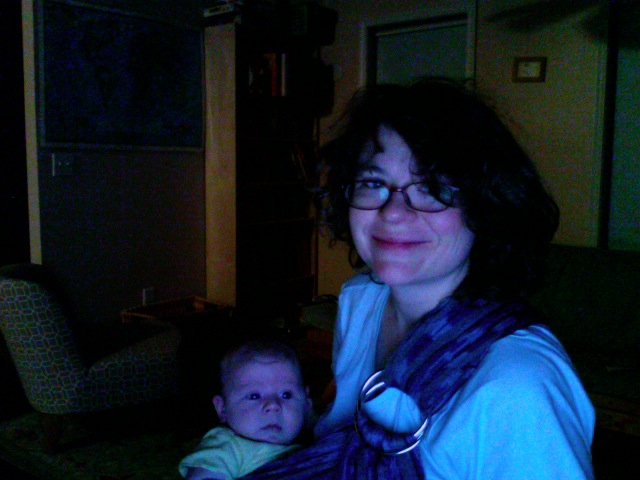
    Uh-oh.  Leo is turning into one of those babies.

    Photo 198
     
     Yeah, it's 1:45 a.m.  He's not fussy, but he wants to talk.


  • Groggy.

    I didn't know it was possible, but as I walked around the 1-18th-mile track that circles the top of the basketball gym at the Y, I was dozing off on the straightaways.  Just for a couple seconds, in between rounding the corners, the music from my iPod floated me away into brief interludes of microsleep.  

    I must be really tired, because I didn't think tunes like "Sledgehammer" are exactly, y'know, soothing.  "Mercy Street," maybe.  But generally, I don't put that sort of thing in playlists called "Running Music 2."

    Here's to hoping the baby doesn't want to chat at 4 AM anymore.  Sooner or later he is going to discover that I am not much of a conversationalist at that hour.


  • Quarantine.

    I doubt I would be this creative if I were locked in a hospital room for 7 weeks.


  • A few new cookbooks.

    Since I'm in losing-the-baby-weight mode, I decided to add a few new cookbooks to the kitchen, all with healthful overtones.  Having some new books around, and new recipes, always helps motivate me.  I thought I'd post a brief review of the books I checked out from the library and decided to buy.  Two are nutrition/diet books with a recipe section, one is a cookbook through and through.

    51lVVfuItZL._BO2,204,203,200_PIsitb-sticker-arrow-click,TopRight,35,-76_AA240_SH20_OU01_ The Flexitarian Diet, by Dawn Jackson Blatner. 

     I've been eating "flexitarian" for a couple of years now, without knowing it.  The term "flexitarian" is variously defined.  Some say it means "flexible vegetarian," i.e., you're basically a vegetarian but you're flexible enough to graciously accept a meat dish when it's offered to you.  Others say it simply means a reduced-meat lifestyle:  vegetarian most of the time, meat some of the time.  At our house, we love meat and eat it frequently; but we have learned to use it in smaller quantities.  I generally serve it either as a flavoring, or as a dish served in modest portions as part of a meal.  

    Blatner's cookbook/diet book offers five full weeks of controlled-calorie menus, plus recipes.  The recipes are all given for single-serving portions, use a lot of convenience food, and come together quickly.  Canned beans feature prominently.  This book is especially good for those who are looking for some new ideas for quick and simple, healthful meals; those who'd like a lot of one-person recipes; and those who would like a pre-written meal plan.   Like most diet books  these days, it stresses low-fat eating more than I like, but that's easily fixed.

    One that doesn't stress low-fat eating at all, and so suits me very well, is Eat, Drink, and Weigh Less by Mollie Katzen and Walter Willett, M.D.  Yes, that Mollie Katzen, of Moosewood Cookbook fame.  I 51JMJ1AMV4L._SL500_AA240_ have had Walter Willett's book Eat, Drink, and Be Healthy on my shelf for a long time — his nutrition work comes from the comprehensive Nurses' Health Study.  The writing is very compelling and common-sense, and earned my respect because he was not afraid to write "We don't know" where necessary.  Anyway, when I discovered recently that he had collaborated with uber-food-writer Mollie Katzen on a diet book with recipes and meal plans, I snagged it.  And I'm very glad I did.

    Mollie fesses up:  she is not a vegetarian after all!  Here we have recipes by Mollie with meat in them.  (not very many — most are vegetarian…)  And not just recipes, but meal plans.  There are three weeks of controlled-calorie meal plans, plus one week's worth of a "portable plan" that can be eaten on the go or prepared with minimal kitchen equipment.  

    The nutrition advice is sound.  There are nine "turning points" (things like "eat lots of vegetables" and "stay hydrated"); a new-and-improved food pyramid with veggies on the bottom where they belong and a special slot partway up that's just for dark chocolate; and a score card for ranking how your habits are improving with time.  I wholeheartedly recommend this one.  It's one of the best diet books I've read.   Oh, I should add that many of the recipes are of the sort that are easily adapted for allergies and food intolerances — swap one grain for another, that sort of thing.

    Finally, a pure cookbook:  How to Cook Everything Vegetarian, by Mark Bittman.  I hesitated before buying this because I already have How to Cook Everything.  51onUKzqhCL._SL160_PIsitb-sticker-arrow-dp,TopRight,12,-18_SH30_OU01_AA115_  I thought there'd be so much overlap that it would be a waste of money.  

    It's  true that there is some overlap:  the pizza sections in the two books, for example, are very similar, and both books contain lengthy discourses on cooking basics (which makes sense, given the title).  But there is enough new material in here to make it worth buying the new book, I think.   There are several techniques that are new to me in this book — have you ever heard of "stuck-pot rice?"  I hadn't — think a sort of stovetop paella with a crispy crust — and lots of new recipes, even in sections that you might think would just overlap, like desserts.  And there is plenty of new material of the sort that Bittman does best:  lists of variations on a theme, menu suggestions, charts that show you how to put together combinations of ingredients.  Plus there's lots of good technique instruction, and introduction to some more exotic things like making your own seitan (that's mock duck) or cooking with sea vegetables.

    What all three books have in common is this:  they will help you cook and eat with less meat, while refraining from moralizing about it.  And that is something I really appreciate.


  • Doublestufthink.

    Even worse for me than a plateful of Oreos is an evening full of Oreo-induced self-flagellation.  So rather than grumble at myself for standing in the kitchen eating Oreos out of the bag at 9 p.m., I have decided to give myself credit for the fact that I stopped after only five.

    Yay, me.

    Did I mention they were chocolate-filled?


  • They don’t make ’em like they used to.

    Popular Mechanics remembers five banned toys of yore, including the "Atomic Energy Lab."

    Called "the most elaborate Atomic Energy educational set ever produced" by the Oak Ridge Associated Universities, this sophisticated science kit contained four types of uranium ore, its very own Geiger counter and a comic book called Learn How Dagwood Splits the Atom. A form on the back of the instruction manual allowed a burgeoning Ernest Rutherford to send a note to New Haven, Conn., bearing the message, "Gentlemen: I need replacements for the following radioactive sources, (check which): ALPHA____, BETA _____, GAMMA ______ or CLOUD CHAMBER SOURCE____." 

    Sweet.

    Mechanical engineer and inveterate tinkerer Bill Gurstelle fondly recalls the Atomic Energy Lab, saying, "everybody wanted that kit." Nowadays, he adds, "science kits are just sugar and salt." This kit appeared 21 years too soon—the as-yet-nonexistent CPSC never got a chance to ban it.

    Ah, those were the days.


  • Declining, again.

    Much to my surprise, it turned out to be pretty easy to start my weight creeping downward again.  

    The whole time I was losing weight for the first time, back in 2008, I kept expecting that "it" would "stop" — whatever kind of magic was working on me.  Mark laughed at me and pointed out that the weight loss slowed when my habits got loose, and resumed when I turned back to my habits.  "IT" wasn't something external to me, but was the sum of my actions, my choices.  That didn't exactly cure me of wondering when "it" would stop, because I couldn't understand how I had gotten the power to make the choices I was making, and I would also wonder when that was going to desert me as well.

    But.  "It" stayed.

    Now here I am four weeks postpartum, and after the usual (I've come to expect it) two weeks of starts and stops, I'm well into practicing the habits I know I need to practice to drop the postpartum weight (roughly twenty pounds, allowing for keeping a few extra pounds to support breastfeeding).  Two pounds came off in those two weeks.   What do you know, the laws of nature are the same in 2010.

    Plenty of vegetables.  Enough protein and fat to satisfy.  Go to bed a little hungry.  Eat on schedule.   Have just enough to feel the appetite growing in that hour before the next meal.   It works, it really does.  And I think I've done it enough that I can pick it back up again, even after the childbearing year.  I do have my moments where I drop control — nibble the kids' plates, that sort of thing — but I'm mostly "on."

    So.  I think I've lost, already, the fear that I'll stay heavy postpartum.  I'm not sure where I'll decide to stop, but I'm more confident that it'll be where I decide to stop — not where "it" decides for me.


  • Leo’s birth story (III).

    Part I.  

    Part II.

    "Should we move Mary Jane?" Mark asks.  Our three-year-old daughter is sleeping only about fifteen feet away, in the dark bedroom, on the pink "girl sheets" we bought her a couple of weeks ago to encourage her to relocate to the twin bed that's always pushed up next to ours.  

    We're both hoping she sleeps through what's about to happen.  "No, don't move her — leave her alone."  I am moaning a little through these contractions.  

    Somewhere in there, Hannah arrives — I see her peek around the closet door, and the rest of her follows.  "You're wearing the birth overalls!" I say, pleased.  She wore those to at least one of my other births — they are black, a fuzzy knit.  All sorts of slime will just wipe right off!  "Did you hear — the water broke already?"  She's beaming.  I'm glad to see her.  

    Also somewhere in there, V____ has gotten her things all up the stairs.  They are a trail leading back to the warmth and light of downstairs — some are in the bathroom with me, some in my closet passage, some further out in the bedroom.  Probably more in the kitchen.  I don't know, I'm always in the deepest part of the house, being the laboring mother and all.  I know what's supposed to be there.

    "Should we move MJ?"  

    "No," I answer.  Someone closes the outer door leading to the bedroom, and my world shrinks:  a bathroom, a closet.  The work is beginning.  

    The floor is slippery under my feet.   I want the bath mat moved in front of the door frame; it is done.  I stand on the bath mat, place one hand on each side of the door frame.  I stand in the door, lean on the frame for the contraction.  And again, and again.  

    Time passes.  I begin to feel a little lightheaded.  I need calories.  Mark brings me a bowl of plain yogurt, a glass of grape juice, a bagel.  I frown at the bagel and wave it away, but I eagerly take the bowl.  I glimpse myself in the bathroom mirror, hurriedly spooning yogurt into my mouth before the next contraction can hit me, and I almost laugh — I'm eating over the sink in my pajamas, like a rushed weekday morning.  Time to get to work!  I set the scraped-clean bowl down with a clink on the counter, brace myself against the door, and work through the next contraction.  

    I growl through them ("Should we move MJ?" "No.") and lean my head forward and turn it from side to side as the pain grows, sharpens, subsides.  Yeah, it hurts now.  I try bending my knees a little, try to open up and feel the descent and the widening.  I know that it is possible to fight each contraction, to tighten and hold in.  I want to make sure that when I feel the  tightening happen, I do the thing that is opposite to that.  It seems to take a fairly strong effort of will, of concentration — it isn't coming naturally to me to open up right now.  I keep waiting for the involuntary pushing to take over but it hasn't started yet.  So I don't push.  I've learned my lesson.

    V_____ reminds me not to push anyway.  It doesn't irritate me — she has a calm and soothing voice, and is gentle.  She does not touch me.  She reminds me to wait and let my body do the pushing when the time comes.  I know that somewhere between "tighten" and "push" there is a thing that is just "let go and open."  That's the place I am supposed to be.

    My brain is a little too busy, scratching at the doorposts to be let out.  I can tell I'm still doing a lot of thinking about what I'm "supposed" to do, a lot of expecting and waiting for recognizable signposts that will tell me how far down this road I've gone, how far there is to go.  One contraction — it is only one — comes in which it occurs to me:  What if this goes on for a really long time?  Hours and hours?  And this sudden thought frightens me badly, but only for a moment.  After the next contraction it is gone and I am just living in one contraction at a time.

    At the back of my mind I am still worried about the sticky shoulders.  It doesn't come forward to my attention because at this point there is nothing more I can do about it.  I have made my decisions.  I am in my own home; there is no going anywhere else now.   I have called my people.  J____ is not here; we called her too recently for her to get here on time.   V____ is here and she is the one who will be helping me, if it comes to that. I just have to get there and find out what happens.

    No, that's not true — I can help.  I can bend and stretch.  And I do.  I try a very deep squat, clinging to the door frame, and that feels the best of all — I can feel the baby descending.  "Almost there, you're bulging,"  I hear V____ report. 

     Perfect!  I will do a lot of deep squats, I decide.  "You're giving him lots of room," encourages Hannah, and it's just what I want to hear.  And then I feel it — the push expands like a bubble, a globe, from the center of my chest, down through my body, up through my throat in a low groan that rises to a roar.  I sink almost down to the floor.  That's good, good!  I'll do it again.

    Except I can't, because now my legs are all jelly.  Never have I felt them so tired, shaky, aching.  But that's what I want to do!  That's what I have to do!  I stand up, wobbly, and order people around:  Mark, you get behind me and support me on your knees — Hannah — in front, I'll hold your hands.  I can feel Mark behind me changing position, and I remember I have a little stepstool — "Hannah, the stepstool, up on the shelf, grab it, give it to me."  I pass it back to Mark.  "Here, you sit on this — spread your knees apart — good –"  and I try to sit back into Mark's lap, leaning on him, a supported squat with my knees wide apart.  I still feel kind of unstable but I am almost in the same position as before, and it seems to work okay.   But I can't seem to trust that Mark won't drop me, and I give up after just one or two contractions and go to hands and knees.

    To be continued…


  • Attention Amy F

    You're wanted in the comments to Flipping the Switch below.  Everyone wants to know how you fixed your diastasis.  Go ahead and discuss in the thread to this post here if you wish….


  • Yoo-hoo.

    Rich Leonardi gripes about On Eagles' Wings, this time pointing out that there are no eagles in Psalm 91.  

    I, the ever-cheerful curmudgeon, join his gripe.  I also hate On Eagles' Wings, and am pretty sure that hatred of On Eagles' Wings is a prerequisite for membership in the orthodox-Catholic-blogosphere — although come to think of it, if the orthodox-Catholic-blogosphere ever had an anthem, maybe it ought to BE On Eagles' Wings.  Because that would let us all be grumpy and curmudgeonly together.  What better way to cement the bonds among us?  We could all hold hands, sing On Eagles' Wings, and, I don't know, wave streamers or something.

    For years I have thought of this as the "Yoo-hoo" song, based on a demonstration performed for me once when I was an alto in a "music ministry" at a parish that shall remain unnamed.  Try singing the first two notes and see what I mean. 

    Actually, the main reason I hate OEW is because I love Ps. 91 so much.  I would go around singing it all day if it weren't for the fact that every time I try, I can't remember any other arrangement because the ingrained memory of OEW, which is an earworm if I ever met one, crowds it out.  (And I know that there are other compositions, including one I like, but I've been trying to remember any for the last 5 minutes and I can't.) 

    I tried  to come up with a way to include Ps. 91 at my wedding.  It may seem an odd choice to others, but it expressed a lot of what I was feeling about entering into marriage at the time.

    God will rescue you from the fowler's snare, from the destroying plague,

    Will shelter you with pinions, spread wings that you may take refuge; God's faithfulness is a protecting shield.

    You shall not fear the terror of the night nor the arrow that flies by day,

    Nor the pestilence that roams in darkness, nor the plague that ravages at noon.

    Though a thousand fall at your side, ten thousand at your right hand, near you it shall not come.


    "Though a thousand fall… near you it shall not come."