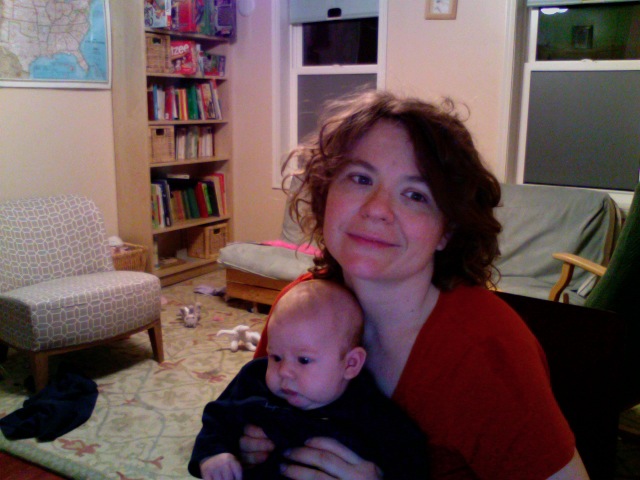
bearing blog


bear – ing n 1  the manner in which one comports oneself;  2  the act, power, or time of bringing forth offspring or fruit; 3 a machine part in which another part turns [a journal ~];  pl comprehension of one’s position, environment, or situation;   5  the act of moving while supporting the weight of something [the ~ of the cross].


  • History, threaded (II).

    Part I is here.

    Here are the rest of the threads of history I think I might use for my literature-based study of (loosely) 20th-century America next year.  Recall that the first five are:  (1)  America as superpower, (2) Establishing current US borders and holdings, (3) African-American history and civil rights/equality in general, (4) changes to the American experience of childhood; and (5) economics.

    Thread 6.  Roots of the War on Terror.  Post-WWII partition of the Middle East; Russians in Afghanistan; Iran hostage crisis; Reagan's strikes on Libya; Iran-Contra affair; US involvement in the Middle East; the first Gulf War; the first attack on the WTC; 9/11; wars in Afghanistan and Iraq; domestic civil liberties issues raised by the Patriot Act and the establishment of the DHS.

    Thread 7.  Party lines, scandal and hostility.  Teapot dome scandal, big government vs. small government, pro- and anti-war stuff, Watergate, the "Reagan revolution," Iran-Contra, Bush v. Gore, "red states" and "blue states" as a cultural meme

    Thread 8.  American mobility.  Increased use of the automobile; national roads; economic migrations (rural to urban, south to North, plains to West coast); migrants and immigrants; the interstate highway system; air travel.

    Thread 9.  Environmental movements.  National parks and wilderness preserves, Rachel Carson, EPA, endangered species act, 1970s energy crisis, controversies over global cooling and warming, international treaties.

    Thread 10.  Mass communication/pop culture and computing.  Radio, cinema, telephones, broadcast television, cable and satellite television with increased "channeling" of viewers, computers and the Internet, social media.

    Thread 11.  Selected Presidential biographies and in-depth look at the administrations.  I argue that the bios and administrations of Franklin Roosevelt, Lyndon Johnson, and Ronald Reagan are the three most worthy of special attention.

    With the exception of the Presidential biographies, all of these threads are chosen in an attempt to explain how we got where we are today.  They are meant to be filaments from pre-WWI America to today's newspapers.  Why is the US occupying the land that it does?  Why do we find ourselves with China as the only other credible superpower?  Why were so many people so excited about the election of the first African-American president? What does the current recession mean?  Why do we have to take off our shoes in the airport?  Why do people disagree about what to do about global warming?  What are red states and blue states?  What was it like before there was an Internet?


  • Gauging.

    It's kind of odd to be saying "No" to ginger-vinegared coleslaw as a weight loss technique, but I am back to doing it again.  Post-pregnancy dietary habits are starting to coalesce and firm up.  And I'm finding that my thoughts about it all have coalesced, too.  I'm not someone who's constantly tried, I'm someone who's done it:   lost 40 pounds and kept it off for six months before my pregnancy.  And the months of my pregnancy were months in which I could reflect, without the confusion of action.

    The habits are coalescing around an observation, maybe specific just to me, but one I'm increasingly certain about:

    If I don't feel hungry or chilly periodically throughout the day, I'm not losing weight.

    I'm pretty well convinced that the "empty-stomach" sensation, the tummy grumble,  is not literally a sense of an empty stomach.  It's not as simple as nerves in my stomach sending "No food here!" messages to my brain.  Hunger signals appear to travel through the body via hormones:  insulin, ghrelin, leptin.  And if that sounds newfangled, that's because it is:   leptin was identified in 1994, ghrelin in 1999.  They're generated at the cellular level, not just because the stomach is empty or full.

    Here's what I've observed:  If I go to bed hungry, and notice real hunger before meals, my weight is down a couple of days later.

    It could mean that I make myself hungry, and that causes me to lose weight.  That is, it could be that "I'm burning body fat because I'm letting myself get hungry."

    My observation of myself makes me think that the causation runs the other way.  If I am burning my fat reserves, my body tells me I am doing so by sending me a hunger signal.   In other words: "I'm burning body fat because I'm losing weight."

    I think it makes a difference in attitude for sure. 

     If hunger causes fat-burning, then I must suffer in order to burn fat.  If I cannot generate the will to suffer, I will never lose weight.

     But if fat-burning causes hunger, then I can try to find the habits that send me the hunger signal — not all the time, not for long waking periods, but several times a day, a little while in advance of meals.  And when the hunger signal arrives, I can regard it as a messenger bringing me the news that I am succeeding.  

    The message, by the way, is not "You must eat."   If it were, it would be nearly irresistible (hold your breath and see how "You must breathe" feels).  

    The message is more like:  "Hey there,  just wanted to let you know that we're burning fat reserves here, mmmkay?  And, like, if that's a problem, you might want to, y'know, ingest some food pretty soon, mmmkay?  OK, well, we'll check back later, dude."  

    Understand that message, and it's not so hard to think, "That's good news."  

    I don't have to be hungry all the time.  I don't have to burn fat reserves all the time.  But a few times a day is effective, apparently, because I notice that when my weight goes down, it's after a day in which I felt hungry a few times.

    And also it seems to be pretty effective for me to go to bed feeling hungry.  Occasionally I enjoy a bedtime snack with the rest of my family, but I find that if I go to bed still feeling the "we're burning fat reserves" signal, I do fall asleep eventually, and then of course I'm not bothered until just before breakfast.  (Except when I'm up late with a noisy baby, but whattayagonnado.  It's not every night.)  So I try to enjoy the satisfaction of knowing I'm getting that message instead.

    Incidentally, I sometimes weigh myself right before bed (even though my "official" weigh-in is in the morning) to reinforce that satisfaction.  I think to myself:  If I don't eat anything between now and morning, I won't weigh any MORE than this.  It's surprisingly helpful.

    I mentioned being chilly.  (Remember this post?) That's another thing.  If I'm losing weight, I find that I've often felt cold even when the ambient temperature has been comfortable.  The chilly feelings don't necessarily come at the same time as the hunger.  So I regard "cold" and "hungry" as twin messages that tell me I'm burning fat.  

    The hungry and chilly messages give me a slightly-more-immediate feedback on my habits.  There is a time delay — it's vital to think of it not as Am I hungry now?  but more as Over the past day, have I gotten hungry and/or chilly a few times?  If not, it's time to scale back on the calories.  And that's pretty easy to do — just eat less at my next meal than I have at the last few meals.   And make sure I stick to my planned eating schedule.

    Which is where saying "No" to coleslaw comes in.  Last night when everyone else was having ice cream before bed, I thought about having a bowl of leftover cabbage slaw.  It's a tasty slaw, very healthful and not at all high-calorie.  But… the habit of "No bedtime snack" is a habit that is correlated with that hungry feeling.  It's what I wanted.  So.  Even the healthy bedtime snack had to go.  It's better to keep the habit than to use a healthful food as a pretext to subvert my habit and thus my plans.


  • History, threaded.

    I'm trying to organize my third year of literature-based U.S. history for my family and two other families, and as I've written before — see my "History" category — I'm considering organizing it not chronologically, but topically.  Or rather, by "threads" connecting the start of the 20th century to today.  I'd like to use it to explain "how we got here," that is, put into a hundred years of context the stories they hear about on today's news, on the radio and at the dinner table.

    You can't teach everything.  Time is limited.  Whenever you design a history curriculum, really any curriculum,  you must decide what's important enough to cover.  I thought maybe my criterion for "importance" might be:  Does this story help explain anything the children see around them, reflected on the news, in the lives of themselves and their friends, in the popular culture they are absorbing?  

    And when I started thinking about it that way, it made sense to arrange history by topic, in terms of what it explains, rather than strictly chronologically as most textbooks do it:  "The Depression Era," "The Postwar Era," and so forth.

    Here are my stabs at potential "threads" through the twentieth century — which, in a topical and cultural sense, is not from 1900 to 1999, but rather is from American involvement in World War I to 9-11.  (I say September 11, 2001 is the cultural beginning of the twenty-first century in America — and I will bet you it will be regarded as such by cultural historians.)

    I present them in no particular order.  Within each thread we can cover the subtopics chronologically.

    Thread 1.  America as a superpower.  World Wars I and II, the Manhattan Project, the UN, NATO, Marshall Plan, Truman Doctrine, Cold War (including Korea, Vietnam, Afghanistan, and Cuba), cultural opposition to and support for Communism, nuclear proliferation and fear of "the bomb" as a cultural meme, U.S. foreign aid, fall of Eastern bloc leaving China as the "other" superpower.

    Thread 2.  Establishing the current U. S. borders and holdings.  Alaska, Hawaii, other U. S. holdings, how we wound up with U. S. military bases all over the place.

    Thread 3.  African-American history and civil rights/equality in general.  Pick up where we left off with Ida B. Wells and WEB Dubois.  Legal segregation, great migration of African Americans to north and to cities, female suffrage, Brown v. Board of Education and school integration, bios of Martin Luther King and Malcolm X, civil disobedience in the civil rights movement, general civil rights legislation including for women and the disabled, election of the first African-American president.

    Thread 4.  Changes to American experience of childhood.  The economic work of children changes with child labor laws; most children attend institutional schools; many gender-based restrictions are lifted; more children spend time with sitters or in institutional day care; more children grow up in divorced families; more children are raised by single parents.   

    Two special note on this one:  

    1. This category contains some sensitive topics that our families will probably want to teach within our families rather than as a group.  For example, as a historical topic, I think Roe v. Wade belongs here, I trust the other families will cover or not cover it in a manner appropriate to their kids' readiness.  Ditto with any implications for sexual morality, etc.   
    2. Much of this thread incorporates what is, in other history texts, folded into a "women's rights" chapter, but I'm shifting things like women's suffrage to the civil rights thread, and keeping here a discussion of how women's equality affected the experience of children.  That makes it sound as if I'm going to stick to "children suffered when their women's libber moms went to work," but no — remember that the experience of girlhood was transformed in many good ways, too, with more opportunities for education, athletics… more possible futures.  The important thing is to put in context the purpose of work: for the good of the family.  More options increases the potential for abuse, but for effective service as well.

    Thread 5.  Economics.  Depression, war industries, GI bill, postwar baby boom, postwar industrialization, the "war on poverty," federal programs like Social Security and Medicare/Medicaid, inflation and recession cycles, waves of immigration, the housing bubble and the current recession.  Talk about the tension between large government and small government ideals — lots of entitlement programs and a big safety net, or a smaller safety net and lower taxes.  

    One of my philosophies about teaching that involves politics at this age (in the classical/trivium domain, rhetoric or "pert" age):  It is my job to teach children that reasonable people can and do disagree.  I like to point out the existence of, and the reasons for, a tension between two political ideals, and make sure that the children are able to articulate the basic arguments of both "ends."    I don't want to impose a requirement that my kids think like me or agree with me in arenas where reasonable disagreement is, well, reasonable (and that's most of politics).  It's especially important when I'm teaching children other than my own, as I am doing with history.  The families I teach with share many values with me, but those same values can inform very different political positions!  Anyway, at this stage, neither am I asking the children to argue or articulate their own political or historical opinions.  Rather, I'm asking them to understand, and maybe to parrot back, the reasonable arguments behind each of opposing positions.  These, I hope, will incubate for a couple of years and help them develop opinions that really are their own.  And then they can discover the fun of attempting to convince and win over their reasonable opponents.

    This has gotten long, so I'll continue in the next post, when I'll  talk about the rest of my threads:  [Update:  Missed one — added it and reordered these] (6) roots of the so-called "war on terror," (7) the environmental movement, (8) party lines, (9) American mobility, (10) mass communication, and (11) selected Presidential biographies.  Can you guess which three presidential administrations I plan to highlight, and why?


  • Abundance.

    Even after working hard for almost two years to overcome my toxic overeating habits, there are still a couple of things I find very difficult to deal with.  One of these is the abundance of choices I have.

    It's not the fairly common problem of  "I can't throw food away, and so I eat it."   This isn't such a problem for me, though I understand it.  It is undeniable, after all, that to throw away perfectly edible food is wasteful, and maybe even offensive.  The error is in the assumption that it's somehow less wasted if it is eaten by someone who doesn't really want or need its food value.  It's wasted either way.  The way to avoid wasting food is not to buy, open, or prepare extra food in the first place.   The way to respond to food-that-will-go-to-waste is not to dump it surreptitiously into the nearest available esophagus, but to take notice of it, learn, and make less food next time.

    I know this isn't my problem because I get this agitated feeling of needing to eat up what we have at the beginning of the week.  Not at the end of the week when the refrigerator has lots of odds and ends of leftovers that "need using up." No, at the beginning of the week, right after the grocery-store trip.  

    When the crisper is full of fresh fruit and vegetables; when the pantry is stocked with crispy crackers and tasty tinned things; when we have fresh milk and eggs from the farm, maybe a couple of wedges of local cheese; when a new flavor of ice cream appears in the freezer at eye level; when there are tomatoes on the counter and bananas in the fruit bowl, and homemade sourdough and honey-oat bread in the bread box:  that is when my head spins and I want to taste everything all at once.

    This morning, for instance — we shopped yesterday — I felt panicky about the strawberries.  Strawberries were on sale, and we haven't had them in many weeks, it seems.  Mark had bought just one box.  I just knew that if I didn't get some of those strawberries today, the children would eat them all up right away and I wouldn't get any of them at all.  But I didn't remember that until after my full breakfast of toast, fried egg, and tomato juice… and I didn't really need to eat the strawberries on top of that, just to make sure that the kids didn't eat MINE all up.   

    (I managed, though, by making fruit-and-yogurt parfaits for the children's breakfast, using up MOST of the strawberries, and saving a bit back for my afternoon snack, already sliced, in the back of the fridge.  Still, it was touch-and-go there for a few minutes…)

    When lunchtime rolls around I'm often paralyzed by choices.  Should I have a green salad or steamed greens?  Should I have homemade bread (it won't stay fresh forever, you know) or crispy, satisfying Swedish crackerbread?  And what to put on it — Mediterranean-style sardines, or a BLT, or cheese melted in the toaster oven?  Should I have the local raw-milk Monterey Jack that's been piling up in the fridge since the kids decided they didn't like it anymore, or should I eat that wedge of aged Gouda Mark bought me as a special present?  Should I finish my meal with a tiny bowl of premium strawberry ice cream, or one of these ice-cold clementines, or maybe a piece of dark chocolate?  

    No, wait, if I was actually paralyzed by choices, I wouldn't have a problem.  What I am is overwhelmed by choices — and I want some of everything.  I need to eat the strawberries before the children get them, I need to eat the Gouda before mold grows on it, I need to eat up the Monterey Jack before next week's dairy delivery arrives and brings me more, I need to eat the tomato before it goes all yucky, I need to eat the sardines because Omega-3 fatty acids are good for me, I need to eat the homemade bread before it dries out, I need to eat the crackers because they are lower-calorie than the bread, I need to eat the ice cream because, uh, do I need to have a reason to eat the ice cream?

    But I don't have too much trouble at dinner.  I plan dinners, prit-near compulsively.  If the week's menu plan says spinach-ricotta pie, marinara sauce, carrot salad, well, that's what we're having.  No problem.

    Lesson possibly learned:  Plan breakfast and lunch too.  Ya think?

    Another problem.  When I'm tired I have a lot of trouble resisting all those choices, and the new baby has deprived me of much sleep recently.  Two nights in a row of bad sleep left me wanting — and eating — handfuls of chocolate chips, and wedge after wedge of the Irish soda bread my nine-year-old made for his science project — all white flour too.   Slathered in butter.  I'm not sure whether I was trying to give myself enough energy to get through the day, or wallowing in resentment; it seems that the reasons change with every handful I stuff in my mouth, whatever I am most tempted to soothe myself with in the moment.

    Lesson possibly learned:  try to get enough sleep, and keep an extra pot's worth of coffee ready to go in the pot.  Even if it's half-caff or decaf, the placebo effect (plus the something-in-my-hands-to-sip) might help keep me from self-medicating with sugar and refined flour.

    I'm actually doing pretty well by the numbers — five more pounds to BMI-normal — but I'm trying to clean up my act as my first goal.  I'm still only partway there.


  • Happy baby, tired me.

    How do I do it?  

    Right now (1 AM for the second night in a row) , the answer is:  I am fueled by more chocolate chips than I care to admit.

    Photo 174 

    He's not fussy, he's in a great mood.  Too great to be shared with his sister who, unlike me, is precariously asleep in my bedroom.


  • Trial run.

    Today I returned to running.  Not for very long:  I started with just five minutes.  But it was a good start.

    I signed MJ and Milo into the child care, but Oscar came with me and Leo up to the track.  As we headed up the stairs we passed a quartet of women coming down, toting yoga mats.  One cooed at Leo.  "Oh!  So new!  How old?"

    "Thanks!"  I said with a big smile.  "He's six weeks."

    "Beautiful!" she said as she went down the stairs.  From around the corner I heard another of the women tell her, "That's her fourth baby — can you believe it!"  I didn't recognize her — I must be famous.  (Stairclimber sessions at 9 months pregnant — to turn the baby — will do that, I suppose.)  That comment made my day.

    There's a little stretching area in an alcove off the indoor track, with mats and posters of muscular anatomy and a couple of Pilates balls.  I had Oscar sit on the mat, and Leo slept nestled on a folded sling in the V of his outstretched legs.  "Pick him up if he cries," I instructed him.  No worries.  Oscar read a chemistry book he'd brought, placidly earning a nickel a minute.

    I walked briskly for five minutes, craning my neck to check on my boys at every lap, and then broke into a run.  It felt so good for the first couple of laps, all those muscles working the way I remember — except my sports bra isn't nearly as supportive as I hoped it would be, darn it, there's another errand I have to run this week.  The next couple of laps I got winded, and after that I got pretty slow.   But I was huffing and puffing and had broken a sweat by the time five minutes had gone by, when I pulled the earbuds out of my ears and went to fetch Leo back from Oscar.

    I scooped the baby up, and a white-bearded gentleman from the next mat said to me, "Oh gosh, that was such a great sight.  I wish you could have taken a picture of those two boys together.  What a great way to make sure you take care of yourself."

    I smiled and thanked him as I stuffed Leo into the pouch sling.  Then I led Oscar out onto the track for an impromptu lesson in Running Track Etiquette and Safety.  The learning never ends, my friends.


  • Habit, habit, habit.

    It’s slowly coming back to me.  

    Last week the kids and I had a pizza-and-movie night, as we often do when Mark goes out of town for more than three days; I remembered to order only just enough pizza for the children, to order a sandwich and a large salad for myself, and to save half the sandwich for the next day.  That was the first time I’d done that in a while.

    A little reluctantly, I’m keeping the stack of nutrition and health books on my night stand to be my “fluff” reading.  

    I’m polishing off lots of vegetables again, a quart at every lunch and dinner, and some at breakfast too.  Crispy cabbage-and-carrot slaws.  Coconut curries with tomatoes and broccoli.  Tall glasses of tomato juice.  Garlic-and-olive-oil-braised collard greens.   

    All that stuff is pretty easy.  Remembering to drink lots of water is hard.  Remembering the smallness of an ounce of cheese.  Remembering to eat my food slowly.  Remembering that after dinner I’m done.  It’s tough sometimes.  I chew a lot of gum, especially when I’m clearing up after meals.  

    And yet it’s paying off.  Four more pounds and I’ll cross back into BMI-normal territory again (correction) back from BMI-obese into BMI-overweight territory again.

    I can hardly believe it’s working again.  Part of me thought I was “allowed” to get to a healthy weight in 2008 just so I could have a healthy pregnancy in 2009.  And here I am in 2010, having the pregnancy weight to lose, and watching it … get lost.  Maybe this really is permanent.  Maybe in a few months I’ll get to send that e-mail to the National Weight Control Registry:  please enroll me in your database of successful long-term weight loss anecdotes.  

    Some things haven’t changed.  I can tell I’m on track when I keep looking for warmer clothes to put on, because I’m cold all the time.  I’m looking longingly for the sun to come out.  

    Today, with the baby six weeks old, I got in the pool for the first time, while Mark held the baby.  I have a new tankini-type two piece in case I need to nurse, but Leo slept the whole time.   Twenty minutes’ swim wore me out.  I’ll get better.

    [Editing noteI went on making references to BMI long after I learned that it’s not all that great a metric. Why? I’m really short, so reporting my weight tended to alarm people. Ideally I would delete past references to BMI and use another metric that’s proven a better proxy for health, like waist circumference, but I didn’t take the data at the time.]


  • The Driving Me Crazy list.

    Mark went out of town last Monday and didn't come home till late Friday afternoon.  It was the first business trip since the baby was born — in fact the first week he was back at work full time.  On Thursday morning, while I was waiting for Hannah to get to my house, I paced from room to room, scattered with toys and books and crumpled paper airplanes and the occasional apple core, and slowly boiled inside.  In particular I stood in the little office at the end of the hall upstairs — the one that is the "focal point" of the upstairs hallway —

    (mental note:  if you hate cluttered-looking things, NEVER EVER EVER design a house so that an office is the focal point of a hallway, no matter how spic-and-span they look in the Pottery Barn catalog)

    –and stood there and looked at the Legos and the piles of unfiled papers and the cardboard box full of torn-open envelopes and statements and flyers from the last bill-paying session and the scraps of paper that the children had pulled out of the box and cut up with scissors and left lying on the floor —

    — and I could just feel myself getting angrier and angrier and angrier.

    For a brief moment I entertained the thought of paging Mark at the plant in Tennessee so I could yell at him about the bin of paper.

    Fortunately I did not entertain that one for long.  I mean, for one thing, he pays the bills every month so I don't have to.  Must I quibble about the detritus?  Seriously, perspective.

    Anyway, I grabbed a pen and a pad of paper and wrote DRIVING ME CRAZY across the top in big letters.  Then I began to enumerate.

    1.  Office full of toys

    2.  Office full of unfiled papers

    3.  Kids walk around eating apples

    4.  Kids leave apple cores on the carpet

    5.  Kids don't hang up coats…

    Astonishingly, nothing *I* am responsible for ended up on the DRIVING ME CRAZY list, which ran to about thirty items.  By the time I had filled up the sheet, I felt much, much better.  Filling the sheet up also made me feel as if I could actually do something about the problems besides wander from room to room getting more steamed.  

    So I cleaned the bathrooms, except for the tubs which are too hard to do with the baby in the sling.  It was the first time I had deep cleaned anything since the baby was born.   I didn't finish before Hannah arrived, but I felt so much less pissy that it was worth it.

     I showed the list to Hannah when she got to my house.  She was probably glad not to appear on it herself.

    The next day when Mark got home, I went over the list (well, actually, a somewhat stripped-down version) with him, and we decided we needed some new house rules and new emphasis on the kids' cleaning up after themselves, now that we have the baby keeping us tired and busy.  We posted them.  Griping has ensued, but at least the expectations are all a lot clearer.


  • Sleeping with the diaper-free.

    Well, not really.  Diapers are involved, as you'll see.  But I thought I would write a bit about what I do to sleep in the same bed with a naked-bottomed baby, without getting soaked.

    First off, why not just put the baby in diapers?  The short answer is:  Because I'm lazy, and I need my sleep.  I don't like to get up to change diapers in the middle of the night, and this method makes for faster changes (no getting out of bed; maybe not even any sitting up).  

    The long answer is also because I'm lazy, and I need my sleep.   I suspect this method helps the baby be dry at night sooner than conventional nighttime diapering.

    Here's how I set it up on my bed:

    1. Mattress
    2. Mattress protector
    3. Ordinary cotton fitted sheet (so far this is just my "normal" bedding)
    4. A big piece of polar fleece that goes all the way across the bed
    5. A small 25"x30" wool "puddle pad"  (optional, but nice — see below)
    6. A couple of overlapping regular-size cloth flat or prefold diapers
    7. The naked baby
    8. A flannel  receiving blanket
    9. The rest of the blankets

    When the baby wets, the diapers under him get wet.  But the wool puddle pad and the fleece will not absorb the urine, because the diapers are so much more hydrophilic than either wool or fleece.   Urine won't wick from the diapers to the fleece.

    Wool is truly superb for this purpose, much better than the fleece.  The wool will not let the urine through at all, really.  Fleece works pretty well without the wool pad, except that if the baby happens to pee directly on it — say the diaper layer shifts under the baby — the urine will pass through the fleece and be wicked into your cotton sheet.  

    (If your mattress is well protected, this still isn't much of a problem.  You will stay dry and comfortable because the fleece, which is between you and the wet sheet, won't wick the urine to where you are.  You can deal with the wet sheet in the morning.)

    So why bother with the fleece at all — why not just have a giant wool pad?  The answer is:  Giant wool pads are expensive, as you will see if you follow the link above.  A small one isn't so bad, considering how useful it is.  Oh, and also, I find wool a little scratchy to sleep on.  I'd rather put it just under the baby, and protect the rest of the bed with the lesser power of fleece.

    Much cheaper, synthetic waterproof pads can also be bought, and work fine in place of the wool.  I just don't think they are as comfortable in the bed as wool.  

    So anyway.  When the baby wets, he complains.  I reach under him and pull the wet diapers out from under him.  I throw them over the side of the bed into a waiting diaper pail.  If the flannel receiving blanket on top of him got wet — it doesn't always, depends on the "fountain" — I toss that over the edge too.  Then I reach for the stack of clean diapers that's on the bed with us, slide two of them under the baby, and if necessary replace the receiving blanket with one from the stack.   Then we go back to sleep.  I don't even have to sit up.

    For a little extra insurance that your blankets won't get wet, have the layer that's directly on top of you be a synthetic — either a light fleece, or one of those thermal foam blankets.  It won't wick moisture away from the flannel.

    I admit that if I've had a few nights in a row of poor sleep, I will put the baby in a disposable for one night just to cut down on the number of my wakings and give myself a break.


  • No “food” for Lent.

    No, I'm not starving myself for forty days.  

    My policy on voluntary Lenten sacrifice, which I finally settled on a couple of years ago, and which I'll continue indefinitely:  No giving up anything food-related for Lent.  Period.  I don't do it.  

    (Note that I'm talking about voluntary sacrifice, not the Friday abstinence from meat or the Ash Wednesday and Good Friday obligatory fasts.  I of course observe those as required.)

    Food-related sacrifice for Lent is highly recommended for most people, but I've become convinced that it's bad news for people who suffer from seriously disordered eating.  

    Back when I used to try giving types of food up for Lent — snacking between meals, say, or sweets, or caffeine — I would obsess about the missing items, to the point where I could not think about anything else.  Let's just say that it did not foster a prayerful Lent.  And it tended to act as a trigger for my bulimia.  I can only imagine how much trouble such a thing might cause for someone who tended towards anorexia.  

    Please, distinguish habits — even harmful habits — from addictions.   A pleasurable habit can be appropriate to give up for Lent.  That is, something that you can truly lay down of your own accord.  It may cause you some suffering, you may miss it, you may look forward with longing to the "feast" — but still, you CAN do it if you choose to.  Trying to give up for Lent something that you have a pathological addiction to, however, is setting yourself up for failure, self-blame, self-hatred.  And possibly an extremely dangerous binge or bender come Easter Monday.   In the natural order of things, medical or psychological intervention is required to break addiction.  Do you want to set yourself up for the temptation of thinking, I could make it through Lent without it, if I only had more faith, if I only was a better person?  Or the temptation of feeling abandoned by God:  My prayers aren't answered, He hasn't given me the strength?

    And one more thing about this.  The focus of Lent is not on you and the thorn in your flesh.  The focus of Lent is on Christ and His Cross.  Its purpose is not to cure people of their addictions and dependencies.   

    Lent is penance, not therapy.  

     But to hear some folks talk about it, you'd think it was advertised as a diet plan.  "Lose 10 Pounds of Belly Fat In 40 Days."   If you're constantly trying and failing to give up snacks between meals anyway, what's so specially penitent about trying and failing to do it during Lent?  Or is it really Lent all year long?

    So give up something that stands between you and God — sure.  If you like, give up something that hurts. But make it something that you can choose to give up of your own free will.  So that you do it.


  • Slings.

    Christy P is writing about her favorite slings here.   

    Many people ask my about babywearing, and I have helped a lot of moms and a few dads learn to wear their babies. The most frequent question is "Which carrier should I get?" To which I must reply, "Different tools for different jobs, my friend. In our house we have several."

    I am continually bemused by the notion that a family should have only one baby carrier, or maybe one for Mom and one for Dad.  Especially considering that it's apparently completely normal to buy things like 

    • wipe warmers ($22)
    • Pack 'n' Plays ($57)
    • expensive car seats (Britax minus Graco equals $100 or more upcharge)
    • baby "gyms" ($48)
    • full-size strollers ($80 minimum, goes up to $500 or more just at Babies R Us)
    • shopping cart seats ($30)
    • "stationary entertainers" ($100)

    And also considering that it's pretty easy to pick up a lot of those sorts of things for free from people who used to have babies.  

    A new Maya Wrap costs $55 or so.  I found a couple of places selling them today for $35.  An Ellaroo wrap will set you back about $100.  Basic fleece pouch slings, $25 to $35 (and my favorite, the Kangaroo Korner one, is about $70).

    Let's put this in context.  Even the "best" baby slings cost in the same range as a piece of clothing for Mom — a nice blouse, for instance, or a warm sweater, or a good bra.  Many slings cost less.  They can also be made, even without sewing a single stitch (though sewing skills will expand the variety of possible homemade slings).  I understand the need to prioritize spending, but if it's sensible for a woman to have more than one "nice" blouse or more than one "good" bra, or more than one bag for crying out loud, then it's also sensible for her to have more than one baby sling.  Three is perfectly reasonable.  Five or six is not crazy.  

    I'd rather have the slings than the bags.  And hey, I like bags. 

    I think it would help overcome this fear of slings if we stop thinking of the sling as "gear" (which is optional and lifestyle-dependent — many women don't think of themselves as the "sling type") and start thinking of it as "clothing" (which is necessary — everyone is a "clothes" type).  If it can be trendy to carry tiny dogs around in your purse, perhaps someday it will be trendy to carry your baby around on your hip.

    If you like the idea of having several slings but are worried about affording them, here's my advice:  When you are pregnant, find your crunchiest friend and drop hints until she throws you a sling-themed baby shower.