bearing blog


bear – ing n 1  the manner in which one comports oneself;  2  the act, power, or time of bringing forth offspring or fruit; 3 a machine part in which another part turns [a journal ~];  pl comprehension of one’s position, environment, or situation;   5  the act of moving while supporting the weight of something [the ~ of the cross].


  • Roaming.

    Jamie's neighbors are at it again, this time telling her children not to trust her judgement.  Read it, sigh, and shake your head.  

    As I wrote in the comments:  This is why kids don't play outside anymore.  Parents aren't afraid of hit-and-runs or kidnappings; they're afraid of their own know-it-all neighbors.


  • Reflexive rejection.

    Good post from And Sometimes Tea on rejection of Latin, and by extension, other stuff.  Or was it rejection of other stuff, and by extension, Latin?

     I've seen this attitude myself, in both of the parishes I've been a member of in the last decade. In the first, some of the older choir members were dismayed by a plan to sing more Latin at Mass–for them, Latin conjured up images of dark, silent churches, a priest with his back to the people, women forbidden from any participation other than membership in the Altar Society, etc. In the second, a gentleman spoke quite passionately to me about his dislike of the "old, traditional" music we were singing (most of it English) because he thought the young people would be driven away from the Church with all of that musty old stuff that wasn't "relevant" to their lives. I've also heard people praise some rather ugly modern hymn with "Oh, I'm so glad you sang that! I love that song–I've loved it for years!" and that sort of thing.

    It will surprise no one that I think these attitudes are entirely erroneous. For the first, I think honestly that the women–and it's always women–who tearfully or angrily say such things are confusing the Church with their memories of what life in general was like for women in their young days. Though many people coat the past in rosy hues, it's quite discernible from history that women weren't always treated as if they were intelligent, capable, thoughtful equals to their male counterparts (just do a search for sexist vintage advertising, if you don't believe me–but be careful; some of those ads are shockingly unfit for children's eyes). Sadly, I think that some older Catholic women associate those attitudes with the Church; they may even have encountered them in their parishes when they were young. So anything that even reminds them of those past days becomes coated in their memories with a whole lot of other, negative memories or emotions–leading to a reflexive rejection of Latin or of anything that smacks of tradition.

    Practically everyone I've ever met who rejects traditional things out-of-hand is well older than me.  Sometimes it's downright bizarre… I once met an old lady at a parish I used to attend (a parish that had gone so far over the edge that the archbishop actually dissolved it) who proclaimed in letters to the editor that the Rosary was a tool of oppression.  I have never been able to figure that one out.  Did someone tie her to a chair with one when she was a kid?

    This isn't the same as "everyone my age or younger prefers traditional stuff to contemporary stuff."  The truth is that Generation X hasn't had very much exposure to the traditional things, thanks to our elders tossing them all into the trash.  I believe there is good to be found in contemporary music and architecture, too, though it requires some sifting because there's also a lot of piffle and silliness and ugliness as well, and time is perhaps the best sieve for that.  Still, it's funny how many of the aging Boomers and their immediate predecessors don't seem to have caught a clue that the winds of change have passed them by, and that timelessness has the upper hand… almost by definition.

    Latin is part of our heritage, and "dead" or not, it could become practical as well as beautiful.  My neighborhood is full of immigrant families who worship in Spanish at the church up the street, a church building that also houses an administratively separate, English-speaking parish.  Latin is as much their heritage as it is mine (and they'd probably have an easier time learning it than I am having).  Here in the U.S., as in many other countries with linguistically mixed populations, Latin could become (again!) a lingua franca enabling us to worship side by side instead of in linguistically segregated congregations.  Cut the homilies in half (please!) and deliver them twice, once in English, once in Spanish, and bingo:  two communities made one.  Isn't that progressive enough for you?


  • Toy houses.

    Jen at Conversion Diary has a post up with a quote from St. Francis de Sales that I'd never encountered before.   Quoting it in full because it deserves it:

    Soon we shall be in eternity and then we shall see how insignificant our worldly preoccupations were and how little it mattered whether some things got done or not; however, right now we rush about as if they were all-important. When we were little children how eagerly we used to gather pieces of broken tile, little sticks, and mud with which to build houses and other tiny buildings, and if someone knocked them over, how heartbroken we were and how we cried! But now we understand that these things really didn't amount to much. One day it will be like this for us in heaven when we shall see that some of the things we clung to on earth were only childish attachments.

    I'm not suggesting that we shouldn't care about these little games and trifling details of life, for God wants us to practice on them in this world; but I would like to see us not so strained and frantic in our concern about them. Let's play our childish games since we are children; but at the same time, let's not take them too seriously. And if someone wrecks our little houses or projects, let's not get too upset, because when night falls and we have to go indoors — I'm speaking of our death — all those little houses will be useless; we shall have to go into our Father's house. Do faithfully all the things you have to do, but be aware that what matters most is your salvation and the fulfillment of that salvation through true devotion.

    Isn't that wonderful, realistic, practical writing about detachment?  It seems that so many of the saints are urging us to be ethereal and otherworldly, passing through the things of this world like light and with nary a thought about any of the stuff around.  Well, thank you St. Francis for recognizing that most of us live in the world, with children and spouses and other people we provide for… we touch the things of this world, and are touched by them.  

    I think he does a fantastic job putting things in their proper place.  "I'm not saying that we shouldn't care… because God wants us to practice on them… Let's play our childish games… but… not take them too seriously."  Strikes the perfect note, I think…


  • The other daily specials.

    The last fast-food restaurant I took the kids to was Sonic, an eat-in-your-car drive-in kind of place.  We were in Bloomington, I didn't want to get the sleeping baby out of the car, and I thought the novelty of the roller-skating car hops would be entertaining.  (I was right about that one, by the way.)

    The Sonic menu is pritnear devoid of light sandwich items, although there are some pitfalls there: sandwiches that look as though they might be more healthful (but probably aren't), and the possibility of getting a banana on the side, so that you can bask in its health halo while scarfing down your double cheeseburger topped with deep-fried jalapenos.

    That got me thinking, though, about some options that exist at every restaurant, but which are not printed on the menu.  In my mind's eye, these are printed in a sort of "Daily Specials" menu, up on the board next to the "Sides" and "Drinks" or possibly handed to you by the server along with the wine list.

    DAILY SPECIALS

     This Place Is So Fancy, They Even Have Fancy Water

    I don't drink sparkling water on a regular basis, but it feels festive and indulgent to order it in a nice restaurant.  Festive and indulgent enough to substitute for a glass of wine.  Bottled water instead of soda gives a similar effect at non-fancy joints and convenience stores.

    The Oil and Vinegar

    Many restaurants leave this "dressing" off the menu, and many servers forget to list it when you ask "What dressings do you have?" so don't forget that you can ask if they have "just oil and vinegar" for your salad at any sit-down restaurant.   You know what you're getting then.   Salsa works too, if there's anything taco-like on the menu.  And don't forget salsa or mustard as an alternative to anything that comes with a dip.

    The Something Small

    Here's a game:  What's the smallest meal on the menu?  It may be a bowl of soup, it may be buttered toast, or it may be an appetizer.  Make a meal out of something that just isn't very big.  Since you're here, it'll probably have plenty of calories, and hopefully you'll get something you enjoy.  Don't worry about ordering extra food to make sure it's "balanced."  It's just one meal, not a lifetime eating plan.

    The Buy One Get One Free Option

    Nothing small on the menu?  Split something with a companion.  'Nuff said.  Go ahead and get your own salad though.

    The Hope They Don't Ask For I.D. Meal

    Check the children's menu and (even better) the seniors menu.  Portions are usually smaller, and if you were going to order a burger anyway, there's simply no excuse.     Keep a straight face and you won't be carded.  (If you are carded, offer to bribe tip your server).

    The Virtual Plate

    Building the one-plate habit?  Restaurant plates too big?    Ask for an extra salad plate and transfer your dinner onto it; toss what won't fit.  Nothing to eat off of but a fast-food wrapper?  Draw an imaginary (or real) circle on the wrapper, its diameter the length of a soda straw.  Or fold the wrapper into a square as wide as the straw is long, and tuck in the corners.  There's your plate.  Toss what won't fit.

    The Two Side Salads

    A meal-size salad may seem like a good idea, but they're frequently piled high with more meat and cheese than you need.  Side salads are plainer than meal- salads, and often two side salads cost less than a meal-size salad.  This is a great option at many fast-food restaurants, if you remember that they probably give you far more dressing than you need.   Add half a sandwich and you've got a very filling meal.  Or, if the salads come with cheese on them, let that be your protein and enjoy as-is.  (Nota bene:  At McDonalds, side salads are on the dollar menu.)

    The Glass of Milk

    This is a kind of "something small," really.  But whole milk is actually a great snack all by itself.  A latte does the same thing, if you skip the sugar.  But even chocolate milk's not so bad.

    The High Maintenance

    It is completely normal in the U. S. of A. to ask for small changes to the food presentation, like "dressing on the side," "hold the mayo," "no cheese," or "just don't bring me any of the hash browns, I don't want them."  And even if the menu says NO SUBSTITUTIONS you may ask:  "Is there a way I can just pay more, so I can have extra veggies and no rice?"  I draw the line at ordering food that isn't on the menu, or issuing special cooking instructions  (are they really equipped to steam the fish for your sandwich?!?);  but your server will likely be glad to give you less food for more money.

    The I'll-Have-What-She's-Having Add-on

    Are you sorely, sorely tempted to have the fries or the deep-fried shrimp?  Are you dining with other people?  Skip ordering that stuff for yourself, get a salad or the Something Small, and then steal just a few tasty morsels from your family and friends.  Practice saying this:  "Hey, can I have a few of your french fries?"  or "Let me have just a bite of your dessert" until it feels natural and normal.  (Caution:  This strategy can backfire if you have more than three children)

    The Veggie-Habit Trainer

    It's true that at many restaurants, the vegetable dishes, salads, and veggie sandwiches are every bit as high-calorie as the burgers and fries.  But if you're working specially on the "eat more veggies" habit, and you're planning to eat your full meal here, it may be better for your habit to double down on veggies, even if you an't get them plain and they come soaked in butter or in coleslaw dressing that adds up to more calories than the potatoes or rice you'r
    e substituting them for.  These calories, at least, are nutrient-rich rather than nutrient-poor.

    The Deliberately Unbalanced Meal

    When all the "sides" available are deep-fried, soaked in sauce, or concentrated in sugar, remember this:  You can get fruits and veggies at home.   Have a kid-sized sandwich or some plain protein now, all by itself, and "balance" it later in the day with a bag of frozen vegetables or something.

    The Takeout Box

    Order this on the side when the meal you really want only comes in "too big," i.e., almost any restaurant sandwich.  It's ready to take half your meal or more as soon as it arrives, ready to be a most indulgent (and basically free) lunch the next day.  (Note:  A six-inch sub is not already a "half" sandwich.  It is full size.  The twelve-inch sandwich is two sandwiches.)

    The I-Am-Not-A-Garbage-Disposal Special

    No dining companions to share with?  Leftovers will spoil in your car?  Food still too big?  Before you start eating, remove half your overlarge entree and throw it away immediately, or else mutilate it severely and hide it in a napkin.   Remember, if you eat more than you ought to eat, you're still wasting the food.

    The Cup of Coffee And A Water with Lemon, Please

      Just because your kids need to eat now doesn't mean you do.  Are you, in fact, not actually hungry?  Did you have a pretty big and filling breakfast?  Does this stuff not actually look very good anyway?  Do you expect to be able to have something you like better, that's better for you, if you just wait a couple of hours until you get home or to the store?  Then you will not die if you wait for something better.  Practice this:  "I'm still full from breakfast, I'm not hungry now."  Order something nice to sip while you enjoy the company, or maybe the solitude.  Note:  Skip the sugar here or the strategy will totally backfire.

    The Cappuccino For Dessert

    A corollary to the last menu item:  A cup of coffee or perhaps hot tea is a pleasant way to end a restaurant meal, especially if you're with others who will want dessert.  Sugar and cream are appropriate after a full meal if you like those things.  Hot chocolate is another choice to get you used to ordering hot drinks instead of a dessert.

    To sum up, you can add these meal options to almost any meal anywhere you go.  Print 'em up on a menu sheet if you like:

    • Have nothing and eat later instead of now.
    • Order something that's guaranteed to be small.
    • Order just part of a balanced meal, trusting that the other part can be found later.
    • Oil and vinegar or salsa instead of salad dressing.
    • Mustard or salsa instead of the dip.
    • Substitute more vegetables for the starchy side (even if it costs more)
    • Order off the kids' or seniors' menu
    • Get a takeout box and take the extra stuff home
    • "Hold the stuff I don't want to eat" (even if it costs more)
    • Make a virtual plate and toss the extra
    • Wrap up half of it to take home 
    • Steal someone else's fries instead of ordering your own
    • Hot drink for dessert

  • Co-schooling (4). Teaching three readers at once.

    A lot of what we do, we have figured out as we went along, trying ideas and tweaking them here and there.

    Take phonics practice.  For a long time, we all assumed that it really only works well to teach phonics one-on-one.  Of course, we never had any two kids reading at exactly the same level; and reading instruction, done right, requires a parent or teacher to pay close attention to a child's steps and mis-steps, providing feedback exactly as needed.   So for a long time we did reading practice separately — each child with his own parent.

    This worked okay for a while, but at one point we got very tired of splitting everyone up all the time.  We were seeking a way to teach, not side-by-side, but together.  And so we tried some different ways of putting the learning readers together. Even though they were not at exactly the same level, and even though we knew that they were each responding very differently to reading instruction, all of them were at the point of learning which sounds were spelled by which graphemes (letter combinations), and all of them could blend words made of the graphemes they already knew. 

    We tried sitting them around the same table, each with his or her own sheet of reading.  Then they took turns each reading one line of the sheet.  That worked a little better for keeping everyone feeling together, but the wait between turns was just too long; while one child was painfully sounding out the words and letter combinations on the sheet, the others would start to squirm, and by the time we were back to the first child again, he'd forgotten where he was (if he hadn't managed to escape to the back yard when we weren't looking).

    We tried alternating reading with a related language activity, like copywork.  Each of the children would receive a sheet of copywork for handwriting practice.  Then, one would read under our watchful eyes while the others would copy, more or less independently.  When the first child finished reading, she would start on her copywork, and the second child would interrupt his copywork to begin working through his reading sheet with one of us.  And so on.  This went okay, except that we would really rather the children spent more time reading than they did on copywork.  And there would always be sleeve-tugging on the part of the copiers, with one question or another, and so it was hard to pay close attention to the reader.  Still, it was an improvement.

    What to do?

    Well, understand that each of the children got some form of direct reading instruction on the other days of the week, when they weren't all together.  So what we were doing on co-schooling days didn't have to stand alone as the only reading instruction they got.  It only has to complement it.  So… enter simple word and sentence reading drills.

    A few years ago, when I was teaching my first child to read, I compiled a lot of "common word" lists.  Word lists along the line of this: 

    • UI spells the sound /oo/: bruise, cruise, fruit, juice, nuisance, pursuit, suit
    • UE spells the sound /oo/:  blue, clue, cruel, due, glue, pursue, statue, sue, tissue, true, Tuesday, virtue
    • OU spells the sound /oo/: bouquet, cougar, coupon, group, mousse, routine, soup, wound, you, youth…

    and so on.  I wasn't starting from scratch, mind you.  I was building on a huge body of work that had already been done by a friend and her husband who are writing a comprehensive reading program.  Anyway, I had already made these word lists in the process of teaching my first child to read, and I had saved them.  Mostly I taught my kids to read one word at a time, drawing from the lists for combinations I had already taught them.

    But when Hannah got a hold of them, she looked at the word lists and they turned into sentences, some little stories even. 

    The miner climbs into the icy cave.

    She cannot make a single error with her ice axe.

    I don't know why you are frightened when my wildcat only bites a little.

    So she started writing out sentences that  the children could read, many of them very fun sentences.  She wrote them, mostly, on lap-sized dry erase boards.  She has more boards to write on than children to teach.  So one way she does it is this:  each child gets a board with a different sentence on it.  They all read the boards, and don't pay much attention to each other.  Hannah listens and helps them as necessary.  Then when they're all done, hopefully at approximately the same time, they trade boards.   She might give them 6 to 10 sentences in a session.

    She mixes it up a bit with single-word drill and practice with flashcards.  Recently she tried something that seemed to work pretty well:  holding up a single long sentence and having the kids take turns reading one word at a time; after the last word is read, the next child in line has to re-read the whole sentence.  That seemed to work great, because they all had to pay attention to the reading so as not to lose their place. 

    This group of emergent readers is really almost done with needing intensive phonics drill, and will soon graduate to reading a variety of texts for "reading practice."   We think we'll start phasing out reading and phasing in Latin in the same time slot.  Meanwhile, there's a younger cohort coming up right behind them who, we hope, will reap the benefit of our experience,


  • Self-denial.

    This morning for breakfast I had a fried egg on top of leftover polenta, along with a glass of tomato juice.  Then one of the kids asked for some of the whole-wheat coconut banana bread I made yesterday.  And before I really thought about it, I had had a second breakfast of two slices of banana bread.   Which tasted really good at the time.  

    But now I am aware that it was a mistake.  Not because of guilt, not because "now I'll have to eat less at lunch to make up for it," not because I've incrementally slowed the rate at which I approach my prepregnancy weight — but because my stomach feels uncomfortably full.  

    I don't like overeating anymore.  I mean, I really don't like doing it.  Not because of its effects.  Just for what it is.  I don't like to do it.   I get a sort of hangover from it.

    * * *

    If you'd told me before I changed my eating style that I would feel this way,  I wouldn't have believed you.  Just look at this post from July 2008:

    Will I keep getting hungry between meals, ever?  Will I never eat an entire pizza?  Will I always ask for the half portion?  Will I forget about ever filling up on bread, ever again?  Will I roll over in bed when my stomach growls at 3 a.m., saving that appetite for breakfast?  Will I throw out the kids' sandwich crusts?  Will it start to feel wonderful, instead of worrying, to believe that the eating-till-I'm-stuffed is over? 

    That is the writing of someone who is frightened by the idea of never eating an entire pizza again.  I write now as someone who is relieved by the idea of never eating an entire pizza again.  Even by the idea of never having more than, say, a quarter of a pizza at a sitting.

    Not only would I not have believed it about myself, frankly, I didn't believe it about other people.  If some other person had told me that she felt better when she ate lightly and didn't really want to "splurge" now and again, I would have thought she was either (a) lying or (b) mentally ill, possibly anorexic.  

    And yet here I am.

    Let me give you a measure of how much I mean this.  My mom, when she was dying of lung cancer, once told me, "I'm never going to deny myself anything ever again."   My mom, she loved her some Coca-Cola and Baby Ruth candy bars.  I hope she enjoyed every last one of them.  One of the last things I ever did for her was to hold the straw for her while she sipped Coke from a can around her oxygen masks.

    But I've been thinking of that comment — "I'm never going to deny myself anything ever again."   If I learned I only had a few months to live … I still wouldn't want to eat an entire pizza.   I wouldn't want to stuff myself with food, even really tasty food.  I guess I might eat a higher proportion of my food from the Deep-Fried Group, but … "not stuffing myself" doesn't feel like a sacrifice, like any kind of self-denial.  It's what I want to do now and for the rest of my life.  I feel so much more free about it than I did when I ate whatever I "wanted."


  • Dietary laws.

    Maybe it's because food choices have been on my mind again lately, but I've found myself thinking about religious dietary laws.

    It's fashionable among the set known as the "New Atheists" these days to denigrate all forms of all religion as not only incorrect, but dangerous, something that ought to be purged from mankind.  My view is that we don't need to argue from any sort of religious principle to refute this notion; no appeals to apparent design or to authority are necessary.  Just look:  humans everywhere have always had an impulse to religion and spirituality.  It's clearly something that is an innate part of the human animal, wired into our sociobiology, as natural to us as mother's milk (another thing once viewed by the experts as suspiciously backward, distasteful and unscientific).  Getting rid of it entirely, for our own good, would be likely to backfire — if it's even possible.

    Dietary laws — ritual avoidance of certain foods and ritual consumption of others — are an example.  Aren't they pretty much found everywhere in every culture?

    This goes beyond kosher and halal, all the way to people who don't think of themselves as religious at all.  For example, avoiding factory-farmed meat because of concerns about cruelty is a self-imposed religious dietary law.  So is carefully selecting your groceries for their carbon footprint.  You might prefer the connotations of "philosophical" or "ethical" versus religious, but there's not much practical difference. 

    Since people can and do thrive on traditional diets that are heavy in meat and other animal products — the Masai come to mind, as do Native Americans of the far north reaches of Canada — it's pretty obvious that even healthism-based vegetarianism is a sort of religious dietary law.

    Mainstream america has ritual dietary laws too.  When was the last time you saw tenderloin of dog or horse in your local supermarket?  And why, pray tell, not?

    It seems to be part of human nature to attach an importance to food that goes beyond physical sustenance.  So even if we can't understand it, or see a practical reason for it, I would hope we can see it as, well, not utterly crazy when some culture or another follows a certain set of dietary restrictions — just because.

    Which takes me to the Garden of Eden.  How many times have you read or heard a non-Christian, non-Jewish person complaining of the arbitrariness of that whole "tree of the knowledge of good and evil" nonsense?  Why would God care if they ate this one fruit?  There's no good reason for it — whoever wrote it down even made a point of mentioning that the stuff was good to eat, so what's the big deal?  Alternatively, you'll occasionally see a well-meaning believer defending the don't-eat-that rule on some practical ground of healthfulness or learning obedience or some such thing.

    I think it's easier to understand the story — and this works both if you take the story as something that really happened, or if you take it as a useful teaching story passed down by one of the world's most influential cultures — as the story of the first dietary law.  The first "We eat this, not that.  Just because."

    Pointing at the fruit of the tree while uttering "In the day you eat of it you shall surely die" is not, inherently, any nuttier than pointing at your tablemate's cheeseburger while muttering, "That shit'll kill you."  It doesn't matter that the modern health nut thinks that science is on his side — it's still a prediction of religious significance — because in reality the connection between any given cheeseburger and the untimely death of the cheeseburger-eater is practically zero, unless the eater chokes on it, I suppose.  And even if a lifetime diet of cheeseburgers will shorten your life, who's to say that's not a reasonable choice for someone who likes cheeseburgers?

    But let's go back to dietary laws for a minute.  It's significant that the breaking of a dietary law should play such a crucial role in the stories I'm speaking of.  And it's not something that's alien to human nature either.  There are many layers to the story, but I can't help but think that it's in part a lesson that there are limits to our natural inclinations.  The tree's fruit was "good to eat," and there is no reason to assume the senses of the man and woman couldn't be trusted.  Yet, as the story goes, it was better, in that place and in that time, to choose not to eat it.  Resisting, if only on occasion, what we naturally want and can see is a good thing, must itself be something good.  And doesn't that fit with our ordinary experience?


  • MrsDarwin on marriage.

    This post is great.    Especially the second part, with the English muffins.


  • Wow.

    Lots of hits today, thanks to  Jen at Conversion Diary and Margaret at Minnesota Mom who linked to some co-schooling posts and weight loss posts.

    (Click through to Margaret’s blog and you’ll see a photo of me with Margaret and her youngest last June, a photo which startled me:  maybe I actually got a little too thin for a while there.  Perhaps I should set my postpartum weight goal a little bit heavier.)


  • Co-schooling (3). Preschoolers tagging along.

    View from my cell phone yesterday afternoon:

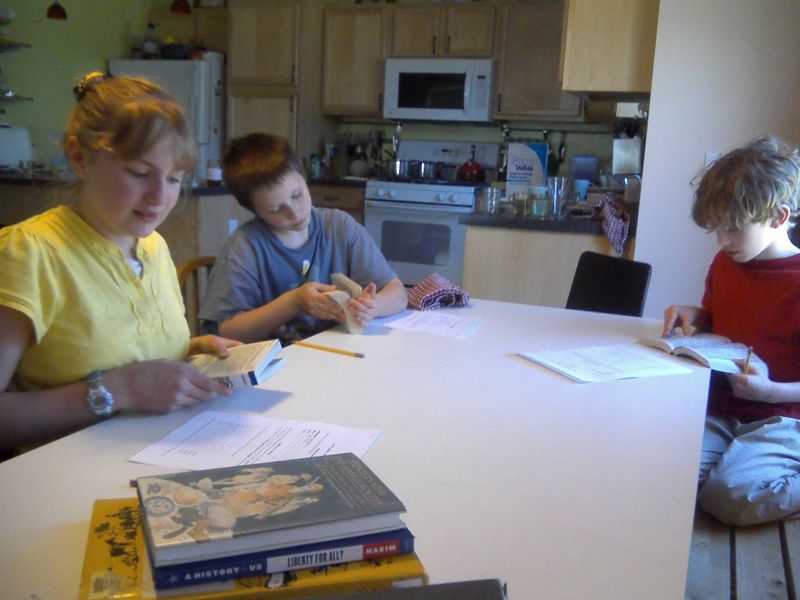
    I was working with the three oldest children on Latin; they are doing a worksheet I wrote up to introduce them to the Latin-English dictionary.  (In the foreground you can see the books we worked from for U. S. History earlier.  In the background:  my kitchen.)

    2010 Apr 24 - 04
     

    Meanwhile, Hannah had the three emergent readers, who are all getting close to graduating from phonics to more text-based reading instruction.  They're all between six and eight.

    2010 Apr 24 -02
     

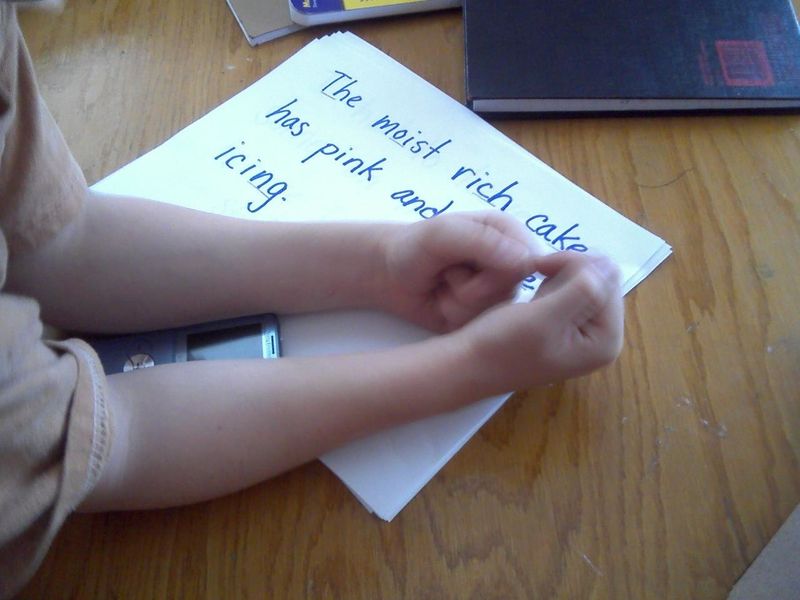
    I know you're going to want to know more about how she teaches phonics to three children at once, and I promise I'll write about that next.  I can do it too by following her methods, but she's really good at it.  (Short answer:  Several lap-sized dry erase boards, and a word list prepared in advance.  I can take credit for the word list at least.)

    2010 Apr 24 - 03 

    Meanwhile, what were the 5yo and 3yo doing?

    Having screen time:

    2010 Apr 24 - 01
     

    Hey, we're not perfect.

    One of the realities of having this many children learning in the house at once has been the judicious use of screen time.   I like for screen time during the school day to be at least arguably part of learning time.  Sometimes I allow educational candy like the games and videos on pbskids.org or National Geographic Kids, and sometimes Hannah allows the fitness-oriented games on her Nintendo Wii.  Most often it's DVDs though — I keep two separate binders of DVDs for kids, one of which is marked "Educational."  Now, mind you, I am of the opinion that everything — everything — teaches, but some things teach more of what I want to teach than others.  I try to pull from that binder during the school day.  And there is always the library.  In the photo above, the girls are watching a DVD of a theater production of "Cinderella."

    The preschoolers' "together curriculum" is the least-planned.   When we really got started co-schooling, we decided not to worry about them too much.  We are together twice a week, and a homeschooled preschooler — even a homeschooled kindergartener — gets plenty of schooling on a M-W-F schedule.  So it's perfectly fine to allow them lots and lots of free play on Tuesdays and Thursdays.  And play they do:  they are always weaving in and out of our school days in their princess dresses or their rain boots, toting dollies or toy swords as the mood strikes them, having tea parties and playing house.

    Still, the little ones need two things from us.  They need us to connect with them, to "collect" them, several times during the day.  And they need to do work that they know is important and real. 

    We strike the balance between over-programming them and under-connecting with them by "semi-planning" their work.  At the end of last school year, Hannah and I sat down together and went through the big catalogue and picked out several workbooks, curricula, and manipulatives that would be a healthy part of a good pre-K/K curriculum for the five-year-old, and that the three-year-old could also work with.  Of course, we also each have a library of good read-alouds and our own collections of learning tools that we've curated over the years.

    On any given school day together, we've got three or four different lessons ready that we can give to the little girls on short notice, whenever they come up and announce that they want to "do school."  We also try to call them to the table for school at least once every school day together, and we try to gather them up for story time sometime at the beginning of the day.  Too, they enjoy joining the older kids at their lessons once in a while; it's good to have extra coloring pages or maps printed for those occasions.  (I'm not sure we could do this if we didn't each own a photocopier.)  Any of us moms can run a lesson for the girls with little extra preparation, because we always have several things ready to go.

    What kinds of lessons and activities work really well for this format?

    • Identical workbooks, one for each child, kept as a set.  Tear out the same page from each workbook and hand them out.  We started with the Kumon workbooks.   We choose the level based on what the five-year-old ought to be doing, figuring that the three-year-old can "tag along."
    • Charlotte-Mason-style art appreciation.  Show the children an art print and simply talk about it.  It's surprising the direction the discussion can go.  Afterward, they can try to copy the picture if they want.  More ideas at Ambleside Online.
    • If you're patient for the mess, some play dough is always nice.  
    • Shape stencils are also good.  You can use them as if they were Montessori-style "metal insets."
    • Quick "exploring" activities with the older kids' math manipulatives are fun.  Pattern blocks, linking cubes, that sort of thing.
    • Helping prepare the lunch and snacks, and set the table, is good for this age group.
    • We have also bought a preschool music theory curriculum that takes five or ten minutes a lesson.
    • Bible stories are a nice lesson to do together; even if your families aren't of the same religious denomination (and we are not), it is not usually hard to find a children's Bible you are both happy with.  We like this one for the smallest kids — it has little questions for narration built right in.  Another book we like to use is a good illustrated Aesop, since the stories are short and classic.  
    • Look for more ideas in books about Montessori lessons.  Here's one I have.

    The ideal kinds of lesson for this format have this in common:  they are relatively ready-to-go out of the box, so to speak; they lend themselves well to improvisation; they don't take a lot of time; they require minimal extra supplies that can be quickly grabbed; and they are easy to clean up.    All one of us has to do when she finds herself needing to teach the little girls NOW is grab the supplies, which we try to have ready to go, clear a space on a table and go to it.  A few minutes later the little ones are trotting off to something else, pleased as punch that they have "done school" just like the big kids.  


  • In the moment.

    A real-life friend of mine recently started blogging her journey towards healthier eating, and I've been enjoying following her entries. 

    Something she wrote last night struck me as worthy of comment here:

    So today I could have done worse, but I could have been much, much better.  It is getting easier to look back at the day and say "OK, I should have done it this way."  I am wanting to transition to thinking of it on the spot so I don't have to look back on the day and apply to tomorrow….  I know it'll come eventually.

    I think it's actually really, really hard to learn the habit of "thinking of it on the spot" — making careful food choices in the moment, in the face of hunger and possibly cravings, and sometimes in a less-than-healthful food environment.  I can make on-the-spot choices that match my goals now, in almost any environment, but this is something I had to learn.

    And I did not learn to make good on-the-spot choices by making good on-the-spot choices, or by making bad on-the-spot choices, or in fact by making ANY on-the-spot choices at all.  What taught me to make on-the-spot choices was to make choices well in advance, and then stick to them.

    Back in 2008, when I was learning, I would sit down in the evening and write out everything I planned to eat the next day, and when I would eat it.  Very quickly I realized why I had been unable to make good on-the-spot food decisions:  It takes time to figure out what to eat in advance!  Even more time when I expected my choices to be limited by circumstance. So why was I being so hard on myself for failing to make good choices on the fly?

    The good news is that, after many months of planning ahead, I found that I had gotten better at making choices on the fly. I'd gained a lot of experience in difficult situations, like fast food restaurants and buffets, and I'd internalized some good rules of thumb that I can call on "in the moment" — like "Eat entrees as if I were half a person and vegetables as if I were two people."  

    I'd also learned that in some situations, even if my kids needed to eat a meal right then, the best choice for me might be to wait, to stay hungry until I could get home and have a real meal.  In other situations, I could eat something very small with protein in it — a handful of the almonds I keep in my car, for instance, or maybe a kid-size hamburger — and complete the meal by having vegetables and fruit, by themselves, later in the day. 

    And I had more knowledge.  I had learned that a homemade bran muffin has just about as much protein as an egg — so I don't need to add the egg to the bran muffin if I eat the bran muffin first.  I had learned that certain "healthy" items have more calories than the "unhealthy" items.  I had learned that it was possible to ask to have the cheese and croutons left off, the dressing on the side.  Things like that.

    Just yesterday I found myself at Sonic with the kids at lunchtime.  There are no "healthful" meal choices there, although to their credit you can get fresh bananas or apple slices on the side.  I could have stayed hungry till I got home, but instead I opted to order one ordinary (not double) hamburger with "the works," and skip the sides and drink. It's a reasonable portion size, really.  Adding a banana might have added a health halo, but I know darn well (by now) that the calories in the burger were enough to be my whole lunch.  In the past I might have ordered a superficially "healthier" sandwich (like the grilled chicken wrap) and let that convince me I should order fries and a soda too.   Which would have given me far more food that I needed — a gluttonous amount — even if the sandwich part was theoretically better (something I question anyway).

    But the point is, I only got to this point by planning ahead, which forced me to learn the real content of my choices, and empowered me to make better ones.  Once I had plenty of practice, I knew what the best choices really looked like — and they aren't necessarily the ones I thought was best before, with people in line behind me and my children whining for fries.  I know better now.

    [Editing note.  Years and years later, I wish I’d done a better job distinguishing gluttony from other problems with food, like clinical eating disorders and other kinds of compulsiveness.  

    I want to emphasize that, whereas I identified some behaviors in myself that probably qualified as self-centered gluttony in the technical sense, I am not and never have been qualified to make that distinction for anyone else.

    I hope to add some commentary to all the posts that have this problem as I find the time to review them.  Here’s a more recent post where I acknowledge some of the problematic material I wrote and set new ground rules for myself going forward.]


  • Confession.

    I recently received a question from a reader who agreed to let me share the question and my response.  Here we go:

    I am 42 and had our 5th child almost a year ago. Previous to that pregnancy, I had cleaned up my eating and dropped to 120 lbs. – my college weight! I never thought I could do it and it was such a victory.

    Since then, I have been discouraged day after day because climbing back onto the healthy eating wagon is turning out to be so hard for me. I know what I need to do because I’ve done it before. Yet, I keep choosing to eat junk.

    … You credit the Sacraments to your weight loss. PLEASE elaborate on that if you have the time.

    About the Sacraments and weight loss. It’s funny, I don’t think I’ve ever confessed the “sin of gluttony.” I consider myself to suffer from an eating disorder, and so I was never really aware that I was being gluttonous for a very long time. If one is not aware  that one is doing something wrong, one doesn’t incur guilt or require confession.  And guilt is mitigated in the presence of compulsions or even strong habit. I’m positive my sin [of gluttony] was venial, if there was indeed any sin at all.*

    After I realized that my behavior was, objectively, gluttonous, and became convinced that I had to change, I asked Jesus for help in the Eucharist, and received that help. Specifically, I asked Him to remove my disordered attachment to  all food except Him. I don’t think it’s entirely removed, but I am much less disordered than I was before!

    I have never been “convicted” (as the Protestants say) that I was committing a sin in most incidences of overeating. It has been more a case of trying to develop the virtue of temperance in myself. As such, it’s entirely appropriate that I got that strength through the Real Presence… as Food. 

    Also, one has to eat every day, and it’s not helpful to work hard at trying to draw the line [between sinful gluttony and garden-variety overeating]. Eating ten gumdrops is okay, but the eleventh is a sin? Is it only a sin because I’m overweight? Does a normal person need to confess every time she eats a double helping of ice cream and cake at someone’s birthday party?  Thinking that way is, I’m convinced, harmful to me.

    What I did bring to the confessional was my backsliding into bulimia. 

    Whereas I need to eat every day, and it’s difficult to decide when moderate eating crosses into immoderate eating; I don’t need anyone to tell me that it is immoderate to make myself throw up. It harms my health (I have damaged my larynx) directly, in a way that eating a bag of chips doesn’t. 

    What’s more, I was very aware of my free choice in the matter. I would feel  that I had eaten too much. I would see before me two paths: 

    (1) I could remember the uncomfortably-full feeling and use it as a lesson to eat less the next time, to  stay out of the near occasion of sin-by-purging;

    (2) or I could go to the bathroom, stick my finger down my throat, and make the extra food go away, thus reinforcing the habit and allowing myself an easy way out that would  even promise I could overeat in the future, again and again and again.

    Sometimes I chose #2. And that is what I brought to confession. And for a long time after each confession, I believe I had the grace to not be tempted to purge.   (It wore off eventually. I have backslid and reconfessed this sin numerous times in my life.  But not constantly. I can tell I am receiving real help in the confessional with  this temptation.)

    It’s not a problem for me right now, I should add.  But I don’t think I’ll ever be completely safe from it.

    *

    [Editing note.  Years and years later, I wish I’d done a better job distinguishing gluttony from other problems with food, like clinical eating disorders and other kinds of compulsiveness.  

    I want to emphasize that, whereas I identified some behaviors in myself that probably qualified as self-centered gluttony in the technical sense, I am not and never have been qualified to make that distinction for anyone else.

    I hope to add some commentary to all the posts that have this problem as I find the time to review them.  Here’s a more recent post where I acknowledge some of the problematic material I wrote and set new ground rules for myself going forward.]