bearing blog


bear – ing n 1  the manner in which one comports oneself;  2  the act, power, or time of bringing forth offspring or fruit; 3 a machine part in which another part turns [a journal ~];  pl comprehension of one’s position, environment, or situation;   5  the act of moving while supporting the weight of something [the ~ of the cross].


  • Innovation.

    My friend Marybeth blogging at Confessions of a Fat Loser is the first person ever to find a new use for a bridesmaid dress she hates.

    So I got the bridesmaid dress for my sister's wedding (that she decided to go small on and not have bridesmaids…).  I HATED the dress on the David's Bridal website, and had to decide to 'suck it up' and wear it joyfully (and without comment, which is big for me) because I love my sister.    It's even worse in person, I think.  My husband pointed out what physical aspects the dress really emphasizes, and the kids said I look beautiful in it.  (Kids are such a wonderful esteem booster!)  Still, I really do hate the thing….

      Anyway, I figured as much as I hate the dress and hate the photos, I'd post them as my 'before' photos.  I think every few months, I'll repost photos of me in that icky dress and eventually, over time, I'll look better in it.  And this way, I'll get some use out of the thing 🙂

    Marybeth is several good habits and a little more than twelve pounds along in her blog/food journal/weight loss journal.  I'm commenting there daily.  Come on over and follow along if you like.  I believe she said later today she'd post requesting healthy recipes — maybe you'll have some ideas for her?


  • Mantras.

    There are a few mantras I find myself muttering from time to time, mantras that remind me to stay on track.  I'm not sure whether tossing them out to the Internet would be helpful to anybody else, though.  I didn't find them in a book or even sit down and compose them; they bubbled up out of my
    subconscious, and some other part of me — my conscious? — repeated them.  Over and over and over again.

    Here we go.

    (1) "I don't do that anymore."

    This is what I say to myself when I am driving home, alone, and it occurs to me  that I could go through a drive through and get a cheeseburger or something, and I could eat it, in the car, and nobody would know but me.  I also find myself repeating it to myself when I wander past a vending machine and pause, regarding the bags of Chee-tos and pretzels.  Basically, any time that I have a little bit of free time available and it occurs to me that one thing I could do with that free time is buy some food and eat it:  I hear myself say, "Remember?  I don't do that anymore."

    I'm sort of  amazed at the power of this statement.  I pronounce it neutrally.  There's no judgment or shame directed at my former self; it's just a true statement.  And yet it is a remarkable statement, because it is self-fulfilling.  The simple act of repeating it and intending it to be true helps make it more true, every time I say it.  I can't remember a first time, but you know – it could have been true the first time I said it, even if my last binge had been only that morning.  It can become true at any moment, for anyone.  Think about it.

    And I can feel its power growing:  The more I repeat it, the deeper a  groove it wears in my subconscious, the more distance I put between myself and the old me. 

    (2) "I've already had my treat; I don't get another one."

    I use this most days, I think.  It's a sort of bookmark:  reminding me that moderation means stopping, that treats are rare by definition.  I can have a square of chocolate after lunch if I want, sure.  But if I find myself reaching for a second or third, I often find my hand pausing as this sentence comes to mind.  I've already had my treat; I don't get another one.

    Too, It helps dispel that awful temptation that says, "You've already had a bunch; what's one more?"   Because with one stroke, I've declared it all one thing — all of  the "bunch" I've already eaten — whether it's two cookies or a whole bag or some of all the different kinds of leftovers I had in the fridge – all that added up to one thing, "my treat," what I've already had. And the next bite, however small, woulde be "another."  What I don't get .  You see, the line can be drawn anywhere. 

     Sometimes I have to remind myself that I've already had an "extra" even if it wasn't very treat-like.  My kids had soup and saltines for lunch; you know my weakness for saltines.  I polished off the crackers left in the sleeve after the kids had had their fill, while I was waiting for my own lunch to heat up.  After I finished lunch, when I wandered into the kitchen thinking about a square of chocolate, I
    remembered the handful of crackers, and said to myself:  I've already had my treat; I don't get another.  I turned around and headed out again.

    I think it's important to note, again, that there isn't an element of judgment or shame here.  I'm not punishing myself for the sin of eating crackers.  I'm just  trying to practice reality-based eating: 
    I already chose a treat and now I live with — live on — the treat I had.

    (3) "A piece of cheese is like a truffle."

    Now this little food-specific gem, I know where it came from — Hannah suggested it to me.  I liked it so much that I adopted it, and I repeat it to myself almost every time I have a snack or a meal in which the protein source is mostly cheese.  Which is almost daily, in fact.

    Cheese, of course, is more nutritious than chocolate truffles, but it's about as dense, rich and satisfying — more satisfying, really, since there's much more protein and hardly any sugar.  Those calories aren't empty.

    The reason I repeat it, though, is that I spent many years eating enormous amounts of cheese at one sitting, for a snack, on crackers with mustard.  It was one of my favorite snacks.  And yet I probably didn't even really taste it.  Should have just eaten the mustard off the spoon, I guess. 

    I repeat this mantra to keep myself honest and to remind myself that it isn't okay either to eat cheese without enjoying it or to binge on huge amounts of cheese.  Since I eat it often, the effort adds up.

    A "serving" of cheese is, of course, one to two ounces.  That's where the  truffle comes in.  The imaginary truffle is about the same size as the cheese I ought to be eating.  And the image of a single chocolate truffle is a reminder to slow down; to let the cheese come to room temperature for full flavor; to take tiny bites; to enjoy it.  And to leave it off of dishes where its contribution won't be noticed:  a cheesesteak is  worthy to me, a hamburger really isn't.  What with the mustard and all.

    (4) "One egg is enough eggs for breakfast."

    As a former consumer of countless three-egg omelettes, I can attest that this mantra is necessary. Does it sound more like a rule than a mantra?  But I adhere to it almost obsessively, and I really do repeat it to myself.  I am positive that I don't need to be eating two or more eggs at breakfast, ever.  If I ever catch myself starting to cook two eggs for myself in the morning, I'll know I'm in danger of returning to my old habits.  Not.  Going.  To.  Happen. 

    I repeat the one-egg mantra to myself whenever I make eggs for breakfast, whenever I order eggs in a restaurant.  Yeah, I know, I could still overeat even if I stick to only one egg.  I could get the Sunny Side Up Special with four links of sausage, Belgian waffle drowning in syrup, ketchup-laced hash browns, and one egg.  And yet…  I am never really tempted to order such a thing, unless I am dividing the breakfast up between me and two of my children.   What I *am* tempted to do is eat the second half of that Eggs Benedict.  This mantra keeps me from doing it.  One egg is enough eggs for breakfast.

    (5) "A twelve-hour fast feels better than a seven-hour fast."

    What I tell myself when I'm deciding whether to have a snack before bed.  It's true for me, too — I really do feel better in the morning if I have fasted since dinner.  Sometimes I wake up ravenously hungry, and then the most mundane of breakfasts is fantastically delicious; buttered toast, heaven on earth.  Other times I wake up only feeling light and quick and sunny. 

     I don't feel bad per se, if I've had a bedtime snack, but it just isn't as good a feeling as having fasted since dinner.  Heavier and slower.  It reminds me a little bit of a hangover — there's no headache or dizziness, but instead there's a sense of something unpleasant sort of lingering in the system.

    I don't always avoid bedtime snack.  My husband and kids always have one, and sometimes I join them.   But I always pause and repeat this to myself, to remember that it's a choice with a consequence.

    That's not all, thanks to another important word in that mantra. In part because of it, I have come to think of the period between dinner and the next day's breakfast not just as a time when I don't usually have food, but as a literal daily fast — a positive decision I have made to give my body something it needs, i.e., a rest from eating and some of the work of digestion.  There's a reason we call it "breakfast" in English, after all.

    These five mantras are specific to me and might not help anyone else.  Do you have any truths or mottoes you regularly remind yourself of to keep yourself on track?


  • Decluttering inspiration.

    Just in time for spring, Willa at Quotidian Moments has put up an index of many posts about systematic, house-wide decluttering.  If you are looking for something to read to get yourself into the mood, you might enjoy checking it out.


  • Barefoot running?

    Announcement:  I'll be running my first postpartum 5K on August 7.  You have no idea how good it feels to be planning for another race — now that I have it scheduled, I can truly say that I am not just "recovering," I am in fact training.  I ran for 25 minutes today and will be bringing my run times up to 30 minutes in just a few weeks; barring injury, I am sure I'll be covering 5K in that time by the time August rolls around.    My goal:  to beat my pre-pregnancy time.

    So, time for a post about running!

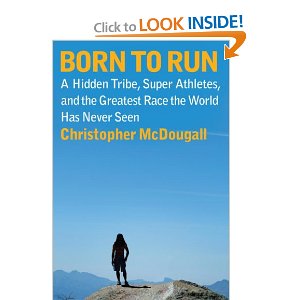
    Born to run cover  A while ago, Christy P recommended Christopher McDougall's book Born to Run:  A Hidden Tribe, Super Athletes, and the Greatest Race the World Has Never Seen.  Apparently it's gotten a lot of press, because I had to wait in line behind 230 other people in the hold queue at the library.  I finally got to check it out last week and am really enjoying it.  It's not what I would call literary, more fluffy, but it is a very fun read.  I would take it with me on vacation, except that I want to get it back to the library so that the next 400 people in line can read it.

    I haven't finished the book yet, but I am already intrigued by one of its major themes:  running barefoot or in minimalist footwear — that is, with no cushioning or "support" whatsoever, just a thin layer of rubber or other tough material on the bottom of the foot to protect the sole from puncture wounds.

    I'm sort of surprised that the idea hasn't really occurred to me before, although Mark has been thinking about it for some time, and has considered buying a pair of FiveFingers or similar shoe, which gets some discussion in the book.

     After all, it goes along with one of my guiding principles of life:  when you engage in an activity that humans have been doing since humans were human, you're not likely to be able to improve on it significantly in terms of optimum human health and happiness by modernizing it much beyond the stone age.  

    Feeding babies?  No matter what they said in the fifties, human milk is still the best food for baby humans.

    Hungry?  Eat food, not too much, mostly plants.

    Having sex?  Steer clear of barriers, drugs, and mutilating surgeries, and pick a partner who'd make a good parent for the babies you'll make.

    Running?  

    Well, why not run barefoot, or at least with minimal cushioning?   

    I do not doubt that modern humans have designed running shoes that can allow humans to run faster or farther or on more difficult terrain than they otherwise might be able to run.  This is not a refutation of my guiding principle.  After all, we designed cars, and cars get us places faster and farther and on more difficult terrain than we could walk.   But faster, farther, and on more difficult terrain is not the same thing as for optimum human health and happiness.  What is more consistent with human health, walking ten miles every day or driving the same distance?   Perhaps running barefoot, with its limitations on speed, distance, and terrain that come with it, is ultimately better for your feet, knees, hips, back — and heart and lungs — than is running with high-tech shoes.  It makes sense:  humans ran down their prey for tens of thousands of years without Nikes.  

    And of course, if you are going to run on a modern surface — a littered asphalt running path  is just as unknown to our prehistoric feet as is a gel cushioned insole — you may need modern protection from that surface to counteract it.  I don't want to step barefoot on a kid's Lego, let alone an upturned metal bottle cap. But given that the human body is pretty adaptive to a vast variety of environments, maybe the foot only needs a thin layer of protection — something tough but not squishy.

    It turns out that if you google "barefoot running" you will find quite a lot of videos and information out there.  Not surprisingly, there is a sort of quasi-cult among running enthusiasts for the practice.   It does not take long to find some video of people running over crazy-rough terrain with only thin little sandals, and running on tracks totally barefoot.   The difference in stride is striking.  Intriguing even.  It makes me want to give it a try.

    (I have to say, though, I fear a stubbed toe.  Once when I was a child I stubbed my toe running barefoot on the sidewalk, and a layer of skin split from the toenail and peeled horrifyingly back off my big toe like a hood.  Eeeeyuch, it still gives me chills just thinking about it.  I hope that NEVER happens to me EVER AGAIN.)

    The book I mentioned above tells a short history of the modern running shoe.  Supposedly the seriously-cushioned heel was invented on the theory that if the heel was cushioned so that the foot could strike with the heel when running — instead of just when walking — the runner could lengthen his stride, putting his foot way out front, and that with a longer stride he would be able to go faster.  Such a running stride, however, is unnatural, and your body's not meant to use it.  Injuries are the result.  Apparently, the more money you spend on your running shoes, the more likely you are to get hurt.  

    Correlation is not causation, of course, but take note of this:   no running shoe company makes a claim that their shoes will decrease the risk of running injury.  Ask yourself how likely it is that Nike would keep such an advantage secret, if it had one.  So I don't know if I'm going to take up barefoot running, but I do know that I will not be tempted to buy super-expensive running shoes, no matter how serious a runner I become.

    Anyway, one of the most fun things I found today was this three-part video explaining how to make your own running sandals out of any sort of mat material (doormats, old tires, or bulk Vibram soling material if you want to get fancy) and some cord.  The kids were fascinated and I am tempted to make some of these for the whole family as a family project!

    Part 1

    Part 2

    Part 3

    The guy who made the videos will sell you a $20 kit to make a pair of sandals, but since you can also order the same soling material in bulk and any comfortable cord/thong/strap will do, I'm thinking we could outfit the whole family in some stylin' huaraches for a bit less than that.  

    Please don't tell The Manolo.


  • My laugh of the day.

    Rachel at grasping for objectivity in my subjective life gives us a detailed list, with commentary, of the Google searches that led to her blog.  Read and enjoy.

    Probably the three most common searches that I get are "how to stop being Catholic," "savory sweet potato pie," and "bearing in mathematics."

    The sad thing is that I could probably provide some kind of a useful answer for all three of these seekers.  I might have to crack an old set of class notes about lubrication flow.  But I wouldn't have to crack a cookbook or a volume of canon law.


  • Muir of the Mountains: A review.

    One of the things I really love about literature-based history in elementary school is that you get to decide the criteria of who's "important" enough to spend lots of time on.    In elementary school, you can, if you wish, pick historical characters based on interestingness, or, well, character.   Even if some of the folks you pick would be relegated to a little side box in a typical American history textbook for elementary school kids.

    We just finished reading a biography of John Muir:  Muir of the Mountains by William O. Douglas.  We spent four precious sessions of American history on it.  And I am so glad we did!  

    First of all, the kids all loved the book and listened with rapt attention.   Really good biographies are wonderful ways of getting at history, I suppose because they are at bottom stories.  The more interesting the character, the more interesting the book, of course, and Muir was definitely an interesting character.  "He's crazy," all the kids agreed as I got to the part where Muir was leaping across crevasses during a morning walk with his dog Stickeen.  "Definitely crazy," they added when I got to the part where he had to lie in hot-spring-warmed mud all night to keep from freezing in a mountain snowstorm.  But they didn't think he was crazy when I read about his efforts to protect the redwood trees from extinction, or his elaborate descriptions of the Yosemite valley.  (This particular book includes lengthy passages of Muir's own writings — poetic, detailed, multisensory.  All the better.)

    Second, the book gave us a window into how much people's attitudes towards nature have changed just in the last hundred years or so.  We were able to discuss how much they take it for granted, the idea that parkland should be set aside for people to enjoy it in a state close to its natural state; the idea that future generations deserve to enjoy the resources that our generation has now.  It really helps put into perspective the modern environmentalist movement.   The proper end of nature conservation is to make life better for human beings — a point Muir stressed over and over in his writings, and one that comes through in this particular biography quite clearly.

    Third, the book pointed out something to love about the United States of America (Canada too) — unlike in many other places in the world, our country stepped in to protect huge areas of the wilderness before it got destroyed, and we still enjoy that today.  America's national parks are a treasure we should never take for granted.  The book taught the kids that it might have gone differently — the giant redwoods might have been logged into extinction, for example, or the parks and forests might never have been created for us to enjoy as hikers, campers, bird watchers.  Someone had to care about the land and the species that inhabit it, and someone had to lobby the government to get the necessary laws passed.   Seriously:  Our national parks are a big reason why I'm glad to live in the USA and call it my country.

    Fourth, the background information about Muir's life, like many biographies, reinforced a lot of other concepts in American history that could have been taught from a textbook — so we don't have to.   We got to discuss immigration, economics,  political lobbying, among other things.  Several U. S. presidents make cameo appearances in the book — most notably, Teddy Roosevelt, who went camping with Muir, and Woodrow Wilson (boo hiss) who undid some of Muir's work.  

    Fifth, it gave us another opportunity to talk about the tensions between different interest groups and to point out the way they interact non-simplistically.  For example, why encouraging more people to participate in hunting and fishing can help state DNRs protect the same species that are hunted and fished as well as other species.  

    Sixth, the book contains a considerable amount of scientific information about glaciers, rocks, and the animal and plant species that interested Muir.  

    Seventh, it gave us a chance to talk about Muir's admirable character traits.  Not just his love of the outdoors and his eye for beauty, his persistence and his charisma that helped him get laws passed that would protect his beloved Sierra Nevadas, although these alone would be  The biographer made a point of telling how after Muir married, he deferred his dream of full-time naturalist/environmentalist work for about ten years while he worked on a farm, carefully saving money until he had ensured that his wife and daughters were provided for.  Not till then did the family sell off the farm and Muir devote himself year-long to his beloved mountains.

    Finally:  this is history that my kids can relate to.  Mark and I try hard to pass down our love for outdoor activity, for the outdoors in general, to our kids.  It's really one of our family values.  I'm glad to be able  to place something so important to our family in its historical context.

    After we finished the book, we unrolled the U. S. map and spent quite some time looking over it and marveling at the national parks and forests and wilderness preserves shown all over the country.   The kids all want to see Yosemite for themselves, and wished the only Minnesota national park (Voyageurs — it's up in the north woods) were close enough to make a day trip.  Well, we are heading out to Rocky Mountain National Park this summer at least, and I expect the trip will be made more meaningful with a little bit of background knowledge about the man who more than anyone else made it and all the other national parks possible.  


  • Quick poll: grease and salt edition.

    Answer in the comments, since I don't have enough readers to bother with a poll widget.

    Which is more difficult to do if there is a plate of French fries within your reach?

    A.  eat zero — don't even touch them

    or

    B.  eat one or two, and then stop

    (If you don't love French fries, please substitute any other item that you love that comes in small bite-sized quanta, e.g., jelly beans, chips with salsa, etc.)


  • Burger binge.

    Last night we went for a VERY late dinner with the kids — after 9 pm — to a bar-type burger restaurant in Uptown.  The restaurant has a gigantic photograph on the wall, a Chuck Close-style photograph of the head of an urban hipster having a gigantic juicy burger stuffed ironically into his gaping mouth, the lettuce and tomato dripping onto his ironically unshaven chin.

    The kids had kid-sized cheeseburgers and fries and a shake and some onion rings.  Mark, who enjoys a good burger sometimes, had a big bacon cheeseburger and a pint of local stout.

    I asked if the veggie burger was made in-house and got a curt "No."  Not about to shell out $8 for a veggie puck that had been shaken out of a box moments ago, I contemplated a big patty melt, since the last thing I had eaten was three slices of Hannah's homemade banana bread, six hours ago.  My stomach was really growling.

      But!  I noticed they had sliders for $3 each, which I suspected (correctly) were the same as the kid-sized burgers.    I ordered a big salad and one slider, with lettuce and tomato to drip onto my non-ironically unshaven chin.  I ate the little burger first, so I could enjoy it while it was still hot and fresh and the edges of the bun still crisp, and at the end of it I wished there was a second one on my plate.  But by the time I had gotten to the bottom of my salad, I felt comfortable.  

    I was glad I had not said to myself, "I'm truly hungry, so it's okay to have a full-size burger."   Even though I surely could have eaten it and would have enjoyed every bite.  The truth is, whenever I try to eat in response to my hunger, I fool myself into eating more than my hunger requires.  Structure is more important.  

    I keep learning this over and over again:  sometimes by making a mistake (eating too much and being overfull), and sometimes by not making a mistake (fixing less food than I think my hunger requires and discovering that it is indeed satisfying.)  

    I am less and less impressed by the idea that to lose or maintain weight, people should eat "when hungry and only when hungry."  It's just too vague and easy to defeat in the face of the slightest desire to eat.


  • I still don’t understand myself sometimes.

    Here's a case in point.

    I usually fill the children's Easter baskets with random grocery-store novelties as well as candy — things like mini boxes of Froot Loops, tiny cans of pineapple juice, that sort of thing.  (Since I am one of those never-buy-neon-cereal nasties, the mini Froot Loops are always a bigger hit than the chocolate eggs.  Go figure.)  This year I bought a box of "100 Calorie Packs" of mini fudge-coated shortbread cookies to add to their baskets, only because I thought the tiny packages of tiny cookies would fit nicely into the basket.

    When I was up in my locked bedroom packing the three Easter baskets on Holy Saturday I discovered there were five cookie packs in the box.  Two extra.  I had been happily nibbling on jelly beans and Rolos and mini peanut butter cups — one doesn't get to fill Easter baskets every day — and the cookies looked tasty, so I tore into one of the bags and popped a couple of them into my mouth.

    Huh.  They were okay, I guess, but not as good as I thought they might be.  (This happens to me all the time with packaged cookies now.)  I ate a couple more with decreasing enthusiasm and then tossed the rest of the bag, plus the last unopened bag, onto my dresser, where I forgot about them.

    Until the next morning.  I was heading out of the bathroom from my shower, passed the dresser, saw the cookies, and thought:  "Hey, cookies!  I could have one."

    Then I remembered that they were only so-so cookies, and I was going to have breakfast in a few minutes, so I passed them by.  "Save them for later," I thought.

    The same thing happened when I walked through the bedroom later that day.  And then the next day.  And the next.  I would see the cookies.  I would think, "Hey, cookies!  I could have some."  Occasionally I would reach my hand out to take one.  And then I would think, "Well, they aren't very good."  

    At some point, you would think I would throw the cookies away.  

    Eventually I threw away the bag that had already been opened, because of course they were going to be stale by now.  But you know what?  The last, unopened bag is still sitting on my dresser.  I am still walking past it every morning and thinking, "Huh, cookies!  I'll have them, one of these days when they look good to me."

    Now what's up with that?  Am I just reluctant to "waste" these crappy little cookies by throwing them in the trash?  At the same time too greedy to just give them to the kids (not very good, but mine, my precioussssss cookies….)?  Or am I taunting myself on purpose to see how long I can last? 

    Whatever the reason, it's getting pretty ridiculous.


  • A woman on a mission.

    That's Erin Manning this week.  

    Mother's Day Post 1

    Mothers Day Post 2

    (this post is not a veiled hint to my wonderful and supportive husband.  that is all.)