This is meant only to be an easily accessible “before and after” post that I can refer people to. No comments are being solicited 🙂
2006 (160 lbs)
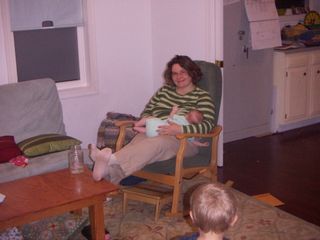
2007 (148 lbs)

October 2008 (113 lbs)

January 2010 (9 months pregnant and 153 lbs)


bear – ing n 1 the manner in which one comports oneself; 2 the act, power, or time of bringing forth offspring or fruit; 3 a machine part in which another part turns [a journal ~]; 4 pl comprehension of one’s position, environment, or situation; 5 the act of moving while supporting the weight of something [the ~ of the cross].
This is meant only to be an easily accessible “before and after” post that I can refer people to. No comments are being solicited 🙂
2006 (160 lbs)
2007 (148 lbs)
October 2008 (113 lbs)
January 2010 (9 months pregnant and 153 lbs)
Yesterday I blogged my day's eating, and a commenter mentioned tracking on SparkPeople, which I used to do regularly and really haven't since I got pregnant last year.
I already did half the work, though, in making the list, so I went to SparkPeople and typed everything in. I made generous estimates of the food I ate, where I didn't measure it.
It came out this way:
Breakfast (veggie omelette, coffee): 200 calories: 12 g fat, 10 g carb, 13 g protein
Snack + Lunch at McDonald's: 515 calories: 21 g fat, 57 g carb, 28 g protein
Dinner + dessert (chicken, corn, salad, asparagus, ice cream, chocolate): 1,003 calories, 81 g fat, 53 g carb, 32 g protein
____________________
Total: 1,719 calories, 148 g carb, 87 g fat, 73 g protein
____________________
My rough fat-carb-protein goal is 50-25-25– this was 47-36-17.
I got a request for a day's dietary intake and the decisions and trade-offs I made. I'm going to have to do this from memory, and I didn't measure, but I'm game.
Yesterday wasn't exactly typical, because we were on the road home from Ohio. We woke up in a hotel in Wisconsin Dells, Wisconsin, and drove several hours, having a fast-food lunch and stopping at the grocery store before going to the house.
Morning
I started my day with a bottle of water, a 40-minute treadmill run in the hotel fitness center, followed by a cup of decent in-the-room black coffee. The all-you-can-eat breakfast included cooked to order and other things served buffet-style. I am never tempted by restaurant pancakes, waffles, or French toast; my homemade ones are better. I don't like pre-sweetened yogurt cups. So the only choices I considered were oatmeal (the only whole grain around) or "fluffy omelette with choice of fillings."
I asked the waitress if they were two- or three-egg omelettes; she said "The eggs are already mixed up and the chef uses a scoop. He uses however much he needs to wrap around all the fillings."
I said, "OK, have him make me an omelette with lots of veggies, and the absolute minimum amount of egg necessary to hold it together." Cheese? "Sure, go ahead, cheese."
The omelette was still too big, so I gave about a third of it to Mark. I would have had tomato juice if they'd had it, but there were only fruit juices, so I stuck with coffee.
Summary:
Midday
We carried a small supply of snacks in the car: my usual jar of almonds, a bag of oatmeal cookies sent with us by Mark's mom, a box of assorted granola bars, and a mini-cooler with grapes, string cheese, and a few apples. When I opened up the cooler to fetch MJ a string cheese, I snagged a few ice-cold grapes to quench my thirst.
The children were restless, so I suggested to Mark that we stop for lunch at a McDonald's or Burger King with a play structure. "We can eat while the kids play, and they can keep playing while you go to gas up the car, and then we can take their food with them in the car." I declared it a No Fries Day and took the kids' orders as we approached Exit 65 (I have memorized the exits at which fast food playlands can be found all the way from Minneapolis to Cincinnati).
I made my standard McDonald's order: two side salads and a grilled chicken club sandwich, of which I planned to eat about half. I ate the salads first and then opened the sandwich box to discover that they had given me a crispy sandwich instead. It's possible I ordered the wrong sandwich by mistake. I like that kind of sandwich, so I shrugged and decided to eat it instead of getting a different one. I had about half the sandwich plus a couple of bites, and then put it back in the box and closed the box.
Mark didn't finish his salad. "I forgot how big these are!" he said to me. I nodded — that's why I get the side salads. On the dollar menu, they are a pretty good deal.
Summary:
Dinner and afterwards
I was busy making a grocery list in the car, and I never got hungry for an afternoon snack. We got to the grocery store about 3:30. I had planned to have rotisserie chicken, salad, asparagus, and boiled new potatoes for dinner — that is my standard "we shopped right before dinner" dinner. But the children clamored for sweet corn, so I told Mark to cross the potatoes off the list.
This had to be a simple, quick dinner. At home, I tossed the asparagus in olive oil and put it in the oven to roast. I cut up the chicken, sneaking just one bite as I transferred the pieces to a serving dish. I rinsed the salad (a bag of hearts of romaine plus part of a box of arugula) and sliced tomato and lettuce. I cut the ears of corn in half and set them steaming. We had a bottle of dressing that everyone likes pretty well, so I just used that. We opened a bottle of wine and sat down to dinner around 5:15.
Originally we had planned to go to a 9 pm Mass, but two of the children had run a fever in the past 48 hours, so we didn't go. I was kind of relieved not to, honestly. I was tired and glad to be home.
We have sundaes on Sunday for bedtime snack. Afterwards I wanted more chocolate so I got myself some.
Summary:
I said it wasn't a typical day but in some respects it was entirely typical: spur-of-the-moment decisions for breakfast and lunch, a planned dinner, children to feed, occasional detours. Anyway. That was yesterday.
I've sort of lost touch with whether that seems like a lot of food or not. Does it?
(update: calorie totals here)
I'm all for having easy, quick, natural childbirths. But I like to take them a little slower than this one:
A Minnesota mother and newborn are doing fine after the mother delivered the boy while driving, the father steering from the passenger's seat.
Twenty-nine-year-old Amanda McBride felt labor pains at work last week and rushed to her car. She picked up the baby's father, staying in the driver's seat because he has a history of seizures.
She drove to the hospital experiencing mild labor pains. Suddenly her water broke and the baby "just slid out."
Yow! It doesn't say whether that was her first baby…
I have been maintaining that the secret to eating moderately for weight loss is to desire the new behavior of eating moderately for its own sake, instead of trying to desire weight loss strongly enough to overcome daily temptations. Often I've wondered if it's possible for people to make themselves want that: to teach them to desire the means instead of the end.
Because it's obvious that "wanting to lose weight" often isn't strong enough. Commonly, weight loss pundits advise the dieter to write down all the advantages of losing weight that she can think of, either in a long list or individually on cards. Then, she is supposed to renew them regularly, every morning or however often as necessary to keep them front and center in their priority list.
So, you'll see suggested advantages like this:
All of these reasons are extremely attractive and I think it is interesting that
even though they are so attractive, many people have to deliberately place them
before their minds on a daily basis so that they can overcome the temptation to
make better food choices.
And that got me thinking… if people with really attractive reasons to lose weight still have trouble keeping themselves motivated… but if reviewing those reeasons daily really helps them remember why they want to lose weight…
…could people use a similar method to teach themselves to want to eat moderately for its own sake? To desire the means, and not just the end?
Here's my idea for a set of means-based affirmation cards.
All these are affirmations of the advantages of moderate eating — not of the advantages of being thinner. I wonder if writing them on cards and reviewing them daily could help train people to want to eat less for its own sake — which is so much more powerful than wanting to be thin and having to eat less to get there.
Can you think of some more? Add them in the comments.
Check it out:

It's a linen-rayon "fashion scarf" off the sale rack at Old Navy. (Full price $12.50).
I don't know how durable it will be, but it just goes to show that babywearing does not have to be expensive or complicated.
Several people have complained to me in the past month or so that my blog's font is too small to read. Nobody ever complained before. Is it the tipping point in the advent of mobile devices with tiny screens? Are you all getting old and nearsighted?
Regardless, I can't change my default font size without either paying Typepad more money, or changing my blog's appearance to an entirely different theme.
I fear change. And yet I am considering it, so that you all don't strain your eyes.
What do you think? Go with something close to the classic pale blue bearing blog theme you've known for so long? Or strike out with something totally new? (Either way with a bigger font)
I'm keeping my cactus flower photo. I like it.
One problem with being “on a diet” in America: It tends to make you an aggravated, and possibly aggravating, dinner guest.
This is where the habit of gluttony* really shows its true colors, and in so many different ways. Our cultural expectation of overeating as part of a celebration — and I don’t mean ordinary, natural festive feasting food, I mean really overstuffing — tempts those who would like to remain temperate; and it causes people to take offense when a dish is declined, however politely.
One of the more insidious ways, though, is that the dinner guest or houseguest “on a diet” often can see no way to limit her eating, except to fall into another kind of gluttony: eating “too daintily.” That is: “being a picky eater.”
Allergies excepted, it’s indeed gluttonous to ask that your host conform the dinner to your imagined dietary requirement. What’s that? Did I just say “imagined?” Yes, indeed. There are no dietary requirements over the time scale of a single meal that are not imagined. There may be dietary exclusions — allergies and true food intolerances, as well as religious and philosophical taboos — but no requirements. Many exclusions are imaginary, too. It will not kill a low-carb eater to have a polite quantity of rice or pasta or potatoes. White flour may not be good for you, but it is not poison in small quantities to most people. An entire dinner of deep-fried food, with nary a fresh vegetable to be seen, will not destroy a low-fat dieter. But it is so tempting to sit unhappily at the table and think “Don’t they know I can’t eat all this stuff?” Or to conspicuously peel the skin and breading off your chicken and leave it in a sodden pile on your plate. Or else to become the Guest from Hell — “Do you have any plain vegetables? What’s in this salad dressing?” Even following the best advice — bring a “safe” dish of your own to share — often carries a subtext of “You make the WRONG food and I am trying to show you what is the RIGHT food.”
Look, I’ve been there. I’ve done this. I spent several years trying to eat low-carb, which is one of the worst offenders in terms of diets for turning its proponents into picky eaters, certain that one bite of dessert will send them out of ketosis and derail them for the next 3 weeks. I am keeping my fingers crossed that my in-laws and friends don’t invade the comboxes and say “Come on Erin, you should talk.” I’m trying to be better! I swear!
I’m bringing this up trying to make a plug for simple moderation of quantity as a dietary tactic. Since I stopped following strict dietary regimens and started “not eating so damn much,” I find it’s a lot easier to be a dinner guest. There’s nothing I can’t accept on my plate graciously: potatoes, bread, meat, dessert. If there are plenty of vegetables around, it’s not hard to fill my plate up with half veg as I try to do on a daily basis. But even if there aren’t, so that I must subsist (for just this one meal!) on high-calorie, low-nutrition stuff, no one can stop me from taking servings that are small enough to get the right amount of calories at least.
You know the phrase “I’m saving room for dessert”? Use it. Really do save room for dessert, by eating a right-size portion of everything you’re served. You do not have to clean your plate. Use “No, thank you” as many times as necessary. And then when dessert comes, rave over it. And then, if you like, stop before you’re done and proclaim yourself too stuffed to eat any more.
It’s as simple as that. And you can do it without explaining to anyone that you’re on a diet, or have special needs, or are… “special.” You can just concentrate on being a gracious guest and having a good time with the company.
Reality: You may not be able to consume a perfect meal, or even a “good for you” meal, when you are a dinner guest. But you can always reinforce anti-gluttonous habits. That includes pickiness. Cheerfully accepting what’s served to you and eating a moderate portion of it — meaning that the only control you choose to exercise over the menu is self-control, i.e., STOPPING when you have had enough calories — is part of being a gracious guest, and also an important skill that I think many of us have not developed and that transfers to lots of other eating situations. And when you leave, you can reflect with pleasure on the habits you have reinforced — making good choices (not just biochemically healthy choices, but charitable ones) in a situation where choices are, as always, limited.
[Editing note. Years and years later, I wish I’d done a better job distinguishing gluttony from other problems with food, like clinical eating disorders and other kinds of compulsiveness.
I want to emphasize that, whereas I identified some behaviors in myself that probably qualified as self-centered gluttony in the technical sense, I am not and never have been qualified to make that distinction for anyone else.
I hope to add some commentary to all the posts that have this problem as I find the time to review them. Here’s a more recent post where I acknowledge some of the problematic material I wrote and set new ground rules for myself going forward.]
Seen on my mother-in-law's countertop yesterday evening:

Those are fresh-baked shortcakes, my friends, and fresh-picked strawberries from the garden. Truly I have married into wealth beyond my wildest dreams.
Friend of the family receiving Sacrament of the Sick, possibly last rites, at this hour (5 pm Sunday Eastern time). If you catch this message, prayers urgently requested, esp. Divine Mercy Chaplet. Patient's name is Dave. Thank you and God Bless.
Via SortaCrunchy. An excerpt:
"Don't we both have the same goal of ending up with kids who love God and serve Him?"
I would say that is absolutely NOT my goal, nor is it a reasonable goal for any believing parent to have.
Is it the cry of my heart? Is it something I long for? Will it be one of my greatest joys?
Absolutely.
But a goal? Nope.
A goal has to be something that I have the power to actually accomplish.
Thanks to Melanie Bettinelli at Wine-Dark Sea for putting this in front of me today.
It reminds me a little bit of a one-liner I have been keeping in mind for a long time: "Quit asking yourself 'what Jesus would do.' Whatever He would do, it's not your job to do it, because you aren't Jesus." Your job is to be the you that He wants…
Co-schooling runs into a bit of a snag when the families can't get together on the appointed day. It might be something unexpected: the phone rings, and we hear that someone is sick; the family will have to stay home that day. School won't happen together. Other absences can be planned for in advance: a family goes out of town for a vaction, or perhaps Grandma is coming to stay for a few days and nobody's going to have school. Either way, some allowance has to be made for the co-schooled subjects.
The first question: Are the families still both doing school that day, or is one family having the day off school? Often, we keep doing school even when we are out of town; for example, if we go to visit the grandparents for a weekor two, my children will still have school (albeit a reduced schedule) in the mornings. Or, if we stay home because one child is sick, the other children will still have some school to do. So sometimes it is the case that the families are both able to work, but separately rather than together. On the other hand, perhaps one family is taking the day totally off and the other is having a
full school day.
Hannah and I always try to talk to each other and decide what to do with each of the subjects on a given day. Here are some of the possibilities.
(1) One family does a lesson and the other family skips the lesson: that is,some children "missed school that day." This works pretty well for subjects where one day's lesson doesn't necessarily build heavily on what preceded it. An example would be a history lesson that involved reading a biography and then discussing that person's life.
Advantage: Both families stay "on schedule." Disadvantage: one family misses the lesson outright, and the other families miss the benefits of larger-group discussion. Some lessons will have to be altered because of the group being smaller.
(2) Each family plans to finish the assigned lessons by the next time they meet. This keeps you on a schedule if necessary, and it works well for workbook-type curricula where each family has identical resources (e.g. if you each own a copy of the textbook and the workbook), because all you have to do is agree which pages will be assigned during the separation. You don't have to be doing the work on exactly the same day, so this strategy can sometimes be used even if one family is taking a "day off," as long as there is sometime to make up the work. Hannah and I often do this with fourth-grade English grammar; even though she usually teaches the children and guides them through the workbook we use, I am comfortable enough with the material that I can teach it too, although I think not as well as she can. We can always call, text, or email if we have a question.
But if you don't have identical resources — for example, if you are working from a set of books or materials owned by only one family — another approach must be taken, such as one of the next two.
(3) If you can afford to set yourself back one session, you could postpone the lesson until the next time, and have one or both families do an "extra" enrichment or extension activity instead — whatever works best for the family. Watch a video, take a field trip, write a paragraph, read a book, build a model… any sort of thing that you might not get to do if you were following the regular schedule, something that it won't matter that the other family misses.
(4) Or, if you need to stay on schedule more than you need to cover the material exactly as planned, you can abandon the planned lesson for that day and let each parent cover the same topic spontaneously with the resources they have available to them. Thanks to the Internet, there is always SOME information available to work from, even if the other family has all the books. Each child is going to have a different experience with the material, but this means they can spend some of their next class time recounting what they learned to each other.
(5) Or each family can do a special topic in the same general subject. Right now our middle children are studying art prints by Jacques-Louis David; but if we can't get together (I own all the David art prints), Hannah and I can each pull any art print from any resource, and work with that. I migh use a Renoir painting off an old calendar, and she might use a Cassatt print from another collection of postcard prints she owns, and we'll both still have "done" art appreciation that day. Skills stay sharp and habits are reinforced, and we can return to the David unit when we are back together.
(6) Assign extra practice or drill, and put off learning new material until the next time you meet. This is great for subjects where one parent is in charge of almost all the teaching of new material, but where either family is able to run a drill or practice session. It also means that no one will be "behind" even if they cannot complete the assignment.
We often do this with Latin. If I know in advance that we will be apart for one or more sessions, I will write up a worksheet of translation practice for each session and share the worksheets on Google Docs. If I don't have advance notice, I'll assign vocabulary drill with flash cards. It's always useful to get in a little bit of extra practice or drill.
(7) Use the opportunity to let one child catch up to the other. Every once in a while, even though they are all working together, one child will have a stronger grasp of the material, or will have completed more of a project, than the others. Then, if they are apart, the child who's "ahead" can pause his work on the subject while the others keep working. We have done this with a multi-step writing project where each child was working on his or her own research paper — one child was farther along than the others, and so when a separation came up, we planned to have him take a break from working on the paper while the others had several sessions in his absence. Since there is no hurry to get the papers done by any deadline, and it is efficient for the teaching parent to be guiding the children together through the steps of the paper-writing, there's no reason not to give more worktime to the kids who need it when we get the chance.
(8) Swap the schedule around. We usually study world history together on Tuesdays at Hannah's, and American history together on Thursdays at my house. But if we have to be apart on a Thursday, we will often swap a session of American history with a session of world history, because it is much easier to use our world history curriculum separately than to use our American history curriculum separately. We'll do American history on the next Tuesday we're together instead.
(9) Everybody just skips working with a subject that day. We do this pretty often with composition, which is taught by Hannah at the pace the children naturally progress rather than on a schedule. At least in our state, we have no obligation to follow a pre-set schedule. We can use the extra time to catch up on something else.
(10) Embrace a complete change of plans (also known as "blowing off
school for the day"). I don't know about you, but every once in a great while I wake up and the weather is beautiful and I just know that we need to go to the zoo more than we need to stay home and study Latin and spelling and math. Or I wake up and the weather is CRUMMY and I just know it is a perfect day to spend the morning cleaning the house together, order pizza for lunch, and then re-organize the schoolroom while the kids watch movies. You've got to allow for that to happen a few times every year, I think.
Well, if you are co-schooling, you KNOW that some of the co-schooling days, your friend is going to call you up and let you know that morning that your expected plans are not going to work. I try to save up my we're-blowing-off-school days so that I can afford to do it on those days when the co-schooling plans fell through. Then I always feel like the unexpected change of plans was an opportunity to do something I otherwise wouldn't have made the time for. If I have enough advance notice, I might schedule a play date with some other friend and her kids, or get my husband to use a vacation day.
ADDED ON 1/6/11:
(11) We've tried co-schooling via Skype by now and found that it worked pretty well.
—
In short, because your schedule is intertwined with that of another family, co-schooling may reduce your spontaneity — but because that family has the power to change YOUR schedule, it also teaches you how to be flexible on short notice. I am the original Mrs. Hates-To-Change-Plans, and I am living proof that this ability can be learned… at least when someone forces me to.
Recent Comments
Recent Posts
Categories
…more to come later
 bearing blog