bearing blog


bear – ing n 1  the manner in which one comports oneself;  2  the act, power, or time of bringing forth offspring or fruit; 3 a machine part in which another part turns [a journal ~];  pl comprehension of one’s position, environment, or situation;   5  the act of moving while supporting the weight of something [the ~ of the cross].


  • More on the body-person dissociation.

    I wrote a couple of days ago about the idea, common among Christians but incompatible with traditional Christian theology, that the body after death is "just an empty shell" and that the "real person" is completely absent from the body.  (Christian orthodoxy, on the other hand, looks forward to "the resurrection of the body" and teaches that the human person is the union of body and soul.)

    The Anchoress (Elizabeth Scalia) has a story that illustrates another logical consequence of this sort of belief:  the idea that a mentally ill spouse (in this case, a person with advanced Alzheimer's disease) can be "not the person I married" and therefore that the marriage vows are no longer binding.

    The comments on this article are very, very worth reading, as some people challenge Ms. Scalia's conclusions and others step up to explain them.  One commenter responds to the idea that those who remain with a seriously mentally ill spouse are only keeping up a "front" of devotion:

    Yes, it's easy to chalk up calls to fidelity to a highly romantic belief that one can maintain unswerving devotion in the midst of a devastating kind of alienation. However, I generally give the people commenting here more credit that than. I believe that what's being said is that fidelity to the marriage is paramount even when it's hard — even when the internal feeling doesn't match the external performance of duty.

    BTW, if the person is maintaining a constancy toward the debilitated spouse, that is no "illusion." The difference between feelings and performance is not equal to the difference between reality and illusion. The devotion is still being shown, and most significantly, the violation … is still refrained from.

    Emphasis mine.  This is a point that far too few people recognize.

    Anyway, it's just an example of how supposedly arcane details of theological belief, like whether "the body" is part of "the person," have real-world logical consequences.  If "the person" is reduced to "the consciousness alone, and only as long as memory and reason remain intact," we have a very different moral calculus towards those who have been struck by mental illness than we do if "the person" is "the consciousness as it is, and the body before us."  Care and disposition of a person's physical body, during life and after death, is a kind of care of the person.  


  • Saint Paul outing.

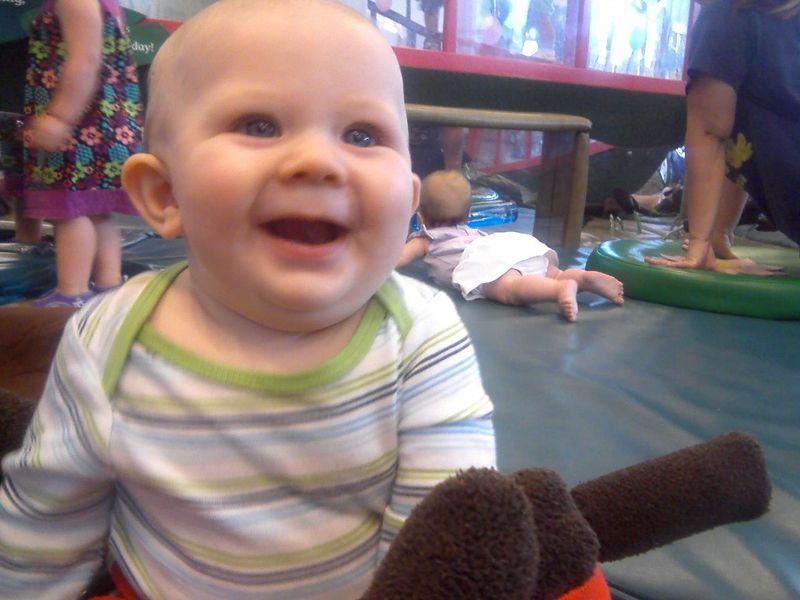
    The big boys are at Grandma and Grandpa's, so we had a Girl Day Plus A Boy Baby.

    First, the Children's Museum, where I plunked the 6-m-o in a pond:

    Leo_mcm 

    Followed by that standby just up the street, the celebrated Mickey's Diner:

    Mj_mickeys
     
    I think Mickey's has the best baked beans I've ever had.  Lots of black pepper or something.  


  • Favorite sporadic devotions tag.

    MrsDarwin tagged me with the question, What are your five favorite devotions? Here’s what she wrote about hers:

    When Betty tagged me to write about my five favorite Catholic devotions, I started making a list in my head of this and that and composing little snippets of prose in my head, already crafting what I was going to say about various forms of piety. But then I thought that perhaps I ought to assess not just what I like, but what I actually do. It’s one thing to say you like a particular devotion, but what does it avail one to like a devotion but never practice it?

    I agree, so let’s answer the same way:  things I actually do, albeit sporadically.  Almost every devotion I practice, I practice sporadically.  This isn’t all the devotions I practice sporadically, but it is a representative selection.

    (1) Grace before meals

    “In the name of the Father, and of the Son, and of the Holy Spirit:  Bless us, O Lord, and these thy gifts which we are about to receive from thy bounty through Christ Our Lord, Amen.”

    I love Catholic grace before meals.  I love not having to make something up on the spot, which perhaps exemplifies why I love Catholic prayers in general.   I love that it doesn’t take very long and it’s easy for kids to learn.  I love how it sums everything up so quickly.  I love how it happens every time we sit down to dinner together as a family.

    I grew up in a family which did not sit down together for dinner at all, let alone say a prayer before meals.  I occasionally ate with friends who did, and always felt pretty awkward.  The first time I ever heard the Catholic prayer-before-meals was, in fact, the first time I ever had dinner with my future husband’s family (quite a long while before we got engaged!).   My in-laws’ family recites the prayer all together, and has a litany of a handful of saints accumulated at the end which they all also recited together, and as I listened to this little ritual — so ordinary for them, and so extraordinary and beautiful for me — -I nearly burst into tears and wailed “Adopt me!”

    Six years later, they did, so it worked out.

    (2) Three-Minute Eucharistic Adoration

    Maybe I don’t give my four kids (10, 6, 4, 6 months) enough credit for being able to sit still and not disturb other people, but here is how I like to use my parish’s wonderful perpetual adoration chapel:  if we’re driving near the church, and we have a few extra minutes, I like to stop in, herd the kids into the chapel while smiling apologetically at whoever is there, spend just a few minutes praying (fairly noisily) in the presence of the Blessed Sacrament, and then herd them out again. 

    Sure, I like spending more time there by myself.  And I don’t take them in as often as I should — I do a lot of “Should I stop?  No, I think we’re in too much of a hurry.”  But I’d probably never take them in there at all if I wasn’t content to say, “Well, I’ve got time for just a couple of minutes.”

    (3) Liturgy of the Hours

    I have written before that I really like the LOTH.  It’s very hard for me to pray it regularly.  But I always have a breviary nearby at home, and always pack a breviary when I travel, just in case I get a chance.  Sometimes I manage to stick to it for a whole Advent or Lent.  

    (4)  Short spontaneous prayers

    An unexpected benefit to praying the LOTH even sporadically is a much, much deeper familiarity with the Psalms, which has provided me with a multitude of short, one-liner, under-my-breath prayers (which actually have a technical name that I won’t use because the last time I used it it drew nasty search terms to my blog).   I say them without even thinking, many times a day.  Things like

    “Give thanks to the Lord for he is good, his mercy endures forever”

    or

    “This is the day the Lord has made, let us rejoice and be glad”

    or, if I’m feeling sorry for myself or stressed out, and this one may seem kind of odd, but I do it because it restores my perspective,

    “My God, my God, why have you forsaken me?”


    (5)  When somebody asks me to pray for them

    So I don’t forget about it and then feel guilty later for having promised to pray for someone and not followed through, I do it immediately after being asked.     It’s the easiest way to say “Yes” to every prayer you’re asked for, including prayers for some unspecified thing that — who knows whether it’s really a good thing to pray for or not?

    I think I remember getting that idea from Fr. John Corapi, and I use the words he said he uses:  “I entrust N. to the enclosed garden of the Immaculate Heart of Mary.”  Then I let the B.V.M. take over from there.   So now you know, when you ask me to pray for you, that’s what you get.


  • Gluttony pants!

    Thanks to commenter Rebekka for pointing these out.  Does the world really need a whole series of trousers themed after the seven deadly sins?   Maybe!

    (Me, I admired the design of the company's "Bike-to-work" pants.  Too bad they cost $90 or I'd get some for my husband.)


  • Separation.

    Katie Allison Granju struggles with the imagery of her son's cremation.

    I don’t remember much of that period immediately after Henry died, but I do remember the agony I felt every time I thought about what was going to happen to Henry during the autopsy and then later, at the crematorium.

    Knowing that Henry’s body was inside a bag or refrigerated box in a cold, impersonal mortuary space at the hospital was bad enough. The thought of his body being transported in a hearse from the hospital to the crematorium made me ill. The understanding that strangers  would undertake the medical desecration of my child’s gorgeous physical self during the autopsy was even worse. But the thought of my baby being placed into a sealed wooden box and pushed into a white hot oven was honestly the most horrible thing I’ve ever considered – worse than any nightmare I’d ever had before. And yet, I made myself think about it. All of it. Every detail.  I forced myself to imagine exactly what would happen to his hair, his skin and  his eyes. I allowed the images of his burning body to flood my consciousness without pushing them away. This horrific  imagining was the only way I could sort of, kind of be with Henry as the burning of his body took place in reality.

    In the days just after Henry died, when I would express my great pain due to the autopsy and cremation, people who love me kept telling me that it was “just his body.”

    “The real Henry is gone,” they would remind me gently. “What he’s left behind is just an empty shell.”

    I understood completely what they were trying to convey, and I know they wanted nothing more than to take away some of my pain. However, these particular words were no solace to me at all. In fact, there is nothing anyone could have said to make the impending burning of my son’s body any less painful for me. That’s because there is no way that any mother can EVER see her child’s physical being as “just an empty shell.”  While I understood and accepted that Henry’s spiritual self had been separated from his body at death, that didn’t make his actual body – his gorgeous, lithe, strong young body – any less important to me. I  didn’t love my child’s body any less now that his spirit had gone elsewhere. I loved it the way I always had, and that was a lot.

    I would not presume to write a comment on a grieving mother's blog giving my own religious opinion, especially when I don't know her beliefs.

    But I wish I could give my opinion directly to the people who told her that her son's body was "just" an empty shell.

    It seems to be a pretty widespread belief that the body is an unimportant husk, that it somehow doesn't matter in an eternal sense.  You see it even among Christians.  And yet that's not the traditional Christian belief, which includes the literal "resurrection of the body."  Yes, the body.  The body, like the soul, is meant somehow for eternity, even if here in time it disintegrates.  We don't know how it is going to be re-made, but somehow it will be, and that is the traditional belief.  And that's why we know the body is important.

    The body is not a "shell" containing the "real person" either.  The spirit is not the "real person."  The person is the body AND the soul.  That is why we are horrified at the earthly destruction of the body.  That is why there is incomplete solace even in the knowledge that the soul survives.  Solace is incomplete because the person is incomplete without his body.  

    This is why we grieve at death — the separation of the person into live soul and dead body.   However much we believe that all will be made new again, it's not happening yet, and while we wait, it hurts.

    I would like to honor Katie's grief.  It would be unseemly for me to volunteer my own beliefs on a grieving mother's blog.  But I can write them here.


  • New medical pain-rating chart.

    From Hyperbole and a Half.  Haha.

    I definitely think my ten- and six-year-old boys would relate better to the chart she suggests.  I am tempted to print it out and bring it with me next time someone has to have a needle stick.


  • Results.

    If I could only learn to live in the moment, I'd have a much easier time running races.  I spent the first two miles of my 5k worrying about the big hill that I was going to have to climb in the third mile.  I'd seen it as soon as I rounded the first bend — the half-marathoners, who got to go first of course, were running up that long, low hill and down the other side.  No, it didn't look too steep, but it was so long!

    It's not that I was afraid I couldn't run up the hill — more like anticipating a needle stick.  You know it's coming and it won't be fun.

    So I sort of gritted my teeth and worried about the hill.  I was worrying about climbing the hill when I passed the one-mile mark.   I was worrying about climbing the hill when I rounded the turnaround.  I was worrying about climbing the hill while people passed me and I tried to find someone I could pace myself against.  Finally I spotted a woman wearing a bright pink top and with a long thick braid of red hair falling down her back — she was going about as fast as I thought I could go, so I fell in behind her and tried to keep up.  I worked for a while and nearly caught up before she picked up the pace.  Another woman with a brightly colored hair band barely passed me — I thought, maybe I can stay between these two?  And that's what I worked on, staying in front of Hair Band and behind Red Braid. 

    Somewhere in there I felt a sort of ka-chunk in the pit of my stomach followed by a wave of desire to fall to a walk.  It's a weird feeling that has hit me in all three races — a very sudden feeling of emptiness.  It feels like I suddenly get hungry, I told Mark later — "Weird," he said.  (He claims that running makes him lose his appetite until a good while after he's done.) 

    I don't know, maybe that's the moment when I suddenly run out of available muscle fuel?  Who knows.  It's a mini-bonk.   "Oh no," I thought, "and I haven't climbed the hill yet!"  Except that when I looked around I realized I was already almost to the crest of the hill — the folks not far ahead were already starting to spill over the downhill.   It had snuck up on me when I wasn't looking.

    I made a mental note to add incline to my training runs, at the end, where I fear it the most.

    "What's your strategy?" Mark had asked me before I started. 

    "Boring, steady pace."

    "That's right!  Keep it steady, and then you'll sprint to the finish!"

    "I don't sprint."

    "Come on!  It's a downhill finish!"

    "It flattens out before the end."

    "I'll watch for you about a tenth of a mile from the end so MJ can cheer you on."

    So, there I was, running steady, and now going downhill.  I tried to swing my legs long and easy, resting them after the climb (which must have tired them out at least some, even though I didn't notice it at the time.  Right?)  Red Braid was still in front — I could see her as she spat on the ground, stepped on the spit, her shoe peeling it up from the pavement.   I thought maybe I could run the same pace as the downhill all the way to the end.  I could see the road sign (40 mph) that I knew was half a block from the end.  And then I could see the clock.  The first two digits were a two and a six — no, a seven!

    I watched the clock counting up:  27:14, 27:15, 27:16.  "Seventeen, eighteen, nineteen," I heard myself puffing.  I picked up the pace, even as I thought, "I am not going to make it."  Meaning my goal of twenty-seven-something.  But a few steps later I realized that I had temporarily forgotten how many seconds there are in a minute.  Sixty, not thirty.  Okay then!  And I crossed the line.

    I gave the finisher's medal to my daughter for her fourth birthday today.

    UPDATE:  Data:  My chip time was 27:27 — a full minute faster than the last time I ran.  I came in #82 overall out of 241 runners — #35 out of 165 females, and #28 out of 126 females younger than forty.  

    I beat twenty-three of the 53 males younger than forty.

    Me!


  • Off to the races.

    Pre-race breakfast:  coffee, broccoli-onion omelet, part of a bagel with butter.

    Wish me luck!


  • Introduction to the Devout Life: Plan of attack.

    Alternate title:  I hope this is the most important post I make all year.  And on the Feast of the Transfiguration, too!  An auspicious (if audacious) day to lay out a plan for "transfiguring" one's own spiritual life.

    The following is my plan for implementing the advice in Introduction to the Devout Life by St. Francis de Sales.

    First, the setup, in two phases.

    SETUP  PHASE 1

    Begin by setting out on "St. Francis's Three-Step Program" to rid yourself of mortal sin and of any attachment to it.

    (1) Read Part 1, Chapter 8 and then pray the "novena" formed by the ten meditations in Chapters 9–18 of Part 1.

    (2) Prepare for confession with these readings: Part 1, Chapter 19; Part 2, Chapter 19; Part 1, Chapters 20 and 21.  Make a good confession, preferably a general one, preferably general, accusing yourself directly, simply, and specifically as described in Part 1, Chapter 19 and Part 2, Chapter 19.

    (3) While still in the confessional:  Let a solemn resolution as described in Part 1, Chapter 20 be part of your Act of Contrition.

    SETUP   PHASE    2

    If  you haven't figured it out yet, choose the virtue you're to focus on.

    To help you discern the virtue to choose, I recommend these readings:

    • From Part 1: Chapters 22-24, describing the attachments (other than to mortal sin) that can hinder the devout life
    • From Part 3, Chapters 1 and 2: "The Choice of Virtues" and "Further Advice on Choice of Virtues"
    • If necessary, a quick reading of the remainder of the chapters in part 3, perhaps according to this thematic arrangement, in order to narrow down which virtues you will choose

    Then, once you've chosen a virtue, read more carefully the relevant chapters of part three.  I did this here, here, and here.  Use that to develop (cue orchestra flourish):  THE PLAN.

    * * *

     OK, so I've already chosen my virtue and I've started the novena (yeah, I know, I didn't mention it; it struck me as sort of an individual thing to do rather than a corporate one, so I didn't invite my readers to come along.  I'm up to number 9 as of this morning).  Here are my goals, or rather"desires" after St. Francis's words, to which I guess I'll be committing myself come Sunday. 

    1. To learn to pass with peace and tranquillity from my prayer to my work
    2. To refuse to multitask, accepting all my duties peacefully, taking them in order, one by one
    3. To learn to be faithful in my duties while being detached from their outcome
    4. To keep checking in with God during the day, "holding fast to his hand while handling the things of this world with the other"

    Each desire calls for some specific resolutions, or habits to develop.  Now here is where I apply what I learned about gluttony:  I am not going to try to begin all these resolutions at once!  I will take them one or a few at a time, recognizing that it might take me YEARS to work on them all.

    FIRST  DESIRE 

    Learn to pass from prayer to my duties "with such gentleness and tranquillity that the soul is not disturbed."

    The meditation for this goal is found in Part 2, Chapter 8.  I wrote about it here

    The first habit I will develop so that I can work on this goal is the habit of a short morning prayer.  But really, praying a "good" morning prayer is not the part I'm trying to learn; rather, it's the ending of morning prayer, and the passing with tranquility from prayer to the duties of caring for my family.  So the prayer itself has to be short, sweet, and easy. 

    Resolution 1:  I will meditate on St. Francis's Part 2, Chapter 10, "Morning Prayer," and use its counsel to compose a brief morning prayer which I will write down and keep at my bedside. 

    Resolution 2:  I will try to pray the Morning Prayer daily and I will endeavor, with God's help, to pass from the morning prayer to my duties "with gentleness and tranquillity."  If I forget to pray it first thing in the morning, I will do it as soon as I remember, and again will endeavor to return to my duties "with gentleness and tranquillity."

    Resolution 3:  If I am interrupted at my Morning Prayer, I will endeavor to allow myself to be interrupted, passing "with gentleness and tranquillity" to attend to whomever interrupted me; and I will count the interruption as a morning offering.

    SECOND  DESIRE

    Refuse to multitask, but rather, "Accept all the duties that come my way peacefully, taking them in order, one by one."

    Resolution 1:  I will look people (especially children) in the eye when speaking to them or when being spoken to; give them my whole attention, not just what's left over from my work. 
     
    Resolution 2:  I will learn to respond cheerfully and constructively to interruptions by setting a time period in which I will respond immediately to all interruptions from others — however trivial their requests may seem.
     
    Resolution 3:   After Resolution 2 ends, I will still  refuse to reject interruptions automatically with "I have to finish this first."  Instead, I will practice pausing to consider whether the principle of obedience can help me discern whether to allow the interruption.
     
    Resolution 4:  I will attend carefully to any feelings of anxiety, and will refuse to act on their urges without pausing to reflect on what I ought to do.
     
    Resolution 5:  I will attend carefully to any feelings of over-eagerness, and will refuse to act on their urges without pausing to reflect on what I ought to do.

    Resolution 6:  I will practice pausing, when interrupted, to remind myself to be faithful in small things as well as in great ones — in other words, not to be fooled into thinking that the more unusual, more interesting, or grander task is the one I should choose to take up. 

    THIRD  DESIRE

    Learn to be faithful in duties while detaching myself from the outcome:  "do  my part peacefully, assured that, if I trust in God, the result will always be for the best even though it may not seem so to me."

    (See here)

    Resolution 1:  I will practice responding cheerfully and constructively to any discoveries that "my" work  has been undone, or done for naught, or must be repeated.

    Resolution 2:  I will meditate on St. Francis's Part 2, Chapter 11, "Evening Prayer," and use its counsel to compose an Evening Prayer which I will write down and keep by my bedside. 

    Resolution 3:  I will pray the Evening Prayer before retiring each night, commending all my work to God.

    FOURTH  DESIRE

    Keep checking in with God:  "Hold fast with one hand to that of your heavenly Father while gathering and handling the things of this world with the other; turn to him from time to time to see if he is pleased with what you are doing, being careful never to let go of his protecting hand."

    (See here.)

    Resolution 1:  I will endeavor to embrace God's work in love at every moment by writing an extremely short (one-breath) prayer that will help me offer my work to God. 

    Resolution 2:  I will begin by reciting the short prayer whenever I am called to nurse the baby.

    Resolution 3:  I will extend the short prayer to other times of the day.

    Resolution 4:  I will pray for the grace to discover a "place" I can retire to in spirit, even in the midst of my work, for rest and refreshment.

    Resolution 5:  I will practice standing aside from my work to go to that place, spiritually, several times a day.

  • Michael Pollan: “Pay more, eat less.”

    This interview really resonates with me.

    We've been conditioned by artificially cheap food to be shocked when a box of strawberries costs $3.

    But it's important to know that farmers aren't getting wealthy. When you see strawberries being sold for $1 a box, picture the kind of labor it takes to pick those strawberries and the kind of chemicals it takes to produce those kinds of strawberries without hand weeding.

    Eight dollars for a dozen eggs sounds outrageous, but when you think that you can make a delicious meal from two eggs, that's $1.50. It's really not that much when we think of how we waste money in our lives.

    I'm not sure I'm convinced that buying local is better for the environment in terms of shipping costs,  because it usually involves some seriously-inefficient distribution schemes.   And living as I do in Minnesota, I'm not sure I'm on board with the idea of eating seasonally, as I like green vegetables and fresh fruit more than 5 months out of the year.  But I'm pretty well on board with "pay more, eat less."

    ADDED:  His point about the eggs is well taken.  We expect eggs to be pretty cheap, but considering the high-quality protein they provide, maybe we should be doing the math on a per-meal basis, and comparing them to the meat they replace.   Four ounces of meat easily costs more than $1.50 for two eggs. 


  • Introduction to the Devout Life shout out.

    So, I understand that despite the dearth of comments, there are at least a few people following along with my series here on Introduction to the Devout Life, which is also entangled to some extent with my resolution to detach from "my" time by applying some of what I learned in giving up gluttony a couple of years ago.

    If you are following along, would you mind dropping a comment in this post just so I know you are still reading?

    And also if you are willing, comment on if you are "choosing a virtue" of your own to develop, in the way that I am choosing detachment from my work and my time? 

    I'm about to make a post with a proposed step-by-step plan for following through with St. Francis's advice, but it's necessarily going to be very specific to my own needs.  I was wondering if anyone out there is following along but working on a different virtue.


  • Tomorrow’s run.

    Last night our family went to the gym, as we usually do on Thursdays.  I've been swimming on Thursdays, running on my other two days a week, but last night I ran because it was my last workout before tomorrow's 5K.

    My "tapering" run, so I got to have an easy run.   "How fast should I go?" I asked Mark, and he suggested I run two-thirds of my usual pace.   I feel kind of cheesy calling one workout "tapering," but since I only run twice a week, one workout will have to do.

    After I finished my last run — by the way, I've finally gotten my running back to where it was when I got pregnant — just in time for the baby's half birthday — I was so happy.  "Only one more workout, an easy one," I thought.  "And then I run the 5K, and after that I can go back to swimming most of the time and running only occasionally.  Yay!"

    Yep, I still kind of hate running.

    I barely broke a sweat during my "easy" run yesterday. It was almost like sitting on the couch watching Alton Brown on the treadmill TV.  I told Mark so.

    He must have detected a skeptical note in my voice.  "After an easy workout, you'll be much better prepared to go all out for the finish on race day!" he said cheerfully.

    "I don't like going all out," I complained, thinking about the yucky feeling of having already run fast for twenty minutes and having many minutes left.  Thinking about the clock counting down on the treadmill and how often I look at it and think, What do you mean only forty seconds have passed since the last time I looked at the clock?

    He laughed at me.

    The truth is, I really can't lose tomorrow.  It is my third 5K ever.  My two previous times were 28:24 (not pregnant) and 28:27 (several weeks pregnant).  If I do better than that tomorrow, great.  If I do worse, then, well, I just had a baby!  Also, last time I was in the 30-34 age group, and now I'm in 35-39, so what do you expect from a geezer like me? 

    (But I admit I would really like to manage 27:something.)