I'm often kind of snarky about innovations trumpeted by our public school district, but here is a good one: sending volunteers door-to-door to find students who left without graduating, both teens and adults, and to invite them back.
bearing blog

bear – ing n 1 the manner in which one comports oneself; 2 the act, power, or time of bringing forth offspring or fruit; 3 a machine part in which another part turns [a journal ~]; 4 pl comprehension of one’s position, environment, or situation; 5 the act of moving while supporting the weight of something [the ~ of the cross].
-
-
Beef stew with no yucky green stuff, augmented with green stuff.
It was cold and dreary on Monday night and promised more for Tuesday, and I have a freezer full of beef, so I decided to make beef stew for the children on co-schooling day. I started a crock-pot full of stock on Monday night with roasted soup bones and some leek tops and pork bones I had been saving in my freezer. In the morning before breakfast, I started browning two pounds of stew meat and considered my options.
It's hard to please all those kids. I know, I know, I ought not worry too much about pleasing everybody and such, but the truth is that if they eat a good lunch they are all a lot happier about schoolwork in the afternoon. So I do try to come up with things that most of them will like.
I thought — What if I make a very plain stew, just beef and carrot? Carrots are fairly popular among the kids, certainly good for them. It seemed like a good idea. Anyway, shopping day was a long time ago and there's no celery or potatoes. Beef and carrot it is.
I happened to have some fresh ginger and, of course, onions. Onions mince up pretty finely and disappear into soup, so I browned just one diced onion with my chunks of stew meat and added some minced ginger, maybe a three-inch piece. Garlic too for good measure. I peeled six or eight carrots and cut them into one-inch chunks and tossed them in (and also threw in what was left of a bag of baby carrots). Then I opened up my crock pot and ladled plenty of the night's beef stock through a strainer into my pot. It must have been about two quarts, because that's how much water I had to add back to the pot to top it up so it could bubble away for another day. I tossed in a couple of tablespoons of oats for a thickener. Then I added salt, covered the pot, and let it go. It smelled wonderful.
Then I started a loaf of bread in the bread machine.
At lunchtime, we gave the kids big bowls of steaming beef and carrot stew, and thick pieces of buttered homemade bread. They also each got some home-canned peaches — just a little bit. And you know, they liked the stew a lot! Several kids had seconds and thirds.
But I was not done with the stew yet, because Hannah and I had to eat, and we love yucky green stuff. So I brought what was left of the stew up to a boil, and then I dumped a bag of frozen okra into the pot. We covered it up and let it cook. Then we dished it up, the magical properties of okra having turned it silky and thick. And we topped it with chopped cilantro and just a bit of Thai fish sauce — it's ginger carrot beef stew, remember?
Yum! What's really great about this technique — make a plain soup, then dress it up at the end for the grownups — is that it pleases everyone without really making extra work. A great way to do it when you've got to feed a passel of kids, and also some moms who really don't want to eat kid food.
-
Happy Nativity of Mary!
I went for the chocolate and almond cake after all.
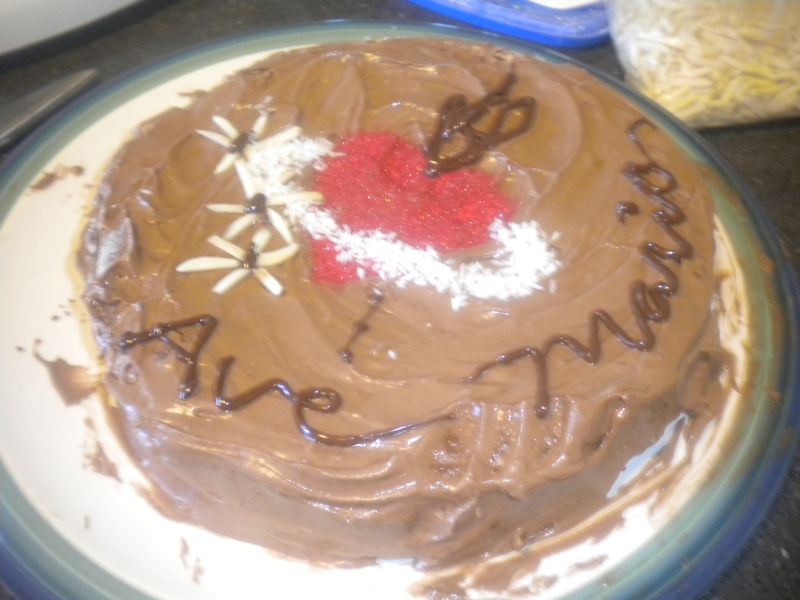
Man, I'm a bad photographer. But you can blame my sneaky little children's fingers for the smears of icing around the edge of the plate. I told them they couldn't touch the cake, but they interpreted that to mean they could touch the plate and any icing that might be on it.
We have a chocolate-almond butter cake with chocolate buttercream-yogurt frosting — really I think I should call it chocolate butter-yogurt frosting, it hasn't any cream — a little red decorator's sugar, a little coconut, a little melted chocolate and a few blanched almonds.
I will provide a recipe if we decide it is tasty! And I will try a Tres Leches cake next time we have a Marian feast, I think, because I thought that was just a great idea (and I've never made one and would like to try.)
P. S. I never did manage to make dinner. Leftover night! (plus cake.)
-
Kids walking to school.
Really good discussion in the comments here at the blog Free Range Kids.
-
Beginning WWII history.
Yesterday we repeated the exercise of writing dates down on cards — 1492, 1776, 1860, 1865, 1900, and 1918 — and added a new date, 1941, for the attack on Pearl Harbor and the U. S. entry into World War II.
(I'm not neglecting 1929, but I'm doing some things out of order. I want to do all the wars and foreign policy straight through and then backtrack and talk about the economy.)
After talking about the dates, we read through the first three chapters of a Landmark book by Blassingame called Combat Nurses of World War Two. It's a really great book because it covers many of the major battles of WWII, only the perspective is mostly that of the nurses — which means you get a picture of the support staff in a military campaign, and we are getting a perspective of women who (despite not being "combat troops") spent time under fire in foxholes, were taken prisoner, were killed in battles, and occasionally did have to fight. This is an awesome book. I can't recommend it enough. And so far, the only on-the-fly redacting I've had to do is say "women" instead of "girls" and occasionally replace "Miss so-and-so" with "Lieutenant so-and-so" — in my opinion, these women deserve to have their ranks attached to their names.
Another bonus of using this book is that it has plenty of emphasis on the Pacific theater. I don't know about you, but did you come away from U.S. history with much more of a sense of how the European theater went than how the Pacific theater did? I sure did — I didn't remember anything about the battles that occurred when the Japanese took the Philippines, for example. (Except what I re-learned a couple of years ago by reading the novel Cryptonomicon by Neal Stephenson.)
I assigned the kids to read some chapters out of a textbook (volume 9 of Joy Hakim's History of US) today, to give some necessary background on the period before the U. S. entry into WWII, and on the rise of Nazism in Europe. We will cover WWII again in world history, so I am just focusing on the United States right now.
On a slightly different note, Simcha Fisher has a great post about teaching the "myths" and "heroes" of history to kids. The comments are just starting to get interesting. Check it out.
-
“Manners are the tip of the charity iceberg.”
My favorite quote from this AMAZING post by Leila.
-
Study skills.
Cool article in the NYT about what helps students retain knowledge. Unsurprisingly, the educational establishment hasn't caught up with recent research.
Advice is cheap and all too familiar: Clear a quiet work space. Stick to a homework schedule. Set goals. Set boundaries. Do not bribe (except in emergencies)…. Does Junior’s learning style match the new teacher’s approach? Or the school’s philosophy? Maybe the child isn’t “a good fit” for the school.
Such theories have developed in part because of sketchy education research that doesn’t offer clear guidance. Student traits and teaching styles surely interact; so do personalities and at-home rules. The trouble is, no one can predict how.
Yet there are effective approaches to learning, at least for those who are motivated. In recent years, cognitive scientists have shown that a few simple techniques can reliably improve what matters most: how much a student learns from studying.
The findings can help anyone, from a fourth grader doing long division to a retiree taking on a new language. But they directly contradict much of the common wisdom about good study habits, and they have not caught on.
What works, according to the researchers quoted in the article:
- studying the same material in at least two different environments, alternating between them
- studying distinct but related concepts and skills in one sitting (think a musician's practice session, with both scales and musical pieces)
- study sessions on the same material spread out over time
- repeated tests and self-tests, including practice tests and quizzes
The article does not really discuss teacher effectiveness or teaching style, and is all about what the individual learner can do to help himself or herself when studying on his or her own.
-
Watching station for five.
See the comments for more information about this…
Multimedia Message
-
Introduction to the Devout Life, 4-3 through 4-6. Troubleshooting: Entertaining temptations.
This is part of a continuing series. An index of all posts on St. Francis de Sales' work Introduction to the Devout Life is here. A post outlining part 4 of the book is here.
Chapters 3 through 6 of part 4, which I have been calling the "troubleshooting guide," have to do with temptations in general, both large and small; in them, St. Francis instructs us to distinguish three steps to sin. (Enumeration and paragraph breaks added by me.)
…The world, the flesh and the devil send tempting suggestions to a soul espoused to Christ.
- First the sin is proposed;
- secondly the soul is either pleased or displeased;
- thirdly the soul either consents or refuses.
These three steps to sin — temptation, pleasure in the temptation, consent — are not always easy to distinguish but they are clear enough in the case of grave sin.
"Clear enough in the case of grave sin?" I guess what St. Francis means is that if the sin is serious enough to endanger our soul, then we ought to be able to tell temptation from pleasure and consent well enough to make a free choice that we're fully responsible for. Come to think of it, it would work equally well to say that if we can tell temptation from pleasure well enough to make our choice free, we might be dealing with serious sin; if we really can't tell, then our ignorance would mitigate our culpability. Whatever: if we can tell the difference, we're going to be responsible for the knowledge.
In Chapters 3 and 4, Francis is mostly concerned with letting us know that simply being tempted — noticing a temptation — is not necessarily our fault and is not itself a sin.
Temptation of any sort, no matter how long it endures, cannot make us displeasing to God so long as we take no pleasure in it and do not yield; to be tempted is something passive, not active, and no blame attaches to us while we are opposed to it.
If we find it disagreeable to be tempted, that's a good sign:
Have great courage, Philothea, in the midst of temptations, knowing that your displeasure is the sign of your victory, for it is one thing to experience temptations and another to consent to them; we may still feel them even though they displease us, but we can consent to them only if they please us, this pleasure being the first step to consent.
And it's even a good sign if we find ourselves of two minds about it, so that we might say "Part of me wants to, and part of me is repulsed":
Even with regard to this pleasure, we must remember that there is a superior and an inferior part of the soul; the inferior part does not always follow the superior part, but often goes its own way, taking pleasure in the temptation without and against the consent of the superior part, a conflict to which St Paul refers, when he says "the impulses of nature and the impulses of the spirit are at war with one another" (Gal. 5:17); and that "the disposition of the lower self raises war against the disposition of the conscience" (Rom. 7:23), and so on….
…[W]hen the inferior part of the soul is overlaid with terrible temptations, the whole souls seems covered with ashes, the love of God reduced to a spark in the very centre of the heart… so imperceptible that it hardly seems to be there at all; yet it is therel that resolution never to consent in the midst of temptations which flood the soul and body; that displeasure, in spite of an outward sense of pleasure, which prov es that though temptations may be all about the will they have not been admitted and that the pleasure, because involuntary, can be no sin.
St. Francis wants to give us the utmost benefit of the doubt. It is clear that he is used to dealing with people who get discouraged because temptations tempt them and because the temptation is partly pleasurable to them — "I'll never get rid of these temptations, I can't help but take some pleasure in them, I must be so depraved there's no hope for me." St. Francis wants us to think: even if we do take pleasure in the temptations that assail us, if there is even the tiniest bit of us that rebels against temptation, that tiniest bit is the spark that "will serve to kindle the whole fire again."
St. Francis admits that it is very difficult to be in this situation, because it's hard to know whether that bit of the will is really there; but, he says, to suffer this distress is itself a blessing:
How distressing to one who loves God not to know whether he is present in the soul or not, to be uncertain if that love by which and for which we fight is still alive; but to be asked to suffer thus is the fairest flower of perfect heavenly love.
If we need reassurance we have one thing to ask ourselves:
…[I]t sometimes happens that our soul seems to have lost use of its powers and to be bereft of spiritual life owing to the violence of temptation. If this is the case we must…. consider if our will is still active in rejecting the temptation and pleasure as it should. As long as this is the case we may be assured that we still possess charity, which is the life of the soul, and that Jesus Christ our Saviour is present in our soul, though hidden and concealed; so that by means of continual prayer, the sacraments, and confidence in God, we shall regain the strength to live a good and happy life.
Whew. So, if I'm assailed by temptations, even if I am taking pleasure in those temptations to some extent, as long as my will is "still active" in rejecting the temptation and pleasure — not even if my will is totally successful! – there is hope for me by means of prayer, sacraments, and trust in God.
This is a very useful piece of information, especially for the scrupulous.
Chapter 6 has to do with moving past the innocent part of temptation to the not-so-innocent step of deliberately entertaining it and lingering on it, and also of inviting temptation by deliberately and unnecessarily entering a near occasion of sin.
St. Francis makes some nice distinctions between taking delight in certain goods that may accompany a temptation, and taking delight in the temptation itself. He gives a couple of examples; for example, if a man flirts with a woman while playing the lute beautifully, it's okay to enjoy the lute-playing but not the flirtation. Or — well, see what you think about this one:
In the same way, if anyone suggests an ingenious and cunning way to revenge myself on an enemy and I simply take pleasure in the ingenuity of the plan and not in the thought of revenge, I do not sin at all;
Whew! Oh sweet deviousness, I am free to revel in you!
…though, here again, I should not dwell too long on this pleasure lest it lead me to take pleasure in the thought of the revenge itself.
Hmph.
St. Francis goes on to explain that it does take time to resist a temptation, and the longer we take, the more serious the sin of delay. (He seems to see a limit to the seriousness, though: the sin of entertaining temptation, it seems, cannot rise past the level of gravity of the sin that is the subject of the temptation.)
Sometimes a temptation takes us by surprise and we feel pleasure before we have had time to resist it; at the most this is a very light venial sin
…and only becomes more serious if, aware of the evil, we entertain the pleasure while we make up our mind whether to accept or reject it.
It becomes more serious still if once aware of it we dwell on it for any length of time through downright negligence, without making any effort to reject it;
but if we willingly and deliberately resolve to accept such pleasure, it is a grave sin if the temptation itself was grave.
Why bother going into such minute detail? I think the reason is that the detail serves to help us be aware of the workings of our wills, and to diagnose the particular problems that might beset us. I told you that part four is a troubleshooting guide, after all!
-
World War Two movies.
I've been thinking about using one or more of these films when we study WWII in upcoming weeks.
- The Great Escape
– Twelve o'Clock High
– Sands of Iwo Jima
Commenter Tabitha suggested To Hell and Back but I don't have access to a copy without buying it.
Comments? Anything obvious I'm missing?
-
Oops.
Someone hung a Tamagotchi on my key hook. Am now locked out of house awaiting rescue by exasperated husband.
-
The evolution of my nursing clothes.
When I first was pregnant with my first child, I bought a bunch of nursing tops from Motherwear and One Hot Mama. Only a few of them survived; the rest went to the thrift store, or to friends who liked them better than I did, as soon as I had a chance to try breastfeeding in them.
The first style of nursing tops that I decided I liked was called the "Super Secret" nursing top, and was sold at One Hot Mama. They still have some tops that bear that name, but the ones I used back then were different: they looked a lot like twin-sets, except that the "cardigan" was attached to the "tank," and the openings were sort of under the arms, hidden by the cardigan part. I thought it was a pretty ingenious design, because the opening wasn't obvious. I liked that, since I was going to school at the time, and didn't always have the baby with me to carry in front of me and hide the nursing openings (the way the annoying models do in the catalogs of nursing tops — hello, WE WANT TO SEE WHAT THE SHIRT LOOKS LIKE.)
I also liked the "all-around crop top" style of tee shirts and turtlenecks, where the whole shirt had two layers and the top layer lifted up all around to allow access to the layer underneath with the openings. Mostly because I could tuck the bottom layer into your waistband, and thereby keep from exposing your belly flesh to Minnesota winter winds. One of those crop top tees, a black one with the One Hot Mama label, I used for eight years straight and didn't get rid of until I lost a lot of weight and it didn't fit anymore. It was one of my favorite shirts.
But the lots-of-nursing-tops phase didn't last long past my second baby, after I was done with school. I figured out that it was easier and cheaper, most of the time, just to wear any old knit top. As long as it was loose and long enough, I could just lift up the shirt for the baby and still nurse discreetly enough by tucking the extra folds of the material around his face. I was heavier then, and I wore a lot of loose-ish, long-ish tops. I still used nursing tops and nursing dresses just for Sundays and nice restaurants, when I didn't want to look too sloppy. Since they were my "nicer" clothes, and I had fewer of them, I was willing to spend a little more. For those dressy clothes, I love the Japanese Weekend label (hint: as soon as you get pregnant, check their out-of-season sale, which will be in season by the time you are big), and hands-down my favorite design for nursing openings is made by Boob Nursingwear. It's especially good for a dress.
This time around, though, I've settled on an entirely different strategy. Probably because, being a lot slimmer, I'm not wearing so much loose flappy stuff on top, and I find that in the trimmer and more fitted stuff I'm finally able to wear, I can't really nurse discreetly just by lifting up. I'm also kind of loath to invest in a whole new wardrobe of nursing tops, which aren't cheap anyway, after having had The Year Of Three Wardrobes last year (an entire, if abbreviated, wardrobe in size 6 or so; an entire, if abbreviated, wardrobe in size 2 or so; and a maternity wardrobe). I am willing to wear a stretchy-necked or button-front dress and go down through the neck if I am at home or among friends, but not out in public.
So I've taken to wearing an inexpensive cotton v-neck camisole, slightly too small. The kind they sell at Old Navy or Gap Body go on sale for five to eight dollars. I adjust the spaghetti straps so they are a little too long, and tuck the camisole into my waistband. Then I wear whatever ordinary top I want to wear over that. When it's time to nurse the baby, I lift up the top and pull the camisole down out of the way, and open the nursing bra. I find that the combination of (say) a trim tee or knit top that covers my shoulders and chest, and a camisole that covers my belly, plus the added coverage of a sling, is really effective at minimizing exposure. Except, of course, for the few seconds it takes to get the baby latched on, but I don't really care about that; it's over quickly.
I think a large part of the reason I'm so much happier with the camisole strategy is that it thoroughly hides my squashy mommy tummy, which has gotten even squashier after the weight loss. Further evidence for my theory that different body types require different strategies of nursing clothing.
I still want a good nursing dress in my current size, but I despair of finding one I like without being able to try it on.


Recent Comments
Recent Posts
- “Unprofitable servant”… of God.
- Mardi Gras recipe hack: Bread Machine king cake.
- Minnesota furious.
- Contemplation of the work.
- Boundaries and whom to set them with.
Categories
…more to come later
 bearing blog