bearing blog


bear – ing n 1  the manner in which one comports oneself;  2  the act, power, or time of bringing forth offspring or fruit; 3 a machine part in which another part turns [a journal ~];  pl comprehension of one’s position, environment, or situation;   5  the act of moving while supporting the weight of something [the ~ of the cross].


  • Procrastination and the “extended will.”

    Interesting article about procrastination in the New Yorker, one which goes into the idea of separate “selves” with different desires.  So, tangentially related to some of the stuff I’ve written on gluttony.*

    Here’s an excerpt: 

    The idea of the divided self, though discomfiting to some, can be liberating in practical terms, because it encourages you to stop thinking about procrastination as something you can beat by just trying harder. Instead, we should rely on what Joseph Heath and Joel Anderson, in their essay in “The Thief of Time,” call “the extended will”—external tools and techniques to help the parts of our selves that want to work. A classic illustration of the extended will at work is Ulysses’ decision to have his men bind him to the mast of his ship. Ulysses knows that when he hears the Sirens he will be too weak to resist steering the ship onto the rocks in pursuit of them, so he has his men bind him, thereby forcing him to adhere to his long-term aims. Similarly, Thomas Schelling once said that he would be willing to pay extra in advance for a hotel room without a television in it. Today, problem gamblers write contracts with casinos banning them from the premises. And people who are trying to lose weight or finish a project will sometimes make bets with their friends so that if they don’t deliver on their promise it’ll cost them money. In 2008, a Ph.D. candidate at Chapel Hill wrote software that enables people to shut off their access to the Internet for up to eight hours; the program, called Freedom, now has an estimated seventy-five thousand users.

    Not everyone in “The Thief of Time” approves of the reliance on the extended will. Mark D. White advances an idealist argument rooted in Kantian ethics: recognizing procrastination as a failure of will, we should seek to strengthen the will rather than relying on external controls that will allow it to atrophy further. This isn’t a completely fruitless task: much recent research suggests that will power is, in some ways, like a muscle and can be made stronger. The same research, though, also suggests that most of us have a limited amount of will power and that it’s easily exhausted. In one famous study, people who had been asked to restrain themselves from readily available temptation—in this case, a pile of chocolate-chip cookies that they weren’t allowed to touch—had a harder time persisting in a difficult task than people who were allowed to eat the cookies.

    Given this tendency, it makes sense that we often rely intuitively on external rules to help ourselves out. A few years ago, Dan Ariely, a psychologist at M.I.T., did a fascinating experiment examining one of the most basic external tools for dealing with procrastination: deadlines. Students in a class were assigned three papers for the semester, and they were given a choice: they could set separate deadlines for when they had to hand in each of the papers or they could hand them all in together at the end of the semester. There was no benefit to handing the papers in early, since they were all going to be graded at semester’s end, and there was a potential cost to setting the deadlines, since if you missed a deadline your grade would be docked. So the rational thing to do was to hand in all the papers at the end of the semester; that way you’d be free to write the papers sooner but not at risk of a penalty if you didn’t get around to it. Yet most of the students chose to set separate deadlines for each paper, precisely because they knew that they were otherwise unlikely to get around to working on the papers early, which meant they ran the risk of not finishing all three by the end of the semester. This is the essence of the extended will: instead of trusting themselves, the students relied on an outside tool to make themselves do what they actually wanted to do.

    I like the concept of the “extended will” — a much more positive term than, say, “crutch” to describe some of the self-control techniques I’ve developed to deal with gluttony…

    *[Editing note.  Years and years later, I wish I’d done a better job distinguishing gluttony from other problems with food, like clinical eating disorders and other kinds of compulsiveness.  

    I want to emphasize that, whereas I identified some behaviors in myself that probably qualified as self-centered gluttony in the technical sense, I am not and never have been qualified to make that distinction for anyone else.

    I hope to add some commentary to all the posts that have this problem as I find the time to review them.  Here’s a more recent post where I acknowledge some of the problematic material I wrote and set new ground rules for myself going forward.]


  • Under-utilizing my kitchen, on purpose.

    Hasn't it been a long time since I wrote a Homemaking for Engineers post?  Since late summer, I think.  

    Once a new baby arrives in the house, it takes quite a while for me to feel I've got the time to methodically tweak my systems.  No, for the first nine months or so my system-tweaking is strictly frantic and ad-hoc.

    But I must be feeling in control of myself again, because I started thinking about the work triangle in my kitchen. 

    A side comment first.  Who on earth started the idea that the "three main work sites" in the kitchen — the vertices of the "work triangle" — are the sink, stove, and refrigerator?  Sink — check.  That's where you are working when you wash dishes, run water, deal with raw meat, or clean vegetables.  Stove — check.  That's where you are working when you sauté in a skillet or stir a boiling pot.  But unless you're putting away groceries, which isn't "cooking," who "works" at the refrigerator?  The third vertex of the work triangle needs to be a prep station, not the spot that the fridge door swings through.  But I digress.

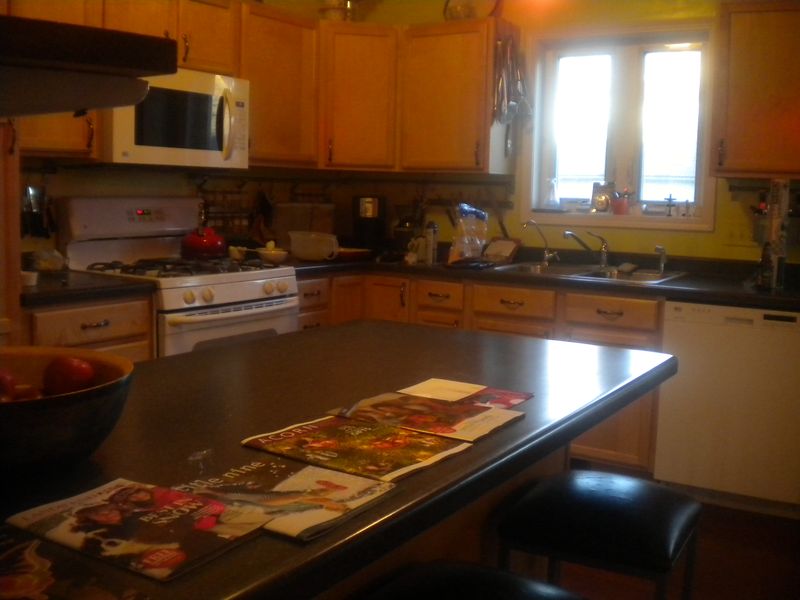
    This is my kitchen, designed by Mark and me:
    DSCN0727

    DSCN0734

    You can tell that we read about "the work triangle" before we committed it to blueprints.  It's kind of a classic peninsula shape.  You see where the stove, sink, and refrigerator are.   And you see that there are several expanses of counter for prep work.   There's plenty of room to spread out.

    This is nice when I am cooking with another person.  Which happens at least a couple of times a week.  It's a great kitchen for two cooks to maneuver around each other — one chopping vegetables on the peninsula, another standing at the stove stirring.   You can have three people working at the peninsula alone.   It really works quite naturally and hardly ever feels cramped (until children start parading to the refrigerator in search of cold drinks — a major design trade-off.)

    I'm very grateful to have such a nice, spacious kitchen.  I used to cook in a much smaller one.  Before that I cooked in an even smaller one.  Before that I cooked in a truly tiny one, with about four square feet of counter space.

    And yet it seems that my cooking mess expands to fill the space I have.  When I am done cooking dinner, I have generally strewn messes all over the entire kitchen.  

    Here is a picture from about a year ago (heaven knows why this picture was taken):

    DSCN0002

    You can't see it, but I'm sure the mess extends to the left all the way across the peninsula and to the right all the way past the dishwasher.  Since our dining table is in the same open area, this (or something similar) is the sight we are treated to while we have our dinner.  Every night.

    Anyway, I got to thinking… how much space do I actually need to cook in, when it's just me that's cooking?  What if I tried to do as much work as possible in a very small part of my counter, and left the rest of it clear?  How would that work?

    I decided to try it, on several nights over the last couple of weeks.

    I started by clearing and wiping down the entire peninsula top and the countertop over the dishwasher, to the right of the sink.  Why those places?  Purely on aesthetic grounds (though you'll see it was a happy choice for practical reasons too).   These two surfaces are the most visible ones in the kitchen, especially in the view from the dining table or when entering the kitchen area from the front door.  I wanted my kitchen to look nice even to a guest who walks in on me when I am in the middle of dinner.

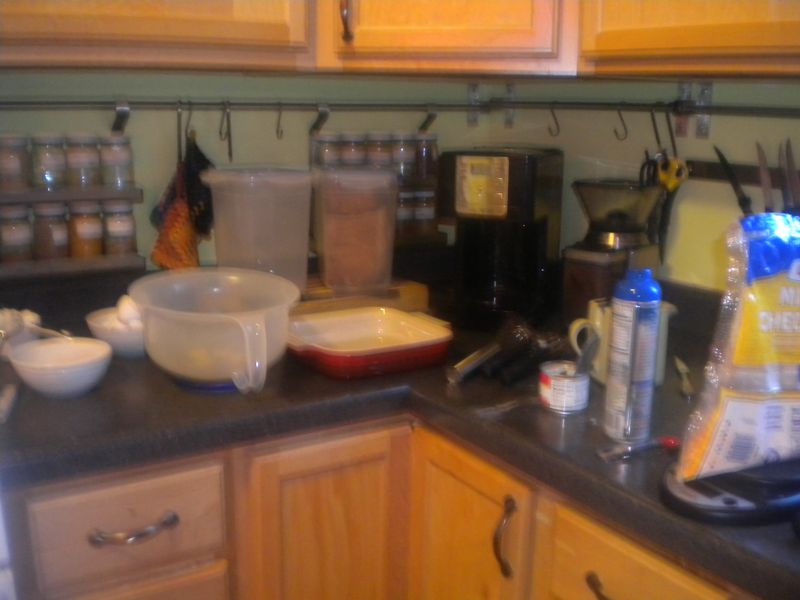
    I chose to work chiefly in the back corner, by the coffee maker:
    DSCN0728

    Here is what the back corner looked like tonight while I was in the middle of assembling an egg bake:

    DSCN0729

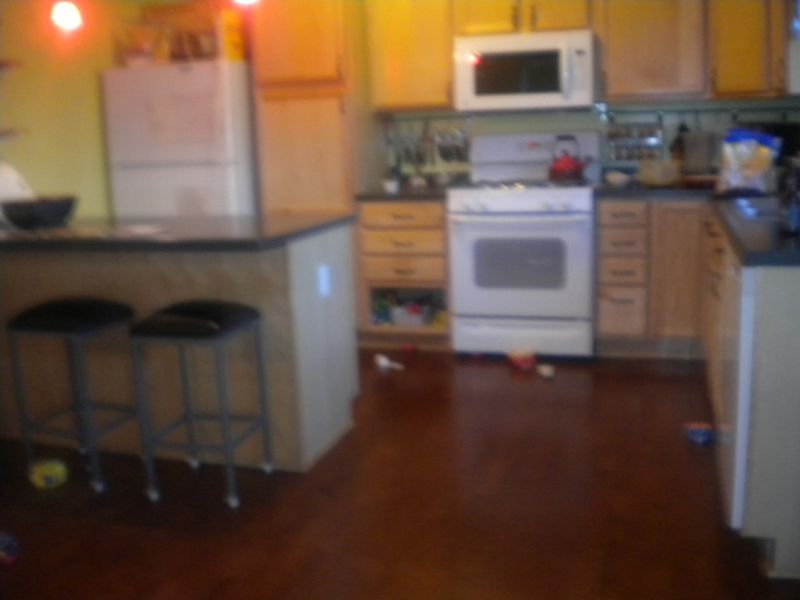
    Normally I take up the whole peninsula for this.  It still looks quite crowded and messy.  But if you take a step back you can barely tell I'm using the kitchen:
    DSCN0732

    (You can tell that the baby's been using the kitchen, though.)  

    So what's it like working in such a small space?  Well, I could definitely streamline it a bit if I had fewer items taking up space on the counter.  The bread boxes and cutting board sometimes live on top of the fridge, for instance.  And I could have put that little green teapot in the dishwasher before I started cooking.  I probably could get the coffee maker into a cabinet if I worked at it.

    But even with those things in the way, it is not as cramped as you might think.  After having cooked in this spot over a few different nights, I notice that I do more clean-as-I-go.  I have to.  And that I am remembering the chef's art of mise-en-place:  getting all the ingredients lined up and ready before diving into assembly.  By restricting myself to this tiny corner of my kitchen — much as I was restricted  to a tiny kitchen in my college days — I'm forcing myself to adopt habits that are adapted to a smaller space.  And just as I did back then, I'm finding that I can work in a smaller space, quite well.

    One advantage became clear right away:  The less I move around the kitchen, the less stuff I drop on the floor.  And the less risk I'll spill something hot or raw on an underfoot child.  The spot I picked to prep in,  though small, turned out to be pretty convenient for that use.  It's right between the sink and the stove; it has lots of electrical outlets; and it's within reach of knives, spices, and several drawers and cabinets of useful prep items.

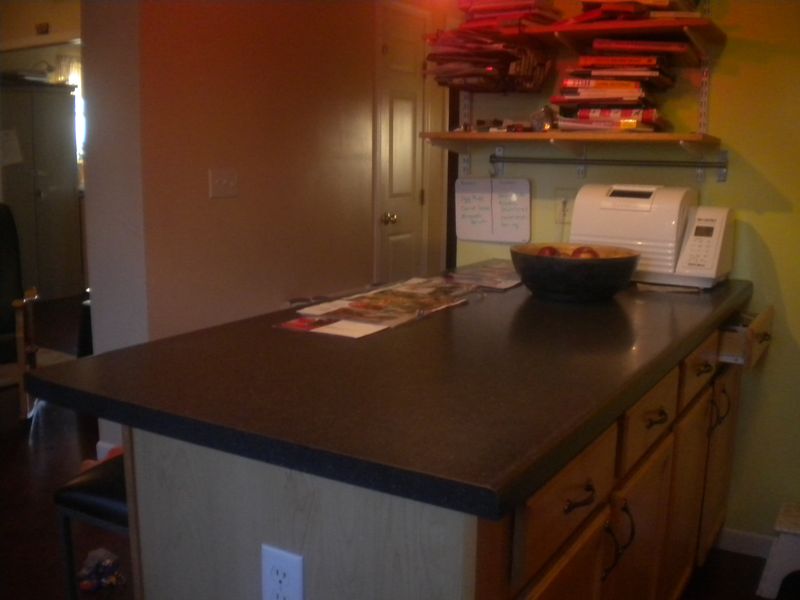
    After I finished assembling my egg bake and popped it in the oven, I started on a carrot salad.   I had to put the mixing bowl and other items into the dishwasher before there was enough room on the countertop in that corner to set up the food processor and a sheet of waxed paper to catch the carrot peelings.  But while all that was going on, my peninsula still looked beautiful from where I was standing:
    DSCN0731

    (See the little dry-erase board?  I'll post about that another time.  It's another idea I'm testing.)

    Eventually, I had finished the carrot salad and started on the last two dishes, a pot of brussels sprouts (frozen from the grocery store) and a bowl of corn (frozen for us by my wonderful mother-in-law).  That wasn't a big deal, of course — just had to open the bags.  The carrots went onto the peninsula and were out of my way.  The egg bake was almost done.  Remind me to give you the recipe.  Everyone loves it.

    DSCN0735

    Sprouts are on the stove.  Corn is in the microwave.

    My dear husband set the table, we moved all the dishes over there, and sat down and had a relatively peaceful dinner.  Here is the view from my husband's chair (minus me):

    DSCN0737

    There's still mess in the corner, but you can barely see it!

    The dishwasher was still running when we cleared the table, so all the dishes you see in the foreground of the previous photo (and more you don't see) went to the sink and the counter.  Quite a lot of dishes.
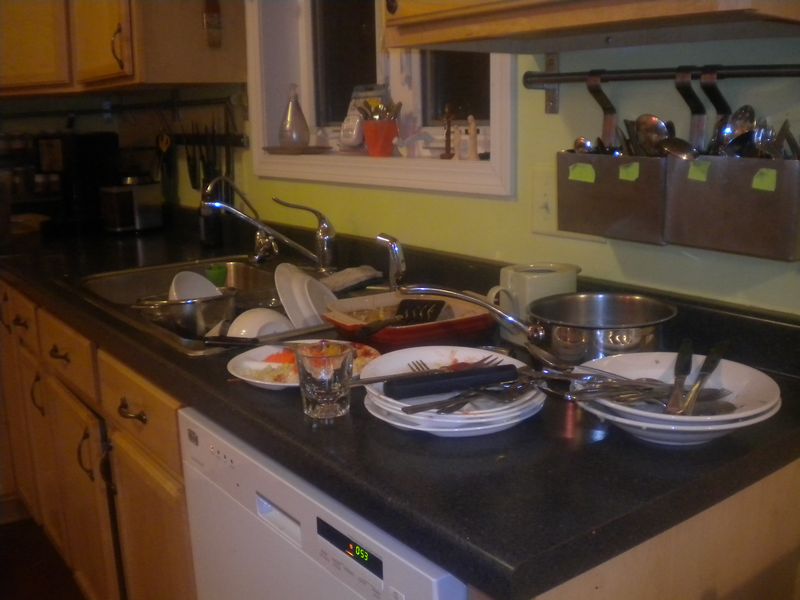
    DSCN0739

    And yet, if you happen to be seated at the table enjoying your wine, the kitchen still has an air of overall peace:
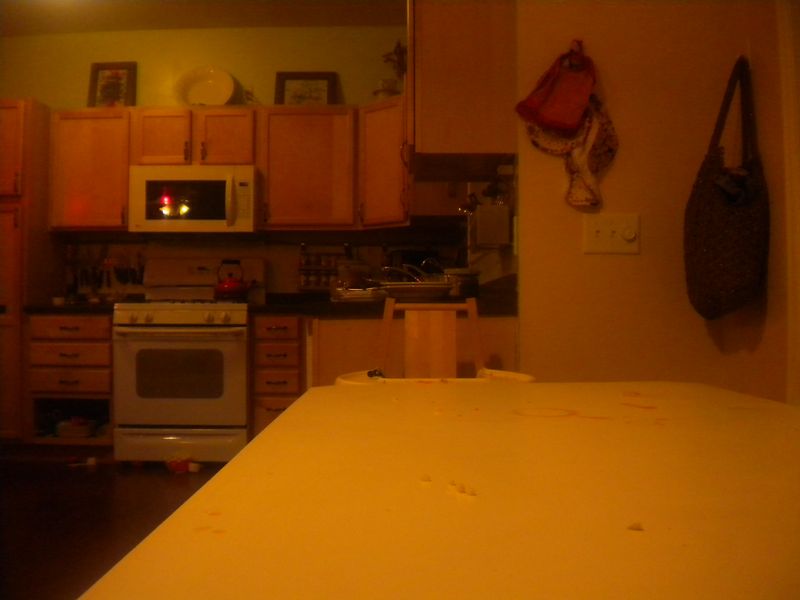
    DSCN0738

    I mean, compared to how it usually looks.  Maybe you'll have to take my word for it.

    (The rattan tote bag hanging from the wall is where we keep cloth napkins.  The other shapeless stuff on the wall is baby bibs hanging from a hook.  I am on the lookout for nicer-looking, but inexpensive, tote bags.)

    Now, some important notes.

    It seems as if I'm under-using the kitchen this way.  Why have all that beautiful counter space if I'm not going to use it most nights?  But actually, the "clear" parts of the counter are  being used.

    The bar stools next to the peninsula make a great place to sit and talk to the cook, if the bar part is kept clear and welcoming.  Why do you think the bottle of wine wound up there during dinner?  Because my husband came home, opened it, and sat down there to chat with me over a glass of bubbly while I made dinner.  When we have friends over, the adults usually wind up sitting or standing around the peninsula while children eat at the table.  It's so much nicer to use that area when it's not covered with food-prep mess.

    The peninsula surface is a great spot to collect each serving dish as I finish it.  Notice that's where the bowl of carrot salad turned up?  If I want to serve from the kitchen instead of pass dishes at the table, it makes a fine sideboard.  But it's so much more convenient (and food-safety-conscious) to place the serving dishes on a clean surface instead of one that's been used for prep.

    The bit of counter above the dishwasher — to the right of the sink — is an obvious parking spot for dirty dishes being cleared from the table.  They'll be scraped into the trash can under the sink and maybe rinsed in the sink before being put into the dishwasher; right by the sink is where they should go, so that when the clearing is all done one person can stand in front of the sink, with the dishwasher open, and process those dishes from countertop to trash can to sink to dishwasher, all without having to take a step or move a drippy dish over any expanse of floor.  But for a person to stand at that work space, the dishes first have to be collected on that countertop, and to make room for the dishes, that countertop has to be clear.

    Now, of course, there are going to be times when I will want to prepare food on those other expanses of counter.  I will want to use the peninsula if there are two or more cooks in the kitchen.  I might want to do prep on the peninsula if there is a friend seated at the bar stools, so I don't have to turn my back on my guests.  The peninsula, being bigger, is best for rolling out dough or topping pizzas.  And raw meat should be dealt with on a separate counter, without a lot of extra stuff on it, to avoid cross-contamination.

    But by restricting my work, and my mess, to a smaller spot in the kitchen, I've opened up plenty of space for other uses, and a little more beauty.

  • The difference between a job and a vocation.

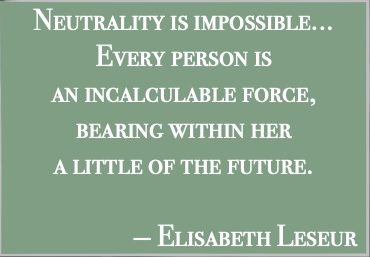
    Never assume that someone else can, should, or will treat his job as if it is a vocation.

    A job is a job.  And that's fine.  But when someone tells you he will treat what is essentially his job as if it were his vocation — only at your own peril would you assume it is true.


  • Introduction to the Devout Life 4-14 and 4-15: Troubleshooting spiritual desolation.

    (An index of all posts on St. Francis de Sales' work Introduction to the Devout Life is here.  A post outlining part 4 of the book is here.)

    In the last post, I wrote about St. Francis de Sales's guide to the problems and temptations of consolations.  It may seem counterintuitive that spiritual consolation can be a problem, but Francis makes a case for it.

    It shouldn't give anyone trouble that desolation can be a problem.   That's the subject of the next two sections.  

    The "desolation" discussion, like the "consolation" discussion, is largely arranged in bullet points.  They're both very bloggy all by themselves.  Let's recap the points about dealing with consolation:

    Preamble:  Our circumstances and emotions change all the time, so we have to keep our superior will fixed on God.

    I.  Devotion does not consist in our feelings, including spiritual consolations.

    II.  But our "devout" feelings and spiritual consolations are useful to us, and worth much more than worldly pleasures.

    III.  Q.  How can we tell the difference between spiritual consolations and useless pleasures?  A.  By the fruit they yield.

    IV.  How to receive consolations:

        (i) Humble ourselves and be aware that our consolations are not evidence of our goodness

        (ii) Realize that God probably gives us consolations because we're so darn weak that we need them

        (iii) Be thankful to God for providing them

        (iv) Use them as God intends

        (v)  Detach ourselves from them by protesting to God that we want Him, not His consolations

        (vi) Tell your confessor if you get a lot of consolation so he can help you deal with the abundance.

    OK, what does the desolation one look like?  I won't paraphrase these nearly as much because they are wonderful examples of Francis's gift for analogies, especially from Scripture.  The bit about the Canticle of Canticles is especially good — it makes me want to go back and read it over…

    Preamble:  "[Consolations] do not last; …you will sometimes find yourself desolate and deprived of all feelings of devotion…What must we do at such a time…?  The first thing is to discover the source of this evil…"

    I.  "[O]ften the cause of this desolation lies in ourselves."

    1. "A mother refuses sugar to a child subject to worms; so God withdraws his consolations when he sees that we take pleasure in them and are subject to the worms of vanity."
    2. "When, through sloth on our part, such consolations fail to bear fruit, he punishes us by taking them away.  We find ourselves like those Israelites who, having failed to gather the manna before dawn, found it melted away after sunrise."
    3.  "Like the bride in the Canticle of Canticles we sometimes rest on a bed of sensible consolation and when the spouse of our soul knocks on the door of our heart and calls us to the practice of devotion, we delay, unwilling to deprive ourselves of our false feeling of contentment and satisfaction, so that he passes on, and leaves us to our laziness; then, when we wish to seek him, he is hard to find."
    4. "Lack of frankness and sincerity with our confessor often causes spiritual desolation… If you are not simple and sincere as a little child you will not receive any sugar plums."
    5. "If you have sated yourself with worldly pleasures it is not surprising that you have lost your taste for those of the spirit.… He has filled the hungry with good things, says our Lady, and sent the rich away empty-handed." (Lk 1:53)
    6. "Have you carefully preserved the fruits of the consolations you have already received?  If so, you will receive more."  [N.B. This point is distinct from number two; that refers to consolations that don't bear fruit at all because of our sloth.]

    II.  "Examine your conscience and see if you have been guilty of some such defects as these… if, on the contrary, you can find no particular cause for this dryness, spend no more time on further examination, but carry out the following advice in all simplicity:"

    1. "[H]umble yourself profoundly before God… 'See what I am, my Saviour, left to myself…'"
    2. "Pray that God may grant you his joy… My father, if it is possible, let this chalice pass me by. (Mt 26:39)"
    3. "Open your heart to your confessor… then follow his advice with great simplicity and humility….  God…often renders such counsels fruitful even though they may not appear very likely to prove useful, just as he cured Naaman by using the waters of the Jordan in which Eliseus had, seemingly without reason, ordered him to bathe."
    4. "Beyond all this, the best thing you can do is remain indifferent to deliverance from your spiritual desolation.  This does not mean that you may not wish for this deliverance, but you must not set your heart on it….  Let us say to God, My Father, if it is possible, let this chalice pass me by; but let us add courageously:  only as thy will is, not as mine is;  (Mt 26.31)… We must say… The Lord gave me consolations and the Lord has taken them away; blessed be the name of the Lord." (Job 1:21)
    5. "Finally… let us remain courageous, and… preserve the even tenor of our way, omitting none of our spiritual exercises, but rather, if possible, performing even more.  If we cannot offer our Lord a devotion that is sweet let us offer him one that is dry."

    III.  In an example from the life of St. Bernard we find a sort of a pattern of dryness following on richness of consolation:

    1. "God usually gives a foretaste of heavenly delights" [i.e. consolations] "to those who enter his service to detach them from earthly pleasures and encourage them in the pursuit of divine love, like a mother who honeys her breasts to entice her child."
    2. "[I]t is this same God who sometimes, in his wise providence, deprives us of the milk and honey of consolations so that, having been weaned, we may learn to eat the dry but more solid food of a vigorous devotion…"
    3. "[S]ometimes great storms arise in the midst of such desolation.  At such times we must fight constantly against temptations, for these do not come from God; but we must bear patiently with the sense of dryness as ordained by God for our advancement."  (Distinguish between temptations within dryness, and dryness itself; dryness is not itself a temptation, but an environment in which temptations may arise, just as consolation is an environment in which temptations may arise.)
    4. "[W]e must never lose courage… or say… 'I shall never be happy again'; for in the night we must await the dawn. On the other hand no matter how fair the weather in our spiritual life we must not say, 'I shall never experience sorrow again'."
    5. "[T]he best remedy is to reveal our trouble to some spiritual friend who can console us."


    Now I want to point out something that Francis adds almost as an afterthought, but that I would rather put at the very beginning of the possible interior causes of desolation:  we may have tried to "do" too much devotion.  It is indeed possible to overdo it.

    "Sometimes these feelings of distaste, dryness, and desolation arise from some physical indisposition as when, for example, we find ourselves oppressed with tiredness, drowsiness and fatigue through some excess in watching, labouring or fasting, which not only weary the body but the soul as well, by reason of the intimate relation between them."

    Francis does want us to make valiant acts of virtue when we're spiritually exhausted like this, because God finds them pleasing; but he wants us to remedy the dryness at its source:

    "The remedy on such occasions is to refresh the body by some lawful recreation and relaxation."

    So there you go:  Yes, it is possible to do too much fasting, adoring, and good works.  Take a vacation once in a while.

    Now, let's look at a couple of the themes in this section.

    First, asking why:  yet another example of Francis meeting real people where they really are.

    I like that Francis starts right out with the question that's on everyone's mind when bad times come:  "Why?"  Far from chiding us for asking such a question, he knows that faith in the Christian God requires a trust that there must be some reason, even an inscrutable one, for dark nights of the soul; and yet, that our trust is weak and is aided by pausing to consider the many reasons that might be.  He's helping us, through use of our reason, to give God the benefit of the doubt.

    And why might we have lost our consolations, our "feelings" that God is there and loves us?  I can almost imagine Francis counting them off on his fingers.  Maybe God took them away for our own good.  Maybe we have wasted them or their fruits.   Maybe we were stuck in a rut of self-satisfaction.  Maybe we made a bad confession and this is the fruit of that.  Maybe we are too involved with worldly pleasures to notice the more subtle spiritual ones. 

    But an even more fruitful theme can be found in Francis's plays on the word "dry."  I like very much this sentence:   

    "If we cannot offer our Lord a devotion that is sweet let us offer him one that is dry."  

    We have all heard the word "dry" used to describe the soul, or the emotions, of one suffering spiritual desolation.  "Spiritual dryness" is almost a technical term in the language of devotion.  I have always thought of "dry" meaning "arid," that the opposite of spiritual "dryness" is necessarily lushness, swelling rivers, greening land.   But here St. Francis puts "dry" as the opposite of "sweet," which (maybe because he's French?) immediately puts me in mind of wine.  

    Perhaps spiritual dryness is not dry like a desert, but dry like a champagne brut nature.

    Something to think about.

    Later, having surprised us once by setting "dry" in opposition to "sweet," he does it once again by setting "dry but more solid" food opposite mother's milk.  Babies eat food like milk — not at all dry.  Grownups eat food like bread.  

    So our dryness is dry like a desert.  It is also dry like wine, dry like bread.

    Hm.  Clever.


  • Waste not, want not.

    This post at Tara Parker-Pope’s NYT health blog points out that 40% of food waste occurs in the home, and the average home wastes a quarter of the food they buy.

    She makes the obvious point that this wastes our money.  I’m surprised she didn’t also point out that it’s wasteful from an environmental standpoint too.

    You know the whole locavore movement, the one that tries to shrink the transportation carbon footprint of your food?

    Well, if you are a typical household, your transportation footprint is likely less than half of your food waste footprint.  Start cutting where it really counts:  buy less, cook less, and waste less.

    I’m convinced, after struggling to reduce food waste in my own house, that a lot of the problem with food waste really does come from two gluttony-related subtopics.

    (1) Worry that we won’t have enough food, or enough variety of food.  This is utterly ridiculous.  You should see my pantry.  We are stocked to the ceiling.  And my family, far from being disappointed in me if I made chili every week for a year, would probably cheer.  Nevertheless, worrying that we don’t have enough food, or that our food isn’t interesting enough, appears to be a symptom of my inner glutton.

    (2)  Refusal to engage with the reality of what my family really likes to eat.  Yes, it’s fine to make things that are new to us, to try new things.  But once I’ve discovered that some dish is a loser with most of us, I shouldn’t repeat it except in small quantities.

    I have often thought that one way to cure myself of this tendency might be to deliberately skip going to the grocery store from time to time, forcing us to eat down our stores.


  • The Catechism, pot, and California Prop 19.

    Joe Hargrave at The American Catholic makes a case for California's Prop 19 (state-level legalization of marijuana for recreational use).  I participated in the commentary and thought I'd crosspost here.

    One of the commenters (Chris C.) pointed out:

    Recreational use of drugs is prohibited by the CCC [Catechism of the Catholic Church]. That alcohol and tobacco are used legally is hardly a valid argument in favor.

    I responded:

    I don’t live in CA, but I’d be voting yes on 19 if I did. I hope it passes, if only so we can find out what the consequences will be. One of the benefits of having 50 states is that we can have 50 laboratories of laws.

    About the CCC — I’ve always found the wording of the English in that section (#2281) bizarre. It says baldly that the use of “drugs” is gravely wrong, without qualification — and that would seem to mean that we can’t use alcohol or tobacco either, period. Are alcohol and tobacco not drugs? It would strike me as extremely odd and/or convenient that the teaching of a universal Church that knows no boundaries of nation or state would correspond exactly with the controlled-substance laws of the U. S. of A. Cigarettes are peachy keen as long as you don’t abuse them, but joints are inherently evil? This makes no logical sense.

    The Latin is “stupefactivorum medicamentorum usus.” Anyone want to take a stab at that one? Does the term “medicamentorum” imply that naturally occurring substances (alcohol, tobacco, and various psychoactive plants) aren’t included?

    The second part of #2281 [correction:  #2291] makes reference to illegal drugs only (and it makes sense that the Church would want us to obey local laws even regarding substances the use of which is not INTRINSICALLY evil).

    I hope someone can answer my questions about the Catechism's wording on this one, because I honestly don't get it.  I seriously cannot see a logical reason why it should be inherently wrong to use pot, and yet not inherently wrong to use alcohol.  I have heard people say that it's "impossible" to use marijuana moderately, but have never seen any data to that effect.   I have never seen any data that indicates there are any special arguments against marijuana use that could not be levelled equally (or worse) at alcohol.

    (And I write, by the way, as a regular consumer of alcohol who has never used either marijuana or tobacco and probably never will regardless of legality).

    For reference, here're the Latin and English texts of the passage in the Catechism.

    2290 Temperantiae virtus ad omne genus excessuum vitandum disponit, abusum mensae, vinolentiae, tabaci et medicamentorum. Qui in ebrietatis statu vel propter immoderatam velocitatis voluptatem, securitati aliorum vel suae propriae periculum afferunt in viis, in mari vel in aere, graviter fiunt culpabiles.

    2291 Stupefactivorum medicamentorum usus gravissimas infligit valetudini et vitae humanae destructiones. Extra indicationes stricte therapeuticas, gravis est culpa. Clandestina stupefactivorum medicamentorum productio et mercatura operationes sunt scandalosae; cooperationem constituunt directam, quoniam ad usus legi morali incitant graviter contrarios.

    2290 The virtue of temperance disposes us to avoid every kind of excess: the abuse of food, alcohol, tobacco, or medicine. Those incur grave guilt who, by drunkenness or a love of speed, endanger their own and others' safety on the road, at sea, or in the air.

    2291 The use of drugs inflicts very grave damage on human health and life. Their use, except on strictly therapeutic grounds, is a grave offense. Clandestine production of and trafficking in drugs are scandalous practices. They constitute direct co-operation in evil, since they encourage people to practices gravely contrary to the moral law.

    Comments on the morality situation?  (Feel free to comment on the legality situation if it interests you, but what I'm really interested in here is why the Church would distinguish between the morality of marijuana and tobacco, because I don't see why it should — and I'm not positive that it does.)


  • Obesity in a land of starvation.

    Had a busy weekend and not much time this morning, but here's a quick link:  People losing weight for charity.

    Annie Retter was so shaken by the hunger she witnessed on a recent trip to Africa that she slashed her food budget — and consumption — to send her savings there. Her sister [Linda Clute] did the same.

    Each has dropped more than 60 pounds thanks to the "Africa diet" they started in March. They now send $400 to $500 a month to a children's meal program in Namibia….

    Retter has traveled to Namibia every year for the past four years to support the project and/or do research. But this year's visit with her sister really broke her heart. Sitting at the kitchen table at her sister's house last week, she opened a photo album showing children lining up in front of a corrugated tin shack offering free meals.

    Both Retter and Clute weighed more than 200 pounds at the time….

    The article also describes some "lose a pound, donate a pound" type programs.  

    Of course, food shelf donations are good, so don't take this as advice not to try such a thing.  I have to say I'm a little skeptical about the weight loss effectiveness of programs where you link how much you donate to how much weight you lose.  I think you might be setting yourself up for nothing more than a higher-stakes guilt cycle, and one where (if you happen to reach your goal weight) the motivation disappears right when you need it most.  (Though maybe you could vow to donate 40 lbs of food every year that you keep off your 40 lbs.)

    But linking food donations (and an awareness of the plight of truly hungry and malnourished people worldwide) to your daily behavior — as the sisters in the above quote do — now that seems like it could be motivating, effective, and the trigger for a lifetime of healthy eating and community activism.  Eating very simply and sparingly as an act of solidarity, and/or donating the cost of the excess food you're not eating anymore (or even donating that volume of food directly to a food pantry)?  Well, there's an ongoing motivation.   

    A lot of what turned things around for me was sheer revulsion at my own behavior.  Mine was not triggered by any specific experience, but it's easy to imagine that revulsion and embarrassment being triggered by being a (relative) glutton in a land of starvation.  Perhaps we should all imagine ourselves there, once in a while.  


  • The “maintenance algorithm” as it stands today.

    Rebekka asked me a couple of days ago to write about the weight maintenance algorithm some more.  I already mentioned it pretty recently, but I'll do it again.  As always, I find there's a difference between the ideal and the reality, and that difference changes over time too, and I'll try to show that.

    Okay, so in this post long ago I explained some me-specific context, a few habits I have all the time that set me apart from the average person.  I don't drink a lot of caloric beverages, I eat a lot of vegetables, I use small plates at home, I'm habitually wary of sugar and white flour, I don't buy much snack food (lately this has slipped — I can at least say, "not for me"), I keep almonds in my car, and I chart my weight daily.  

    That's pretty much the extent of my self-control as long as my weight stays within range.  I would like to say I don't eat kids' PB&J crusts, or that I don't take seconds unless I'm actually still hungry, but it's not true.  I don't eat like I used to, but that's largely because I'm used to a different level of eating, not because it requires a lot of self-denial.  The small plates are a big help.

    So, if I get seven measurements in a row above my target weight, that's what triggers my "oops, I need to lose weight."  And then I don't get to go back to maintenance until I bring the five-day average down at or below the target.

    So while I'm in that "oops" mode I am mainly working on reining in the sloppiness that may have developed since the last time, a surprising amount of which consists of "eating things I don't even want to eat." Often, getting rid of that is all it takes, and I'm back to my usual weight in a week or two.


  • Surprisingly relevant suggestions.

    You know, I've been blogging about Introduction to the Devout Life, getting an overview of the whole book, and tentatively trying some of the ideas in it; and I'm hoping that by the end of it I'll have an idea of how to follow its suggestions more thoroughly to attack a pressing problem, namely, undue attachment to my time. 

    I've been following Gretchen Rubin's blog The Happiness Project for some time now, off and on, and today she posts "9 surprising mental exercises" that she bills as, oh, productivity- or creativity-enhancers.  But I found them fascinating because for weeks now I've already been pondering some of them as spiritual exercises for becoming more cheerful and positive about interruptions and schedule changes, all in order to detach myself from a firm grip on "my" time and cultivate an attitude instead of Omnia pro Te.

    Here are the exercises out of the nine that struck me as exactly relevant:

    1. Spend an hour each day without saying anything except in answer to direct questions, in the midst of the usual group, without creating the impression that you’re sulking or ill. Be as ordinary as possible. But do not volunteer remarks or try to draw out information…

    3. Talk for 15 minutes a day without using I, me, my, mine….

    5. Keep a new acquaintance talking about himself or herself without allowing him to become conscious of it. Turn back any courteous reciprocal questions in a way that your auditor doesn’t feel rebuffed…

    9. From time to time, give yourself a day when you answer “yes” to any reasonable request.

    The other suggestions struck me as neutral or contrary to the changes I would like to make for myself, but still interesting and maybe good for others — check them out if you like.  


  • Teachers, students, and gatekeepers.

    I'm sort of in "assessment mode" here in the homeschool, nine weeks into the school year.  We're just finishing up a grammar text and assessing before we start a new one; my 10-y-o just finished a unit in his physics-kit-based activity; I just gave a quiz to all three of the oldest kids to see what they remembered from American history so far; and last week I made them a Latin test.  Next week a proctor will come to my house to administer the required annual standardized test  to my 10- and 7-year-olds.

    Some of these assessments are created by third parties, but a lot of them I write myself.   I expect that won't change much as the kids grow older, unless I radically change my style of homeschooling.  Which always makes me think about the purpose of assessment, and consider how third-party assessments and my own homegrown style achieves those purposes.

    Let's set aside the derivative purposes of (1) meeting state-mandated requirements and (2) teaching children how to perform on various assessments to demonstrate accurately their mastery of material.  The primary reasons for assessment are these:

    (1) use by the teacher to find out how well students have mastered material, so that the teacher can either move on to new material or to adjust her teaching to present material more effectively

    (2) use by the teacher or student as a practical tool to aid retention through motivated reviewing of material and working under external constraints (e.g. without outside help, or with time limits)

    (3) by third-party gatekeepers (e.g. potential employers, educational admissions staff) as a purportedly objective credential.

    By the way:  Not just the teacher, but the student, can use self-assessment techniques for purposes (1) and (2).  It also must be said that he student can also evaluate his assessments as credentials, and in so doing tailor his search for employment, educational opportunities, and other benefits that are controlled by third parties.

    As the teacher who's also the parent, I have a certain dilemma.  

    As the teacher (and to some extent, as the scientist I will always be), I want to measure something.  I need the information so I can tailor my teaching to my young students.  But I'm aware, as that teacher, as that scientist, that I'm also not a biased observer — because I'm the mother of the student, there's always a result I'm hoping to see, a hope that my child will "do well."  I want my child to show himself that he is learning, and to be pleased with his progress, and to confidently attack new material.  I want to believe, and I want him to believe, that he's smart and studious and capable.

    And because I'm the teacher, I am also hoping to see that same "good" result because it will demonstrate that I'm a pretty darn good teacher.  Since I only have a few students, by the way, it isn't acceptable for "almost all" or "all but one" of my students to pass muster.  They all have to do it — some slower, some faster, but they all have to do it — or else I have to face an unpleasant truth:  inadequate teaching or parenting.  (Yes, as kids get older their schooling decisions become more their own; but the responsibility of choosing the school is mine until they are adult.)

    And because I know each of my own kids pretty well, I could (if I wished) design a test on purpose that I know he would complete at an apparently excellent level.  Or I could design one to trip him up on purpose.  It all depends how I select the questions. 

    Choosing only objective assessments written by someone else is one way to get around the bias, and of course it takes little time or effort.  I do this with most of our purchased curricula — for example, I use the tests that come with our math program and some of the tests that come with the Latin book.   The downside is that it may not measure exactly what I am interested in knowing.  The math assessments I choose are pretty objective and matched to the material, so I'm comfortable with those (especially in combination with the annual standardized test).   But the Latin tests don't quite cover everything I teach, because I've tweaked the material so much and also added some material that I thought was being covered too slowly.   And then of course I sometimes want to know more subtle things, like the difference between remembering detailed objective facts and understanding how causes led to effects, or the difference between failures of understanding and failures to avoid careless oversights.  Sometimes you have to look deeper than the test-in-a-box to see those.

    I don't use school-in-a-box much; I write or design or improvise most of my own curriculum.  And if I want an assessment, I have to come up with the assessment myself .  If all I cared about was leaving a paper trail proving I had done something that looks like assessment — and I respect the views of parents who choose to assess only to provide the state with its required paper trail — it would not be so hard.  But I really do want to measure how the kids are doing.  And the truth is, when I sit down to write an assessment, I can feel the temptation to write questions that have an outcome I already know.  

    That's not to say that there's no purpose in writing some questions that I am sure will be answered correctly, because those questions may help the children remember what they've learned or make them confident to attempt harder material.  And of course it generates a paper trail for the state.  But it's not really "assessment" if it tells me only what I already know.  I'm wasting my time unless I go beyond demonstrating and really start evaluating.

    It's never been more clear to me now that I am writing assessments for other people's children as well as my own.  I carefully designed a Latin test for three different children a couple of weeks ago, and I'm pretty sure that was a fair assessment, although I knew well how my own son would perform and couldn't predict quite as closely how the other two would do.   I decided on impulse to write a history quiz yesterday, and wrote it in about fifteen minutes, and I am less confident that I designed it well.  

    The difference is how much time I spent on them.  With the Latin test, I began by asking myself pretty objectively, "What have I been trying to teach for the last few months?  What do I want the children to know before I can move on?"  I listed those teaching goals, and then I tried to write questions that would measure them.  As I wrote it, I had a pretty good guess which children would do well on which parts of the test, but I didn't know exactly what was the extent of their knowledge.  I tried to suppress an impulse to trip them up on purpose.  I needed the test to see what to emphasize in upcoming lessons; I also wanted to use it to demonstrate to my friends, their mothers, how well they were mastering the material. 

    I wrote the history test more on impulse, and not wanting to make it very long, used just a few questions.  The first part, where I listed eleven historical events (1492 through 2001), and asked them to put them in order — that was definitely a well-designed question.  But for the other ones, I just sort of thought quickly about a few of the books we had read, and then asked a question or two about the time periods they covered.  Two questions asked for recall of details that I knew quite well my own son would know easily and that I had a pretty good idea the other children wouldn't.   That's not why I picked them, I picked them because they were objective-sounding questions that came quickly to mind, but I didn't think very hard about whether it was the kind of question I really needed to be asking.  The other two questions were meant to be essay- or list-type questions, and while I think the questions covered good material, I didn't write them well — it wasn't obvious to the children that I wanted them to write as much as they could remember about each subject (they each wrote a few words and had to be sent back to write more, and only one answer of one question turned out to be anything like what I wanted them to write).

    So, that history test created a paper trail for the state, and demonstrated mastery of one question, but I'm not really satisfied with it.  As an assessment of myself it was pretty darn effective.  I now know that I need to take more time writing tests.  I can also use the essay questions to help teach the kids how to answer essay questions.  So:  not useless, but needs more work.

    I haven't written yet about the gatekeeper/credential function of assessment.  Unfortunately, the traditional use of "grades" (as assessed by the teacher) as credentials — for employment or higher education admission– is obviously  absurd for the homeschool student.  If higher grades will help my kid get a job or a scholarship, wouldn't I be insane not to give him higher grades?  Or rather, wouldn't it be insane to imagine that I could assess performance objectively?  On the other hand, maybe it's not unfortunate that it's obviously absurd, because maybe all grades-as-credentials is absurd, and homeschooling only makes that absurdity more obvious.  How can letter grades be objective credentials at all, when different schools teach to different levels of difficulty to different pools of students?  When the student is also a "customer" paying for the credential?  Do credentials such as letter grades really predict success in all the endeavors for which they serve as proxy qualifications?

    The bottom line is that a single method of assessment cannot serve two masters, i.e., the teacher and the third-party gatekeeper.  As my children approach high school age, when the assessments and the credentials start to converge, I'm going to have to decide how to navigate this problem.


  • Ten days.

    About ten days ago I mentioned that I was having to go into "weight loss mode" for the first time since returning to my postpartum goal weight.   You know what?  It's still not easy, getting back into gear.  Yesterday was the first of those ten days that I really hit most of the habits I was shooting for.  

    Ever since the baby was born (he's almost 9 months old), I've been struggling a little bit with how much I need to eat while breastfeeding.  As I wrote in the linked post, this baby's newbornhood was the first time I've noticed that nursing gives me a bigger appetite — since I wasn't used to eating too much all the time, I noticed needing more food.  And I had to ditch some of my trustworthy habits, like "never eat a bedtime snack."  

    All of that kind of worried me.  Here I had spent two-some years carefully cultivating all these habits that were going to keep me from gaining the weight back, and now I was having to eat whenever I needed food? I'm going to have to start eating in response to hunger signals? Disaster.  This hasn't worked for me before, you understand.  And yet, my postpartum weight did come off pretty steadily and I got to maintain for about three months.

    Lo and behold, the baby started eating solids and bing!  my weight jumped up a couple of pounds.

    But this post isn't about weight gain; it's about habit mentality.  Ten days is how long it took for me to go from "okay, my weight is out of bounds" to "today I behaved in a way consistent with weight reduction."  Now that the baby is eating solids (though still nursing heavily) I will have to find a new balance of habits for maintenance; but as always, I will look for that maintenance by first practicing habits strict enough that my weight starts to decrease.  

    Ten days!  This is why it's so important to focus on habits instead of scale numbers (even though I weigh daily as a measure of whether the habits are working).  In ten days I could see a blip on the scale that might convince me the problem isn't that big of a deal and I could "afford" to indulge in a destructive habit.  But in that same ten days, it is keeping the habits before my mind that gets the rusty gears grinding again and reminds me how to live in this slightly more austere mode.  There are so many little things I learned to do to serve the less-eating habits that I haven't had to do for a long time.  Wash the spoon so I don't lick it.   Deliberately make not-quite-enough rice.  Brew coffee for after dinner.  It's not second nature anymore and it takes me a good ten days to get there.