
Yesterday I said I’d say more about this sign:
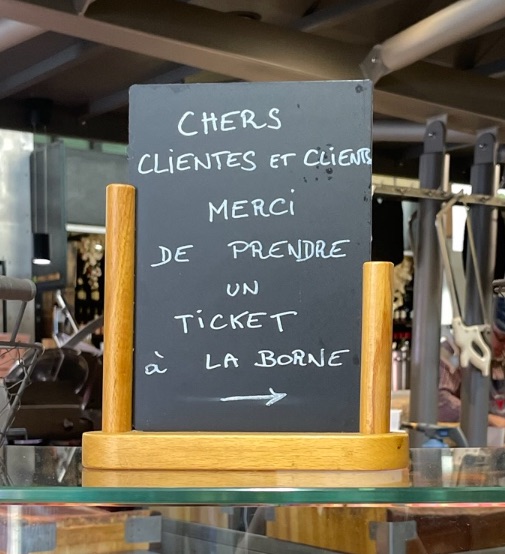
I took a picture of this sign because it’s an example in the wild of a change in the everyday rules of French grammar since I learned them in high school.
You know, probably, that French is a gendered language, and a binary one: it has no neuter gender (unlike German or Latin) and it has no neuter pronoun for objects (unlike English). Every noun has a specified gender, masculine or feminine, with which you must use the agreeing articles and adjectives. Sometimes, say with nouns naming animals or a person’s job, there are masculine and feminine forms distinctly pronounced and spelled. Even if the two noun forms are identical, because of the articles and adjectives and perhaps because of sheer mental habit, you wouldn’t say “oh, that word isn’t gendered,” the way English speakers would say “pilot” is not gendered, nor “flight attendant,” but “steward/stewardess” is. You would say, “oh, the masculine form is the same as the feminine form.”
(Obviously there are a lot of little details that complicate this grammar and make it frustrating or fun, depending on how you feel about languages, like the fact that une personne is feminine even if the person in mind is a dude, and the creation—spontaneous or systematic, I am not sure—in recent decades of distinct feminine forms of professional nouns like avocate (lawyer, with an e) that didn’t exist before. I don’t want this post to take forever so I better stop. I’ve been reading this really interesting book (French edition) that gets into some of these. Anyway.)
So one of the rules we had back in the late 80s and early 90s was that if you were referring to a group of people, only if the group was entirely made up of girls and women could you use the feminine pronoun (elles) for them nor could you use a feminine noun referring to their class (such as employées). As soon as an evidently male person joins, the group receives the stamp of masculinity: ils sont tous employés, one e, in their class, their adjective or participle, in their they pronoun.
That’s what we learned, and any French placement test was guaranteed to include a question designed to catch if you remembered this fact, probably by having a question about three teachers or something who all have female-presenting names or who are pictured wearing dresses. Because the all-feminine group functions almost like an exception.
But something that I haven’t learned from a rule book but that I have been noticing here and there for years as I occasionally read French news articles or listen to French podcasts (not as often as I wish I had, it’s too much concentration needed while driving): increasingly, describing mixed groups of people by doubling nouns and pronouns.
And here is an example I saw in the wild: not clients (meaning customers-in-general, using the standard masculine form) but clientes et clients (meaning female customers and male customers).
Even on a small chalkboard with not a lot of extra space!
+ + +
I freely admit the following is an amateur take and welcome correctiom from experts….
This is not what English speakers have done as our language has moved (starting from before I was born) to adopt changes perceived by many as more inclusive and modern. In some cases we’ve done the opposite.
Here’s one way we do it in English. You take a word like chairman or fireman that sort of embodied the assumption that the role was almost entirely filled by men. Occasionally you might see chairwoman but we have largely moved to gender-neutral terms, some of them crafted for the purpose: chairperson, firefighter, postal carrier, flight attendant, Congressional representative, etc. And I still see these new words sometimes being coined: instead of the feminine-gendered seamstress you now sometimes see sewist, which I think I only saw for the first time a couple of years ago (replacing some wordier, less precise options like textile artist). I wonder about which words get the -person treatment and which don’t. I don’t see an obvious pattern. Some sound clunky to me and some don’t.
Another thing we have done in English is the exact opposite of the French evolution. Where one word came in masculine and feminine forms (e.g., actor and actress) some style standards are to eliminate the feminine form (everybody’s an actor). Oddly enough sometimes this has been followed by a second substitution (waiter/waitress to waiter to server) —maybe because the first change didn’t stick?
At any rate, we are definitely not saying actors and actresses every time we discuss Hollywood. You don’t see that double construction except in a few formulaic and possibly fading expressions (Ladies and gentlemen) and when you need to emphasize something (boys and girls perform similarly on this test).
+ + +
I think this is very interesting, nonjudgmentally, and perhaps a glimpse into the interior workings of French as compared to English. It seems to me that there are two linguistic (that is to say, mechanical, not sociopolitical) features of French relative to English that may explain some of the different approaches.
First, English is habitually pithy. English takes fewer words to say things than French does: compare the thickness of your favorite translated novel in trade paperback version to that of the original. I suspect that lengthier phrases just do not sound as lengthy in French whereas they make English speakers itch. Doubling the length of a noun phrase may just fit more comfortably and seem more natural.
The other is that English speakers, having most of our nouns be genderless, including many nouns for people and professions, can easily come to view our handful of gendered people-nouns as exceptions to the rule. English mostly does not have gender. The normal nouns for people are objectively genderless even if the class is male- or female-dominated and thus connotes one or the other: teacher, nurse, lawyer, electrician, engineer, laborer, garment worker; and also customer, boss, consumer, traveler, student, patient, retiree, and many more. The nouns that expressly segregate the genders for no functional reason (like waiter/waitress) are unusual. For language learners they represent a list that “just has to be memorized.” Reducing these doubles to the less-marked counterpart—always the masculine, that’s where the sociopolitical analysis creeps in—is linguistically simple. It makes English grammar more uniform, not less.
One of my goals in French learning is to grasp better and to get more current on how these rules are evolving, because they are not evolving in a way that is predictably parallel to how English is evolving. I don’t, for example, have much knowledge at all of how expressions that in English we call “nonbinary” are coming to exist (or not) in colloquial French, with its structure that’s far more inherently binary than English (itself far more inherently binary than some other languages that I have never studied). I need to do more reading.
Okay, that’s the end of my writing time. More travelogue later!
 bearing blog