
I've been thinking a lot about the power of science communication this week.
Even though I've fallen off on blogging, I think a lot about sci-comm in general… or, now that I think about it, my thinking about sci-comm in general is part of why I've fallen off in blogging.
When I first completed my PhD and transitioned to full-time attention to raising and educating my own family, I was highly confident that I would never be an academic or a researcher again (and not too sorry about it, although I would miss many corollary benefits). I had an idea that sometime in the future (but with no urgency, and no plan) I might move into the broad field of sci-comm. Journalism? Textbook publishing? Something to do with education? It was then, and always has been, a vague idea. I enjoy explaining technical things to non-technical people: converting technical language into everyday language, and I think I have a bit of a natural talent for it; I'm untrained, if I ever decided to really make the career change I'd probably seek out some technical communications courses first to brush up on my skills, but it's always floated around in the back of my mind as "the thing I would do if I decided to re-enter the paid labor market."
(Understand, by the way, that I have zero formed plans or intentions to re-enter said market. It's just a topic that's been on my mind a lot, especially since I decided to follow a bunch of sci-comm professionals on Twitter, who are always tweeting about how valuable it is and generally bumping it up in my consciousness a lot more. So don't read any of this as hints that I am purposefully researching a career change.)
So why am I not blogging, then. I guess, the more that professional writing and communication is on my mind the more clogged up I become as an amateur writer. Sometimes I think about banging out a quick critique of a news article on a technical topic, or an opinion piece about something or other, or even a close reading of some research article that's making the rounds in the form of bad journalism. For a long time I was perfectly happy to blather on at length, applying mathematics or chemistry that I learned in one context to situations that are entirely different, evaluating writers in fields far outside the areas where I legitimately have some expertise. Because I like to have broad technical competence, not narrow and specialized knowledge (I learned that when I spent seven years specializing). I like to drill down deep here and there, all over the place, according to my interests, and as I learn, bringing other people along with me. It's simply… fun.
But I've always been aware of the dangers of thinking that because you're an expert in one field, you get to be treated as an expert in other fields. Even if you count expertise that isn't credentialed — I believe it is possible, even common, for motivated and intelligent people with a good sense of what they do and don't know to develop genuine expertise outside the gates — you run the risk of overstepping your knowledge and not realizing it, and that's downright embarrassing when you get called out by the specialists. The generally nerdy nerd has to be a humble listener, and listen to the specialists. There is a general technical toolbox that we all share, but the specializers are the ones who generate the majority of the information that we generalists relish, chew on, and digest.
I feel like I can come up with new ways to say things, new ways to organize information. Occasionally I have anecdotal experiences that are worth sharing, for the purpose of raising questions about how they connect to the wider world of investigation. I'm not doing original research. I know this. But that doesn't mean I shouldn't be able to write about other people's expertise.
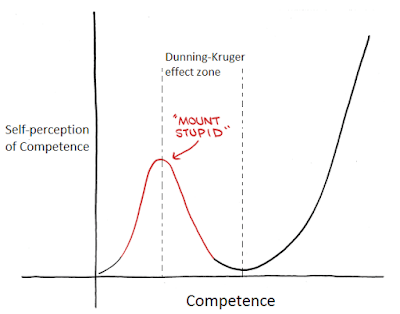
Still, I am a little bit choked these days by the fear that I will either overstep my bounds, or appear to be pulling rank inappropriately: "I have a PhD in something so you should listen to me about this other thing." The more I appreciate the importance of general science communication, the more I respect it as a profession, the meeker I feel about engaging in it as an amateur. It isn't imposter syndrome, exactly; there's no particular place that I belong, but feel a secret un-belonging. It's more the backside of the popular concept of Dunning-Kruger: I've gone over the edge of Mount Stupid and the valley on the other side is long and flat.
The other reason I think I've been hesitating is because I feel more mixed these days about having a blog that is about a million different things. There is no way I could separate them and have one blog for recipes and homeschooling and another blog for technical writing and a third blog for theology and canon law and a fourth blog for constitutional law and… The whole reason this won't work (unless I ever do make that career change) is my penchant for general nerdiness. I am nerdy about recipes, and homeschooling, and numerous technical topics, and canon law, and constitutional law, and language learning, and basically everything I ever think about at any time. It's unclear to me where the dividing line is between "Personal Musings" and "Technical Communication."
….aaaaahhhh, there is no such line for me. I just gotta start climbing the other side of that valley.
+ + +
I'll just close here by noting something that I hope the rest of you have noticed, too: The people who made the various popular versions of the "Flatten the Curve" graph have, personally, probably saved an uncountable number of lives.
I'll highlight Drew Harris's version below for its unfussy and concise elegance. This is not the work of an amateur; it's the work of an expert. But his version nailed the clear communication of the relevant information.
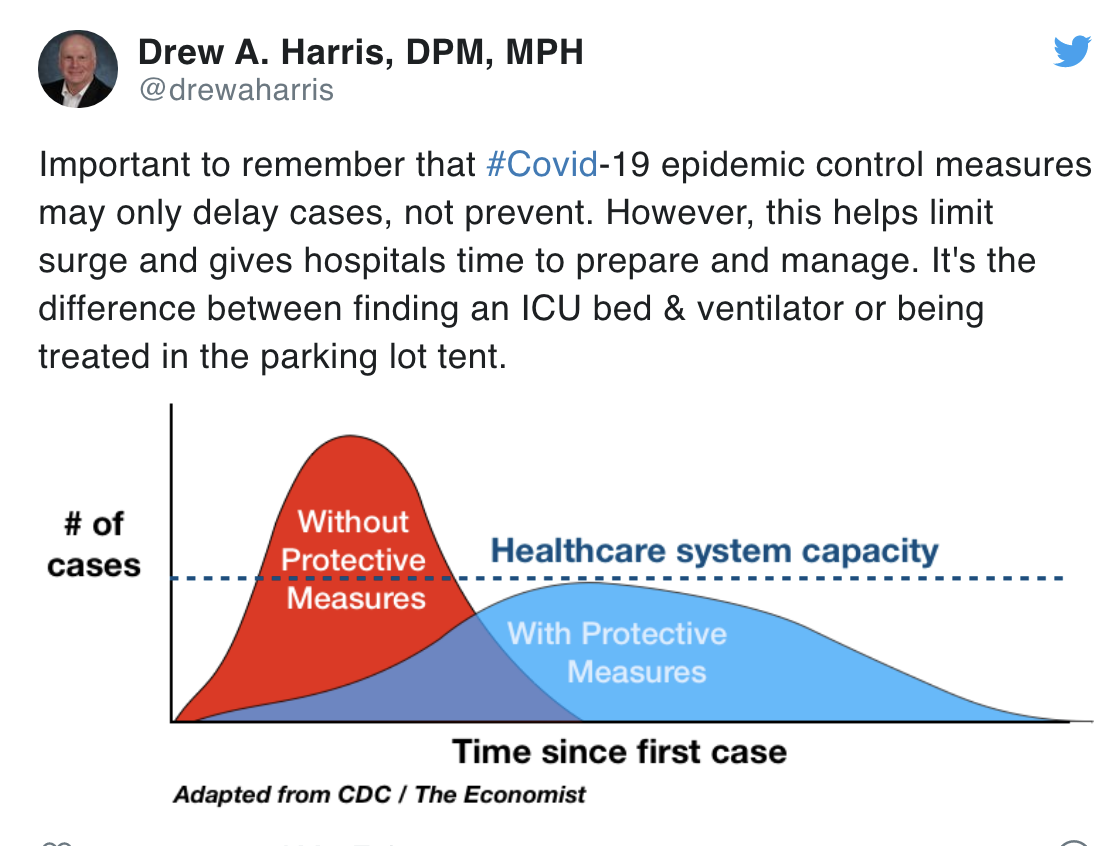
The concept predates Dr. Harris, and other artists made later versions which arguably were accessible to more laypeople and included information showing how ordinary people could "flatten the curve." Personally, I think his version marks the turning point of the dissemination of this idea. This article traces the evolution of the idea's presentation from a 2007 CDC publication, through Dr. Harris's chart, to the memes that people are sharing today.
Now go wash your hands.


 bearing blog