
A side note on logistics.
I've been dabbling in serving "first course" before "mains" at family meals ever since our first European trip three years ago, and it's a habit that has persisted remarkably well. I wrote about it for the first time here:
[O]ne thing I noticed that I liked is the serving of meals in courses. Yes, I know that is a totally normal thing to do "over here," but it's nothing we ever do; we tend to put all the serving dishes in the middle of the table and help ourselves to everything at once.
There's nothing wrong with that per se, but I wonder if I could slow us down just a wee bit, and have a first course.
Not make anything extra. I typically have two or more vegetable side dishes at each meal anyway. Just take that salad, or that soup, and put it out ahead of time so we can warm up to the table and to each other before we start snarfing down our meat and carbs.
In the next post after that, I listed some examples of potential first courses. But I don't think I have written much about it since then, until yesterday when I wrote about searching for meal-planning guidance in French bookstores.
There appeared in the comments a question from ChristyP:
I was thinking yesterday about the logistics of separate courses and quickly became overwhelmed by the number of dishes and potentially serving pieces to wash.
You certainly have more helpers, but are you actually running the dishwasher after the first course so that it can be emptied and refilled with the rest of the dishes from dinner?
Or do people keep the same plates and have other items served upon them (possibly with wiping up any extra salad dressing with a paper towel between courses)?
I can answer this one!
There are several reasons why I have been able to execute this without getting overwhelmed.
+ + +
Simplifying factor #1. I make a maximum of 3 "family-style" meals per week.
How is this so?
- Mondays we take turns preparing meals with another family whose kids and grownups are going to the same Monday night meetings.
- Wednesdays are self-serve Leftover Buffet Nights.
- Saturdays, one of the kids makes dinner. They take turns. I don't micromanage the planning, cooking, or serving.
- Sunday dinner is a cheese-and-meat board with bread, crackers, and crudités.
Not doing it every day is surely one of the reasons it is not overwhelming.
+ + +
Simplifying factor #2. Though I might have three "courses," it's only two sets of dishes, not three.
Except for parties, I basically never make a sweet baked dessert or anything else that couldn't go on the same plate with the mains. The sugariest thing I might cook to go with a regular dinner is a baked apple.
For the most part, until this year, I only ever tried to manage two courses: a first course (usually a salad or other vegetable), and a main.
Lately, inspired by careful attention to French magazine articles and serving suggestions on French prepared-food packages, I have been putting out a "dessert course" which amounts to a platter of either cut fruit or wedges of cheese, at the same time as the main and sides.
I have been enjoying taking my portion of the fruit or cheese after I have finished the main course, but of course anyone can serve it to themselves as a side. It goes on the same plate as the other food, or on the bread-and-butter plate if the main happens to be soup or something else that requires a bowl.
So if you're imagining three sets of plates, banish that. Think two, max.
+ + +
Simplifying factor #3: Smaller plates.
This really helps with the dishwasher.
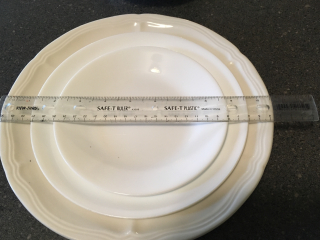
Shown below, stacked from bottom to top: (1) a "standard" 10-3/4-inch dinner plate, (2) our dinner plates, (3) the plates we typically use for first course (or for a bread plate if we're having soup):
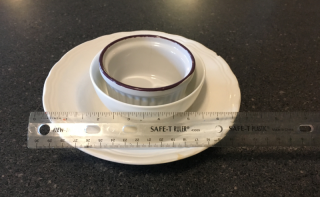
Shown below, stacked from bottom to top: (1) a bowl for first-course soups for Mark and teenagers, (2) a bowl for first-course soups for me and middle-size children, (3) a ramekin for first-course soups for smaller children:
I generally get away with two dishes per person. And unless I have to break into our "standard" plates for some reason, every plate and bowl can fit on either the bottom or the top rack of the dishwasher. So it's not terribly difficult to get them all in.
That is, it wouldn't be difficult if we started with an empty dishwasher. In truth, with six people here all day long, the dishwasher is almost never empty, and there's usually a backlog waiting in the sink; so maybe the real reason it seems easy is that seven extra dishes from first course don't make a noticeable contribution to the pile.
+ + +
Simplification #4: It's routine.
In practice, when I am in charge of a multicourse dinner, I plan it this way:
- I plate the first course and put it on the table while the table is being set.
- We wait for everyone to come to the table and say grace before we let anyone dig in (or complain).
- As we start eating, the main course items (including the stealth fruit-or-cheese-course) are in resting on the counter, chilling in the fridge, or staying hot in the oven, depending.
- When most of us are done with the first course (except for the 3yo, who can't be reasoned with yet), I get up, take away those plates and drop them into the sink or stack them by the dishwasher.
- I then bring the dinner dishes in a stack and hand them to a teenager to distribute.
- While he is doing that, I fetch the serving dishes to the table.
- I'm not above just putting the soup pot or the crockpot insert on the table, by the way. I draw the line at serving from the rice cooker because I am not tall enough to see over it when seated.
- We pass the rest of the dishes family style.
If I really needed to conserve plates, I think I would not be above using our divided plates and serving the first course in one of the sections of the divided plates, and letting people keep those plates between first and main courses. Alternatively, I could allow people to opt-in to the multi-plate dinner, keeping their first plate unless it really bothered them that there were traces of salad dressing or whatever on it; in that case they could get their own clean plate if necessary.
I personally find the rhythm of changing the plates to be pleasanter.
+ + +
Simplification #5: I have three offspring who can load and unload the dishwasher and hand-wash dishes without help, plus one apprentice.
I almost never wash dishes in my own house.
As ChristyP noted, this surely is part of what makes it all seem feasible.


 bearing blog