

Plenty of this going on with the little ones, too.

Tuesday Mark had to take off for a business trip. One of the ways we managed to pull together such a long trip is by having him do some work while we’re gone: a few days of telecommuting and some European business that he would have had to travel for anyway.
With him not here to help, I planned something fairly easy:
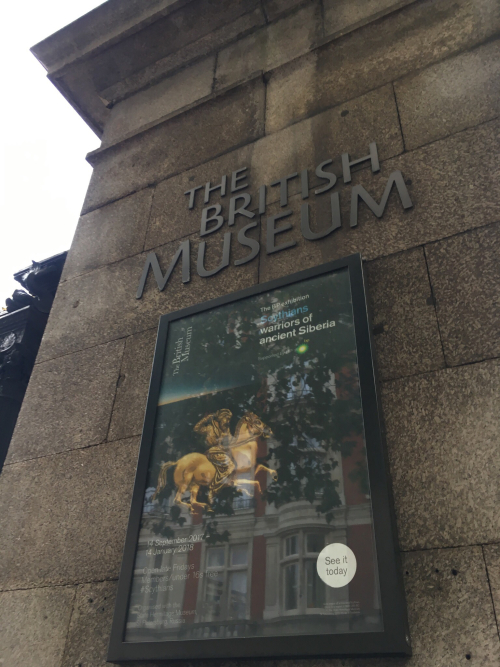
Yes, it’s enormous, but it’s also a five-minute walk from our apartment and free, so we can just go in, spend time, and leave again, and come back later easily if we want.
My plan: all five kids and I would go together at the ten o’clock opening, see what we could manage before lunch, have lunch there, then split up. The teen boys could go off on their own together, and I would take the younger ones back to the apartment to rest.

There is a little line outside just to get through security. They look in all your bags and purses and don’t allow large ones. They did not have a problem with the child carrier, but they do not like it if you absent-mindedly take a picture while you are in the security tent (ask me how I know).

We made a beeline for the Egypt collection.

The Egyptian artifacts are so numerous as to be overwhelming. We had young ones, remember, so we could not give each item a very close scrutiny, but I left with a strong impression of the painted and carved funerary objects as items crafted by real people with individual styles and hands. The picture-words aren’t printed or stamped, each bird and stream of water isn’t the same as each other; there is a fleeting imperfection to each one, as in pop art paintings where the artist has reproduced some scrap of text in the Courier font by hand-drawing and inking each enlarged letter-form.
My 3yo, on the 17yo’s back, greeted the canopic jars: “It’s a bird pot, and a dog pot, and a monkey pot, and a person pot.”
I marveled at the painted linens and funerary portraits from the Roman period. The realism, the twinkle in the eyes:

It isn’t hard to find the Rosetta Stone; just follow the crowds. We squeezed through and got a good long look at it, up close and personal; the best unobstructed view was from the side of the case, which still got you a nice good view of the inscribed texts on the face of the stone. I took a moment to point out to the 7yo the everyday, easier-to-write Egyptian script in the middle. What a treasure, this otherwise plain black rock, unlocking all the gloriously painted ceremonial writings on all the funerary objects in the other rooms.
Here’s what I wish, though: That, however lengthy and tedious and repetitive it might be, that the museum would post by the hieroglyphic objects the translation of the texts that are written on them. I don’t just want to look. I would like to know what everything said.
I suppose it might slow down the crowds. And maybe I would spend more time reading cards than admiring craft. There is a cost to everything.
+ + +
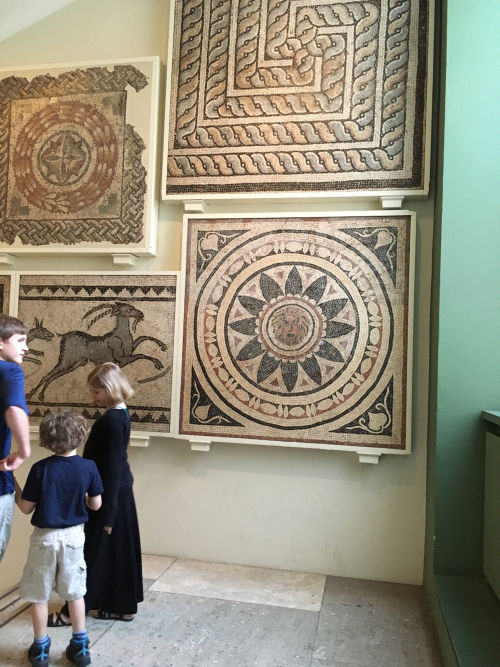
A staircase was hung with Roman floor mosaics:
We spent a long, long time admiring the stone palace reliefs from Assyria, depicting the Lion Hunt of Ashurbanipal:
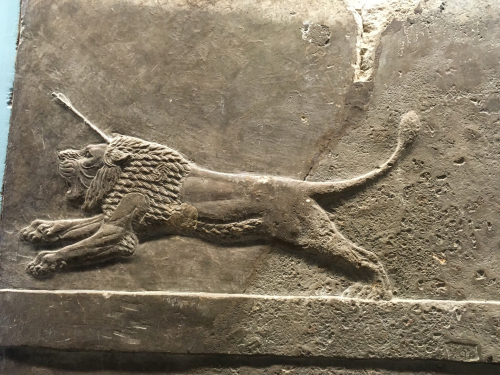
than the lions, aiming to shoot again. Taken as a whole, you can see the arc of the arrows’ flight, and it functions as a three-panel snippet of a story, the intentional blank spaces providing a sense of separation. You can follow one arrow from right to left in time (he shoots—the arrow flies—hits its mark) or you can see the arrows in succession from left to right (the first already piercing the lion—the second in the air—the third already on the bow).
The 7yo was seriously waning by now, so we promised him something modern. Upstairs were two little galleries I wanted to see: Clocks and Watches, and Money.
We walked into the clock gallery just a moment or two before eleven o’clock, and were rewarded with the unexpected music of many chimes: I had not expected this, but many (not all) of the clocks were running.
This one has metal rods mounted on the bottom of the pendulum which expand upward as the pendulum expands downward, compensating for the effect of temperature change by keeping the center of mass closer to where it is supposed to be than it would be otherwise.
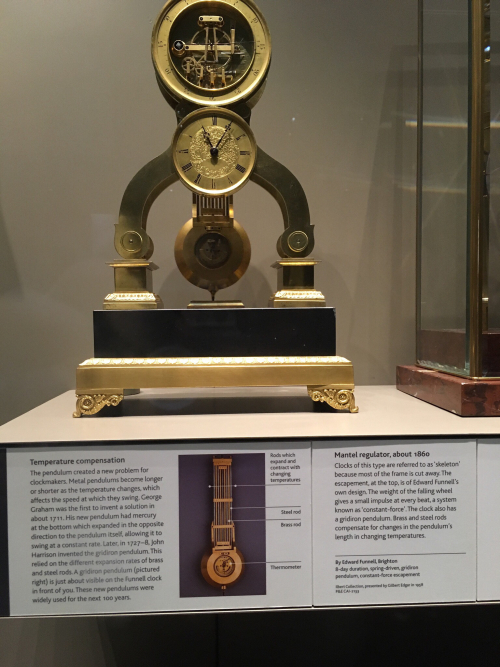
We had a physics problem about this a few months ago, so I made my 17yo come look at it.

In turn, he pointed out to me a springed, chain-driven clock, the chain wound about an axle whose diameter changed as the spring ran down. “The axle profile is a graph of the changing force expected from the spring,” he said. Indeed.

(This clock was also notable for the little silver-colored ball, seen at the left side near the support, that rolled down a zigzag channel, taking a minute to do so; when it reached the edge, the table tipped the other way and the ball rolled back.)
+ + +
The Money gallery included collections of coins and notes and other monetary objects, like cowrie shells and gold wire. There were seals, too, each displayed face up, next to a little wad of putty or clay bearing their impression. The detail on some of the coins was amazing; I have seen many ancient coins in pictures and in museum displays that were very degraded, but I have never seen so many pristine ones.

There were pieces of eight, I think the first ones I have ever seen up close, and a whole case of counterfeit British pounds. There were dies and tools for minting coins. There were examples of some of the world’s oldest paper money, Ming dynasty I think, a note about the size of a piece of A4 paper with a picture of a string of stacked hole-punched coins that was some sort of official measure, displayed next to a physical reconstruction of the same string of coins.
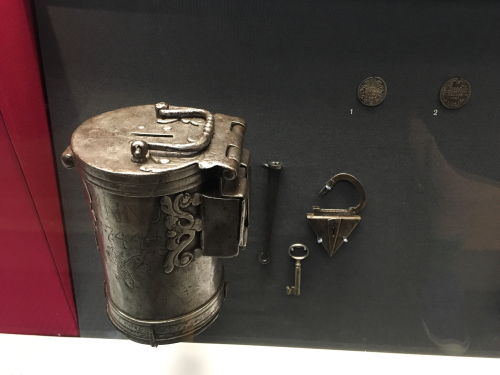
There were items for storing money, such as this 18th-century poor-box, which had a double lock so that it required at least two different keys to open it.

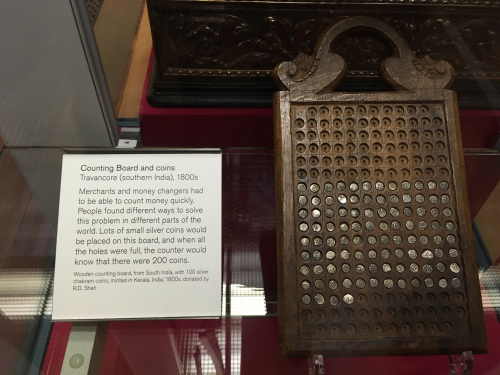
I loved this quick coin-counting board, with slots for the right number of coins to fall into until the excess slides right off. A useful engineering trick you’ll see in other places besides money-counting.


I decided to build a little endurance into the others by inviting them to pick a gallery to see before leaving. The 7yo refused, but the 11yo wanted to take a closer look at Greek and Roman things. She wasn’t interested in the Elgin marbles (the 7yo was a bit interested in the model of the Parthenon displayed in the entryway, but only for a moment), but in the statuary.
What she seemed especially interested in was delivering a lecture on the relevant myths to the 7yo. To his credit, he listened attentively. So she told him all about Aphrodite:


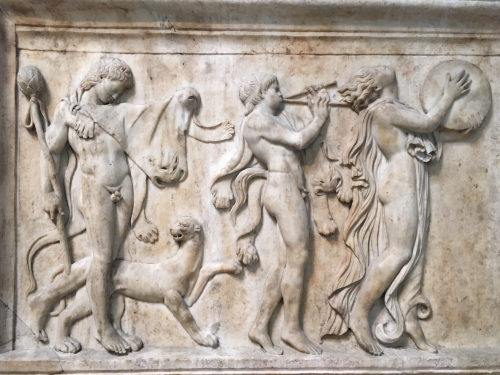
And also about Apollo and Diana and the bragging of Niobe, mother of fourteen, and the twin deities’ subsequent slaughter of her children (thanks to a large medallion-shaped depicting that particular event).
+ + +
But that was about all the small boys could take, so we left and headed through Bloomsbury Square to stop in the tot lot for a little while.


It couldn’t last long, because people had to go to the bathroom. Fortunately our apartment is only a block away. We went there, and turned on the TV, and rested a while.
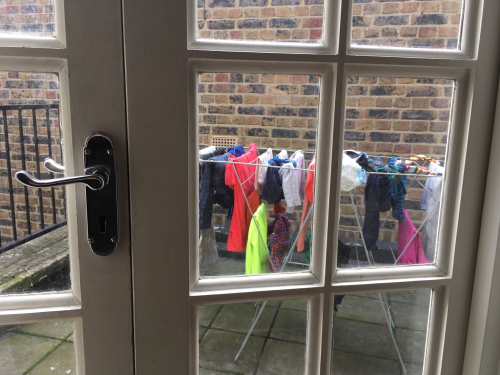
I hung up the still-damp laundry, still hot and moist from the “dryer.” There was a little sun, and I thought perhaps it might evaporate some more of the moisture outside.
I sat down to make a list of the things I wanted to do and a list of the dates that are available to do them in. I stared at the two lists in some dismay. One is long and the other is short. Here I have been in London since Saturday evening, it was Tuesday already, and I have not laid eyes on St. Paul’s or on Parliament or even on the Gherkin. How will I find the time?
Well, if I am going to spend lots of time in one neighborhood, at least I am in a good one, with lots of things to see, eat, and drink.
+ + +
The teen boys returned around three o’clock, and I headed out on my own with a mission.
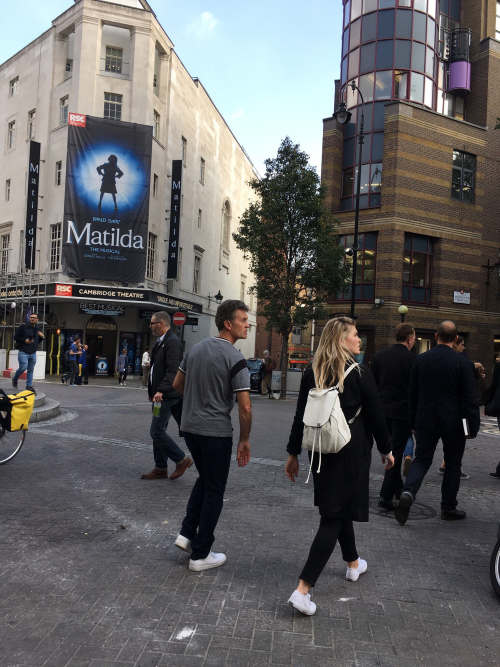
After having learned from the discount ticket office that everything I was interested in seeing wasn’t likely to be discounted much at all unless I got lucky in the rush line a few minutes before the show, I decided the simplest way to get tickets for things in the next couple of weeks was just to stroll right into the box office and buy them in person. We are quite close to many theaters so this was
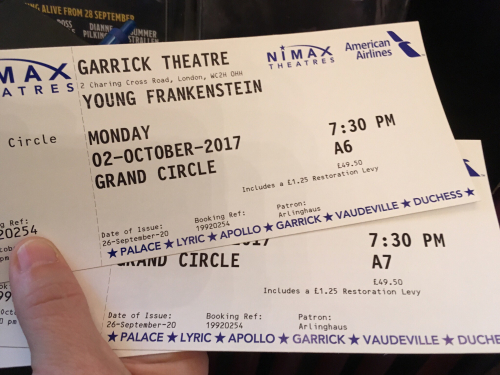
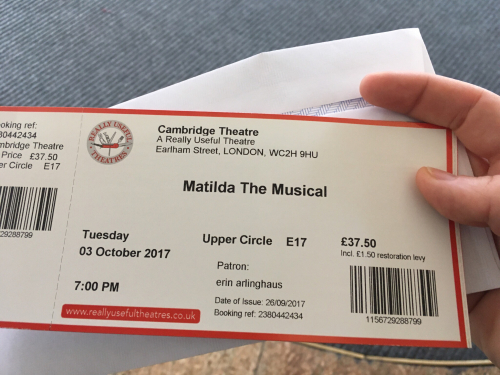
This show opens tomorrow. I haven’t even read the previews yet. I bought tickets for myself and for Mark:
Then I headed back to the apartment, but not in a big rush. I went a roundabout way.
Tried on a couple of wool coats in a vintage store, but had no luck. I am not very attuned to fashion trends, but I have noticed the usefulness of a feminine look that appears common in this part of London in this cool weather: A well-made felt or wool coat, expensive but not ostentatious, either of the slightly battered and beloved variety or shapely and new with a b
eautifully turned collar; sometimes a thick solid color like pigeon-gray or camel, sometimes a retro sort of bright tweed; worn open, the belt loose, over Literally Anything You Just Threw On To Run To The Store.
Maybe if you have a pretty enough coat, you don’t ever have to buy anything pretty to go under it.
+ + +
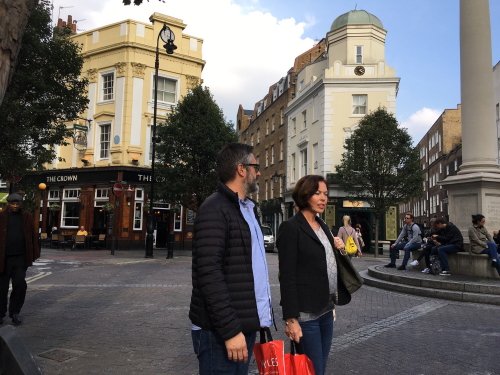
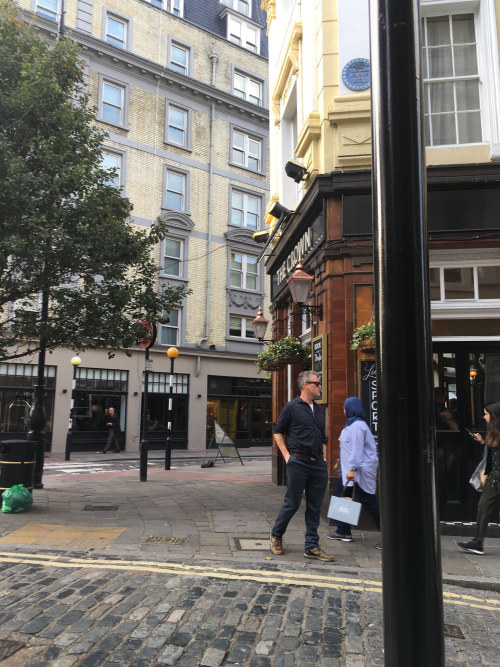
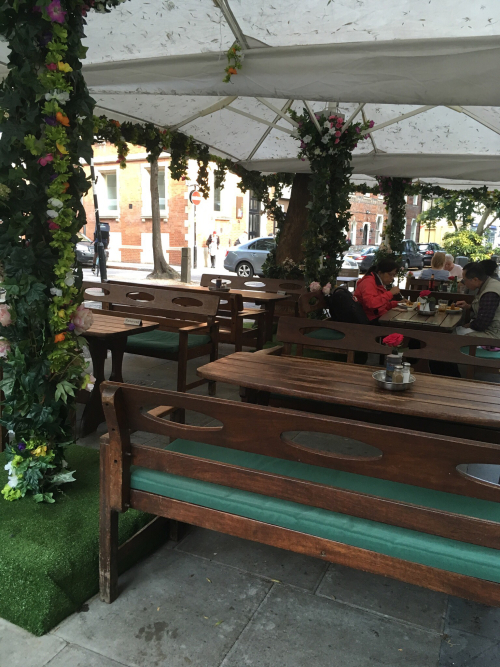
Some neighborhood scenes:



Canned, cold, and well-earned.
 Posted with Blogsy
 bearing blog