
One of my pre-trip errands was to stop at the Guthrie Theater box office to pick up some tickets that I’d ordered over the phone.
It was sunny on Wednesday, and I left the kids at home with their to-do lists for the morning. I parked and put money in the meter, enough for thirty minutes, in front of the Guthrie, and went in and got my tickets; but on an impulse, instead of turning around and retracing my steps through the cavernous entry hall, I walked out the back door, where an expanse of green grass met me.
+ + +
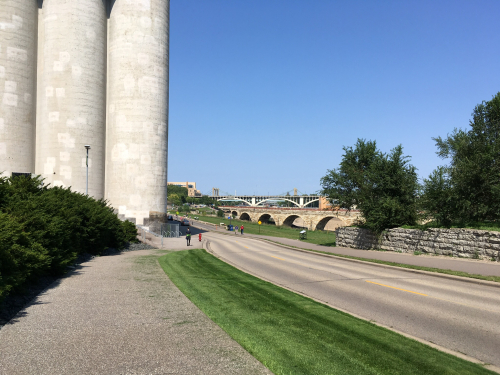
The river, and especially the waterfall, is Minneapolis’s raison d’être. Flour mills and saw mills, and later hydroelectric power, all congregated here. There are still tall grain elevators; you can see the old Stone Arch Bridge that curves in a long arc across the river.

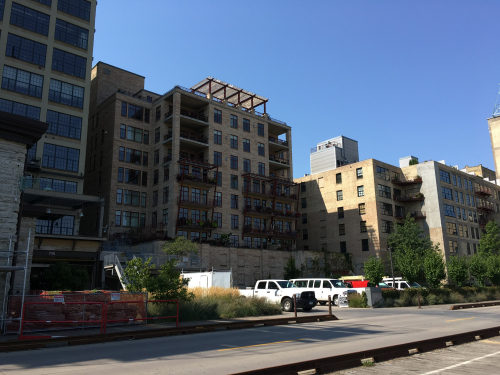
A number of apartment buildings have gone in where warehouses and mills used to be. I admire this one with its red-painted balconies facing the river, most of them bedecked with plants and flowers. They look like good places to sit and drink a cup of coffee.
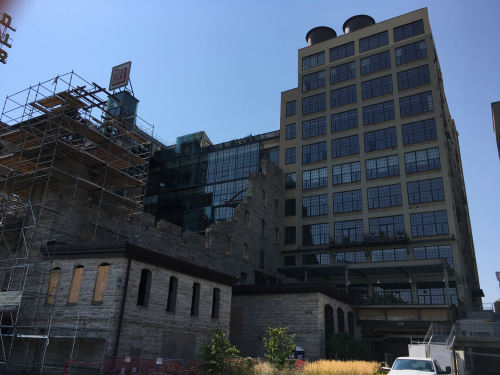
The Mill City Museum, run by the Minnesota Historical Society, is built among the remains of what was once the world’s largest flour mill. If you ever find yourself in Minneapolis and want some local history, I recommend it; it is not too big, and it is very child-friendly, with a hands-on water lab (build the stone arch bridge across the river! make a log jam!) and a ride in the big elevator with a boom from a simulated dust explosion. Groups can have field trips that include a farm-to-table baking lab and recipe testing of chocolate chip cookies. The tour takes you through remaining parts of the mill, which famously exploded in 1878 and burned again finally in 1991.
Since then the historical society has turned the whole area into a park. In some places down by the river, walking trails wind around the crumbling limestone. The tallest mill remains, nearest the museum, are this summer covered in scaffolding, marked with signs advertising a masonry restoration firm.


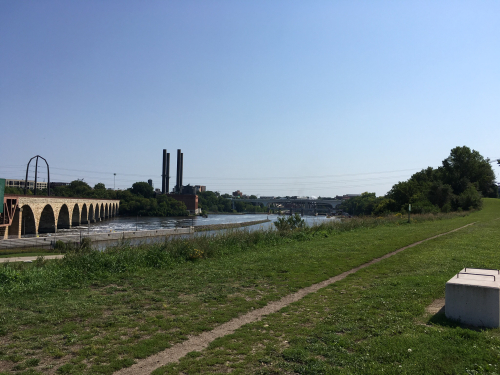
Before climbing back up the steep street that leads away from the waterfront, I turned and took one last picture up the river, towards the rebuilt 35W bridge.
This past summer the aforementioned Mill City Museum hosted an exhibit commemorating the tenth anniversary of the evening rush-hour collapse, which killed 14 and injured 145. They even one of the infamous inadequately-engineered gusset plates on display (photo at the link).
I am kind of sorry I missed the exhibit. At the time, Mark (along with who knows how many other locals) usually drove across the bridge twice daily on his way to and from work; it was an upsetting afternoon. Fortunately, I learned relatively quickly that Mark had left work well before the collapse and was at the gym and not in the river. The twisted remains of the old bridge were left in place on the banks of the river for a disturbingly long time, even after the new and very sturdy-looking bridge went back up.
Just a short break in the middle of a busy day to take in some of the views of my home city.
Next: pictures from somewhere else, I hope.
 Posted with Blogsy
 bearing blog