
After our beach day at Santa Marinella, it seemed as if we all got a second wind.
We came back to a lovely dinner of Italian convenience food from the grocery store across the street:
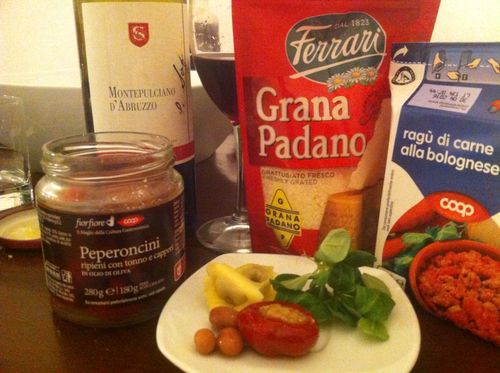
Refrigerated ravioli stuffed with proscuitto. Boxed store-brand pasta sauce (the ragù is shown, but the best was arrabiata). Bagged grated cheese. Jars of little sweet red peppers stuffed with a tuna-caper mixture. A jar of borlotti beans for the baby. A bagged salad with all sorts of beautiful mixed greens.
With three days left in our trip, I bought a three-day bus pass for everyone over the age of 10. And…
The next day we hopped the bus and headed for the Scala Sancta. It is over near St John Lateran and is the original “stairs that you go up one at a time on your knees” indulgence. It is a marble stairway, encased in wood for its protection (although there are a few portholes cut in the wood so you can see and touch the marble). Reputedly they are the 28 steps that once led up to Pontius Pilate’s praetorium in Jerusalem, so: they are, if it is true, a physical part of the Way of the Cross. Since the Middle Ages at least it has been said that St. Helena brought them to Rome from Jerusalem in the 300s. And the legend has a nice long history of annoying people like Martin Luther (possibly) and Charles Dickens (verifiably).
The map was a little confusing and the building was so nondescript (at least compared to the nearby basilica) that I wasn’t sure I had the right place until I got in front of the door and saw the stairs with about a dozen people kneeling on them. (See the Wikipedia article, from which I took the historical information, for a picture not unlike what I saw. I did not feel comfortable photographing people there, although it is allowed from the bottom of the stairs.)
I explained to the children that no particular prayer is prescribed for the stairs, so they could pray something as simple and short as the name of Jesus, or something longer if they wanted. As for me, I had downloaded a set of devotional prayers on my iPhone, the kind that gives you something slightly different to meditate upon for each step. Mark went up the stairs with the 4yo in his arms and I went up with the baby in a front carrier. At first it was not hard, but around the tenth step the wood started to press uncomfortably on my knees and the baby began to stir.
About step 19, the baby started crying loudly, so for the sake of the other pilgrims, I quit with the iPhone prayers and went with something MUCH shorter as I crawled up the remaining nine steps. (You aren’t allowed to step on the stairs, so there wasn’t really a faster means of escape for me, other than tumbling down them, I suppose). At the very top, hands reached down to help me up, and pulled me, sweaty and flustered, to my feet. I stroked the baby’s head and apologized in Italian, and the other strangers who had also just finished their ascents shook their heads, and smiled, and cooed at the baby, and told me it was not a problem, that it was a great blessing.
I believe I was reasonably well disposed, but this was not a time when I was granted any special consolations. I made it up the stairs; it was physically uncomfortable; I was rather focused on my crying baby.
Are they really the steps Jesus walked on? They might be. They might not be. Regardless, they represent the whole via dolorosa; my downloaded prayers don’t say, for example on the sixth step, “O my Jesus! By this 6th step,” etc., they say things like
O my Jesus! By the patience thou didst exhibit amid the outrages and mockeries of which Thou wert the object throughout the night preceding Thy death, have mercy on me!
They take you through the whole Passion. The physical object of the Holy Stairs — there likely were once some holy stairs, whether these are they or not — is not the object of our worship. Replica “holy stairs” have been built for other pilgrims in other places, and none of those pilgrims believes that the stairs they climb are really the stairs Jesus climbed; in at least one sense, it is the thought that counts. Or rather, the intention, allied with the action.
The stairs inspire the faithful to suffer, voluntarily, for a time.
Speaking from experience as someone who hardly ever voluntarily suffers, despite holding a fervent belief that voluntary acceptance of suffering has meaning and bears fruit — this is a valuable thing. I climbed them because they were there. If they weren’t, doubtless there is no other voluntary suffering I would have substituted that day.
 Posted with Blogsy
 bearing blog