
Some time ago I attended a talk at our local Catholic homeschooling co-op, a lecture entitled "The One-Room Schoolhouse." My friend The Road Scholar has put together an entertaining and informative presentation about how the teachers in American one-room schoolhouses in the late 1800s and early 1900s taught their subjects, managed their time, and maintained discipline in classrooms with dozens of children and young people who might be aged 3 through 20. She drew from her own family history and from primary sources like teachers' record books and employment contracts, and included lots of photographs as well as a sample daily schedule and a formidable sample eighth-grade graduation examination. (If you're currently looking for a speaker, I believe she's available for presentations to homeschooling conferences…)
It turned out to be very inspiring, not in the spiritually uplifting sense, but in the kick-in-the-pants sense. As in, If a twenty-year-old high-school graduate could provide quality instruction to twenty kids from kindergarten through eighth grade in the same room, then I can sit my five-year-old daughter and my eight-year-old son next to each other and teach them, too.
There had been so much sniping and bothering each other, and also of each one disappearing from the schoolroom the instant I turn my back to attend to the other, that I had allowed my school day to become like this:
MORNING: Teach the eight-year-old, ignore the five-year-old
NOON: Hashslinging, decompressing
AFTERNOON: Teach the five-year-old, repeatedly shout at the eight-year-old to get back here and finish your independent work
(Meanwhile, my eleven-year-old chugged through his to-do list without any input from me. That kid spoils me. But I should point out that he probably deserved more attention from me than he's been getting.)
I sat down and thought about the differences between my schoolroom and the stereotypical One Room Schoolhouse.
(This is my schoolroom looking its absolute best:)

There are a lot of them. I don't have a big chalkboard, because I use lap-sized dry erase boards or printouts. I have a thermostat instead of a woodstove. I can send people around the corner to watch videos if that seems like a good idea.
But probably the biggest difference is that my schoolroom has no place for me.
In the one-room schoolhouse, the children sit and work facing the teacher, and the teacher works standing at the board or seated at a desk facing the students. She can see all of them at once, and this is true even if she is working one-on-one with a student at the front.
My schoolroom has no "front of the room." There is a countertop on which I prepare my lessons, but no place at the front for me to stand or sit. Typically when I work with a child one-on-one, I pull up a chair next to him at his desk. This works great for the child to whom I am attending, but then my back is to the others. Distraction ensues.
It isn't that I want to create "school-at-home." I don't. But right now I need to borrow a technique for helping two squirrely children stay on task while I work with them in turns.
Fortunately, the desks move (and are the same height and a carefully chosen aspect ratio):
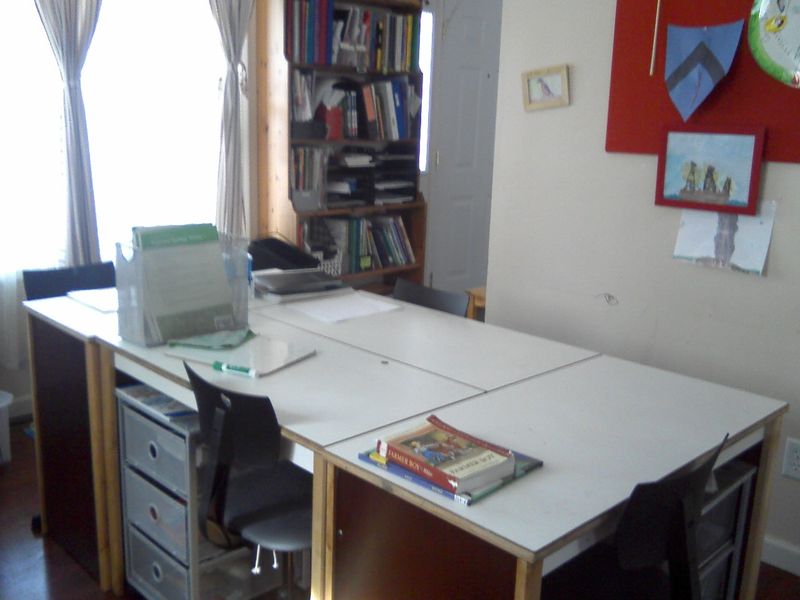
It's not great, but it is the best I could do in a pinch.
See the desk with the dry erase board and marker on it? I can stand or sit there. Now my five-year-old can sit directly across from me, and my eight-year-old can sit at the desk on the right. The eleven-year-old still has access to his desk on the left, although he has proven himself focused enough to be allowed to work anywhere in the house that suits him.
I've been making my five- and eight-year-old plow through their work at their own desks, and insisting that they get permission before getting up to use the bathroom or get a glass of water. (Trust me, they have plenty of opportunity; it is just that there has been a disturbing trend of conversations like this:
ME: Hey, 8-year-old, would you mind—
8YO: I have to go to the bathroom!!!!
[running feet]
[faraway slam]
[silence for the next 20 minutes])
And I have a big basket of already-sharpened pencils on the counter behind me, so that excuse is gone.
With the two of them right in front of me, it is much easier to work with them in turns. When my daughter finishes a task, I can see it, and I can turn around and grab another assignment or at least a book for her to read. When my son casually leans back to try and peek around the corner to see what his toddler brother is doing, I can catch him out. For the most part, I can keep them on task, at least better than before.
There is a lot of moping, and a lot of "Can't you make her be quiet?!?" but I am determined to allow them to learn how to work in the same room with each other, respecting each other's space and cultivating patience for the inevitable distractions. Fortunately the bottoms of the desks are built like enclosed boxes, so they literally cannot kick each other under the table.
It's not that long. Only about an hour in the morning and less than two hours in the afternoon. With plenty of bathroom and glass-of-water breaks — between subjects.
Speaking of subjects, I've aligned their subjects together now — which is to say that the 8yo works on his catechism during the same block of time that the 5yo listens to or reads Bible stories, that the 8yo has math lesson while the 5yo does math worksheets and vice versa, the 8yo writes in his journal while the 5yo prints in her copybook, and they both do independent reading at the same time.
This works shockingly more efficiently than my previous model, which was to teach one while the other (theoretically) worked quietly and independently. The problem is that neither one of them seems to be developmentally ready to sit and work independently without help — not help with the math problems or sounding out words, but help staying on task. Does it sound unrealistic to have a five- and eight-year-old sitting in chairs being directly taught for a two-hour stretch? Trust me, it is more unrealistic to expect this five- and eight-year-old to decide where and how to sit and what order to do their work in, and yet complete their daily tasks.
Still many bugs to be worked out, but I've got something that's going pretty well for these middle two right now.
(And in case you are wondering what I am doing with the toddler, the answer is that I am coping as best I can. He has a little table around the corner. Today it has Play-Doh on it. Tomorrow it may be something else. I'm not above a video or two if it comes to that. Sometimes I am lucky and he goes down for a nap just in time for afternoon school.)


 bearing blog