
A few days ago I wrote about how I discovered that stacks of disorganized files, despite being ugly, can actually be an efficient way of dealing with many kinds of household paper records. They cost time in file-retrieval, but they save time in file-storage (since you don't have to take much time making folders and putting them in the right spots). This kind of storage is only appropriate if the piles stay where you put them, and if it's much more important that you be able to easily put files away than that you be able to easily retrieve them — that is, if it's okay if it takes you a while to find what you're looking for as long as you know it's in there somewhere.
In this post, I write about how I changed paper-storage in my schoolroom to exploit this principle: How can I best use messy piles as quick, safe storage?
+ + +
The whole concept is counterintuitive — we assume that a system must be tidy to be efficient, and conversely, that tidying will make us efficient. But tidiness takes work. Whether that work pays off depends on how much time you can afford to spend putting something away, how long you expect to store it before the next time you need it, and on how much time you can afford to spend locating and retrieving it.
Lots of homeschool items must be kept safe. The law requires me to keep copies of certain forms; I want to preserve a "portfolio" of each child's selected artwork and writings; I must keep and add to the current year's school records, aka "grades"; I already printed up some worksheets and I want to assign them in a few days. I also have to promptly put up certain dangerous tools like the hot glue gun and the craft knife. But only sometimes do I have the leisure to carefully store files and tools away in an organized system. And only some of these things need to be kept close at hand.
So let's look at the different categories of "kept items" for the homeschool.
- I have time to store it carefully, and I need to find it quickly
- I have time to store it carefully, but I don't need to find it quickly
- I don't have time to store it carefully, and I don't need to find it quickly
- I don't have time to store it carefully, but I need to find it quickly
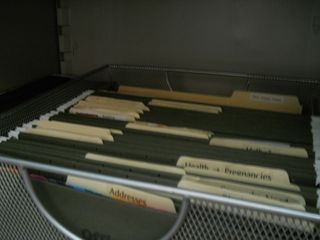
Things I probably have time to store carefully away in a file, and might need to find quickly: vaccination records, other medical records, annual reporting forms, the results from the standardized testing.
The reason I have time to put these away properly is because I don't deal with them every day. I only generate them once or a couple of times a year, and that's enough of a special occasion that I'm willing to take the time to file. For these, I keep a small box of hanging files.
+ + +
Things I have time to put away at my leisure, and can take my time finding: curricula that I'm done with for now but might use again. I keep this stuff in a storage area in the basement, in big bins on big shelves, along with the camping gear and Christmas decorations.

+ + +
Things I don't have time to put away carefully, but that I want to keep for a long time, and probably won't need to find quickly: selected work to archive permanently, and the records of what we did every day (the "lesson plans/grade books"). For these I have a two-stage system. I keep one magazine file for each child, labeled "Records," close at hand on an upper shelf of a bookcase in my school room.
 <–closeup ……..
When I select some child's artwork for his "portfolio," I stow it in the appropriate magazine file. I also drop daily and weekly records and grades, some assessments, and other things in these files as they are generated. Then, when the magazine file is full or the year comes to an end, I transfer the material to one of the labeled bins in the basement storage area.
….eventual destination–> 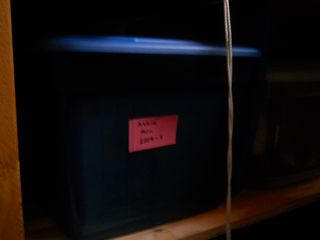
(I don't have much space in my schoolroom, so I don't save everything; a lot of stuff gets tossed instead of stowed in the portfolio file. A person with enough room for a big bin might save everything, let it incubate all year, and cull it at the end. There are some advantages to this idea, but as I said, I don't have enough space to save everything, so I don't.)
+ + +
Things I don't have time to put away carefully, but that I will need pretty soon, and won't want to spend time searching for: schoolwork sheets that I'm preparing and assembling for upcoming lessons; schoolwork that's partly done and needs to be worked on again; finished work I need to go over again with the children; library books.
Much of the material we use daily — the self-contained textbooks and workbooks — are kept in each child's desk drawers. Basically, if it's all bound up nicely so a child can care for it easily, it lives in their desks.
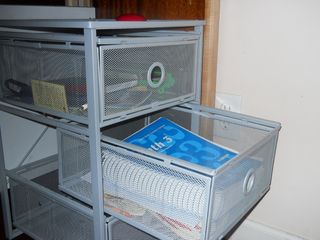 … spiral-bound or tear-off math books
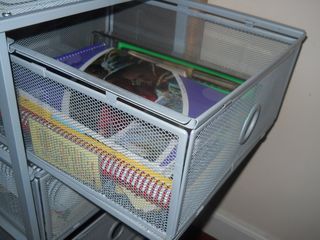 … spiral-bound handwriting and art
But for other subjects, I seem to need to temporarily store a lot of loose paper during school planning or between assignments. History, for example, with all the maps, or Latin, because I often make up translation worksheets. For these I use stacking plastic in-baskets, one for each subject that takes a lot of paper to prepare to teach, especially paper that I need to keep on hand for a few weeks and use intermittently. Some subjects get their own stack box, and then I try to have a "misc." stack basket as well.
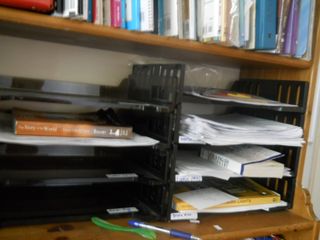 … always keep a baby spork handy
The stack boxes are only for loose paper (and sometimes for small books) – books, being reference materials, are shelved normally, and I mostly try to use binders, not for filing, but for keeping papers together that are supposed to stay that way. Pseudo-books. I try to keep library books in a basket unto themselves, but I won't deny that they often wander off to a child's bedroom.
(A side note: If you've ever used David Allen's productivity system, Getting Things Done — or GTD as it's often called — you might recognize that the stack-baskets function as context-specific lists of action items, where the context of one basket is @planning history and the context of another is @planning Latin. I can only concentrate on one subject at a time, so each one may as well be its own context, right up there with @calls and @computer and @home and @errands.)
It's true that within a stack basket, the papers are disorganized. I have to shuffle through them to find the exact one I want. But it's a manageably-sized pile, and — most importantly — it is very quick to put something away in there. Much quicker than filing it, or even than hole-punching it and putting it in a binder. I don't have to think, "Argh — got to file this — oh well, I'll get to it later" and leave it on the counter where something might happen to it. I can just stick it in the appropriate basket, and trust that it will still be there when I need it the next day or the next week.
What goes in these boxes in your diagram?

 bearing blog