
I have this eight-week-old little girl, you know. She’s my third baby, so you’d think I’d be used to it by now.
But I’m not. She’s perfect and beautiful and sweet-smelling and fresh and new and — astonishing.
If I remember right, the boys as newborns were also astonishing.
Here’s the astonishing part, the part that left me breathless and stunned anyway. They — moved. And had facial expressions: surprised, furrowed-brow-thinking-hard, quizzical, furious, delighted, all-worn-out, bored, interested. Mary Jane in particular has one expression that makes her look exactly like Buddy Hackett, and another, with pursed lips and raised eyebrows, that makes me think of Dana Carvey’s "Church Lady."
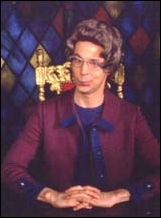 (I’ve given up on taking a picture of it, it’s gone too fast. Just imagine this look on a newborn baby girl.)
And they made sounds — not just crying or farting, no, but all three babies cooed, crowed, laughed, squealed, whimpered, grunted greedily, sighed, even mimicked the vocalizations that adults and children would make for them. Milo and Mary Jane were both taught to pee on cue, and both of them soon knew how to say "the sound" that I used to tell them to pee, a kind of throaty, croaking hum.
So what’s so astonishing about this? It’s that I didn’t expect any of it. When I had my first, I hadn’t cared for a newborn since I was thirteen or so, and I didn’t do it often even then — that baby, my youngest brother, spent most of his time in a carseat; at least, that’s how I remember it. (During family meals, to keep him quiet, the carseat was stuck in front of the TV with a propped-up bottle of soy formula.)
I’d seen babies on TV. Their parts were often played by dolls, wrapped in blankets to disguise their plastic faces, but no director tried to disguise their stiff inertness. Newborns on TV did nothing but sleep, apparently, a stiff, unmoving, silent sleep; occasionally a recorded cry was played back, and some character would pick up the otherwise unmoving package and poke a bottle at it, and someone somwhere pushed a "stop" button and the cry, the only baby sound, stopped.
Babies on TV are not much more than dolls. Is it any wonder I was so surprised to encounter a real one? Not just "encounter" (that implies a chance meeting) but actually spend most of my time with one, get to know him?
They really are people, not just stiff dolls that will someday turn into people. But you have to get to know one, spend more than a day with one real baby, to fully understand that.
Mainstream baby care in the U. S. tends to obscure it too. When most people only see babies strapped into carrier carseats, in restaurants and at the gym and so on, it’s easy to forget that newborns (at least healthy ones born to undrugged moms) usually can hold their heads up from only a few minutes after birth. That they kick their legs and wave their arms around when they’re awake. That, when their view isn’t blocked by the "blinders" that are the sides of the carseat, they look around at their surroundings and react with interest, even pleasant surprise. That they scoot around on a bed in search of mom’s breast. That they snuffle and snort and even giggle with delight when they find it. That they can track, grab at, and seize objects within their reach: often I try to put Mary Jane down only to find that she’s entwined her tiny fingers with the chain around my neck.
This isn’t a baby several months old; it’s a baby within the first several weeks of birth.
They’re born people. They really are. As soon as we meet a new baby, we can see that she is a person.
And once we spend a few hours with her, it’s obvious that she has been for quite some time.
 bearing blog